New Illinois Legal Ethics Rules Navigating the Sweeping Changes to - - PowerPoint PPT Presentation

new illinois legal ethics rules
SMART_READER_LITE
LIVE PREVIEW

New Illinois Legal Ethics Rules Navigating the Sweeping Changes to - - PowerPoint PPT Presentation

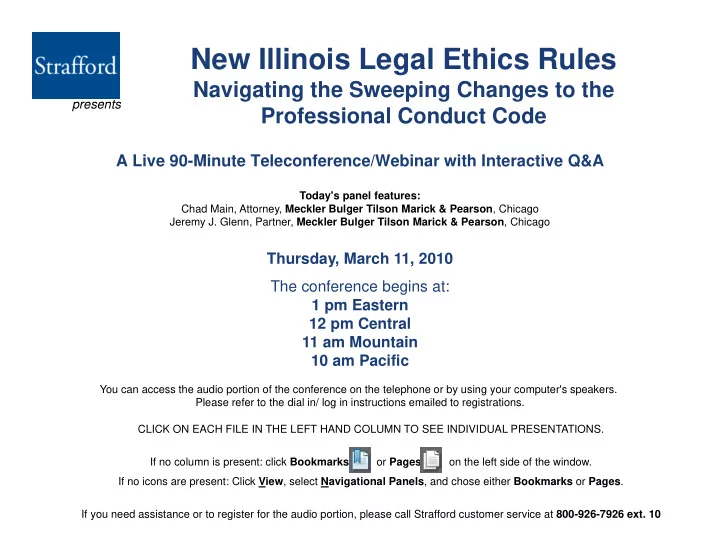
New Illinois Legal Ethics Rules Navigating the Sweeping Changes to the presents presents Professional Conduct Code A Live 90-Minute Teleconference/Webinar with Interactive Q&A Today's panel features: Chad Main, Attorney, Meckler Bulger


slide-1
SLIDE 1

New Illinois Legal Ethics Rules

Navigating the Sweeping Changes to the

presents

Professional Conduct Code

presents

A Live 90-Minute Teleconference/Webinar with Interactive Q&A

Today's panel features: Chad Main, Attorney, Meckler Bulger Tilson Marick & Pearson, Chicago Jeremy J. Glenn, Partner, Meckler Bulger Tilson Marick & Pearson, Chicago

Thursday, March 11, 2010 The conference begins at: 1 pm Eastern p 12 pm Central 11 am Mountain 10 am Pacific

CLICK ON EACH FILE IN THE LEFT HAND COLUMN TO SEE INDIVIDUAL PRESENTATIONS. You can access the audio portion of the conference on the telephone or by using your computer's speakers. Please refer to the dial in/ log in instructions emailed to registrations. If no column is present: click Bookmarks

  • r Pages
  • n the left side of the window.

If no icons are present: Click View, select Navigational Panels, and chose either Bookmarks or Pages. If you need assistance or to register for the audio portion, please call Strafford customer service at 800-926-7926 ext. 10

slide-2
SLIDE 2

For CLE purposes, please let us know how many people are listening at your location by

  • closing the notification box
  • and typing in the chat box your

company name and the number of attendees.

  • Then click the blue icon beside the box

to send.

slide-3
SLIDE 3

ILLINOIS ATTORNEYS TAKE NOTE: REVISED RULES OF PROFESSIONAL CONDUCT & ETHICAL OBLIGATIONS OBLIGATIONS

123 North Wacker Drive Chicago, IL 60606 312/474-7900 www.mbtlaw.com

slide-4
SLIDE 4

OVERVIEW OVERVIEW

 Introduction

 Speakers – Chad Main and Jeremy Glenn of

Meckler Bulger Tilson Marick & Pearson

 Overview of the 2010 Revisions to Illinois Rules of

Professional Conduct

  • Practice What They Preach - The Attorney-

Client Relationship and Confidentiality Client Relationship and Confidentiality

  • The Dollars and Sense of Illinois Ethics Rules

2

slide-5
SLIDE 5

CONFIDENTIALITY - - RULE 1.6 CONFIDENTIALITY RULE 1.6

 General Rule:  General Rule:  “A lawyer shall not reveal information relating to

y g the representation of a client. . . .”

 Exceptions

Client consent

  • Client consent
  • Permissive and Mandatory Disclosures

3

slide-6
SLIDE 6

CONFIDENTIALITY RULE - - 1.6 CONFIDENTIALITY RULE 1.6

 Permissive Disclosure  Permissive Disclosure

 To prevent crimes other than death or substantial bodily

harm To prevent fraud that is “reasonably certain to result in

 To prevent fraud that is “reasonably certain to result in

substantial injury to the financial interest or property of another and in furtherance of which the client used the lawyer’s services” lawyer s services

 To secure advice about compliance with ethical rules  Client puts at issue in claim against lawyer  Comply with law or court order

4

slide-7
SLIDE 7

CONFIDENTIALITY RULE - - 1.6 CONFIDENTIALITY RULE 1.6

 Mandatory Disclosure  Mandatory Disclosure

 To prevent act that will cause death or substantial bodily

harm No requirement that client be cause of harm

 No requirement that client be cause of harm

5

slide-8
SLIDE 8

CONFIDENTIALITY RULE - - 1.13 (Entity as Client) (Entity as Client)

 Must refer matter to “higher authority” if lawyer  Must refer matter to higher authority if lawyer

knows that an officer or employee is engaged in action:

h l f h ’ l l bl

 that is a violation of the entity’s legal obligation, a

crime, or fraud;

 imputable to corporation;  likely to result in “substantial injury” to entity

6

slide-9
SLIDE 9

CONFIDENTIALITY RULE - - 1.13 (Entity as Client) (Entity as Client)

 “May” disclose wrongful act if “higher authority” 

May disclose wrongful act if higher authority fails to act

7

slide-10
SLIDE 10

DUTIES OWED TO PROSPECTIVE CLIENTS - - RULE 1.18 PROSPECTIVE CLIENTS RULE 1.18

(a) A person who discusses with a lawyer the possibility of forming a client-lawyer relationship with respect to a matter is a prospective client. respect to a matter is a prospective client. (b) Even when no client-lawyer relationship ensues, a lawyer who has had discussions with a prospective client shall not use or reveal information learned in the consultation, except as Rule 1.9 would permit with respect to information of a former client. ( ) A l bj t t h (b) h ll t t li t ith i t t t i ll d t (c) A lawyer subject to paragraph (b) shall not represent a client with interests materially adverse to those of a prospective client in the same or a substantially related matter if the lawyer received information from the prospective client that could be significantly harmful to that person in the matter, except as provided in paragraph (d). If a lawyer is disqualified from representation under this paragraph, no lawyer in a firm with which that lawyer is associated may knowingly undertake

  • r continue representation in such a matter, except as provided in paragraph (d).

(d) When the lawyer has received disqualifying information as defined in paragraph (c), representation is permissible if:

(1) both the affected client and the prospective client have given informed consent, or

(2) the lawyer who received the information took reasonable measures to avoid exposure to more disqualifying information than was reasonably necessary to determine whether to represent the prospective client; and that lawyer is timely screened from any participation in the matter and is apportioned no part of the fee therefrom. 8

slide-11
SLIDE 11

MULTIJURISDICITONAL PRACTICE - - RULE 5.5 RULE 5.5

 Out of state lawyer can provide legal services on  Out of state lawyer can provide legal services on

a temporary basis if:

 Undertaken with local counsel

b h l ( f l

 Obtains pro hac vice approval (can perform preliminary

legal services if “reasonably expect” to be admitted for case

 ADR related  In-house counsel

9

slide-12
SLIDE 12

SALE OF LAW PRACTICE - - RULE 1.17 SALE OF LAW PRACTICE RULE 1.17

Perm itted Sale Conditions

(a) The seller ceases to engage in the private practice of law in geographic area; ( ) g g p p g g p ; (b) The entire practice is sold; (c) The seller gives w ritten notice to each of the seller’s clients regarding: (1) the proposed sale; (2) the client’s right to retain other counsel or to take possession of the file; and and (3) the fact that the client’s consent to the transfer of the client’s files w ill be presum ed if the client does not take any action or does not otherwise object within ninety (90) days of receipt. If a client cannot be given notice, transfer only upon entry of an order. (d) The fees charged clients shall not be increased by reason of the sale.

10

slide-13
SLIDE 13

SALE OF LAW PRACTICE - - RULE 1 17 Comments SALE OF LAW PRACTICE - - RULE 1.17 Comments

[ 3] Seller can go to staff of a public agency or a legal se ices entit that p o ides legal se ices to the poo services entity that provides legal services to the poor,

  • r as in-house counsel to a business.

[ 4] It is advisable for the parties’ agreement to define the [ 4] It is advisable for the parties agreement to define the geographic area. [ 6] The purchasers are required to undertake all client [ ] p q matters in the practice, subject to client consent, but excuses conflict of interest. [ 7] P idi th h t li t ifi [ 7] ..Providing the purchaser access to client-specific information relating to the representation and to the file requires client consent.

11

slide-14
SLIDE 14

SAFEKEEPING PROPERTY - - RULE 1.15 SAFEKEEPING PROPERTY RULE 1.15

(c) A lawyer shall deposit in a client trust account funds received to secure payment of legal fees and expenses, to be withdrawn by the lawyer only as fees are earned and expenses incurred. Funds i d fi d f l i d i h ll b received as a fixed fee, a general retainer, or an advance paym ent retainer shall be deposited in the law yer’s general account or other account belonging to the law yer. An advance payment retainer may be used only when necessary to accomplish some purpose for the client that cannot be accomplished by using a security retainer. An agreement for an advance payment retainer shall be in a writing signed by the client that uses the term “advance payment retainer” to describe the retainer, and states the following: (1) the special purpose for the advance payment retainer and an explanation why it is advantageous to the client; (2) that the retainer will not be held in a client trust account, that it will become the property of the lawyer upon payment, and that it will be deposited in the lawyer’s general account; the lawyer upon payment, and that it will be deposited in the lawyer s general account; (3) the manner in which the retainer will be applied for services rendered and expenses incurred; (4) that any portion of the retainer that is not earned or required for expenses will be refunded h li to the client; (5) that the client has the option to employ a security retainer, provided, however, that if the lawyer is unwilling to represent the client without receiving an advance payment retainer, the agreement must so state and provide the lawyer’s reasons for that condition.

12

slide-15
SLIDE 15

SAFEKEEPING PROPERTY - - RULE 1.15 Comments Comments

Dowling v. Chicago Options Associates, Inc., 226 Ill. 2d 277 (2007).

Advance paym ent retainers

Advance paym ent retainers

 Limited circumstances - property of lawyer upon payment.  May not be deposited into a client trust account.  Must be in a written agreement signed by the client that contains

the elements listed in Rule 1 15(c) the elements listed in Rule 1.15(c).

Security retainers

 Secures payment for future services and expense

M b d i d i li

 Must be deposited in a client trust account  Remain the property of the client until applied for services

rendered or expenses incurred. A i i h ld l l d fi h ki d f

Any written retainer agreement should clearly define the kind of retainer being paid.

If the parties’ intent is not evident, an agreement for a retainer will be construed as providing for a security retainer construed as providing for a security retainer.

13

slide-16
SLIDE 16

REASONABLE FEES - - RULE 1.5 REASONABLE FEES RULE 1.5

 A lawyer shall not make an agreement for, charge, or

y g , g , collect an unreasonable fee or an unreasonable amount for expenses.

 Eight Non-Exclusive Factors to be considered in determining

the reasonableness of a fee

 SHALL BE COMMUNICATED, unless and except for…

14

slide-17
SLIDE 17

REASONABLE FEES - - Rule 1.5 Comments REASONABLE FEES Rule 1.5 Comments

Expenses

Services performed in-house, such as copying, or for other expenses incurred in-house, such as telephone charges, either by charging a reasonable amount to which the client has agreed in advance or by charging an amount that reasonably reflects the cost incurred by the charging an amount that reasonably reflects the cost incurred by the lawyer.

Beware Impermissible Incentives

An agreement may not be made whose terms might induce the lawyer improperly to curtail services for the client or perform them in a way contrary to the client’s interest. For example a lawyer should not enter into an agreement whereby

For example, a lawyer should not enter into an agreement whereby services are to be provided only up to a stated amount when it is foreseeable that more extensive services probably will be required, unless the situation is adequately explained to the client.

15

slide-18
SLIDE 18

Advertising - - The 7 Series of Professional Conduct Conduct

Rule 7.1

NO false or misleading communication about the lawyer or the lawyer's services.

A communication is false or misleading if it contains a material misrepresentation

  • f fact or law, or omits a fact necessary to make the statement considered as a

h l t t i ll i l di whole not materially misleading.

 “Achievements” may be misleading if presented so as to lead a reasonable

person to form an unjustified expectation that the same results could be

  • btained for other clients

 Unsubstantiated “comparison” of the lawyer’s services or fees with the

services or fees of other lawyers may be misleading if presented with such specificity as would lead a reasonable person to conclude that the comparison can be substantiated.

Disclaimer or qualifying language may preclude a finding that a statement is likely to create unjustified expectations or otherwise mislead a prospective client.

16

slide-19
SLIDE 19

Advertising Ethics Continued Advertising Ethics Continued

Rule 7.2

 Adds language permitting advertising through “written,

recorded or electronic communication”

 Comments: Television is now one of the most powerful media

for getting information to the public, particularly persons of low and moderate income; prohibiting television advertising, ; p g g, therefore, would impede the flow of information about legal services to many sectors of the public.

 Similarly, electronic media, such as the Internet, can be an

important source of information about legal services, and lawful communication by electronic mail is permitted by this R l Rule.

17

slide-20
SLIDE 20

Advertising Ethics Continued Advertising Ethics Continued

Rule 7.3

 Prohibits in-person, live telephone or real-time electronic

contact to solicit business unless contacting a lawyer or family, close personal or prior professional relationship

 Every written, recorded or electronic communication from a

lawyer soliciting professional employment from a prospective client known to be in need of legal services in a particular matter shall include the words "Advertising Material" on the

  • utside envelope if any and at the beginning and ending of
  • utside envelope, if any, and at the beginning and ending of

any recorded or electronic communication, unless the recipient

  • f the communication is a person specified in paragraphs

(a)(1) or (a)(2). (a)(1) or (a)(2).

18

slide-21
SLIDE 21

CONCLUSION CONCLUSION

 Be Sensitive to New and Revised Rules  Be Sensitive to New and Revised Rules  Study the Comments to the Rules

y

 Gray Areas  Continually Monitor Practices and Conduct

19

slide-22
SLIDE 22

QUESTI ONS