New Forms of Cultural Capital Professor Philippe Coulangeon Dr - - PowerPoint PPT Presentation

new forms of cultural capital
SMART_READER_LITE
LIVE PREVIEW

New Forms of Cultural Capital Professor Philippe Coulangeon Dr - - PowerPoint PPT Presentation

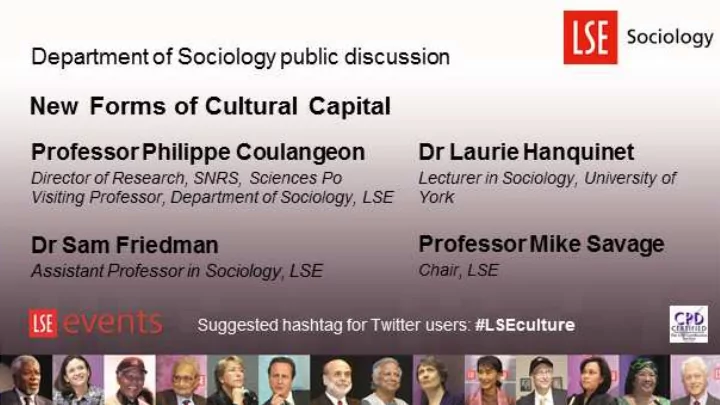
Department of Sociology public discussion New Forms of Cultural Capital Professor Philippe Coulangeon Dr Laurie Hanquinet Lecturer in Sociology, University of Director of Research, SNRS, Sciences Po Visiting Professor, Department of Sociology,


slide-1
SLIDE 1

New Forms of Cultural Capital

Suggested hashtag for Twitter users: #LSEculture

Department of Sociology public discussion Professor Philippe Coulangeon

Director of Research, SNRS, Sciences Po Visiting Professor, Department of Sociology, LSE

Dr Sam Friedman

Assistant Professor in Sociology, LSE

Dr Laurie Hanquinet

Lecturer in Sociology, University of York

Professor Mike Savage

Chair, LSE

slide-2
SLIDE 2

New forms of cultural capital

A reflection and discussion Mike Savage, Philippe Coulangeon, Sam Friedman, Laurie Hanquinet,

slide-3
SLIDE 3

New debates in cultural sociology

slide-4
SLIDE 4

Can we still talk of ‘cultural capital’

Bourdieu’s influential account was developed in the 1960s and emphasises

– The historical cultural canon as key reference point – The Kantian aesthetic (with its ‘modernist’ assumptions about the ‘avant garde’, ‘abstraction’) – The ‘capital composition’ principle separating economic from cultural capital – Age and gender seen as ‘secondary’ dimensions – Assumptions of ‘national’ culture

slide-5
SLIDE 5
slide-6
SLIDE 6

Challenges to Bourdieu’s model

Whilst the broad conception of cultural capital may be useful, a number of issues have been posed to this specific account of cultural capital, e.g.

– The loss of historical canon and rise of stakes around ‘contemporary’ culture – Changing role of ethnicity, gender and age – The rise of ‘cosmopolitan’ tastes which cross ‘national’ borders

slide-7
SLIDE 7

Emerging cultural capital

This concept deals with these challenges by foregrounding three issues

– Role of age and generation in structuring cultural tastes and practices – The prime value of cultural ‘detachment’ is replaced by forms of ‘engagement’ and ‘activity’ and has a greater visual and physical component – Elite culture is no longer defined by highbrow tastes and being remade along more contemporary lines

  • But more work needs to be done to assess its analytical value
slide-8
SLIDE 8

MORE OR LESS UNEQUAL? EMERGING FORMS OF CULTURAL CAPITAL IN FRANCE

Philippe Coulangeon SciencesPo/CNRS - Paris

slide-9
SLIDE 9
  • Evidence of the emerging forms of cultural

capital

– Focus on cosmopolitan resources

  • Questionable impact on inequality

– Are the emerging forms more equally distributed?

slide-10
SLIDE 10
  • 1. Emerging forms of cultural capital
  • MCA on the 2008 survey on French Cultural

Practices (FCP2008)

– 3 groups of active variables:

  • Participation in « highbrow culture »: books owning and

reading, theatre, opera, museums, art exhibitions, etc.

  • Participation in media culture: Time spent on TV, preferred

TV channels, etc.

  • Participation in cosmopolitan culture: foreign books, Foreign

TV channels, Travels, etc.

slide-11
SLIDE 11

Fig 1: Map of the first two axes - active variables (most contributing modalities)

slide-12
SLIDE 12

HGP: higher grade professionals and managers LGP: lower grade professionals and managers SSE: Small self-employed NMRW: Non manual routine workers MW: manual workers

Fig 2: Map of the first two axes – illustrative variables (Class, Education, Age)

slide-13
SLIDE 13
  • 2. More or less unequal?
  • Emerging forms of cultural capital more difficult to transmit

than more conventional ones;

– More generationally differentiated; – More uncertain and changing; – Less strongly related to established cultural and educational institutions.

  • BUT these emerging forms of symbolic domination may be

even more difficult to challenge

– Irrelevance of educational and/or cultural “goodwill”

slide-14
SLIDE 14

Fig 3: Map of the first two axes – illustrative variables, class × age

slide-15
SLIDE 15

Fig 4: Map of the first two axes – illustrative variables, education × age

slide-16
SLIDE 16

Concluding Remarks

  • Things that need to be investigated:

– Need to investigate transmission and conversion; – Need to investigate the relation between emerging cultural capital and education (where the notion of cultural capital was originally coined); – Need to investigate these emerging forms of cultural capital in comparative perspective;

slide-17
SLIDE 17

Comedy and The Expression of (Emerging) Cultural Capital in Everyday Life

Sam Friedman, LSE s.e.friedman@lse.ac.uk @samfriedmansoc

slide-18
SLIDE 18

Comedy and Distinction

(2014) Routledge

  • Comedy traditionally ‘lowbrow’ but re-evaluated

after ‘80s Alt Comedy Movement

  • First sociological study of British comedy field

2008-2013

  • Conducted at Edinburgh Festival Fringe
  • Mixed methods:

– Survey of comedy taste (n=901) – 24 follow-up interviews – Go-along ethnography with 9 comedy television scouts – Textual analysis of comedy reviews

slide-19
SLIDE 19

Liking the ‘Right’ Comedy

  • Survey data analysed using Multiple

Correspondence Analysis (MCA)

  • Certain critically-acclaimed comedians

markers of cultural capital

  • Stewart Lee: ‘Like sitting a comedy

exam’ (Dale, 32, lawyer)

  • Working-class respondents report such

humour as ‘going over their head’ or ‘beyond them’

S.E.Friedman@lse.ac.uk; @samfriedmansoc

slide-20
SLIDE 20

‘Working’ for Your Laughter

  • Most comedy is ‘crossover’
  • Distinction activated less through taste ‘objects’ and more

via styles of comic appreciation

  • Cultural currency of ‘getting’ the joke
  • For upper middle-class comedy should never be just funny
  • Enduring sense of being able to ‘get’ more, to extract a

‘whole other level’ (Melanie, actor)

S.E.Friedman@lse.ac.uk; @samfriedmansoc

slide-21
SLIDE 21

But How is Emerging CC Deployed in Social Life?

We need to push further on: –The expression of the dominant aesthetic in Emerging CC – The complexities of expressing Emerging CC in everyday life

slide-22
SLIDE 22

Distinction in Action

  • Benedict, 38, senior IT Consultant:
  • Unapologetic about ‘pop sensibility’ but looking for

‘combination of originality and familiarity’, something ‘conventional but a little unhinged’.

  • On American synthpop band Future Islands:

‘It’s fairly conventional, but the singer’s got a very unusual vocal style, he’s really odd. He’s got these two registers, falsetto and quite deep, but at the same time just enough

  • f a normal pop sensibility.’
slide-23
SLIDE 23
  • Applied his aesthetic across cultural spectrum:

‘I suppose it’s about the choices you make in almost any situation. Whenever the opportunity is there to make a choice between doing

  • ne thing or another, eating some sort of food or the other, there

tends to be thought behind it. Operating principles. It’s not arbitrary, it’s thought about. For example, [laughs] we don’t like McDonald's, that kind of fast food, but we would choose Burger King over McDonald's [laughs]. So everything, the bands, everything, you know, there’s nothing that escapes scrutiny.’

Distinction in Action

slide-24
SLIDE 24

Snobbery and The Presentation of Self

Benedict: But some people do find it annoying. And I do want to retain that connection, because you work in an organisation with people, from cleaners to the principal, and some people are very good at talking vertically or communicating vertically… Q: Do you think you’re good at that? Benedict: I’m not as good as I used to be, but I try… I mean it’s how you appear to

  • thers isn’t it. So I think it’s partly about the performative, yeah, wanting to establish

a sort of zero base, so there’s a persona that I want to project which is more, you know, I’ve got it quite well. You experiment with different approaches, but it is ultimately performative.

So…does ‘knowingness’ of Emerging CC also incorporate capacity to ‘read’ social life and accentuate or downplay difference accordingly?

slide-25
SLIDE 25

Laurie Hanquinet University of York

New forms of cultural capital & Highbrow culture

slide-26
SLIDE 26
  • Does (embodied) cultural capital still need highbrow culture?
  • What does highbrow culture mean in our current cultural

context which is arguably ‘more omnivorous’?

  • What is the theoretical value of the figure of the omnivore

and of the idea of ‘emerging cultural capital’?

Main questions

slide-27
SLIDE 27

Does cultural capital (still) need highbrow aesthetic culture to be defined?

  • Yes, cultural capital is based on the idea of accumulation of

resources , which was, in Bourdieu’s mind, led by different aesthetic principles

  • But highbrow culture cannot anymore be only related to a highbrow

aesthetic à la Bourdieu that valorises form over content and a distanced relationship to art < new aesthetic criteria < changes in the field of cultural production: what is aesthetically refined has changed

slide-28
SLIDE 28

What does highbrow culture mean in our current cultural context which is arguably ‘more omnivorous’?

  • Omnivorous: how to draw and cross boundaries at the same time

The ‘omnivores’ draw new social boundaries by crossing cultural boundaries (that still need to remain in place)

  • A more inclusive highbrow culture?

 New forms of aesthetic refinement (e.g. Young British Artists)  Highbrow by-products’ of popular culture: a hierarchy within cultural genres between the ‘good’ popular culture versus the ‘bad’ popular culture E.g. the ‘Gourmet’ Burger (Johnston and Baumann ), the ‘serious’ rock music (Regev)

  • Distinctive ways to be omnivorous

In some cultural areas, people don’t differ much by what they like but how they like/ appreciate it E.g. Comedy (Friedman)

slide-29
SLIDE 29

What is the theoretical value of the figure of the omnivore and of the idea of ‘emerging cultural capital’?

  • The ‘omnivore’ not a real challenger

Omnivorousness appears to be simply the empirical manifestation of a more inclusive but still distinctive highbrow culture rather than the cause

  • Interest in ‘emerging cultural capital’ as a way to outline its

‘floating’ character // B’s relational approach and historical nature of habitus Re-configuration of cultural capital

slide-30
SLIDE 30

‘Emerging forms of cultural capital’ show that new cultural items and aesthetic criteria have progressively become valorised in the society while being not symbolically accessible to everyone. Yet, these new resources have not seriously questioned the link between cultural capital and highbrow culture but their close examination suggest that there are now different ‘kinds’ of highbrow culture, which can for instance take a more classic or contemporary outlook

In short

slide-31
SLIDE 31

New Forms of Cultural Capital

Suggested hashtag for Twitter users: #LSEculture

Department of Sociology public discussion Professor Philippe Coulangeon

Director of Research, SNRS, Sciences Po Visiting Professor, Department of Sociology, LSE

Dr Sam Friedman

Assistant Professor in Sociology, LSE

Dr Laurie Hanquinet

Lecturer in Sociology, University of York

Professor Mike Savage

Chair, LSE