New Device Options for Conflict of EVAR: What Advantages Intere$t - - PowerPoint PPT Presentation

new device options for conflict of evar what advantages
SMART_READER_LITE
LIVE PREVIEW

New Device Options for Conflict of EVAR: What Advantages Intere$t - - PowerPoint PPT Presentation

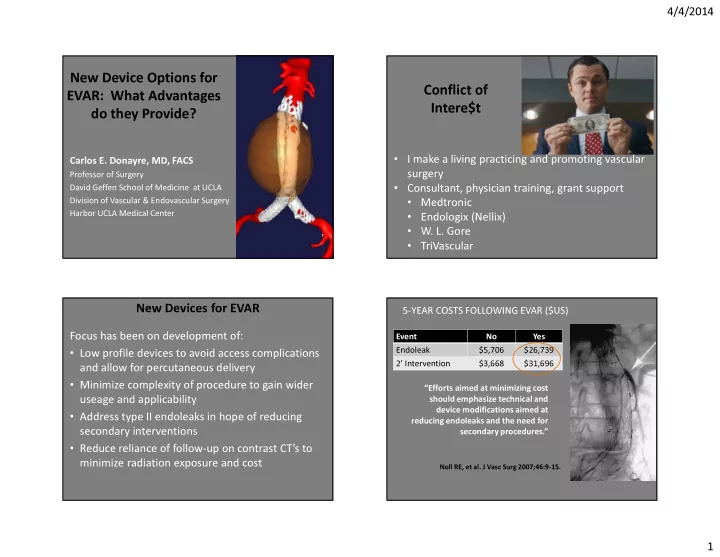
4/4/2014 New Device Options for Conflict of EVAR: What Advantages Intere$t do they Provide? I make a living practicing and promoting vascular Carlos E. Donayre, MD, FACS surgery Professor of Surgery Consultant, physician training,


slide-1
SLIDE 1

4/4/2014 1

Carlos E. Donayre, MD, FACS

Professor of Surgery David Geffen School of Medicine at UCLA Division of Vascular & Endovascular Surgery Harbor UCLA Medical Center

New Device Options for EVAR: What Advantages do they Provide? Conflict of Intere$t

  • I make a living practicing and promoting vascular

surgery

  • Consultant, physician training, grant support
  • Medtronic
  • Endologix (Nellix)
  • W. L. Gore
  • TriVascular

New Devices for EVAR

Focus has been on development of:

  • Low profile devices to avoid access complications

and allow for percutaneous delivery

  • Minimize complexity of procedure to gain wider

useage and applicability

  • Address type II endoleaks in hope of reducing

secondary interventions

  • Reduce reliance of follow-up on contrast CT’s to

minimize radiation exposure and cost

“Efforts aimed at minimizing cost should emphasize technical and device modifications aimed at reducing endoleaks and the need for secondary procedures.”

Noll RE, et al. J Vasc Surg 2007;46:9-15.

5-YEAR COSTS FOLLOWING EVAR ($US)

Event No Yes Endoleak $5,706 $26,739 2’ Intervention $3,668 $31,696

slide-2
SLIDE 2

4/4/2014 2

Modular prosthesis with a flexible nitinol skeleton covered by a ribbed low porosity polyester fabric

  • No need for contralateral

gate canulation

  • Suprarenal fixation and

adjustable in situ iliac extensions

  • Delivery through any 14 Fr

sheath

  • Semi-circular “kissing” aortic

bodies

Altura Endograft System

Partial Suprarenal Deployment Independent Renal Positioning Suprarenal Deployment Aortic Body Deployment Bilateral Iliac Limb Deployment Altura Endosystem

1st in Man – Santiago, Chile (May 5, 2011)

slide-3
SLIDE 3

4/4/2014 3 CT at 1 Year – Significant Sac Shrinkage CT Reconstructions at 1 Year CTA follow up at 1 year (8 patients)

  • All the devices remain patent
  • Type I endoleak: 1
  • Type II endoleak: 1
  • No device migration or type III

CTA follow up at 6 m (12 patients)

  • All the devices remain patent
  • Type I endoleak: 0
  • Type II endoleak: 3
  • No device migration or type III

23 patients enrolled

  • 91 % male
  • Age 75.5 ± 7.4 years
  • AAA diameter - avg 52.1 mm ( 46 – 68 )

52.9 52.3 48.0 45.2 Pre-Op 1 Mo (13) 6 Mos (9) 1 Yr (5)

Aneurysm sac shrinkage during follow-up

slide-4
SLIDE 4

4/4/2014 4

Cardiatis Multilayer Aneurysm Repair System

Multi-layered stent induces “flow modulation” leading to thrombosis

  • f the sac & laminar flow to side

branches arising from the aneurysmal sac CE marked

  • Peripheral and visceral aneurysms
  • Used in thoracic and abdominal

aortic aneurysms

  • Not to be used in rAAA

Cardiatis Multilayer Aneurysm Repair System (MARS)

  • A. Blood flow through a saccular aortic aneurysm
  • B. Saccular aortic aneurysm with an increased flow velocity

C . Saccular aortic aneurysm treated with a multilayer stent, which decreases the flow velocity into the aneurysm

  • D. Blood flow though the multilayer stent maintains flow to

collaterals as the aortic aneurysm thromboses

slide-5
SLIDE 5

4/4/2014 5

TAA Type II (4.7 cm) Covered with 2 overlapping Multilayer stents

Cardiatis -- Orebro Study

13 compassionate cases treated: 11 Thoracoabdominal aneurysms 2 Abdominal aortic aneurysms 4 of the above were symptomatic 5 mortalities: 3 Non-aneurysmal related 2 cardiac / 1 unknown cause 2 Ruptures related to aneurysm No decrease in aneurysm size at 15 months of follow- up, and 2 patients with significant increase in size

NELLIX DESIGN GOALS

Simplify EVAR procedure

  • Simple & intuitive Steps
  • Small inventory to treat all infrarenal AAA patients

Clinical Outcome Goals

  • Eliminate secondary interventions
  • Reduce required patient surveillance

ePTFE Endobag PEG Filled Endobag Cobalt Chromium Endoframe

Nellix -- The Sac Anchoring Prostheses

slide-6
SLIDE 6

4/4/2014 6 NELLIX ENDOBAG DESIGN

  • Durable polyurethane
  • High strength PTFE

sleeve

  • Oversized to flow lumen
  • Aortic Bags: 6.0cm

diameter

  • Seal aneurysm sac

NELLIX STENT DESIGN

  • Cobalt chromium alloy
  • Balloon-expandable
  • Create flow lumens to iliacs
  • Highly flexible
  • Crush resistant
  • 1200 – 1400 mmHg
  • Highly flexible

BIOSTABLE POLYMER

  • Polyethylene Glycol (PEG)

Diacrylate

  • Viscosity of water
  • Fills EndoBags to seal the sac
  • Cures in 3 to 5 minutes
  • Consistency of a soft pencil

eraser ADVANCE CATHETERS OVER 0.035” GUIDEWIRES

  • Advance both Catheters over guidewires
  • Position Catheters under fluoroscopy
  • Pull back Catheter sheaths
  • Reposition Catheters under fluoroscopy
slide-7
SLIDE 7

4/4/2014 7

NELLIX CONSOLE Step 4: Shoot contrast through Angio-Tip to verify Seal

Allow Polymer to cure (3-5 minutes)

Adverse Aortic Neck Anatomy

Flow Model: Posterior view

  • f aortic neck

NELLIX PRE & POST IMPLANT

slide-8
SLIDE 8

4/4/2014 8

CASE OVERVIEW:

6.0CM AAA WITH 10MM LENGTH NECK AND 3.5CM RCIAA

Pre-Operative Post-Operative: Right Hypogastric Artery Preserved with a Nellix Extender Post Operative: 1 Year

AAA 6.3 cm

Type I Endoleak

30 days 60 days

Sac with limited rim enhancement and no

  • utflow

1 year

slide-9
SLIDE 9

4/4/2014 9

EVAR for rAAA’s

EVAR for r-AAA’s is gaining widespread use and acceptance as the best way to treat rAAA’s In the past general surgeons performed most of open repairs for rAAA’s Today that is no longer the case Vascular fellows more are more confortable performing EVAR than doing an open AAA repair At a recent SVS meeting, vascular fellows felt their greatest challenge was doing open aortic procedures Balloon control has been found to be beneficial in open and endovascular treatment of rAAA ‘s

The Nellix sac sealing system appears ideally suited to treat rAAA’s

Devices introduced via bilateral femoral access Balloons inflated with contrast

  • Controls bleeding & allows for fluid resuscitation
  • Outline of aneurysm sac is obtained
  • Angiogram performed from leading Nellix catheters to

identify the renal arteries

Devices are repositioned and endoframes are expanded Contrast in balloons is then exchanged for polymer

Balloon Expanded Endoframes Contrast PEG Filled Endobags

Aortogram Nellix Single System: Rupture (4 year explant)

slide-10
SLIDE 10

4/4/2014 10

Excess polymer injected at implantation