neutrino scattering results from MiniBooNE Outline: - - - PowerPoint PPT Presentation

neutrino scattering results from miniboone
SMART_READER_LITE
LIVE PREVIEW

neutrino scattering results from MiniBooNE Outline: - - - PowerPoint PPT Presentation

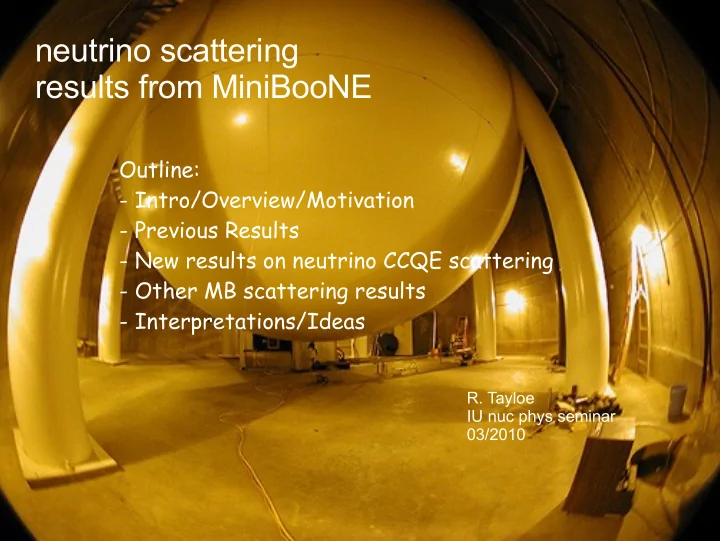
neutrino scattering results from MiniBooNE Outline: - Intro/Overview/Motivation - Previous Results - New results on neutrino CCQE scattering - Other MB scattering results - Interpretations/Ideas R. Tayloe IU nuc phys seminar 03/2010


slide-1
SLIDE 1

neutrino scattering results from MiniBooNE

Outline:

  • Intro/Overview/Motivation
  • Previous Results
  • New results on neutrino CCQE scattering
  • Other MB scattering results
  • Interpretations/Ideas
  • R. Tayloe

IU nuc phys seminar 03/2010

slide-2
SLIDE 2

MiniBooNE experiment:

Booster

K+

target and horn detector dirt decay region absorber

primary beam tertiary beam secondary beam

(protons) (mesons) (neutrinos)

π+

νµ → νe ???

  • Designed and built (at FNAL) to test the LSND observation of ν oscillations

via νµ→ νe (and νµ → νe ) appearance.

  • Currently running. 2002-2005,2007 in νµ mode, 2005-2006,2008-2012 νµ mode.
  • 15 papers published (so far, on oscillations, scattering, details) See

http://www-boone.fnal.gov/publications/ (including theses)

Booster Target Hall

slide-3
SLIDE 3

Quick review/status of MB oscillation results:

6.46E20 POT

New!

Energy distributions of background-subtracted

  • scillation candidate events:

neutrino mode ( νµ→

νe ):

  • Ruled out “standard osc model”

interpretation of LSND

  • however, low-E excess observed

(Excess from 200-475 MeV = 128.8+-20.4+-38.3 events)

  • A.A. Aguilar-Arevalo et al., PRL 102, 101802 (2009)

antineutrino mode (νµ →

νe ):

  • Preliminary results for 4.863E20 POT

(~50% increase in POT):

  • Still not definitive wrt LSND
  • low-E excess not large

(Excess from 200-475 MeV = 11.4 ± 9.4 ± 11.2 events)

  • A.A. Aguilar-Arevalo et al., PRL. 103, 111801 (2009)

(from 3.4E20 POT)

“POT” = protons on target (provides normalization of neutrino flux

slide-4
SLIDE 4

neutrino scattering measurements

In order to understand ν oscillation measurements, it is crucial to understand the detailed physics of neutrino scattering (at few-GeV)

  • for MiniBooNE, both signal and backgrounds
  • and for others (T2K, NOvA, DUSEL etc)
  • especially for precision (e.g. 1%) measurements.

(And it is interesting nuclear physics!) Requires: Precise measurements to enable a complete theory valid over wide range of variables (reaction channel, energy, final state kinematics, nucleus, etc) T2KNOvACNGS DUSEL A significant challenge with neutrino experiments:

  • non-monoenergetic beams
  • large backgrounds
  • nuclear scattering (bound nucleons)

New measurements are forthcoming:

  • MiniBooNE, SciBooNE (publications appearing)
  • MINERvA, µBooNE, T2K, (coming soon)

And likely to require even more input...

  • from more theoretical work
  • dedicated experiments.

nu cross section data

slide-5
SLIDE 5

CCQE scattering

n

− p

νµ µ− W n p νµ CCQE

ene

− p

νe e− W n p νe CCQE

Charged-current quasielastic scattering (CCQE):

  • crucial process to understand as it is... (in MiniBooNE)
  • most common process in ~1 GeV energy region
  • detection signal for νµ→νe
  • normalization signal for νµ flux
  • details are slightly different for experiments with near/far detectors

(but CCQE still important channel)

  • so CCQE scattering must be measured (using νµ )
  • challenging
  • non-monoenergetic beams
  • different detection details between exps. (recoil nucleon detected?)
  • backgrounds (some “irreducible”, eg CCπ w/π absorption )
  • bound nucleons
  • but should be simple process to model...
slide-6
SLIDE 6

CCQE models

The canonical model for the CCQE process is straightforward, and well-constrained. It looks something like this:

  • Llewellyn-Smith formalism for diff cross section
  • Q2 = 4-momentum transfer
  • lepton vertex well-known
  • nucleon structure parameterized with 2 vector formfactors (F1,F2), and

1-axial vector (FA ). These are functions of Q2 and contained in A,B,C.

  • To apply:
  • bound nucleons, use a Relativistic Fermi Gas (RFG) model (typically Smith-Moniz version),

with parameters known from e-scattering

  • F1,F2 from e scattering measurements
  • FA is large(st) contribution, not well known from e scattering
  • FA (Q2=0) = gA.. known from beta-decay ,

assume dipole form, same MA should cover all experiments.

  • No unknown parameters, model can be used for prediction of

CCQE rates and final state particle distributions.

  • Until recently, this approach has seemed adequate (even though more

sophisicated approaches exist) and all common neutrino event generators use this.

n

− p

νµ µ− W n p νµ CCQE

slide-7
SLIDE 7

MAfrom CCQE

summary of ν,ν measurements of MA

  • MA measurments,

from Lyubushkin, etal (NOMAD collab, arXiv:0812.4543)

  • different targets/energies
  • world average from

Bernard, etal, JPhysG28, 2002: MA=1.026±0.021 (also, MA from π photo-production similar)

  • However, recent data

from some high-stats experiments not well- described with this MA and/or the canonical model

from Lyubushkin, etal [NOMAD collab], arXiv:0812.4543, '08

slide-8
SLIDE 8

BNL QE data:

  • Baker, PRD 23, 2499 (1981)
  • data on D2
  • MA=1.07 +/- 0.06 GeV

1,236 νµ QE events

  • curves with diff MA values,

relatively norm'd, overlaid.

  • MA extracted from the shape
  • f this data in Q2

Previous CCQE results

from Sam Zeller

slide-9
SLIDE 9

Previous CCQE results

  • K2K results from scifi (in water) detector

(PRD74, 052002, '06)

  • Q2 spectrum: more events at Q2 > 0.2 GeV2
  • also note data deficit Q2 < 0.2 GeV2
  • shape only fit of Q2 distribution yields

MA = 1.20±0.12 from Rik Gran, Nuint09

n− p

νµ µ− W n p

slide-10
SLIDE 10

Previous CCQE results

  • MiniBooNE results (from CH2)

(PRL100, 0323021, '08)

  • Q2 spectrum of data, compared to

“world average model” (dashed)

  • event excess at Q2 > 0.2 GeV2
  • also event deficit at Q2 < 0.2 GeV2
  • could not get satisfactory fit (at

low Q2 with only MA so had to add new parameter κ that increases Pauli-blocking of outgoing nucleon

  • shape-only fit of Q2 distribution

yielded:

slide-11
SLIDE 11

Previous CCQE results

  • NOMAD (carbon target) total cross section as func of Eν
  • from Lyubushkin, etal (NOMAD collab, arXiv:0812.4543)
  • curve is that predicted with MA of this NOMAD measurement
  • MA =1.05+-0.02+-0.06 GeV2
  • Q2 distribution consistent with this MA

ν cross section

slide-12
SLIDE 12

Additional tidbits:

  • scibar detector at K2K and at FNAL

(sciboone) saw/seeing larger MA also (~1.20 GeV2)

  • MINOS also (on Fe!)
  • so there exists a mystery in CCQE scattering
  • what is MA ?
  • Different for different nuclei?
  • Inadequate model?
  • how much has old (bad?) experimental habits

(necessities?) clouded the issue? EG: nu flux tuning based on data.

Previous CCQE results

BNL QE data, Baker, PRD 23, 2499 (1981)

slide-13
SLIDE 13

Latest CCQE results from MiniBooNE

  • In our latest (and final) analysis of

ν CCQE scattering, we have reported model-independent, absolutely normalized (double) differential cross sections.

arXiv:1002.2680, submitted to PRD.

  • thesis work of Teppei Katori,

IU PhD 08.

n− p

νµ µ− W n p νµ CCQE

slide-14
SLIDE 14

MiniBooNE experiment, overview

Booster

K+

target and horn detector dirt decay region absorber

primary beam tertiary beam secondary beam

(protons) (mesons) (neutrinos)

π+

νµ → νe ???

π → µ νµ K→ µ νµ µ → e νµ νe K→ π e νe

slide-15
SLIDE 15

MiniBooNE experiment, ν flux

  • predicted nu flux:
  • determined from π prod

measurements plus MC simulations of target+horn

(PRD79(2009)072002)

  • no flux tuning based on

MB data

  • most important π prod

measurements from HARP (at CERN) at 8.9 GeV/c beam momentum (as MB), 5% int. length Be target (same material, thinner than MB) (Eur.Phys.J.C52(2007)29)

  • error on HARP data (5%) is

dominant contribution to flux uncertainty which leads to biggest error on scale error of cross sections.

slide-16
SLIDE 16

MiniBooNE experiment, detector

  • 541 meters from target
  • 12 meter diameter sphere
  • 800 tons mineral oil (CH2)
  • 3 m overburden
  • includes 35 cm “veto region”
  • viewed by 1280 8” PMTs

(10% coverage) + 240 veto

  • Simulated with a GEANT3

Monte Carlo program

slide-17
SLIDE 17

MiniBooNE experiment, event reconstruction

µ

12C

ν-beam cosθ Eµ

  • charged particles in MB create cherenkov

(and some scintillation) light

  • tracks reconstructed (energy, direction,

position) with likelihood method utilizing time, charge of PMT hits (NIM, A 608 (2009), pp. 206-224 )

  • in addition, muon, pion decays are seen by

recording PMT info for 20µs around 2µs beam spill

  • In this analysis, all observables are formed

from muon energy (Eµ ) and muon scattering angle (θµ )

  • Energy of the neutrino Eν

QE and 4-

momentum transfer Q2

QE can be

reconstructed by these 2 observables, under the assumption of CCQE interaction with bound neutron at rest (“QE assumption”)

slide-18
SLIDE 18

MiniBooNE experiment, event types

  • raw (no selection, yet) event fractions
  • CCQE process most common
  • biggest background to CCQE, CC1π+
slide-19
SLIDE 19

MiniBooNE CCQE analysis

  • CCQE experimental defintion: 1 µ− , no π
  • Requires id of stopping µ− and 1 decay e- (2 “subevents”)

νµ + n → µ− + p → νµ + νe + e- (τ~2µs)

  • (No selection on (and ~no sensitivity to) f.s. nucleon)
  • CCπ produces 2 decay electrons (3 subevents)

νµ + N → µ− + N + π+ 

→ µ+ → νµ + νe + e+ (τ~2µs)

→ νµ + νe + e- (τ~2µs)

  • CCπ+ is (largest) background,

(e+- missed because of π absorption, µ- capture)

  • MiniBooNE data used to measure this background

p µ n ν

(Scintillation) Cherenkov 1

12C

Cherenkov 2

e

event time dist within (19mus) DAQ window µ− e- CCQE cuts

slide-20
SLIDE 20

CCπ (absolute) background measurement:

  • Use events with 2 observed µ decays to measure CCπ+ (3 subevents)
  • Determine weighting function to apply to MC to better describe CCπ

before CCπ measurement after CCπ measurement Getting CCπ correct is very important in CCQE measurement as it is large background ~20%

MiniBooNE CCQE analysis

slide-21
SLIDE 21

MiniBooNE CCQE analysis

  • MA, κ fit results:
  • at this stage we fit (shape-only) for MA, κ

(but, not main result of analysis and has no effect

  • n cross section results).

Q2 distribution before and after fitting MA

eff - κ shape-only fit result

MA

eff = 1.35 ± 0.17 GeV (stat+sys)

κ = 1.007 + 0.007 - ∞ (stat+sys) χ2/ndf = 47.0/38 Compared to prev result:

  • MA

eff goes up slightly, this is related to our

new background subtraction.

  • κ goes down due to the shape change of

the background. Now κ is consistent with 1. κ doesn’t affect cross section below ~0.995.

  • with world-average MA and κ = 1.0

χ2/ndf = 67.5/40 (0.5% prob)

  • MA

eff only fit

MA

eff = 1.37 ± 0.12 GeV

χ2/ndf = 48.6/39

slide-22
SLIDE 22

MiniBooNE CCQE analysis

after fit before CCQE fit w/ world-average RFG model, MA

eff = 1.03, κ = 1.000

Muon energy, angle distributions:

  • Good description of data in muon energy/angle (2d) space after

background adjustment, fit

  • important check as adjustments to model depend only on Q2
slide-23
SLIDE 23

MiniBooNE CCQE analysis

Now extract differential cross sections for particular true bin i, from measured bin j:

  • unsmearing corrects for detector “smearing” effects in differential cross sections.

Not nuclear model effects. ( excepting total cross section, come back to this)

slide-24
SLIDE 24

MiniBooNE CCQE results

Flux-integrated double differential cross section (Tµ-cosθ):

  • maximum information

possible on CCQE process from MB (using muon only)

  • model-independent
  • normalization (scale)

error is 10.7% (not shown)

  • error bars is remaining

(shape) error

slide-25
SLIDE 25

MiniBooNE CCQE results

Flux-integrated single differential cross section (Q2

QE):

  • data is compared with

CCQE (RFG) model with various parameter values

  • Compared to the world-

averaged CCQE model (red),

  • ur CCQE data is 30% high
  • model with our CCQE

parameters (extracted from shape-only fit) agrees well with over normalization (to within normalization error).

slide-26
SLIDE 26

MiniBooNE CCQE results

Flux-integrated single differential cross section (Q2

QE):

  • same plot as previous but

with “irreducible” background overlaid.

  • this background is

subtracted, but may be undone (if desired) to produce “CCQE-like” sample

  • also report this for

double-diff xsection

slide-27
SLIDE 27

MiniBooNE CCQE results

Flux-unfolded total cross section (Eν

QE,RFG)

4.60% 8.66% 4.32% 0.60% total 10.7%

fractional errors

  • total cross section is extracted

by binning in “true” neutrino energy bins.

  • Caution, model dependent
  • again, total cross section

value well-reproduced from extracted CCQE model parameters

  • fractional errors (as function
  • f neutrino energy) and overall

normalization errors reported

slide-28
SLIDE 28

MiniBooNE CCQE results

Flux-unfolded total cross section (Eν

QE,RFG)

  • MiniBooNE cross section

at 0.5-2 GeV is 30% higher than NOMAD at 5-100 GeV

  • physics? or something

else?

slide-29
SLIDE 29

MiniBooNE CCQE results

Flux-unfolded total cross section (Eν

QE,RFG)

MB neutrino CCQE summary:

  • first measurement of double

differential cross section

  • single, total cross section,

MA , also reported

  • data indicates a larger MA

(or “stonger” Q2 distribution) than previous (world average) in both shape and overall rate.

  • these are separate experimental observations. Coincidence?
  • Can larger MA be attributed to nuclear effects (in carbon)? But at odds with NOMAD.
slide-30
SLIDE 30

30

Much recent theory work on CCQE scattering and the “high-MA” puzzle:

  • J. E. Amaro et al. ,
  • Phys. Rev. C 71 , 015501 (2005);
  • Phys. Rev. C 75 , 034613 (2007);
  • T. Leitner et al. ,
  • Phys. Rev. C 73 , 065502 (2006);
  • Phys. Rev. C 79 , 065502 (2006);
  • O. Benhar et al. ,
  • Phys. Rev. D 72 , 053005 (2005);

arXiv:0903.2329 [hep-ph];

  • A. Butkevich et al. ,
  • Phys. Rev. C 76 , 045502 (2007);
  • Phys. Rev. C 80 , 014610 (2009);
  • S. K. Singh et al. ,

arXiv:0808.2103 [nucl-th];

  • J. Nieves et al. ,
  • Phys. Rev. C 73 , 025504 (2006);
  • N. Jachowicz et al. ,
  • Phys. Rev. C 73 , 024607 (2006);
  • A. M. Ankowski et al. ,
  • Phys. Rev. C 77 , 044311 (2008);
  • A. Meucci et al. ,
  • Nucl. Phys. A 739 , 277 (2004).
  • No solution has yet emerged, except perhaps...

CCQE models

predicted differential cross section

slide-31
SLIDE 31

31

  • ... a recent work by Martini et al

(arXiv:1002.4538v1) proposes a model that reproduces larger CCQE cross section.

  • Involves multinucleon excitations,

tensor correlations.

CCQE models

slide-32
SLIDE 32

Other MiniBooNE scattering results

anti-neutrino CCQE scattering NC:

  • preliminary results presented

(arXiv:0910.1802)

  • results consistent with neutrino mode CCQE scattering

(higher MA prefered)

slide-33
SLIDE 33

Other MiniBooNE scattering results

NC elastic scattering:

  • differential cross section

(arXiv:0909.4617v1)

  • MA consistent with CCQE scattering
  • very little ∆s sensitivity
  • full publication in preparation (will include NC/CCQE ratios)

NC elastic differential cross section NC elastic MA fits

slide-34
SLIDE 34

Other MiniBooNE scattering results

CC pion production:

  • CCπ+/CCQE ratio measured

(Phys. Rev. Lett. 103, 081801 (2009))

  • CCπ+/CCQE ratio in agreement with expectations. So CCπ+ rate (cross section) is

also larger than expected. True in both FSI corrected/uncorrected samples CCπ+ /CCQE ratio, FSI corrected CCπ+ /CCQE ratio, no FSI corrections

slide-35
SLIDE 35

Other MiniBooNE scattering results

CCπ+ total cross section CC pion production:

  • CCπ+ differential cross sections to appear

(article in preparation)

  • CCπ+ cross section larger than expected
  • CCπ0 in the works also

CCπ0 event distribution

slide-36
SLIDE 36

Other MiniBooNE scattering results

NCπ0 pion production:

  • differential cross sections in both neutrino

and antineutrino modes (Phys. Rev. D81, 013005 (2010))

  • coherent fraction extracted
slide-37
SLIDE 37

SciBooNE CCQE results

CCQE results:

  • SciBooNE: (highly segmented) scibar in Booster nu beam at FNAL (as MiniBooNE)
  • (preliminary) results indicated higher cross section as seen by MiniBooNE

(arXiv:0909.5647)

  • final results soon and (hopefully) differential cross sections
  • (near) future experiments such as MINERvA, T2K will also provide CCQE results
  • and there is another possibility... SciNOvA..
slide-38
SLIDE 38

38

A proposal to reinstrument the existing SciBar detector and deploy in front of the NOvA near detector in the NuMI (off-axis) 2 GeV narrow-band beam. A fine-grained detector such as SciBar in this location enables important and unique ν scattering measurements and enhances the NOvA ν oscillation measurements.

SciNOvA

slide-39
SLIDE 39

39

event rate from NuMI near locations

NOvA

neutrino event rate at NOvA near location

  • A measurement with the SciBar detector

(which has produced CCQE measurements in SciBooNE/K2K)...

  • in the narrow-band 2 GeV ν,ν beam, where

CCQE vs CCpi kinematics, are more easily separated..

  • will be invaluable in testing/guiding

future CCQE models

CCQE scattering with SciNOvA

MiniBooNE & others CCQE data

slide-40
SLIDE 40

40

Reinstrumenting the SciBar detector for SciNOvA:

  • PMTs/readout electronics removed from

SciBar after SciBooNE completed

  • At Indiana U. , a system has been

developed (with support from Indiana U. and NSF) for WLS-fiber readout of “scibath” detector

  • 15 “IRM” boards built and running!
  • Integrated readout of (64-channel) PMT

with flash ADC of “ringing integrator” front- end circuit for charge, time info with one- ADC channel.

  • Cost:
  • $50/channel for readout (including

mechanical)

  • $25/channel for PMT

IRM board sampled PMT waveform

SciNOvA experimental plan

slide-41
SLIDE 41

41

SciNOvA status

  • “expression of interest” presented to

FNAL PAC in 11/09:

  • FNAL PAC was “intrigued”, asked for

more information on a few issues and to verify availability of detector

  • A Japanese group wants to use

scibar detector for cosmic neutron experiment in Mexico. Funding situation for that will be more clear in April...

  • ... next steps on SciNOvA

SciNOvA: A Measurement of Neutrino-Nucleus Scattering in a Narrow-Band Beam

  • D. Harris, R. Tesarek

FNAL

  • G. Feldman

Harvard

  • C. Bower, L. Corwin, M.D. Messier, N. Mayer, J. Musser,
  • J. Paley, R. Tayloe, J. Urheim

Indiana U.

  • M. Sanchez

Iowa State U.

  • K. Heller
  • U. of Minnesota
  • S. Mishra, X. Tian
  • U. of South Carolina
  • H. Meyer

Wichita State U.

  • P. Vahle

William and Mary

slide-42
SLIDE 42

Conclusions

  • Important to understand the CCQE process as it is a

fundamental process, required for measuring neutrino

  • scillations as well as independently interesting.
  • Recent results from measurments on carbon, oxygen, Fe,

dont agree with what we thought we knew about CCQE, ~10 years ago.

  • Need to dig into problem and sort this out with:
  • unbiased, cross section (model-independent) measurements
  • complementary measurements with different (but understood) flux
  • detailed work modeling, understanding data (including backgrounds)
  • Recent MB results are a step in this direction.

n− p

νµ µ− W n p νµ CCQE

slide-43
SLIDE 43

backups

slide-44
SLIDE 44

CCQE scattering

n

− p

νµ µ− W n p νµ CCQE

ene

− p

νe e− W n p νe CCQE

Charged-current quasielastic scattering (CCQE):

  • crucial process to understand as it is... (in MiniBooNE)
  • detection signal for νµ→νe
  • normalization signal for νµ flux
  • Thought to be a simple process....
  • Llewellyn-Smith formalism for diff cross section:
  • combined with model of nucleus (eg for Carbon)
  • with only one unknown parameter,

MA (via axial form factor, FA):

  • and measuring νµ CCQE process (has been) thought of as

extraction of MA .

  • However:
  • non-monoenergetic beams
  • different detection details between exps. (recoil nucleon detected?)
  • backgrounds (some “irreducible”, eg CCπ w/π absorption )
  • bound nucleons
  • and a puzzle has emerged (with newer data over last few years)....
slide-45
SLIDE 45

MiniBooNE: continuing to collect data...

  • Have collected both neutrino and antineutrino data
  • 2002-2005, ν mode, 5.5E20POT, published oscillation data
  • 2005-2007,ν mode, 2.3E20POT, first SciBooNE data
  • 2007-present, ν mode, 1.0E20POT, for SciBooNE
  • 2008-2009,ν mode, ~3E20POT,

to collect ~5E20POT inν mode, for MBν oscillation search

  • *POT=protons on target
slide-46
SLIDE 46

03/09/2010 Teppei Katori, MIT 46

  • 6. CCQE total cross section model dependence

Flux-unfolded total cross section (Eν

RFG)

Unfortunately, flux unfolded cross section is model dependent. Reconstruction bias due to “QE” assumption is corrected under “RFG” model assumption. One should be careful when comparing flux- unfolded data from different experiments.

slide-47
SLIDE 47

03/09/2010 Teppei Katori, MIT 47

  • 6. CCQE double differential cross section

Flux-integrated double differential cross section (Tµ-cosθ) fractional shape error This is the most complete information about neutrino cross section based on muon kinematic measurement. The error shown here is shape error, a total normalization error (δNT=10.7%) is separated. cross section value shape error

slide-48
SLIDE 48

PRELIMINARY

Q2 (GeV/c)2

Preliminary CCQE results from SciBooNE

  • 1 track (µ) MRD-stopped sample
  • total measured rate data in excess compared to Neut MC (MA=1.2GeV)
  • excess of data at Q2>0.2 GeV2
  • both are (qualitatively) similar to MiniBooNE observations

Eν pµ Q2 θµ

slide-49
SLIDE 49

49

Estimated costs:

  • readout system, equipment: $1.255M

boards: $775k PMTs: 400k misc: 80k

  • readout system, personnel: $290k
  • readout total (w/overhead) $1.75M
  • costs of moving detector and associated, TBD.

Schedule:

  • 11/09 FNAL support agreed (details TBD)
  • 01/10 NSF MRI submission
  • 08/10-12/11 PMT/readout

procurement/fabrication

  • 08/10-12/11 scibar detector move

planning, support fabrication

  • 01/12-06/12 commissioning,

substructure assembly

  • 07/12 ready for installation at

NOvA near location

costs and schedule

slide-50
SLIDE 50

05/19/2009 Teppei Katori, MIT 50

In low |q|, The RFG model systematically over predicts cross section for electron scattering experiments at low |q| (~low Q2) We had investigated the effect of Pauli blocking parameter “κ” in (e,e’) data. κ cannot fix the shape mismatching of (e,e’) data for each angle and energy, but it can fix integral of each cross section data, which is the observables for neutrino experiments. We conclude κ is consistent with (e,e’) data.

  • 4. Kappa and (e,e’) experiments

05/17/2009 Teppei Katori, MIT, NuInt '09 50 E=240MeV θ=60 degree Q2=0.102GeV2 E=730MeV θ=37.1 degree Q2=0.182GeV2

black: (e,e’) energy transfer data red: RFG model with kappa (=1.019) blue: RFG model without kappa ω (MeV) ω (MeV)

slide-51
SLIDE 51

05/19/2009 Teppei Katori, MIT 51

In low |q|, The RFG model systematically over predicts cross section for electron scattering experiments at low |q| (~low Q2) We had investigated the effect of Pauli blocking parameter “κ” in (e,e’) data. κ cannot fix the shape mismatching of (e,e’) data for each angle and energy, but it can fix integral of each cross section data, which is the observables for neutrino experiments. We conclude κ is consistent with (e,e’) data.

  • 4. Kappa and (e,e’) experiments

05/17/2009 Teppei Katori, MIT, NuInt '09 51 red: RFG prediction with kappa (=0.019) blue: RFG prediction without kappa

RFG prediction-(e,e’) data ratio in Q2 (GeV2) Q2 (GeV2) prediction / data