Neutrino physics D.Duchesneau Neutrino activities since 2013 - - PowerPoint PPT Presentation

neutrino physics
SMART_READER_LITE
LIVE PREVIEW

Neutrino physics D.Duchesneau Neutrino activities since 2013 - - PowerPoint PPT Presentation

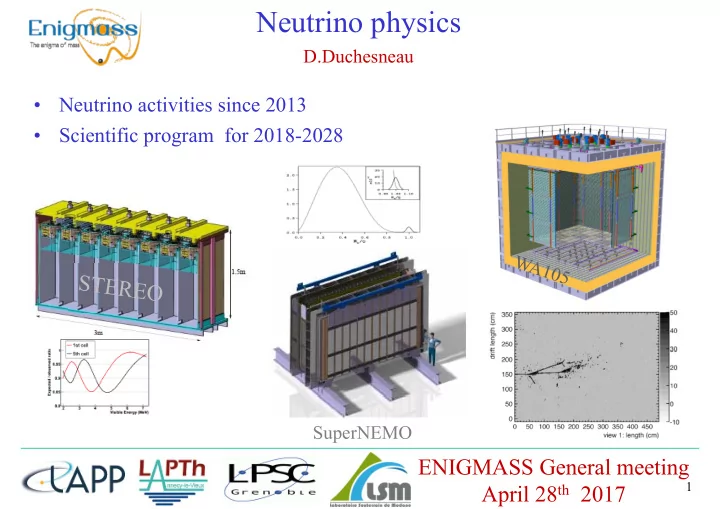
Neutrino physics D.Duchesneau Neutrino activities since 2013 Scientific program for 2018-2028 SuperNEMO ENIGMASS General meeting April 28 th 2017 1 Neutrinos: The neutrino properties are less well tested than for quarks and

slide-1
SLIDE 1

1

Neutrino physics

D.Duchesneau

ENIGMASS General meeting April 28th 2017

  • Neutrino activities since 2013
  • Scientific program for 2018-2028

SuperNEMO

slide-2
SLIDE 2

2

Neutrinos:

The neutrino properties are less well tested than for quarks and charged leptons and several unknown still exist.

slide-3
SLIDE 3

2

Neutrinos:

The neutrino properties are less well tested than for quarks and charged leptons and several unknown still exist.

still several fundamental questions to answer:

slide-4
SLIDE 4

2

  • what is the absolute mass scale?
  • fundamental for cosmology and unification scheme of interactions

Neutrinos:

The neutrino properties are less well tested than for quarks and charged leptons and several unknown still exist.

still several fundamental questions to answer:

slide-5
SLIDE 5

2

  • what is the absolute mass scale?
  • fundamental for cosmology and unification scheme of interactions
  • are neutrinos their own antiparticles (Majorana) or not (Dirac) ?
  • if Majorana => leptonic number violation, theoretical consequence (leptogenesis, GUT)

Neutrinos:

The neutrino properties are less well tested than for quarks and charged leptons and several unknown still exist.

still several fundamental questions to answer:

slide-6
SLIDE 6

2

  • what is the absolute mass scale?
  • fundamental for cosmology and unification scheme of interactions
  • are neutrinos their own antiparticles (Majorana) or not (Dirac) ?
  • if Majorana => leptonic number violation, theoretical consequence (leptogenesis, GUT)
  • Are there more than 3 mass eigenstates?
  • Some experimental data prefer sterile neutrino(s) with mass close to 1 eV/c2

Neutrinos:

The neutrino properties are less well tested than for quarks and charged leptons and several unknown still exist.

still several fundamental questions to answer:

slide-7
SLIDE 7

2

  • what is the absolute mass scale?
  • fundamental for cosmology and unification scheme of interactions
  • are neutrinos their own antiparticles (Majorana) or not (Dirac) ?
  • if Majorana => leptonic number violation, theoretical consequence (leptogenesis, GUT)
  • Are there more than 3 mass eigenstates?
  • Some experimental data prefer sterile neutrino(s) with mass close to 1 eV/c2

Neutrinos:

  • Which is the mass hierarchy?
  • Essential for CP violation quest
  • Is CP symmetry violated in the leptonic sector?

The neutrino properties are less well tested than for quarks and charged leptons and several unknown still exist.

still several fundamental questions to answer:

slide-8
SLIDE 8

2

  • what is the absolute mass scale?
  • fundamental for cosmology and unification scheme of interactions
  • are neutrinos their own antiparticles (Majorana) or not (Dirac) ?
  • if Majorana => leptonic number violation, theoretical consequence (leptogenesis, GUT)
  • Are there more than 3 mass eigenstates?
  • Some experimental data prefer sterile neutrino(s) with mass close to 1 eV/c2

Neutrinos:

  • Which is the mass hierarchy?
  • Essential for CP violation quest
  • Is CP symmetry violated in the leptonic sector?

The neutrino properties are less well tested than for quarks and charged leptons and several unknown still exist.

still several fundamental questions to answer:

slide-9
SLIDE 9

2

  • what is the absolute mass scale?
  • fundamental for cosmology and unification scheme of interactions
  • are neutrinos their own antiparticles (Majorana) or not (Dirac) ?
  • if Majorana => leptonic number violation, theoretical consequence (leptogenesis, GUT)
  • Are there more than 3 mass eigenstates?
  • Some experimental data prefer sterile neutrino(s) with mass close to 1 eV/c2

Neutrinos:

  • Which is the mass hierarchy?
  • Essential for CP violation quest
  • Is CP symmetry violated in the leptonic sector?

The neutrino properties are less well tested than for quarks and charged leptons and several unknown still exist.

still several fundamental questions to answer:

slide-10
SLIDE 10

2

  • what is the absolute mass scale?
  • fundamental for cosmology and unification scheme of interactions
  • are neutrinos their own antiparticles (Majorana) or not (Dirac) ?
  • if Majorana => leptonic number violation, theoretical consequence (leptogenesis, GUT)
  • Are there more than 3 mass eigenstates?
  • Some experimental data prefer sterile neutrino(s) with mass close to 1 eV/c2

Neutrinos:

  • Which is the mass hierarchy?
  • Essential for CP violation quest
  • Is CP symmetry violated in the leptonic sector?

The neutrino properties are less well tested than for quarks and charged leptons and several unknown still exist.

still several fundamental questions to answer:

Challenging experimental program: Enigmass is an major actor

slide-11
SLIDE 11

Neutrino Pole in ENIGMASS

3

The scientific program covers several of the present fundamental research topics in neutrino physics This program is in adequacy with the national and international roadmaps. It is performed using close infrastructures : CERN, ILL, LSM The neutrino project proposed within ENIGMASS is based on the successful development of the activity in this field among the different experimental laboratory (LAPP, LPSC ad LSM) => rich neutrino physics program covering three of the key subjects with scientific

  • utput guaranteed in a medium term and the preparation of the future with longer-term

project

slide-12
SLIDE 12

Experimental activities in this framework:

STEREO project (2013-2019) (ANR ‘programme blanc’ grant)

  • Radioactive source calibration system
  • Shieldings: mechanics, realisation
  • Acquisition electronics + µ veto
  • Installation and commissioning at ILL reactor in 2016
  • Running and data analysis (start end of 2016)

SuperNEMO demonstrator (2013-2019)

  • development of the double beta source foils
  • development of the detector ‘Slow control’
  • Chemical Se purification (with JINR Dubna)
  • Installation and commissioning at LSM in 2017
  • Running and data analysis (expected to start in 2018)

4

WA105 / ProtoDUNE-DP (2014-2020)

  • Scintillation light readout electronic
  • Mechanical structure and automated control of the charge readout plane
  • Simulation
  • Running and data analysis (expected to start in 2018)

+ ….

slide-13
SLIDE 13

5

STEREO activity status in 2016

August 2016 : Assembly of the shielding and the detector complete September 2016 : Detector moved to its data-taking position Installation of the source calibration system Filling of the detector in November 2016 Muon veto system

 1.5 reactor cycle already taken; detector maintenance under way  Next step: reinstall detector by August and restart data acquisition in Sept 2017

slide-14
SLIDE 14

6

SuperNEMO activity status

Realization of full size foils with enriched 82Se

Source radiopurity measurement in Canfanc

Measure 214Bi et 208Tl

Production on going: 13 foils prepared and 10 to be done by June Control & Monitoring System development

CMS VIRE

COMMUNICATION PROTOCOL

  • CMS integration and commissioning with ½ detector
  • Interface control definition for each sub system

116Cd analysis with NEMO-3

Phys.Rev. D95 (2017) no.1 012007

Détecteur BiPo

slide-15
SLIDE 15

7

Detector installation at LSM

Construction and assembly of parts in 2016 and 2017

  • 2 calorimeters ready
  • 1 half tracker ready,
  • Second half is being integrated
  • Source foil installation in summer
  • Shielding, magnetic coil, anti-radon system and

electronics to be installed in the autumn Commissioning and detector run by the end of 2017

slide-16
SLIDE 16

8

The world experimental neutrino physics program for the coming 10 years (until 2027) will focus mostly on a few main subjects:

  • Sterile neutrino searches using short baseline accelerator and reactor experiments
  • Mass hierarchy determination with reactor, accelerator and deep-sea detector
  • Understanding the CP violation in the lepton sector and its CP phase measurement
  • n accelerator long baseline experiments (running and in preparation)
  • The nature of the neutrino will continue to be investigated through neutrinoless

double beta decay experiments where running projects should see upgrades to higher masses in order to improve the actual limits on the half-life of isotopes and the effective neutrino mass

This list is not exhaustive but gives the main topics

slide-17
SLIDE 17

9

The scientific goals of the proposed neutrino project for the coming 10 years are 3 folds: ENIGMASS Scientific neutrino program for 2018-2028

A. To pursue the present activities in order to complete the different running experiments developed within the labex framework since 2013, which are STEREO at ILL and the SuperNEMO demonstrator at LSM B. To develop the participation to the future long baseline project called DUNE aiming at discovering the CP violation in the lepton sector and measuring the CP phase. This long-term project should become the main activity beyond 2020 for ENIGMASS after STEREO and SuperNEMO have finalised their results. C. To develop eventually low energy neutrino experiment at LSM and prospect for ideas to upgrade SuperNEMO double beta source foils with different isotopes (like 150Nd)

slide-18
SLIDE 18

10

A) Continue the actual projects (2018-2021) STEREO running and analysis SuperNEMO demonstrator running and analysis

Schedule and goals: 2018: run the experiment during 3 reactor cycles. This will be added to 3 cycles in 2017 and 0.5 in 2016 2019: Analyse and get results on sterile search

After 2 years

Exclusion plot

Schedule and goals: 2018: commission and run the full demonstrator during 2.5 years with 7kg of 82Se => study all background channels in detail 2020: End of run 2021: Analyse and get results on half life of

82Se and full background estimate

Background level ~ 10-4 cts./(keV kg y)

  • Background free at high energy
  • Sensitivity:

T1/2 > 6.6 1024 y mν ~ 0.20 - 0.40 eV ~1.5 better than NEMO-3

slide-19
SLIDE 19

11

B) Develop participation to Long Baseline (2018-2028) ProtoDUNE-DP / WA105 (2018-2020)

Schedule and goals: 2018: Finish the construction and installation of the Dual Phase TPC in the cryostat. Commission and prepare the experiment to take beam data before CERN accelerator stop in Oct Run with cosmics data 2019: Analyse and get results to validate the TPC technology for DUNE far detector TDR 2019-2021: long run with cosmics and beam eventually Schedule and goals: 2020-2021: Design of the Far detector Lar TPC 2022: start installation in underground cavern 2026: Detector commissioning and first beams

  • Prepare the analysis and develop detector

simulation and reconstruction software

6 m 6 m 6 m

DUNE LBL physics studies and Far detector design/construction

slide-20
SLIDE 20

12

C) Develop low energy neutrino experiments at LSM. Possibility of R&D but program has to be better setup

Spherical Proportional Counter R&D Develop a large scale Radial TPC with spherical proportional counter read-out With SPC filled with Xenon:

  • Double beta decay experiment
  • Low energy neutrino coherent scattering
  • Supernovae neutrino detector

Example: Sedine at LSM

To be discussed among groups and Fabrice

slide-21
SLIDE 21

Finalise analysis

Far Detector installation

13

Neutrino activity Timeline for items A and B

2014 2016 2018 2020 2013

STEREO SuperNEMO

Design 6x6x6 / pre-proto 3x1x1 Constructi

  • n 6x6x6

Commissioning Run /Analysis

ProtoDUNE-DP WA105 DUNE Far detector 10 kt TPC modules

Design / prototype / construction

Install ation

Commissioning Run /Analysis p R&D source & Slow control development

Installa tion

Commissioning Run /Analysis

Technology validation

Installation

2022 2024

Finalise analysis

Design / construction

Commis sioning

Today

Do long term running with cosmics

slide-22
SLIDE 22

14

Thank you

slide-23
SLIDE 23

15

Liquid Argon TPC

Principle: 3D imaging in a large volume Liquid Argon TPC

  • very pure LAr (<0.1ppb)  electrons can drift over large distances (>1.5 m)
  • UV scintillation light (5000 photons/mm @128 nm) for t0
  • Primary ionization in LAr: 1 m.i.p ~ 20000 e- on 3 mm
  •  3D reconstruction with ~1 mm resolution

WA105:

slide-24
SLIDE 24

15

Liquid Argon TPC

Principle: 3D imaging in a large volume Liquid Argon TPC

  • very pure LAr (<0.1ppb)  electrons can drift over large distances (>1.5 m)
  • UV scintillation light (5000 photons/mm @128 nm) for t0
  • Primary ionization in LAr: 1 m.i.p ~ 20000 e- on 3 mm
  •  3D reconstruction with ~1 mm resolution

WA105:

slide-25
SLIDE 25

15

Liquid Argon TPC

WA105 6 m 6 m 6 m

Principle: 3D imaging in a large volume Liquid Argon TPC

  • very pure LAr (<0.1ppb)  electrons can drift over large distances (>1.5 m)
  • UV scintillation light (5000 photons/mm @128 nm) for t0
  • Primary ionization in LAr: 1 m.i.p ~ 20000 e- on 3 mm
  •  3D reconstruction with ~1 mm resolution

WA105:

slide-26
SLIDE 26

16

At CERN to test technical solutions and study the detector physics performance with charged particle beams 6m e- drift Validation of of number of technical aspects with the first 3x1x1 m 3 prototype

Several technical items have to be validated with a large scale prototype

  • LNG tank construction technique
  • Purity in non evacuated membrane tank
  • Long electron drift distance
  • High voltage system for the cage field 300-600 KV
  • Double phase readout
  • Cold front end electronic
  • Interaction reconstruction in the TPC

WA105 Double Phase LAr Demonstrator

slide-27
SLIDE 27

17

Operation at CERN in 2016 and take cosmics LAPP suspension system

slide-28
SLIDE 28

WA105 => DUNE

18

12m Suspension Signal FTs SC FT

DUNE TPC DLAr design

  • 12m x 60m Double phase charge readout plane segmented
  • The basic unit is 3m x 3m  independant detector with its own

signal, slow control feedthroughs and independant suspension system.

Neutrino beam from Fermilab: 1300 km

slide-29
SLIDE 29

19

Hiérarchie de masse: avec des nouveaux projets

  • atmosphériques (ex: Pingu, Orca, INO, HyperK)
  • Réacteurs (JUNO, RENO-50 (20kton LSc, 60 km)
  • Faisceau Long baseline  (> 1000 km)
  • US => DUNE avec TPC Argon Liquide

Hiérarchie de masse des  et violation CP Violation CP:

quête en cours (T2K et NOvA) mais nécessite des nouveaux projets

  • Faisceaux  Long baseline (>100 km)
  • US => DUNE / TPC argon liquide / 1300 km
  • Japon => Water Cerenkov / 295 km (T2K => HyperK)

Ces 2 questions peuvent être abordées avec faisceaux conventionnels en étudiant les

  • scillations → et  → 
slide-30
SLIDE 30

20

Nova (USA) et T2K (Japon): sur faisceaux

Premières indications d’une potentielle violation de CP mais la signification restera marginale et ne pourra pas dépasser 2‐3 sigmas en 2026

Orca (Europe) et JUNO (Chine):

Chercheront à déterminer la hiérarchie de masse avec des atmosphériques dans la mer (Orca) et avec des neutrinos de réacteurs (JUNO); => Pourraient déterminer à 3‐4 sigmas la hiérarchie d’ici 2026

Perspective d’ici 2026: Hiérarchie de masse des  et violation CP

slide-31
SLIDE 31

21

USA : DUNE/LBNF

TPC Argon Liquide 4x10 kton à SURF (Mine de Homestake) ~2400mwe Faisceau de Fermilab (1.2-2.4MW)

baseline=1300 km <E> ~3 GeV

Futurs projets de faisceau neutrino (>2026):

Ancienne mine d’or désaffectée: niveau = -1.5 km

slide-32
SLIDE 32

21

USA : DUNE/LBNF

TPC Argon Liquide 4x10 kton à SURF (Mine de Homestake) ~2400mwe Faisceau de Fermilab (1.2-2.4MW)

baseline=1300 km <E> ~3 GeV

Japon : Hyper-K

Cherenkov à eau 520 kton à Tochibora près de Kamioka, ~ 1750 mwe Faisceau Off axis de JPARC (1.3MW)

baseline=295 km <E> ~0.7 GeV

Futurs projets de faisceau neutrino (>2026):

Ancienne mine d’or désaffectée: niveau = -1.5 km

slide-33
SLIDE 33

22

300 kt-MW-yrs = 3.5+3.5 years x 40kt @ 1.08 MW, 80GeV protons

DUNE physics performance

1 year 2 years 5 years 7 years

CDR, arXiv: 1512.06148

slide-34
SLIDE 34

(A,Z)  (A,Z+2) + 2 e- Detector composed of a tracking chamber and a calorimeter + source foils of the 2 isotope Observables: electron energies, angular distributions

23

SuperNEMO: 0  double beta decay experiment Sensitivity after 2 years : T1/2 > 6.6 1024 y and <m> < 0.2 ‐0.4 eV

Goal: to reach the background level for 100 kg  to perform a no background experiment with 7 kg isotope of 82Se in 2 yr