Neutrino Detectors for Reactor Monitoring: the Angra Project Edgar - - PowerPoint PPT Presentation

neutrino detectors for reactor monitoring the angra
SMART_READER_LITE
LIVE PREVIEW

Neutrino Detectors for Reactor Monitoring: the Angra Project Edgar - - PowerPoint PPT Presentation

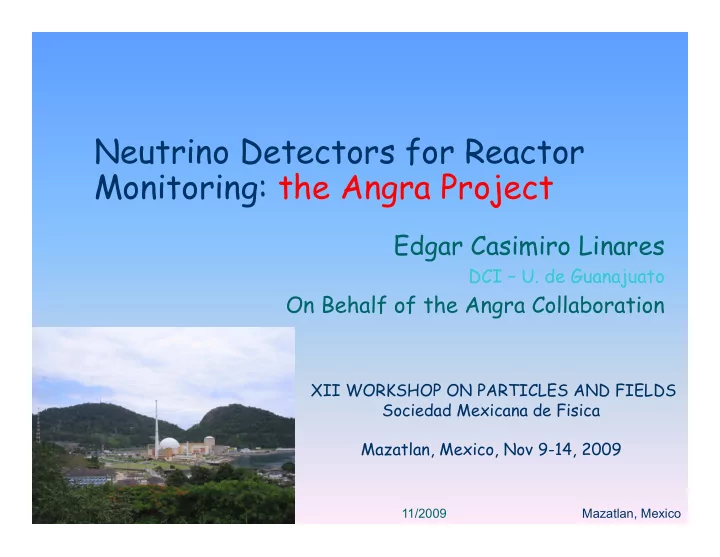
Neutrino Detectors for Reactor Monitoring: the Angra Project Edgar Casimiro Linares DCI U. de Guanajuato On Behalf of the Angra Collaboration XII WORKSHOP ON PARTICLES AND FIELDS Sociedad Mexicana de Fisica Mazatlan, Mexico, Nov 9-14, 2009


slide-1
SLIDE 1

11/2009 Mazatlan, Mexico

Neutrino Detectors for Reactor Monitoring: the Angra Project

Edgar Casimiro Linares

DCI – U. de Guanajuato

On Behalf of the Angra Collaboration

XII WORKSHOP ON PARTICLES AND FIELDS Sociedad Mexicana de Fisica Mazatlan, Mexico, Nov 9-14, 2009

slide-2
SLIDE 2

ECL DCI-UG

The ANGRA Neutrino Project

  • Now: Safeguards Tool Development
  • Eventually: Nu Oscillation Measurement
slide-3
SLIDE 3

ECL DCI-UG

The ANGRA Collaboration:

J.C. Anjos, G.L. Azzi, A.F. Barbosa, R.M.O. Galvão, H. Lima Jr, J. Magnin,

  • H. da Motta, M. Vaz, R. Shellard, F. Simão

Graduate students: Anderson Schilithz(PhD) Andre G. Oliveira (MSc) Arthur B. Villar (MSc) Wallace R. Ferreira (MSc) Undergraduate: Valdir Salustino, Rodolfo Silva, Thamys Abrahão Tiago L. Rodrigues, Rosangela S. Ten, Thaynea Blanche Collaborators: Ana Amélia Bergamini (CBPF, LNGS) L.M.Andrade Filho (COPPE) P.R.Barbosa Marinho (CNEN)

  • R. Machado da Silva (UFRRJ)
slide-4
SLIDE 4

ECL DCI-UG

The ANGRA Collaboration:

PUC-RJ

  • H. Nunokawa
  • R. Zukanovich Funchal

M.M. Guzzo, E. Kemp, O.L.G. Peres, P. Holanda,

  • T. Bezerra, L. F. González, L. P.B. Lima

UFBa Iuri M. Pepe V.L. Filardi UEFS Germano P. Guedes Paulo Cesar Farias

UFABC Marcelo Leigui, R. Da Maceno, P. Chimenti

Other Brazilian Institutions:

slide-5
SLIDE 5

ECL DCI-UG

ANGRA International Group

  • A. Bernstein, N. Bowden
  • L. Villaseñor
  • D. Reyna
  • T. Lasserre (informal support)
  • W. Fulgione, M.Aglietta
  • E. Casimiro
slide-6
SLIDE 6

25/10/07 CBPF 2007

slide-7
SLIDE 7

ECL DCI-UG

Main Goal:

 Monitor reactor with antineutrinos:

Gain insight on the technique Improve it

slide-8
SLIDE 8

ECL DCI-UG

Possible Future Goal:

 Neutrino Oscillations:

Measure the mixing angle θ13

slide-9
SLIDE 9

ECL DCI-UG

Neutrinos from Reactors

 Nuclear reactors produce lots of (electron)

antineutrinos

 Typical fluxes: 1020 s-1  Typical energy: a few MeVs

slide-10
SLIDE 10

25/10/07 CBPF 2007

slide-11
SLIDE 11

25/10/07 CBPF 2007

slide-12
SLIDE 12

ECL DCI-UG

slide-13
SLIDE 13

25/10/07 CBPF 2007

slide-14
SLIDE 14

ECL DCI-UG

Neutrino Detection Principle

The νe interacts with a proton (from the target) via the inverse β-decay: The e+ quickly annihilates Later the neutron gets captured producing a coincident signal Reines and Cowan used Cd to enhance the n capture

slide-15
SLIDE 15

ECL DCI-UG

slide-16
SLIDE 16

25/10/07 CBPF 2007

slide-17
SLIDE 17

25/10/07 CBPF 2007

Reines-Cowan first Detector

Hanford experiment (1953)

300 lt target, 90 2” PMT’s

Captured by Cadmium Annihilation with electron

  • H. Nunokawa
slide-18
SLIDE 18

25/10/07 CBPF 2007

slide-19
SLIDE 19

25/10/07 CBPF 2007

slide-20
SLIDE 20

ECL DCI-UG

Neutrino Event Signature:

 Two-component coincidence signal

( bckgd reduction)

 Scintillator doped with Gd to enhance

n capture

slide-21
SLIDE 21

ECL DCI-UG

Reactor (anti)Neutrinos

D : distance from reactor core [~ 50 m] Pth : delivered thermal power [~ 4 GW] W : energy release per fission [203.87 MeV]

Flux:

~ 6.7/fission

slide-22
SLIDE 22

ECL DCI-UG

Double Chooz Detector

Inner Muon Veto :

mineral oil + 70 8’’ PMTs

Target ν :

80% C12H26+ 20% PXE +0,1% Gd + PPO + Bis-MSB

γ Catcher :

80% C12H26 + 20% PXE + PPO + Bis-MSB

Buffer vessel & 390 10’’ PMTs :

Stainless steel 3 mm

Steel Shielding :

17 cm steel, All around

Non-scintillating Buffer :

mineral oil 10,3 m3 22,6 m3 114 m3 90 m3

Outer Veto :

Scintillator panels

7 m 7 m

slide-23
SLIDE 23

ECL DCI-UG

Motivations for ANGRA

 Neutrino Applied

Applied Physics in Latin America

slide-24
SLIDE 24

ECL DCI-UG

Motivations for ANGRA

 Possibility to do frontier experimental

Physics by using existing infrastructure: Angra-I and Angra-II reactors

 --> Low-cost

slide-25
SLIDE 25

ECL DCI-UG

Neutrinos & Non-Proliferation

 ~ 450 nuclear power reactors worldwide  ~ 200 Kg Pu produced per reactor cycle (~1.5 y)  ~ 90 tons Pu produced every year worldwide  A few Kg of Pu suffice to make a nuclear weapon

slide-26
SLIDE 26

ECL DCI-UG

Neutrinos & Non-Proliferation

 IAEA - verification authority

The International Atomic Energy Agency inspects nuclear facilities under safeguards agreements: keep track of all Pu produced; verify that fissile materials are used for civil appliances

slide-27
SLIDE 27

ECL DCI-UG

Why Neutrino Detectors?

 Explore new methods for nuclear safeguards  Antineutrinos can not be shielded  Reactor Antineutrinos can reveal fissile

composition of nuclear fuel

 Reliable, Non-intrusive, Remote, Real-Time

monitoring

 Can provide Thermal Power info as well as

slide-28
SLIDE 28

25/10/07 CBPF 2007

slide-29
SLIDE 29

ECL DCI-UG

a non-intrusive method to check reactor activity

Antineutrino detector Reactor core

Pu production chain

The Angra Project

slide-30
SLIDE 30

ECL DCI-UG

Reactor Fuel Monitoring: (anti)Neutrino rates

 As the reactor goes through its irradiation

cycle, the amount of U decreases and the amount of Pu increases

 The number of antineutrinos emitted by

U-235 and by Pu-239 differs sensibly

 As Pu-239 builds up in the reactor over time,

the antineutrino rates measured in a detector will drop (by about 5-10% over the reactor fuel cycle)

slide-31
SLIDE 31

ECL DCI-UG

Fuel Composition Burn-up Effect

slide-32
SLIDE 32

ECL DCI-UG

Reactor Fuel Monitoring: Antineutrino Rates

 Removing Pu along the way or altering

  • peration parameters to increase Pu

production will show up in the antineutrino count rates

 Method works better with independent

reactor power measurement

slide-33
SLIDE 33

ECL DCI-UG

Reactor Fuel Monitoring: Energy Spectra Comparison

 The energy spectra of antineutrinos

emitted by Pu-239 and U-235 are different

 Can determine the relative amounts of

Pu and U by measuring ratios between spectra taken at different times

 No need for independent power

measurement

slide-34
SLIDE 34

ECL DCI-UG

Reactor Fuel Antineutrino Spectra

slide-35
SLIDE 35

ECL DCI-UG

San Onofre: reactor activity:

Rovno (Ukraine) San Onofre (USA)

slide-36
SLIDE 36

ECL DCI-UG

Reactor Thermal Power and Antineutrino flux

Delivered thermal power and antineutrino rates

Nν = γ · (1 + k) · Pth

Dependence on fuel composition Dependence on detector features

(Topic of interest for Eletronuclear, CFE, etc.)

slide-37
SLIDE 37

San Onofre: Thermal Power San Onofre: Thermal Power Measurement Measurement

ECL DCI-UG

slide-38
SLIDE 38

ECL DCI-UG

slide-39
SLIDE 39

ECL DCI-UG

  • 1,050 lt liquid scintillator
  • central volume: 510 lt
  • 0.5 g/lt Gd
  • 84 PMTs
  • 1 m3 liquid scint central detector
  • Gd loaded
  • 8 PMTs on top
  • Passive water shield
  • Active muon shield
slide-40
SLIDE 40

ECL DCI-UG

Best Current Limit: CHOOZ

@Δm2

atm = 2 10-3 eV2

sin2(2θ13) < 0.2

(90% C.L)

νe → νx

  • M. Apollonio et. al., Eur.Phys.J. C27 (2003) 331-374

νe  νe (disappearance experiment)

Pth= 8.4 GWth, L = 1.050 km, M = 5 t Overburden: 300 mwe

slide-41
SLIDE 41

Italian (INFN-Genova) Prototype Italian (INFN-Genova) Prototype

ECL DCI-UG

 Plastic Scintillator  Gd foils

slide-42
SLIDE 42

San Onofre Detector San Onofre Detector

ECL DCI-UG

  • San Clemente, California, 2004-2009
  • Livermore Lab + SANDIA Teams
  • Size: 3m x 3m x 3m
  • 25 m from reactor, 10m underground
slide-43
SLIDE 43

ECL DCI-UG

Workshop on the ANGRA Detector Design CBPF - May 16-19, 2006, Rio de Janeiro

slide-44
SLIDE 44

ECL DCI-UG

Safeguards Detector site:

50 m Possible Locations for the SAFEGUARDS DETECTOR

slide-45
SLIDE 45

ECL DCI-UG

Safeguards Detector: Initial Design: 3-volume

slide-46
SLIDE 46

ECL DCI-UG

Important Dates:

 Sep 2006: Meeting with Eletronuclear

representatives

 Dec 2006: Proposal presented to the

Brazilian Minister of Science and Technology

 March 2007: Project Neutrinos Angra

approved by FINEP ~ 0.6 MUSD

slide-47
SLIDE 47

25/10/07 CBPF 2007

slide-48
SLIDE 48

Some possible detector geometries

ECL DCI-UG

slide-49
SLIDE 49

Some Shaft Options

25/10/07 CBPF 2007

slide-50
SLIDE 50

ECL DCI-UG

Expected Neutrino Signals & Muon Background

Distance (m) Signal (d-1) 60 1270 70 933 80 714 90 564 100 457 Depth (mwe) Muons (Hz) 20 755 30 450 40 350 50 245 80 110

Cylindrical Detector R: 1.40m; H: 3.10m; Target Mass: 1ton

slide-51
SLIDE 51

ECL DCI-UG

Number of Photomultiplier Tubes

Photocathode Coverage (%) Number

  • f PMTs

PMT Density (PMTs / m2) 6 40 1.58 8 53 2.11 10 66 2.63 12 79 3.16 14 92 3.68 16 105 4.21

Cylinder R= 1.10m; H=2.50m, ATop = 3.80132; ASide = 17.2787; ATotal = 24.8814

slide-52
SLIDE 52

ECL DCI-UG

Phase I:

Setup infrastructure at CBPF & UNICAMP:

slide-53
SLIDE 53

ECL DCI-UG

Radioactivity Site Background Measurement (rocks and sand)

No relevant content was found

slide-54
SLIDE 54

ECL DCI-UG CBPF 2007

R&D at CBPF: Test of components

  • Hamamatsu 8” PMT characterization
slide-55
SLIDE 55

ECL DCI-UG

R&D at CBPF:

PMT characterization

  • Hamamatsu R5912 (8”)

Tipical Signal, 100MHz digital osciloscope Rise time ≈20ns, duration ≈50ns (FWHM)

slide-56
SLIDE 56

ECL DCI-UG

Electronics & DAQ

Input Buffer Amplifier & Shaper Comparator Line Driver To ADC To Trigger

  • Front-end electronics

 input buffer + amplifier/shaper  To ADC: + line driver  To Trigger system: + comparator

  • Data Acquisition (DAQ)

 VME-based  off-the-shelf high-performance devices (ADCs, FPGAs, FIFOs)  two sub-systems: neutrino signal / VETO  Neutrino: ∼ 120 input channels sampled at 250Msps / 10-bit resolution  VETO: ∼ 110 LVDS signals to a large/fast FPGA (Stratix II)

slide-57
SLIDE 57

ECL DCI-UG

R&D at CBPF: DAQ electronics

prototype

Layout design - top layer (red), bottom layer (blue)

digital inputs USB connector analog input power connector

slide-58
SLIDE 58

ECL DCI-UG

R&D at CBPF: test of components

CBPF HVPS - High Voltage Switching Power Supply

slide-59
SLIDE 59

R&D at CBPF: Outer Muon Veto Test

  • 64-channel PMTs Hamamatsu R8520
slide-60
SLIDE 60

ECL DCI-UG

R&D at CBPF: Outer Muon Veto Tests

  • Muon telescope: 4 planes

( MINOS type scintillator)

slide-61
SLIDE 61

ECL DCI-UG

Setup infrastructure at the Angra site:

  • Measurement of local muon flux:

Cerenkov detector (Auger test tank)

  • Muon telescope deployment

(4 Minos scintillator planes)

  • 20’ container

near reactor building

slide-62
SLIDE 62

ECL DCI-UG

.

R&D: ANGRA NOTES

slide-63
SLIDE 63

Current Angra Detector Design

25/10/07 CBPF 2007

Size: 1,90m (l) x 1,60m (w) x 1,60m (h) Central Detector: 1-ton water (liq scint: flammable, toxic, and carcinogenic!!) with Gd salts 75 9-in head-on PMTs Muon active Veto, Neutron shielding

slide-64
SLIDE 64

θ13

ECL DCI-UG

slide-65
SLIDE 65

ECL DCI-UG

ν ν ν ν ν ν ν ν

1051 m 280 m

The Chooz site in French Ardennes

slide-66
SLIDE 66

ECL DCI-UG

P(νe→ νe) = 1-sin2(2θ13)sin2(Δm2

31L/4E)

Experimental Approach

Near detector Far detector

Nuclear power station 2 cores: 4.27 GWth Near detector Far detector ~250 m 1050 m νe νe,µ,τ Électron antineutrinos flux : 1021 νe/s Clean measurement

  • f θ13
slide-67
SLIDE 67

25/10/07 CBPF 2007

Sites

Near Site Far Site Very Near Detector (thermal power and safeguards)

Detectors for Neutrino Oscillation Measurements

Reactor

500 m Angra III

slide-68
SLIDE 68

ECL DCI-UG

2015, perhaps:

high precision measurement of θ13

Near (reference) detector:

50 ton detector (7.2 m dia)

300 m from core

250 m.w.e.

Far (oscillation) detector:

500 tons (12.5 m dia)

1500 m from core

2000 m.w.e. (under “Frade” peak )

Very Near detector:

1 ton prototype project

< 50m of reactor core

Detector Construction

Standard 3 volume design reactors

“Morro do Frade”

slide-69
SLIDE 69

ECL DCI-UG

Conclusions

 Previous experiments indicate feasibility of using nu

detectors for nuclear reactor distant monitoring

 Thermal power and fuel composition measurement can

be achieved

 Better accuracy and general improvement of

technique is needed

 Good opportunity to develop experimental nu physics

in LA and to contribute to develop new safeguards techniques

 Neutrino Oscillations: collaboration with Double

  • Chooz. Way towards high precision experiment in LA

by 2015.

slide-70
SLIDE 70

25/10/07 CBPF 2007

Thanks

elinares@fisica.ugto.mx

slide-71
SLIDE 71

Pu production chain

ECL DCI-UG

238U92 + 1n0 => 239U92 + γ 239U92 => 239Np93 + e- 239Np93 => 239Pu94 + e-

23 min

2.3d

slide-72
SLIDE 72

Pu production chain (cont…)

ECL DCI-UG

239Pu94 + 1n0 => 240Pu94 + γ 240Pu94 + 1n0 => 241Pu94 + γ 241Pu94 + 1n0 => 242Pu94 + γ

slide-73
SLIDE 73

Ar- and Ge-based nu detectors

25/10/07 CBPF 2007

Detect antineutrinos through coherent neutrino–nucleus scattering. In this process, an antineutrino collides with a nucleus of argon or germanium, which results in nuclear recoil. As the recoiling nucleus collides with its neighbors, it shakes loose a few electrons. Then a sensitive transistor can extract and amplify the electrons.

slide-74
SLIDE 74

Ar- and Ge-based nu detectors (cont…)

25/10/07 CBPF 2007

The Ar detector uses a dual-phase detection process. In the first phase, the electron signal is produced in liquid Ar. In the second phase, the signal is amplified in an Ar gas blanket above the liquid to generate copious scintillator light, which is detected by PMTs. The coherent scatter process has a much higher antineutrino interaction rate per volume of detection medium compared with detectors that rely on inverse beta decay. This process has long been predicted but never observed. Detecting the coherent scatter signal with either approach would signify a major breakthrough. Because detectors that use coherent scatter have a high probability of interaction per unit mass, they can also have a much smaller footprint, possibly as small as 1 cubic meter with the necessary shielding.

slide-75
SLIDE 75

25/10/07 CBPF 2007

slide-76
SLIDE 76

25/10/07 CBPF 2007

slide-77
SLIDE 77

25/10/07 CBPF 2007

slide-78
SLIDE 78

25/10/07 CBPF 2007

Diablo Canyon Braidwood Angra Penly Chooz Cruas Krasnoyarsk Taiwan Kashiwasaki

Un complexe de réacteurs 2 cavités @500 m & ~1-2 km

Daya bay

2002-2004

2002-2006: Looking for sites

Angra Double Chooz Daya bay

1st generation: sin2(2θ13)~0.02-0.03 2nd generation: sin2(2θ13)  0.01

Reno

2007

Remaining (alive) proposals… .

slide-79
SLIDE 79

25/10/07 CBPF 2007

Double Chooz Collaboration

slide-80
SLIDE 80

05/2009 DPYC

Expected Oscillation Signal

@1,05 km

Far Spectrum Near Spectrum

sin2(2θ13)=0.12 Δm2

atm= 3.0 10-3 eV2

slide-81
SLIDE 81

25/10/07 CBPF 2007

Deploy LVD tank

  • 1 ton Gd doped

liquid scintillator tank

  • Test signal+background
  • Tests with Californium

source

  • Final site selection for

underground laboratory

slide-82
SLIDE 82

25/10/07 CBPF 2007

Richard Wigmans

slide-83
SLIDE 83

25/10/07 CBPF 2007

The idea is quite old...

 Kurchatov Institute, 1988

Revisited recently

slide-84
SLIDE 84

25/10/07 CBPF 2007

Reactor power x neutrino flux

Measuring of power production by neutrino method Neutrino Rate per 105 sec Reactor power in % from nominal value (1375 MW)

slide-85
SLIDE 85

25/10/07 CBPF 2007

Reactor power x neutrino flux

Number of antineutrinos

Power generation Power ν / Power Th

slide-86
SLIDE 86

25/10/07 CBPF 2007

Ratio of spectra: time evolution

S(t)/S(t=0) time (days) after reactor starts

slide-87
SLIDE 87

25/10/07 CBPF 2007

slide-88
SLIDE 88

25/10/07 CBPF 2007

Expected Signal & Background

Depth (mSR) Muons (Hz) 10 365 20 150 30 063 40 043 50 019

Rates presented at ICRC 2007

Cylindrical Detector - R3= 1.40m; H=3.10m

slide-89
SLIDE 89

25/10/07 CBPF 2007

Phase II: Deploy LVD tank

Muon veto construction at LNGS

slide-90
SLIDE 90

25/10/07 CBPF 2007

slide-91
SLIDE 91

25/10/07 CBPF 2007

Physics Motivations:

 The discovery of neutrino oscillations implies that

neutrinos are massive and that the SM is incomplete.

 These observations may have profound astrophysical

  • consequences. CP violation in the lepton sector may

hold the key of matter-antimatter asymmetry in the universe.

 The minimal extension of the SM requires 3 mass

eigenstates, ν1, ν2, ν3 and a unitary mixing matrix U which relates the neutrino mass basis to the flavor basis.

slide-92
SLIDE 92

25/10/07 CBPF 2007

Standard Model Extension:

 Minimal extension of the SM requires 7 parameters:

3 neutrino masses m1, m2 and m3 3 mixing angles θ12 , θ23 , and θ13 a CP violating phase parameter δ

 The oscillation probabilities depend on the mass-

squared differences Δm2

12 = m2 2 – m1 2 and

Δm2

23 = m3 2 – m2 2

 Challenges of neutrino experimental community

include to measure as precisely as possible θ12, θ23 , θ13 , Δm2

12 , Δm2 23

slide-93
SLIDE 93

25/10/07 CBPF 2007

Neutrino Mixing Matrix Experimental status:

 The parameters θ23 and Δm2

23 determined using atmospheric

neutrino data from Super-Kamiokande and K2K. (10% level)

 Data from SNO, KamLAND and Super-Kamiokande used to

determine θ12 and Δm2

12 with 10 – 20% precision.

 For θ13 there exists only a limit by the reactor experiment

CHOOZ sin 2 (2 θ13 ) < 0.2

Atmospheric Solar Reactor and LBL

slide-94
SLIDE 94

25/10/07 CBPF 2007

Motivations for reactor experiments:

 Physics considerations:

– Measurement of θ13 is important for it is a

fundamental parameter

– It is crucial for investigation of leptonic CP violation – CP violation phase δ can be measured only if θ13 ≠ 0 – Its value will determine the tactics to best address

  • ther questions in neutrino physics
slide-95
SLIDE 95

25/10/07 CBPF 2007

Motivations for reactor experiments:

slide-96
SLIDE 96

25/10/07 CBPF 2007

ANGRA II:

ν Survival Probability

Emín= 1.8 MeV; 95%@5MeV (far detector)

slide-97
SLIDE 97

25/10/07 CBPF 2007

1 km site 274 m site

1,051 m 300 mwe 15,200 events/y

DAPNIA

~30 m

Integration start mid-2007 Integration end of 2009

274 m 80 mwe 162,260 events/y

slide-98
SLIDE 98

25/10/07 CBPF 2007

EXPECTED SENSITIVITY

slide-99
SLIDE 99

25/10/07 CBPF 2007

Sites

Near Site Far Site Very Near Detector

slide-100
SLIDE 100

25/10/07 CBPF 2007

KamLAND results

slide-101
SLIDE 101

25/10/07 CBPF 2007

J.J. Gómez-Cadenas

slide-102
SLIDE 102

25/10/07 CBPF 2007

J.J. Gómez-Cadenas

slide-103
SLIDE 103

25/10/07 CBPF 2007

  • H. Nunokawa
slide-104
SLIDE 104

25/10/07 CBPF 2007

KamLAND results

slide-105
SLIDE 105

25/10/07 CBPF 2007

slide-106
SLIDE 106

25/10/07 CBPF 2007

Reactor Neutrinos: detection principles

…actually we detect anti-neutrinos. The νe interacts with a free proton (hydrogen) via inverse β-decay: νe e+ p n W Later the neutron captures giving a coincidence signal. Reines and Cowan used cadmium to enhance the neutron capture

slide-107
SLIDE 107

25/10/07 CBPF 2007

Non-proliferation in Latin-America: ABACC

slide-108
SLIDE 108

25/10/07 CBPF 2007

H.W. Kruse

Neutrino discoverers

slide-109
SLIDE 109

25/10/07 CBPF 2007

Sensitivity to Sterile Neutrinos

slide-110
SLIDE 110

25/10/07 CBPF 2007

Physics: Flavor Oscillation basics

νe = ν1 cosθ + ν2 sinθ ν(t)=e-ιΕtν(0) νµ = -ν1 sinθ + ν2 cosθ

P(νe→νµ) = <νµ (t)|νe (0)> = sin2θcos2θ|e-ιE2t-e-ιE1t|2

= sin2(2θ) sin2(1.27 Δm2L/E) νµ νe ν2 ν1 θ Mass Basis Flavor basis

slide-111
SLIDE 111

25/10/07 CBPF 2007

Composition of the Fuel

 The effect of the composition of the fuel is more strongly

manifested in the antineutrino energy spectrum

1 - rbeg/rend

Rovno 1988-1990 Expected from ILL spectra Eν, MeV Main ABACC interest

slide-112
SLIDE 112

25/10/07 CBPF 2007

Sensitivity studies

conventions

  • d/D:

detectors

  • b/B:

bin (energy)

  • capital:

correlated

  • small:

uncorrelated

slide-113
SLIDE 113

25/10/07 CBPF 2007

Outline

 The Angra dos Reis nuclear power plant  The ANGRA Neutrino Project  The Angra Detector  Conclusions

slide-114
SLIDE 114

25/10/07 CBPF 2007

  • Funding has been established in Europe

 Request in Japan and US

  • First goal: measurement of θ13

Double Chooz moving towards the construction phase !

  • 2007-08

 Detector construction & integration

  • 2008

 Start of phase I : Far 1 km detector alone sin2(2θ13) < 0.06 in 1,5 year (90% C.L.)

  • 2009

 Start of phase II : Both near and far detectors sin2(2θ13) < 0.025 in 3 years (90% C.L.) Complementarity with Superbeam experiments: T2K, Nova

  • Feasability study on non proliferation

Reactor ν’s track the Pu isotopic content of reactors

  • 2009-10

 Near detector at 280 m = prototyping a future IAEA monitor?

Double Chooz Status