SLIDE 1 10/16/2018 1
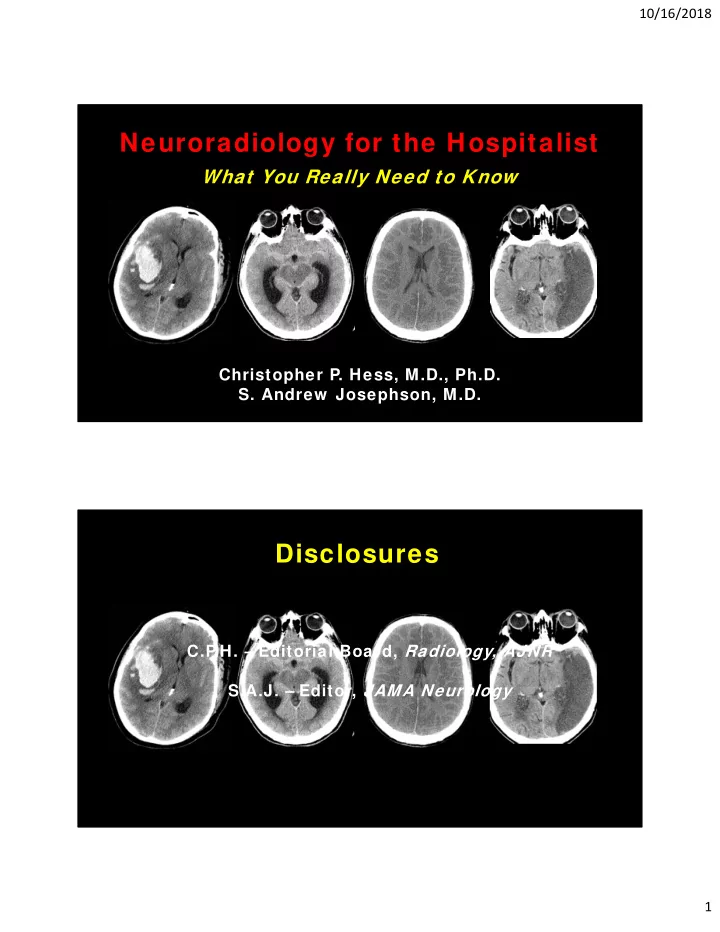
Neuroradiology for the Hospitalist
What You Really Need to Know
Christopher P. Hess, M.D., Ph.D.
- S. Andrew Josephson, M.D.
Disclosures
C.P.H. – Editorial Board, Radiology, AJNR S.A.J. – Editor, JAMA Neurology
SLIDE 2 10/16/2018 2
Goals for This Talk
- 1. Use cases to discuss best practice for use of imaging
- 2. Identify neurologic emergencies on CT
- 3. Recognize implications of imaging on management
- 4. Provide update on imaging safety – devices, contrast
Key Questions
When does your patient need imaging? Can you recognize key emergencies on CT? How should the results of imaging guide management?
SLIDE 3
10/16/2018 3
SLIDE 4 10/16/2018 4
- Hemorrhage
- Herniation
- Hydrocephalus
- Hypodensity
- Huge clot
HEAD CT: “NEURO’S CHEST X-RAY”
5 H’s
SLIDE 5 10/16/2018 5
HEAD CT INTERPRETATION 101
- Is there blood present ?
- Is the midline in the middle ?
- Does the brain look symmetric ?
- Are the ventricles and cisterns ok ?
- Can you see gray and w hite matter ?
- Is there blood present ?
- Is the midline in the middle ?
- Does the brain look symmetric ?
- Are the ventricles and cisterns ok ?
- Can you see gray and w hite matter ?
SLIDE 6 10/16/2018 6
- Is there blood present ?
- Is the midline in the middle ?
- Does the brain look symmetric ?
- Are the ventricles and cisterns ok ?
- Can you see gray and w hite matter ?
- Is there blood present ?
- Is the midline in the middle ?
- Does the brain look symmetric ?
- Are the ventricles and cisterns ok ?
- Can you see gray and w hite matter ?
SLIDE 7 10/16/2018 7
- Is there blood present ?
- Is the midline in the middle ?
- Does the brain look symmetric ?
- Are the ventricles and cisterns ok ?
- Can you see gray and w hite matter ?
- Is there blood present ?
- Is the midline in the middle ?
- Does the brain look symmetric ?
- Are the ventricles and cisterns ok ?
- Can you see gray and w hite matter ?
Can be subtle – w hich hemisphere is abnormal here?
SLIDE 8 10/16/2018 8
- Is there blood present ?
- Is the midline in the middle ?
- Does the brain look symmetric ?
- Are the ventricles and cisterns ok ?
- Can you see gray and w hite matter ?
Normal – distinct gray-w hite boundary
- Is there blood present ?
- Is the midline in the middle ?
- Does the brain look symmetric ?
- Are the ventricles and cisterns ok ?
- Can you see gray and w hite matter ?
Abnormal (anoxia) – loss
SLIDE 9
10/16/2018 9
32 year old w ith altered mental status progressing to non-responsiveness, took GHB during rave
SLIDE 10 10/16/2018 10
A 81 year old inpatient w ith longstanding severe hypertension is hospitalized for treatment of a diabetic foot ulcer. Two days into his hospitalization he develops sudden left sided w eakness.
“Classic” Hypertensive Hemorrhage Locations
- Basal ganglia
- Thalamus
- Pons
- Cerebellum
- (Lobar)
SLIDE 11
10/16/2018 11
CTA
Same history, different patient: Same history, different patient:
SLIDE 12
10/16/2018 12
Same history, different patient:
MRI
SLIDE 13
10/16/2018 13
Different patient w ith hemorrhage
A 73 year old inpatient is POD#2 from an uncomplicated total hip arthroplasty. 3 hours after last being seen normal, she is found to have difficulty speaking and right hemiparesis.
SLIDE 14
10/16/2018 14
Next Step?
SLIDE 15
10/16/2018 15
Likely outcome pre 1995:
SLIDE 16
10/16/2018 16
64 year old woman w ith vertigo, ataxia
SLIDE 17 10/16/2018 17
Go w ith Diffusion-Weighted Imaging (DWI)
CT Has Low Sensitivity for Cerebellar and Brainstem Ischemia
A 32 year old inpatient has been admitted for evaluation of 3 days of fever and altered mental
- status. He has no know n comorbidities.
SLIDE 18
10/16/2018 18
Stroke? Next Step?
SLIDE 19 10/16/2018 19
HSV-1 Meningoencephalitis
- How to make the diagnosis?
- CSF lymphocytic pleocytosis (can be normal)
- EEG (can be normal)
- MRI (can be normal)
- CSF HSV PCR
- If suspected, start IV acyclovir 10-15mg/kg q 8 hours
57 year old breast cancer patient, inpatient admission for headaches, difficulty concentrating
SLIDE 20
10/16/2018 20
Next Step?
But w ait! The patient has an ICD …
SLIDE 21
10/16/2018 21
UCSF Practice Parameters
MRI Safety - Devices
1. Pacemakers, ICDs, DBS - can be done safely using SOP 2. Coronary stents - all ok at 3T if > 6 w eeks 3. Epicardial pacer w ires - must be cut or removed 4. Aneurysm clips – usually safe (UCSF pre-1995) 5. Drug infusion pumps - usually safe follow ing SOP https://radiology.ucsf.edu/patient-care/patient-safety/
Should w e give contrast?
SLIDE 22 10/16/2018 22
When is MRI Contrast Helpful?
- Leptomeningeal disease
- Metastatic disease
- Infection or inflammatory disease
- Lesion characterization
- Certain structures, examples -
pituitary gland, cavernous sinuses, internal auditory canals
When is MRI Contrast NOT Helpful?
- Routine stroke MRI
- AMS w orkup
- MOST inpatient indications
SLIDE 23
10/16/2018 23
Risks of Gadolinium Contrast
1. Allergic reactions - 0.004 - 0.7% of patients (anaphylaxis rate 0.001 - 0.01% of patients) 2. Nephrogenic systemic fibrosis (NSF) 3. Brain stain
SLIDE 24
10/16/2018 24
Nephrogenic Systemic Fibrosis
MRI Safety - Gadolinium
Gadolinium Deposition –“Brain Stain”
MRI Safety - Gadolinium
SLIDE 25
10/16/2018 25
Management question for a subtle physical exam finding w hile you are moonlighting in the ER one day
SCOUT FROM CT SCAN
SLIDE 26 10/16/2018 26 Knife tip MCA ACA
What is the Best Next Step?
- 1. Slow ly pull out the knife
- 2. Craniotomy to remove the knife
- 3. CT study
- 4. MR study
- 5. Break the handle off the blade and leave it
SLIDE 27
10/16/2018 27
74 year-old man, suddenly unresponsive w hile on the floor getting IV antibiotics for CAP. Code called.
SLIDE 28
10/16/2018 28
DWI Predicts Outcome in Basilar Thrombosis
SLIDE 29 10/16/2018 29
Basilar Artery Thrombosis
- Carries a high mortality
- Common from cardioembolic disease or vertebral artery
dissection (in young)
- Embolectomy successful out to 12-24 hours
- CTA can identify this and other posterior circulation
- cclusions/stenoses (VBI)
- Clues on exam - vertigo or coma w ith any cranial nerve
abnormalities
64 year old woman w ith acute onset of WHOL
SLIDE 30
10/16/2018 30
SLIDE 31
10/16/2018 31
Subtle SAH – Look in Dependent Areas
SLIDE 32 10/16/2018 32
- 95-99% sensitive first 24 hrs
- 50% after 1 w eek
- 30% after 2 w eeks
- 0% after 3 w eeks
Sensitivity of Unenhanced CT
STANDARD OF CARE IS LP WHEN CT NEGATIVE
NPV 98-100%
47 year old man w ith severe headaches for 2 w eeks
SLIDE 33
10/16/2018 33
CTA negative for aneurysm…
High Density Subarachnoid
Blood Pus Tumor Granulomas Contrast
Postcon CT
SLIDE 34
10/16/2018 34
36 year-old woman admitted w ith intractable headache CEC
SLIDE 35 10/16/2018 35
Postcon Noncon
(Empty) Delta Sign
Superior Sagittal Sinus Thrombosis
Confirm w ith MRI or CTV
T1 T2
SLIDE 36 10/16/2018 36
- Control elevated ICP
- Control seizures
- Anticoagulation
- Treat primary cause: OCPs, hypercoag states
- Outcomes
- Mortality ~ 30%
- Residual deficits in ~ 30%
Venous Sinus Thrombosis - Treatment Venous Sinus Thrombosis - Outcomes
- More favorable prognosis than w ith arterial stroke
- Younger population in general
- Many deficits due to edema rather than infarction
- DWI lesions not necessarily irreversible
- Typically reimage in 3-6 months to assess extent of injury,
venous recanalization
SLIDE 37 10/16/2018 37
Deep Venous Thrombosis
Summary
- 1. Remember the 5 H’s –look outside the brain on CT
- 2. CT is the chest x-ray of neuroradiology
- 3. Few er barriers now to MRI than in the past
- 4. Think about next steps based on CT results
SLIDE 38
10/16/2018 38
THANKS
christopher.hess@ ucsf.edu andrew.josephson@ ucsf.edu