SEPSIS: Whats New in Diagnosis & Management 10.22.16 Sepsis: A - - PDF document

sepsis what s new in diagnosis management
SMART_READER_LITE
LIVE PREVIEW

SEPSIS: Whats New in Diagnosis & Management 10.22.16 Sepsis: A - - PDF document

10/22/16 Disclosures I have no conflicts of interest to disclose. SEPSIS: Whats New in Diagnosis & Management 10.22.16 Sepsis: A Core Hospitalist Dz: 22% of deaths The Case A 32-year-old man with a history of plundering &


slide-1
SLIDE 1

10/22/16 1

SEPSIS: What’s New in Diagnosis & Management

10.22.16

Disclosures

I have no conflicts of interest to disclose.

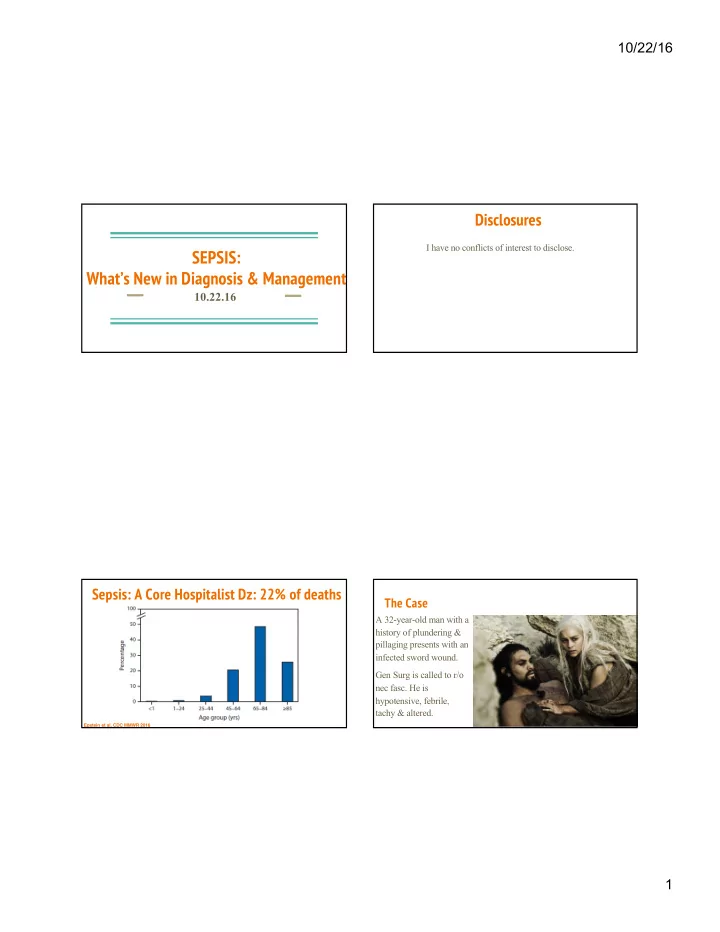
Sepsis: A Core Hospitalist Dz: 22% of deaths

Epstein et al, CDC MMWR 2016

The Case

A 32-year-old man with a history of plundering & pillaging presents with an infected sword wound. Gen Surg is called to r/o nec fasc. He is hypotensive, febrile, tachy & altered.

slide-2
SLIDE 2

10/22/16 2

How To Approach the Septic Patient Sepsis: What’s New in Diagnosis & Management

Our Roadmap for Today

  • i. Dx of Sepsis (Old & New!)
  • ii. Phases of Sepsis

Management

  • iii. 2016 Evidence-Based Sepsis

Updates

INFECTION SIRS

SEPSIS

SEVERE SEPSIS

Burns Trauma Pancreatitis Tox

How Did We Use to Define Sepsis?

§ Severity is on a spectrum § SIRS criteria: HR > 90, RR > 20 or PaCO2 < 32, WBC > 12 or < 4 or > 10 % bands, T > 38 or < 36 § Severe Sepsis = SIRS + Acute Organ Dysfunction § Septic Shock = Severe Sepsis + hypotension not reversed w/ IVF § Multi-system Organ Failure (MSOF)

slide-3
SLIDE 3

10/22/16 3

What Represents Acute Organ Dysfunction?

§ Hypotension - SBP < 90 § Hypoxemia § UOP < 0.5 mL/kg-hr § INR > 1.5 § Plt < 100k § Total Bilirubin > 4 § Lactate > 2 § New Altered Mental Status

If It Ain’t Broke, Why Fix It?

§ 19-member task force by SCCM & European Society of Intensive Care Medicine § Definitions last revised in 2001 § Non-specificity of SIRS criteria & patients with SIRS “at baseline” § New research w/ better correlations with clinical outcomes

But What About that Weird SOFA Thing?

New! But Improved?

Singer et al, JAMA 2016 From: The Third International Consensus Definitions for Sepsis and Septic Shock (Sepsis-3)

  • JAMA. 2016;315(8):801-810. doi:10.1001/jama.2016.0287

Sequential [Sepsis-Related] Organ Failure Assessment Scorea Table Title:

slide-4
SLIDE 4

10/22/16 4

Simplifying SOFA & SEPSIS-3

How do we tell if Khal Drogo Has Sepsis?

  • A. Check SIRS
  • B. Check a SOFA
  • C. Check qSOFA
  • D. It depends on where he

is . . .

H ypotension A ltered mental status T achypnea

slide-5
SLIDE 5

10/22/16 5

Singer et al, JAMA 2016

How the Founders Intended Its Use . . . Difference Between The Sepses (?) Power of Δ SOFA

Jones et al, Crit Care Med 2009

§ ΔSOFA from HD1 to HD3 § If you get sicker . . .

§ 12% of ICU patients have 0 SIRS criteria § In ICU patients with suspected infection, SOFA (AUROC = 0.74; 95% CI, 0.73-0.76) was superior to SIRS (AUROC = 0.64) for predicting hospital mortality § AUROC ~ Email spam filter

Show me the Data!

Kaukonen et al, NEJM 2015

slide-6
SLIDE 6

10/22/16 6

Most Powerful Statement.

“Patients with a SOFA score of 2 or more had an overall mortality risk of approximately 10% in a general hospital population with presumed infection. This is greater than the overall mortality rate of 8.1% for ST-segment elevation myocardial infarction.”

Take Home Points: Dx of Sepsis

§ Sepsis-3 defined new diagnostic criteria but uses TBD . . . § Remember qSOFA (BP, AMS, Tachypnea) in non-ICU § SOFA score helps prognosticate mortality in ICU – ΔSOFA > 2? § No more severe sepsis in the new criteria but still think of

  • rgan dysfunction

§ Not yet endorsed by ATS, ACEP, Medicare, and more . . .

Sepsis: What’s New in Diagnosis & Management

Our Roadmap for Today

  • i. Dx of Sepsis (Old & New!)
  • ii. Phases of Sepsis

Management

  • iii. 2016 Evidence-Based Sepsis

Updates

Phase 1 (Hours 0 – 6): Early Dx & Proactive Stabilization

q Early recognition (with our detection tools) q Adjunctive diagnostic measures (such as lactate) q Early IV fluids q Early broad-spectrum antibiotics q Vasopressors if unresponsive to fluids q Central access if you need vasopressors
slide-7
SLIDE 7

10/22/16 7

Sepsis Presents Atypically!

q Elderly q ESRD on HD q HIV q Immunocompromised q Transplant pts

Initial Lactate Level & 28-day Mortality

Non-Shock Shock Low 8.7 15.4 Intermediate 16.4 37.3 High 31.8 46.9 10 20 30 40 50 28-day mortality (%)

Mikkelsen et al, Crit Care Med 2009

slide-8
SLIDE 8

10/22/16 8

“Dynamic Empiricism” and our EMR

Phase 2 (Hours 6-24): Finding the Source of Sepsis

q It all starts with a careful history & physical! q Consider blood, urine, sputum, stool cx (depending) q Always do basic imaging (CXR, bedside U/S/TTE) q Consider advanced imaging (CT Head, Abdomen/Pelvis, Lower Extremities) q Consider advanced dx procedures (LP, bronch, etc)

DDx: Dr. Jen Babik’s Head-to-Toe Approach

  • Nosocomial meningitis

(post-NSG) CNS

  • Nosocomial Sinusitis
  • Hospital-acquired URI

HEENT

  • Hospital-acquired PNA
  • Empyema
  • ARDS

Pulmonary

  • Endocarditis
  • Pericarditis

Cardiac

  • C. Difficile
  • CA-UTI
  • Abdominal abscess
  • Peritonitis
  • Acalculous cholecystitis
  • Pancreatitis

GI/GU

  • Osteomyelitis
  • Septic arthritis
  • Gout

MSK

  • Cellulitis at line sites
  • Infected decub ulcer
  • Surgical site infection

Skin

  • CRBSI
  • Candidemia

Bloodstream

  • Drug Fever
  • Central fever
  • DVT/PE
  • Malignancy
  • Rheumatologic
  • Post-op fever
  • Transfusion reaction
  • Transplant rejection
  • Adrenal insufficiency

Other non- infectious etiologies

slide-9
SLIDE 9

10/22/16 9

What Might Khal Drogo Have Besides Sepsis?

  • A. Cardiogenic shock
  • B. Hypovolemic shock
  • C. Acute liver failure
  • D. Aortic dissection
  • E. All of the Above

ALWAYS Consider Mimics of Septic Shock!

q

Cardiogenic shock

q

Hypovolemia/Blood loss

q

Pulmonary embolism

q

Myxedema coma

q

Toxidromes

q

Acute liver failure

q Cardiac Tamponade q Acute valvular dysfxn q Aortic Dissection q Anaphylaxis q Adrenal crisis q HLH q And more!

Phase 3 (1-3d): Narrowing Focus, Limiting Iatrogenesis

q Narrow Abx based on cx data (esp Vanco!) q Consider diuresis to counteract your flooding q Limit ICU Harms: PT/OT, Delirium, De-Line q Recognize differing trajectories of illness

Skrupsky et al, Anesthesiology 2011

slide-10
SLIDE 10

10/22/16 10

Take Home Points: Rx of Sepsis

§ Early diagnostics (including lactate) & resuscitation matter § Hunt aggressively for the source – step-wise approach § Think head-to-toe and consider septic shock mimics § Harness the power of the EHR to identify sepsis, but remember limitations § Recognize different clinical trajectories of sepsis

Sepsis: What’s New in Diagnosis & Management

Our Roadmap for Today

  • i. Dx of Sepsis (Old & New!)
  • ii. Phases of Sepsis

Management

  • iii. 2016 Evidence-Based Sepsis

Updates

But What About that Weird SOFA Thing? Graveyard of Missed Deadlines

slide-11
SLIDE 11

10/22/16 11

Graveyard of Sepsis Therapies

EGDT ‘ROIDS

XIGRIS

The “Old” Way

§ RCT of early goal directed therapy (EGDT) versus standard

  • f care

§ Mortality was primary outcome § There was a 15% absolute risk reduction in mortality § Issues: Conflict-of-interest, heavy ED influence, high baseline mortality, & many more!

“New” Era: ProCESS, ARISE & ProMISe

§ No significant difference in the 90-day mortality between the EGDT and usual care groups (29.5% vs 29.2%, p=0.90), despite EGDT having (in first 6 hours): u Higher rate of vasopressors u More RBC transfusions u More IVF fluids

ProMISE, NEJM 2015

“New” Era: ProCESS, ARISE & ProMISe

ARISE, NEJM 2014

slide-12
SLIDE 12

10/22/16 12

“New” Era: ProCESS, ARISE & ProMISe

ProCESS, NEJM 2014

Take Home Points from This Trifecta

§ Strict protocol for EGDT did not lead to improved outcomes § Increased costs with EGDT protocol § All patients basically got Abx + 2 L IVF pre-randomization, suggesting usual care has changed since Rivers § Only 50% got central lines in usual care group

Do Steroids Work For Septic Shock? (Redux)

Keh et al, JAMA 2016

§ Randomized patients to continuous infusion of 200 mg of hydrocortisone for 5 days + taper to d11 vs placebo § Goal was to prevent severe sepsis à septic shock

Levosimendan for Septic Shock

Gordon et al, NEJM 2016

§ LeoPARDS RCT double blind placebo-controlled trial of this Ca-sensitizer § Not currently licensed in the USA § No difference in mean SOFA score or mortality

slide-13
SLIDE 13

10/22/16 13

Graveyard of Sepsis Therapies

EGDT ‘ROIDS

XIGRIS

Under-the-Radar Trial: Tylenol for Fever in the ICU

§ Well-designed RCT! § No reduction in mortality or LOS § Trial was of IV Tylenol, of note § Treat for comfort

Young et al, NEJM 2015

Which Tool Will Best Predict His Response to Fluids?

  • A. Passive Leg Raise
  • B. CVP
  • C. A-line PPV
  • D. IVC U/S
  • E. None of the above

Will My Hemodynamically Unstable Pt Respond to IVF?

§ Passive leg raise vs CVP vs A-line PPV vs IVC U/S § No reduction in mortality or LOS § Trial was of IV Tylenol, of note § Treat for comfort

Bentzer et al, JAMA 2016

slide-14
SLIDE 14

10/22/16 14

Procalcitonin Testing in the ICU

§ Retrospective study of matched 1:3 cases (~33K:99K) pts w/ ICU day 1 PCT testing vs no PCT testing § Decreased hospital LOS, ICU LOS, lower hospital costs, lower Abx days § No mortality difference § $81 per test difference in cost

Balk et al, Chest 2016

Take Home Points: New Trials

§ More trials for the sepsis graveyard – EGDT, steroids § Treat fevers in the ICU for comfort § Some high-tech (procalcitonin) & low-tech (leg raise) dx for sepsis § More literature on sepsis management controversies

Sepsis: What’s New in Diagnosis & Management

Our Roadmap for Today

  • i. Dx of Sepsis (Old & New!)
  • ii. Phases of Sepsis

Management

  • iii. 2016 Evidence-Based Sepsis

Updates

Thank You! Questions?

Lekshmi.Santhosh@ucsf.edu