Neurofeedback Neurofeedback : : Objectives and Disclosure What is - - PDF document

neurofeedback
SMART_READER_LITE
LIVE PREVIEW

Neurofeedback Neurofeedback : : Objectives and Disclosure What is - - PDF document

APNA 29th Annual Conference Session 4023: October 31, 2015 Neurofeedback Neurofeedback : : Objectives and Disclosure What is It? What is It? Describe how neurofeedback works through neuroplasticity and How to Use It as an Integral How to


slide-1
SLIDE 1

APNA 29th Annual Conference Session 4023: October 31, 2015 Bindewald 1

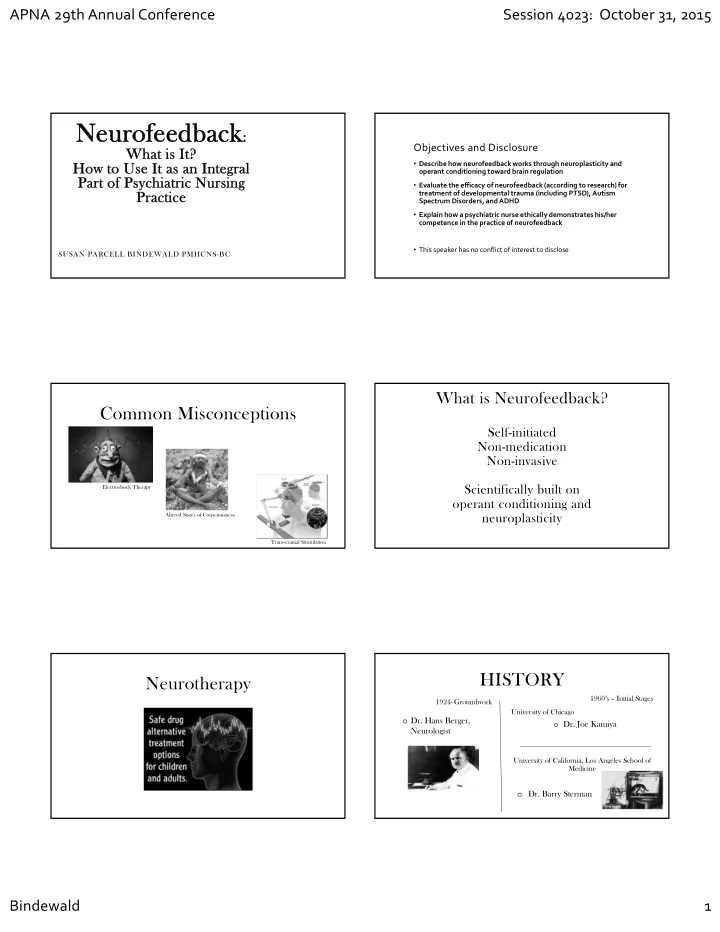
Neurofeedback Neurofeedback:

: What is It? What is It? How to Use It as an Integral How to Use It as an Integral Part of Psychiatric Part of Psychiatric Nursing Nursing Practice Practice

SUSAN PARCELL BINDEWALD PMHCNS-BC

Objectives and Disclosure

  • Describe how neurofeedback works through neuroplasticity and
  • perant conditioning toward brain regulation
  • Evaluate the efficacy of neurofeedback (according to research) for

treatment of developmental trauma (including PTSD), Autism Spectrum Disorders, and ADHD

  • Explain how a psychiatric nurse ethically demonstrates his/her

competence in the practice of neurofeedback

  • This speaker has no conflict of interest to disclose

Common Misconceptions

Electroshock Therapy Altered States of Consciousness Trans-cranial Stimulation

What is Neurofeedback?

Self-initiated Non-medication Non-invasive Scientifically built on

  • perant conditioning and

neuroplasticity

Neurotherapy HISTORY

1960’s – Initial Stages University of Chicago

  • Dr. Joe Kamiya

University of California, Los Angeles School of Medicine

  • Dr. Barry Sterman

1924- Groundwork

  • Dr. Hans Berger,

Neurologist

slide-2
SLIDE 2

APNA 29th Annual Conference Session 4023: October 31, 2015 Bindewald 2

Why Have I Not Heard of Neurotherapy?

  • “Neurofe

feedba back has has be been said said to be to be possib possibly ly the big- the big- gest gest br breakt eakthr hrough in in non- non- invas invasive me medic dicine ne in in the the past fifty past fifty years” years”

  • (E

(Eduardo ardo C Castro, stro, M.D., N D., Neurolo urologist a ist and Robert bert W

  • W. H

Hill, ll, PhD, D, Psyc Psychologist, Healing Y aling Young B ung Brains ns – The N Neurofeedba eedback ck Sol Solution, 2009). 2009).

FRANK DUFFY, HARVARD UNIVERSITY NEUROLOGIST

“The literature, which lacks any negative study, suggests that NFB plays a major therapeutic role in many different areas. In my opinion, if any medication had demonstrated such a wide spectrum of efficacy it would be universally accepted and widely used.”

TH THOMAS IN INSEL, L, DIRECTOR OF NIMH DIRECTOR OF NIMH

Ther There must must be “a retu be “a return to unde to understanding min mind and and brain brain in terms in terms of rh

  • f rhyth

ythms and and patter patterns of ns of elec electri trical communi communicati tion” 2010. ” 2010. NI NIMH MH has reo has reoriented its res its research ch and and is is focus focused

  • n
  • n “diso

“disorders rs of

  • f the human connec

the human connecto tome” me” (int (interconnected netw network of k of neur neurons in s in the the brai brain) 2013. 2013.

Chemical vs. Electrical

“Medicine Man,” Daniel Goldstein Neural Pathways

BESSEL BESSEL VAN VAN DER KOLK, DER KOLK, M.D. M.D.

Harv Harvard ard Psychia Psychiatrist and Trauma rist and Trauma Expert Expert

  • Drugs do not change fundamental brain activity

and medications work only as long as the patient takes them.

  • In the case of ADHD and other disorders, NFB

allows the brain to train to produce different patterns of electrical communication, so after a standard course of treatment, no further drug or

  • ther therapy may be needed.

BCIA CREDENTIALING

What are the BCIA requirements?

  • 36 Didactic hours of

course work

  • 10 sessions of personal

training

  • 100 client sessions
  • 10 case conference

presentations

  • Written certification exam
slide-3
SLIDE 3

APNA 29th Annual Conference Session 4023: October 31, 2015 Bindewald 3

NEUROTHERAPY CONSIDERATIONS

Is Cost Prohibitive?

  • For Clinicians
  • For Clients

Time Considerations Client Expectations

Who Can Benefit From NFB? EVERYONE!

Who? Everyone? Well, almost . . .

  • “When I train others in learning to do 19-channel z-scored NFB, I

really emphasize this need and the discipline required not to ‘chase’ any dysregulations post hoc just because, like Mt. Everest, they are

  • there. When we form hypotheses first, and we find that when the

dysregulations match the hypotheses (and therefor the symptoms), neurotherapy is successful 98% of the time. By "we" I mean the team at

  • ur practice, which includes many specialists”.
  • William Lambos PhD Licensed Neurosychologist BCN also noted that

about 12% of people (after informed screening and/assessment) should not be treated with NFB. July 24, 2015 Email Communication

What About . . .

  • Organic Brain Disorders
  • Parkinson’s, Dementia (e.g.: Alzheimer's)
  • Benzodiazepines
  • Xanax, Valium, Restoril, Klonopin
  • Ongoing Substance Abuse
  • Marijuana, Alcohol, Heroin

Developmental Trauma – Calming the Fear-Driven Brain . . . Using Neurotherapy

Post Traumatic Stress Disorder

slide-4
SLIDE 4

APNA 29th Annual Conference Session 4023: October 31, 2015 Bindewald 4

1 in 1 in Every 68 Children in America meet Every 68 Children in America meet Criteria for Autis Criteria for Autism Spectrum Spectrum Dis Disorders rders

NFB and Autism

http://www.youtube.com/watch?v=qiHFI36wmzo

Substance Addictions

ADHD AND AND LEARNING PROBLEMS

“In five studies NFB has been found to result in sustained benefits when reassessed even up to two years after the end of treatment and these findings are in stark contrast to the lack of sustained benefit from either behavior therapy or stimulant medication as documented in the MTA Cooperative study” (Pigott et. al., 2013).

ADHD

  • NFB was considered a “Level 1” treatment for ADHD by the

American Academy of Pediatrics (AAP): This is “resting on a thirty plus year history of scientific research and clinical success in attentional dysfunctions (Cantor & Evans, 2013).”

  • “Research has commonly shown that with ongoing practice

sessions approximately 75-80% of persons can retrain how the brain is functioning producing significant improvements in a wide range of conditions, such as: ADH ADHD, learning disabilities, anxie anxiety, depression, head injuries, insomnia, autis autism, and addiction” (Hammond, 2011).

NFB: Level 5 Efficacy

slide-5
SLIDE 5

APNA 29th Annual Conference Session 4023: October 31, 2015 Bindewald 5

Inter-Session Reports Alex, Age 10

PRE AND POST QEEG “BRAIN MAP”

REFERENCES

Cantor, D. S., & Evans, J. R. (2013). Clinical neurotherapy: Application of techniques for treatment (1st ed.). Oxford, UK: Academic Press Fisher, S. (2014). Neurofeedback in the treatment of developmental trauma: Calming the fear-driven brain.

  • W. W. Norton & Company.

Hammond, D.C., (2011). What is neurofeedback: An update. Journal of neurotherapy, 15, 305-336. Myers, J., & Young, J. (2012). Brain wave biofeedback: Benefits of integrating neurofeedback in

  • counseling. Journal of Counseling and Development, 90(1), 20-28. doi: 10.1111/j.1556-

6676.2012.00003.x Pigott, H. E., De Baise, E., Bodenhamer, E., & Davis, R. The Evidence-Base for Neurofeedback as a Reimbursable Healthcare Service to Treat Attention Deficit/Hyperactivity Disorder. Sherlin, L., Arns, M., Lubar, J., & Estate, S. (2010). A position paper on neurofeedback for the treatment

  • f ADHD. Journal of Neurotherapy, 14(2), 66-78. doi: 10.1080/10874201003773880

Kolk, B. (2014). The body keeps the score: Brain, mind, and body in the healing of trauma. Viking.

REFERENCES

Images: http://www.nature.org/newsfeatures/specialfeatures/animals/amphibians/strawberry- poison-dart-frog.xml http://homeopaticka-poradna.czweb.org/ http://www.horrorphile.net/mary-and-max/ http://hartleyfoundation.org/biofeedback-yoga-west http://www.drchugh.com/rtms.html http://www.futuredude.com/sci-fi-made-real-is-matt-damons-exosuit-in-elysium-possible/ http://www.usgwarchives.net/pa/blair/1picts/davis/freight-train.jpg http://www.forbes.com/sites/ashoka/2013/04/25/co-creating-our-future-one-big-idea-at-a-time/ http://www.eeginfo.com/newsletter/?p=367 http://sleeptechstudy.wordpress.com/2013/05/13/the-international-1020-system-of-electrode- placement/ http://www.vcstar.com/news/2008/feb/28/art-vs-aids-fowler-exhibit-examines-how- artists/? printer=1%2F http://www.aamsco.com/solutions/light-bulbs/thomas-edison/ http://www.olyfloat.com/benefits/meditation-creativity/

REFERENCES

Images: http://www.adhdsolutions.co.za/what-is-neurofeedback http://www.brainmaster.com/content-sub/discovery-24e/ http://www.patientsleepsupplies.com/Ten20-Conductive-Paste-4-

  • z..html?m1track=googlebase&gclid=CI2x_JPb27wCFY1QOgoduDIALg#googlebase

http://www.eeginfo.com/shop/product_info.php/cPath/55_60/products_id/245?osCsid=c3b03 9588c80f6a4a9ff6de28500350a https://www.cchrint.org/2013/11/25/with-nearly-5-million-u-s-children-on-adhd-drugs-doctors- finally-express-concern/ http://www.homecoming4veterans.org/ http://braintreatmentcenter.asia/english/autism/arts/EEG_findings_in_autism.jpg http://www.eeginfo.com/qiktest/ http://ptsdusa.org/what-is-ptsd/the-statistics/ http://www.aap.org/en-us/advocacy-and-policy/aap-health-initiatives/Mental-Health/ Documents/CRPsychosocialInterventions.pdf http://aspiringmormonwomen.org/2013/10/09/unmet-expectations/ https://onechildvstheworld.files.wordpress.com/2013/10/brain-and-learning.jpg Video: http://neurofeedback2015.kajabi.com/fe/79711‐rewiring‐the‐brain‐free‐ce‐seminar