Network Layer Goals: Overview: understand principles last time - - PDF document

network layer
SMART_READER_LITE
LIVE PREVIEW

Network Layer Goals: Overview: understand principles last time - - PDF document

Network Layer Goals: Overview: understand principles last time behind network layer network layer services services: virtual circuit and datagram forwarding networks routing (path selection) whats inside a router?


slide-1
SLIDE 1

1

23/4-07 Datakommunikation - Jonny Pettersson, UmU

Network Layer

Goals:

understand principles

behind network layer services:

forwarding routing (path selection) dealing with scale how a router works advanced topics: IPv6,

multicast instantiation and

implementation in the Internet

Overview:

last time

network layer services virtual circuit and datagram

networks

what’s inside a router? IP: Internet Protocol

today

routing algorithms

  • Link state
  • Distance Vector
  • Hierarchical routing

routing in the Internet

  • RIP
  • OSPF
  • BGP

broadcast and multicast

routing

23/4-07

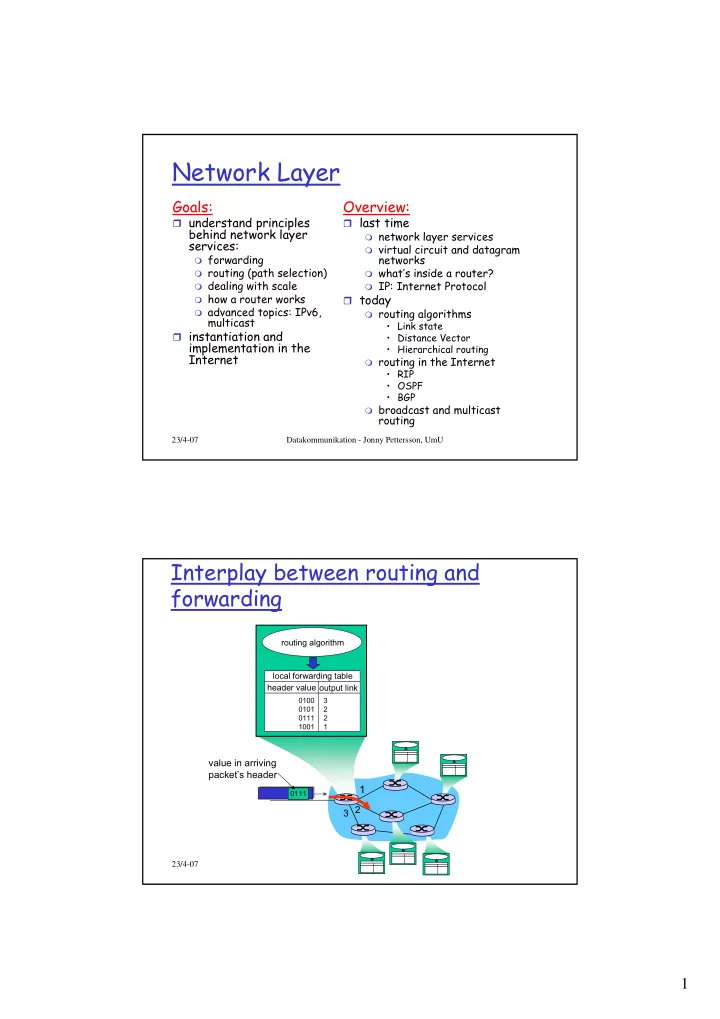
1

2 3

0111

value in arriving packet’s header

routing algorithm local forwarding table header value output link

0100 0101 0111 1001 3 2 2 1

Interplay between routing and forwarding

slide-2
SLIDE 2

2

23/4-07 Datakommunikation - Jonny Pettersson, UmU

u y

x

w v

z

2 2 1 3 1 1 2 5 3 5 Graph: G = (N,E) N = set of routers = { u, v, w, x, y, z } E = set of links ={ (u,v), (u,x), (u,w), (v,x), (v,w), (x,w), (x,y), (w,y), (w,z), (y,z) }

Graph abstraction

Remark: Graph abstraction is useful in other network contexts Example: P2P, where N is set of peers and E is set of TCP connections

23/4-07 Datakommunikation - Jonny Pettersson, UmU

Graph abstraction: costs

u y

x

w v

z

2 2 1 3 1 1 2 5 3 5

  • c(x,x’) = cost of link (x,x’)
  • e.g., c(w,z) = 5
  • cost could always be 1, or

inversely related to bandwidth,

  • r inversely related to

congestion Cost of path (x1, x2, x3,…, xp) = c(x1,x2) + c(x2,x3) + … + c(xp-1,xp) Question: What’s the least-cost path between u and z ?

Routing algorithm: algorithm that finds least-cost path

slide-3
SLIDE 3

3

23/4-07 Datakommunikation - Jonny Pettersson, UmU

Routing Algorithm classification

Global or decentralized information?

Global:

all routers have complete

topology, link cost info

“link state” algorithms

Decentralized:

router knows physically-

connected neighbors, link costs to neighbors

iterative process of

computation, exchange of info with neighbors

“distance vector” algorithms

Static or dynamic?

Static:

routes change slowly

  • ver time

Dynamic:

routes change more

quickly

periodic update in response to link

cost changes

23/4-07 Datakommunikation - Jonny Pettersson, UmU

Link State

Förutsättning

Varje nod kan kolla om närmsta granne är

uppe/nere och kan kostnaden för varje länk Basidé

Alla noder vet hur de ska nå närmsta granne, låt

alla veta det (alla får komplett bild)

Beror av två mekanismer

  • Tillförlitlig spridning av link-state information
  • Beräkning av vägar från summan av all ackumulerad

information

slide-4
SLIDE 4

4

23/4-07 Datakommunikation - Jonny Pettersson, UmU

A Link-State Routing Algorithm

Dijkstra’s algorithm

net topology, link costs

known to all nodes

accomplished via “link

state broadcast”

all nodes have same info

computes least cost paths

from one node (‘source”) to all other nodes

gives forwarding table

for that node

iterative: after k

iterations, know least cost path to k dest.’s

Notation:

c(x,y): link cost from node x to y; = ∞ if not direct neighbors D(v): current value of cost

  • f path from source to
  • dest. v

p(v): predecessor node along path from source to v N': set of nodes whose least cost path definitively known

23/4-07 Datakommunikation - Jonny Pettersson, UmU

Dijsktra’s Algorithm

1 Initialization: 2 N' = {u} 3 for all nodes v 4 if v adjacent to u 5 then D(v) = c(u,v) 6 else D(v) = ∞ 7 8 Loop 9 find w not in N' such that D(w) is a minimum 10 add w to N' 11 update D(v) for all v adjacent to w and not in N' : 12 D(v) = min( D(v), D(w) + c(w,v) ) 13 /* new cost to v is either old cost to v or known 14 shortest path cost to w plus cost from w to v */ 15 until all nodes in N' u y

x

w v

z

2 2 1 3 1 1 2 5 3 5

slide-5
SLIDE 5

5

23/4-07 Datakommunikation - Jonny Pettersson, UmU

Forward Search Algorithm

Två listor – bekräftade (C) och möjliga (T)

  • 1. Confirm = {s}
  • 2. Kalla senaste till C adderade nod NEXT
  • 3. För varje granne till NEXT beräkna kostnaden som summan

av kostnaden från s till NEXT och NEXT till granne (a) Om grannen ej finns i C eller T, lägg i T (b) Om grannen finns i T och den nya kostnaden är lägre, uppdatera

  • 4. Om T är tom avbryt, annars ta den med lägst kostnad i T och

flytta till C samt hoppa till 2 Exempel på tavlan

23/4-07 Datakommunikation - Jonny Pettersson, UmU

Dijkstra’s algorithm, discussion

Algorithm complexity: n nodes

each iteration: need to check all nodes, w, not in N n(n+1)/2 comparisons: O(n2) more efficient implementations possible: O(nlogn)

Oscillations possible:

e.g., link cost = amount of carried traffic A D C B

1 1+e e e 1 1

A D C B

2+e 1+e 1

A D C B

2+e 1+e 1 0 0

A D C B

2+e e 1+e 1

initially … recompute routing … recompute … recompute

slide-6
SLIDE 6

6

23/4-07 Datakommunikation - Jonny Pettersson, UmU

Distance Vector Algorithm (1)

Bellman-Ford Equation Define dx(y) := cost of least-cost path from x to y Then dx(y) = min {c(x,v) + dv(y) } where min is taken over all neighbors of x

23/4-07 Datakommunikation - Jonny Pettersson, UmU

Bellman-Ford example (2)

u y

x

w v

z

2 2 1 3 1 1 2 5 3 5

Clearly, dv(z) = 5, dx(z) = 3, dw(z) = 3 du(z) = min { c(u,v) + dv(z), c(u,x) + dx(z), c(u,w) + dw(z) } = min {2 + 5, 1 + 3, 5 + 3} = 4 Node that achieves minimum is next hop in shortest path ➜ forwarding table B-F equation says:

slide-7
SLIDE 7

7

23/4-07 Datakommunikation - Jonny Pettersson, UmU

Distance Vector Algorithm (3)

Dx(y) = estimate of least cost from x to y Distance vector: Dx = [Dx(y): y є N ] Node x knows cost to each neighbor v:

c(x,v)

Node x maintains Dx = [Dx(y): y є N ] Node x also maintains its neighbors’

distance vectors

For each neighbor v, x maintains

Dv = [Dv(y): y є N ]

23/4-07 Datakommunikation - Jonny Pettersson, UmU

Distance vector algorithm (4)

Basic idea:

Each node periodically sends its own distance

vector estimate to neighbors

When a node x receives new DV estimate from

neighbor, it updates its own DV using B-F equation: Dx(y) ← minv{c(x,v) + Dv(y)} for each node y ∊ N

Under minor, natural conditions, the estimate Dx(y)

converge to the actual least cost dx(y)

slide-8
SLIDE 8

8

23/4-07 Datakommunikation - Jonny Pettersson, UmU

Distance Vector Algorithm (5)

Iterative, asynchronous:

each local iteration caused by:

local link cost change DV update message from

neighbor

Distributed:

each node notifies

neighbors only when its DV changes

neighbors then notify

their neighbors if necessary

wait for (change in local link

cost or msg from neighbor)

recompute estimates

if DV to any dest has changed, notify neighbors

Each node:

Exempel på tavlan

23/4-07 Datakommunikation - Jonny Pettersson, UmU

Distance Vector: link cost changes

Link cost changes:

node detects local link cost change updates routing info, recalculates

distance vector

if DV changes, notify neighbors

“good news travels fast”

x z

1 4 50

y

1 At time t0, y detects the link-cost change, updates its DV, and informs its neighbors. At time t1, z receives the update from y and updates its table. It computes a new least cost to x and sends its neighbors its DV. At time t2, y receives z’s update and updates its distance table. y’s least costs do not change and hence y does not send any message to z.

slide-9
SLIDE 9

9

23/4-07 Datakommunikation - Jonny Pettersson, UmU

Distance Vector: link cost changes

Link cost changes:

good news travels fast bad news travels slow -

“count to infinity” problem!

44 iterations before

algorithm stabilizes: see text

Poissoned reverse:

If Z routes through Y to

get to X :

Z tells Y its (Z’s) distance

to X is infinite (so Y won’t route to X via Z) will this completely solve

count to infinity problem? x z

1 4 50

y

60

23/4-07 Datakommunikation - Jonny Pettersson, UmU

Comparison of LS and DV algorithms

Message complexity

LS: with n nodes, E links,

O(nE) msgs sent

DV: exchange between

neighbors only

convergence time varies

Speed of Convergence

LS: O(n2) algorithm requires

O(nE) msgs

may have oscillations

DV: convergence time varies

may be routing loops count-to-infinity problem

Robustness: what happens if router malfunctions? LS:

node can advertise

incorrect link cost

each node computes only

its own table

DV:

DV node can advertise

incorrect path cost

each node’s table used by

  • thers
  • error propagate thru

network

slide-10
SLIDE 10

10

23/4-07 Datakommunikation - Jonny Pettersson, UmU

Distance Vector - Link State

Link State

Alla pratar med alla Berättar bara om sina egna länkar

Distance Vector

Varje nod pratar endast med närmsta granne Berättar allt den vet

23/4-07 Datakommunikation - Jonny Pettersson, UmU

Hierarchical Routing

scale: with 200 million destinations:

can’t store all dest’s in

routing tables!

routing table exchange

would swamp links!

administrative autonomy

internet = network of

networks

each network admin may

want to control routing in its

  • wn network

Our routing study thus far - idealization

all routers identical network “flat”

… not true in practice

slide-11
SLIDE 11

11

23/4-07 Datakommunikation - Jonny Pettersson, UmU

Hierarchical Routing

aggregate routers into

regions, “autonomous systems” (AS)

routers in same AS run

same routing protocol

“intra-AS” routing

protocol

routers in different AS

can run different intra- AS routing protocol

Gateway router

Direct link to router in

another AS

23/4-07 Datakommunikation - Jonny Pettersson, UmU

3b 1d 3a 1c 2a AS3 AS1

AS2

1a 2c 2b 1b

Intra-AS Routing algorithm Inter-AS Routing algorithm

Forwarding table

3c

Interconnected ASes

Forwarding table is

configured by both intra- and inter-AS routing algorithm

Intra-AS sets entries

for internal dests

Inter-AS & Intra-As

sets entries for external dests

slide-12
SLIDE 12

12

23/4-07 Datakommunikation - Jonny Pettersson, UmU

3b 1d 3a 1c 2a AS3 AS1

AS2

1a 2c 2b 1b 3c

Inter-AS tasks

Suppose router in AS1

receives datagram for which dest is outside

  • f AS1

Router should forward

packet towards one of the gateway routers, but which one?

AS1 needs:

1.

to learn which dests are reachable through AS2 and which through AS3

  • 2. to propagate this

reachability info to all routers in AS1 Job of inter-AS routing! Hot potato routing

23/4-07 Datakommunikation - Jonny Pettersson, UmU

Routing in the Internet

The Global Internet consists of Autonomous Systems

(AS) interconnected with each other:

Stub AS: small corporation Multihomed AS: large corporation (no transit) Transit AS: provider

Two-level routing:

Intra-AS: administrator is responsible for choice Inter-AS: unique standard

slide-13
SLIDE 13

13

23/4-07 Datakommunikation - Jonny Pettersson, UmU

Intra-AS Routing

Also known as Interior Gateway Protocols (IGP) Most common Intra-AS routing protocols:

RIP: Routing Information Protocol OSPF: Open Shortest Path First IGRP: Interior Gateway Routing Protocol (Cisco

proprietary)

23/4-07 Datakommunikation - Jonny Pettersson, UmU

RIP (Routing Information Protocol)

Distance vector algorithm Included in BSD-UNIX Distribution in 1982 Distance metric: # of hops (max = 15 hops) Distance vectors: exchanged every 30 sec via

Response Message (also called advertisement)

Each advertisement: route to up to 25 destination

nets

RIP v1 RFC 1058 RIP v2 RFC 2453

slide-14
SLIDE 14

14

23/4-07 Datakommunikation - Jonny Pettersson, UmU

RIP: Example

Destination Network Next Router Num. of hops to dest.

w A 2 y B 2 z B 7 x

  • 1

…. …. ....

w x y z A C D B

Routing table in D

23/4-07

RIP: Example

Destination Network Next Router Num. of hops to dest.

w A 2 y B 2 z B A 7 5 x

  • 1

…. …. ....

Routing table in D

w x y z A C D B

Dest Next hops w

  • x
  • z

C 4 …. … ...

Advertisement from A to D

slide-15
SLIDE 15

15

23/4-07 Datakommunikation - Jonny Pettersson, UmU

RIP: Link Failure and Recovery

If no advertisement heard after 180 sec --> neighbor/link declared dead

routes via neighbor invalidated new advertisements sent to neighbors neighbors in turn send out new advertisements (if

tables changed)

link failure info quickly propagates to entire net poison reverse used to prevent ping-pong loops

(infinite distance = 16 hops)

23/4-07 Datakommunikation - Jonny Pettersson, UmU

RIP Table processing

RIP routing tables managed by application-level

process called route-d (daemon)

advertisements sent in UDP packets, periodically

repeated

physical link network forwarding (IP) table Transprt (UDP) routed physical link network (IP) Transprt (UDP) routed forwarding table

slide-16
SLIDE 16

16

23/4-07 Datakommunikation - Jonny Pettersson, UmU

OSPF (Open Shortest Path First)

“open”: publicly available, v2 RFC 2178 Uses Link State algorithm

LS packet dissemination Topology map at each node Route computation using Dijkstra’s algorithm

OSPF advertisement carries one entry per neighbor

router

Advertisements disseminated to entire AS (via

flooding)

Carried in OSPF messages directly over IP (rather than TCP

  • r UDP

23/4-07 Datakommunikation - Jonny Pettersson, UmU

OSPF “advanced” features (not in RIP)

Security: all OSPF messages authenticated (to

prevent malicious intrusion)

Multiple same-cost paths allowed (only one path in

RIP)

For each link, multiple cost metrics for different

TOS (e.g., satellite link cost set “low” for best effort; high for real time)

Integrated uni- and multicast support:

Multicast OSPF (MOSPF) uses same topology data

base as OSPF

Hierarchical OSPF in large domains.

slide-17
SLIDE 17

17

23/4-07 Datakommunikation - Jonny Pettersson, UmU

Hierarchical OSPF

Two-level hierarchy:

local area, backbone

Link-state

advertisements only in area

each nodes has

detailed area topology; only know direction (shortest path) to nets in other areas.

Area border routers:

“summarize” distances to nets in

  • wn area, advertise to other Area

Border routers.

Backbone routers: run OSPF

routing limited to backbone.

Boundary routers: connect to

  • ther ASs.

23/4-07 Datakommunikation - Jonny Pettersson, UmU

IGRP (Interior Gateway Routing Protocol)

CISCO proprietary; successor of RIP (mid 80s) Distance Vector, like RIP several cost metrics (delay, bandwidth, reliability,

load etc)

uses TCP to exchange routing updates Loop-free routing via Distributed Updating Alg.

(DUAL)

slide-18
SLIDE 18

18

23/4-07 Datakommunikation - Jonny Pettersson, UmU

Internet inter-AS routing: BGP

BGP (Border Gateway Protocol): the de

facto standard

BGP provides each AS a means to:

  • 1. Obtain subnet reachability information from

neighboring ASs.

  • 2. Propagate the reachability information to all

routers internal to the AS.

  • 3. Determine “good” routes to subnets based on

reachability information and policy. Allows a subnet to advertise its existence

to rest of the Internet: “I am here”

23/4-07 Datakommunikation - Jonny Pettersson, UmU

BGP basics

Pairs of routers (BGP peers) exchange routing info over semi-

permanent TCP connections: BGP sessions

Note that BGP sessions do not correspond to physical links. When AS2 advertises a prefix to AS1, AS2 is promising it will

forward any datagrams destined to that prefix towards the prefix.

AS2 can aggregate prefixes in its advertisement

3b 1d 3a 1c 2a AS3 AS1

AS2

1a 2c 2b 1b 3c

eBGP session iBGP session

slide-19
SLIDE 19

19

23/4-07 Datakommunikation - Jonny Pettersson, UmU

Distributing reachability info

With eBGP session between 3a and 1c, AS3 sends prefix

reachability info to AS1.

1c can then use iBGP do distribute this new prefix reach info

to all routers in AS1

1b can then re-advertise the new reach info to AS2 over the

1b-to-2a eBGP session

When router learns about a new prefix, it creates an entry

for the prefix in its forwarding table. 3b 1d 3a 1c 2a AS3 AS1

AS2

1a 2c 2b 1b 3c

eBGP session iBGP session 23/4-07 Datakommunikation - Jonny Pettersson, UmU

Path attributes & BGP routes

When advertising a prefix, advertisement includes

BGP attributes.

prefix + attributes = “route”

Two important attributes:

AS-PATH: contains the ASs through which the

advertisement for the prefix passed: AS 67 AS 17

NEXT-HOP: Indicates the specific internal-AS router to

next-hop AS. (There may be multiple links from current AS to next-hop-AS.) When gateway router receives route advert, uses

import policy to accept/decline.

slide-20
SLIDE 20

20

23/4-07 Datakommunikation - Jonny Pettersson, UmU

BGP route selection

Router may learn about more than 1 route

to some prefix. Router must select route.

Elimination rules:

1.

Local preference value attribute: policy decision

2.

Shortest AS-PATH

3.

Closest NEXT-HOP router: hot potato routing

4.

Additional criteria

23/4-07 Datakommunikation - Jonny Pettersson, UmU

Why different Intra- and Inter-AS routing ? Policy:

Inter-AS: admin wants control over how its traffic

routed, who routes through its net.

Intra-AS: single admin, so no policy decisions needed

Scale:

Hierarchical routing saves table size, reduced update

traffic Performance:

Intra-AS: can focus on performance Inter-AS: policy may dominate over performance

slide-21
SLIDE 21

21

23/4-07 Datakommunikation - Jonny Pettersson, UmU

Skalbara nätverk

Interdomän routing för att hitta rätt AS

Färre AS än nätverk

Intradomän routing för att hitta rätt

nätverk i AS

Färre nätverk i en domän än i hela Internet

CIDR

Slår ihop routing information

ARP (nästa lager)

Hitta rätt host i ett nätverk (subnät)

Skalabilitet viktigare än optimal väg

23/4-07 Datakommunikation - Jonny Pettersson, UmU

Broadcast och multicast routing

Multiple unicast

Enkelt, men

bandbreddskrävande Nätverksstödd

broad-/multicast

Mindre antal paket,

men kräver support från nätverkslagret

slide-22
SLIDE 22

22

23/4-07 Datakommunikation - Jonny Pettersson, UmU

Multicast routing

Problem

Hur identifieras mottagarna av multicast-meddelanden? Hur adresseras ett datagram till dem?

Lösning

”address indirection”, en identifierare för hel multicast

grupp

Class D multicast-adresser 23/4-07 Datakommunikation - Jonny Pettersson, UmU

Multicast routing - frågor

Hur startar och slutar en grupp? Hur väljs gruppadress? Hur ansluter man till befintlig grupp? Kan vem som helst ansluta sig? Känner man till vilka övriga som är

anslutna?

Hur samarbetar routrarna? Involverar IGMP

slide-23
SLIDE 23

23

23/4-07 Datakommunikation - Jonny Pettersson, UmU

IGMP

Internet Group Management Protocol Mellan host och första router Kan ej identifiera andra i gruppen Tre typer av meddelanden

Membership query, membership report, leave

group Körs över IP Receiver-driven

23/4-07 Datakommunikation - Jonny Pettersson, UmU

Multicast routing - generellt

Mål: Hitta ett träd med alla routrar

Detta gälller även för broadcast

Ibland måste andra routrar involveras Två varianter:

Group-shared tree, endast ett träd Source-based trees, ett träd för varje sändare

slide-24
SLIDE 24

24

23/4-07 Datakommunikation - Jonny Pettersson, UmU

Multicast routing – i Internet

DVMRP

Distance Vector Multicast Routing Protocol Source-based

MOSPF – Multicast OSPF

Source-based

CBT – Core Based Trees

Group-shared

PIM – Protocol Independent Multicast

Dense mode – liknar DVMRP Sparse mode – group-shared

Mellan AS – DVMRP

Men inte helt lyckat 23/4-07 Datakommunikation - Jonny Pettersson, UmU

Network Layer

Goals:

understand principles

behind network layer services:

forwarding routing (path selection) dealing with scale how a router works advanced topics: IPv6,

multicast instantiation and

implementation in the Internet

Next time:

The Link Layer

Overview:

network layer services virtual circuit and datagram

networks

what’s inside a router? IP: Internet Protocol routing algorithms

Link state Distance Vector Hierarchical routing

routing in the Internet

RIP OSPF BGP

broadcast and multicast

routing