
SLIDE 1
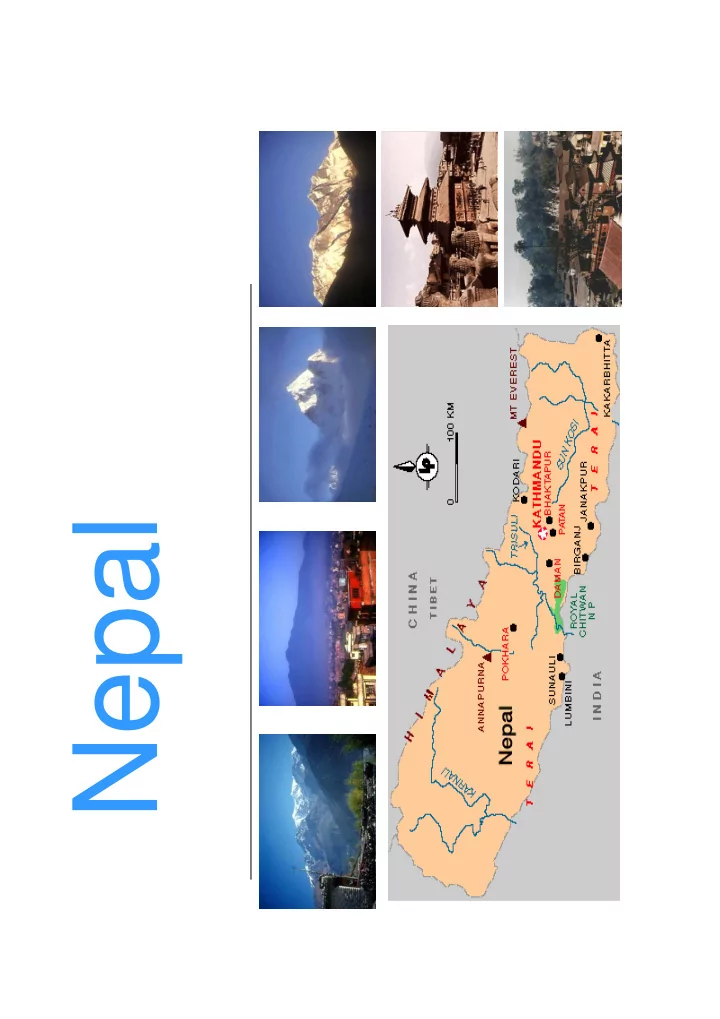
Nepal Expert Group Meeting on Regional Cooperation towards Building - - PDF document
Nepal Expert Group Meeting on Regional Cooperation towards Building an Information Society in Asia and the pacific, Bangkok, 20-22, July 2009 Purushottam Ghimire Joint Secretary Ministry of Environment (MOE) Nepal National Policy for ICT
Expert Group Meeting on Regional Cooperation towards Building an Information Society in Asia and the pacific, Bangkok, 20-22, July 2009
Purushottam Ghimire
Joint Secretary Ministry of Environment (MOE) Nepal
National Policy for ICT Development
To create IT enabling environment in the country Encouraging private sectors for development and promotion of IT sector in order to eradicate poverty Developing sustainable and competitive IT by using modern technology in the rural areas, Introducing new development programs in IT for socio- economic development
National Policy for ICT Development
Three-Year Interim Plan (2007-09)
“Promote ICT sector in such a way that it could be used by all
community and micro-level economic units and linked with business and service purposes. It will promote the way of life skills promptly. It will also help reduce unnecessary channels
ultimate consumers. ” National Planning Commission
Major Goals of the 11th Interim Plan (2007-09)
and Training Center (GIDTC)
National ICT Policies
2.1 Background of ICT Development
in 1974 and dissolved in 1998
Number were 150000 and Now the figure is 500,000
Main ICT Policy Components
2.2. Telecommunications Act 1997 and Regulation 1998
Establishment of NTA (Telecom-authority) Telecommunication Policy 1999 - Standard and reliable Telecom service -Policy Liberalization , Telecommunication sector open ( Private Sector Participation) Telecommunication Policy 2004
Nepal IT Policy 2000
Vision
– To place Nepal in the Global Map of Information Technology within the next five years
Objectives
– To make information technology accessible to the general public and increase employment through this means – To build a knowledge-based society – To establish knowledge-based industries
Major Components of IT Policy
certain extent Regulator
Major components of IT (cont..)
hardware.
e- Government initiatives (examples)
CAN)
www.company-registrar.gov.np
www.healthnet.org.np
IT Policy and Strategy
framework,
Key ICT Players
Government Agencies
(MOIC)
(HLCIT)
under the Prime Minister’s Office
Key ICT Players Cont….
Selected Private Institutions
(ACEN)
Key ICT Players Cont….
Selected Private Institutions
(ACEN)
ICT Infrastructure up to June 2009
Available Voice Telephone Service Service NDCL UTL SNPL STM Total ( in thousand) Fixed PSTN 556
WLL 180 68
252 Mobile GSM 2696
,, CDMA Sky 529
Others Limited
WCDMA (G3) .6
Total 3961.6 135 1856 4 5956.6 Penetration Rate in% Fixed 2.93 % Mobile 18.47 % Others 0.25% Total 21.65 %
ICT Law and Regulations
– To validate & give legal recognition to electronic documents, signature & transactions – To facilitate the admission of electronic documents, signature & transactions as evidence in case of dispute.
– Penalization of unauthorized access to information
ICT Human Resources: Status/Progress
ICT Human Resources: Challenges
6000 ICT graduate are produce by 62 colleges per year.
development is not explicit, and there is no institutional champion.
graduates, highlighting insufficient work-place exposure prior to graduation.
high as 90% for Nepal for all overseas study (i.e. higher for IT majors).
resources/IT professionals. Lack of ICT industry integration
Millennium Development Goal and ICT as a Tool
MDG 1- Eradicate Extreme Poverty and Hunger
– Information Dissemination – Awareness Raising – Increase Productivity/ High Yield – Efficient Public Service Delivery
MDG 2- Achieve Universal Primary Education
– School Net – Education in/ with ICT – School Content on Web
Millennium Development Goal and ICT as a Tool cont..
MDG 3- Promote Gender Equality and Empower Women
– Equal Access to ICT – ICT Applications on Women’s Initiatives
MDG 4- Reduce Child Mortality
– E-health – E-learning – Program dissemination through Media – Online Consultation
Millennium Development Goal and ICT as a Tool cont..
– Educational program through Media – Regular Dissemination of Information – E-Health – Online Consultation
Diseases
– Awareness Program through Media – Online Consultation – Information Dissemination
Millennium Development Goal and ICT as a Tool cont..
MDG 7- Ensure Environmental Sustainability
– Raising Awareness – Information Dissemination – Geographical Information System (GIS)
MDG 8- Develop a Global Partnership for Development
– ICT friendly Policy, Legislation, Regulation, Operation, Financial Mechanism & Customer Care – Integration and Harmonization of Sectoral Policies with ICT application and Services
On Going Initiatives
provisions
Policies
Institutional Development
Policy and Regulation respectively
implementation
sectors IT
electronic transaction
Challenges
Development Endeavor
Cooperation and Collaboration for Peace, Progress and Prosperity
financial Support
Initiatives for Regional Cooperation
initiatives
level
Thank you