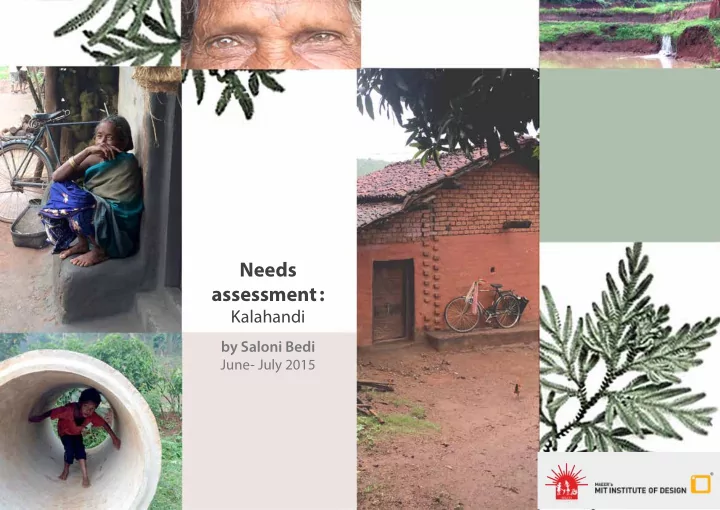
SLIDE 1
Needs assessment :
Kalahandi
by Saloni Bedi
June- July 2015
SLIDE 2
Identifying Innovations Existing In Health Space Identifying and Understanding Difgerent NGO’s, Government bodies and schemes in Odisha related to health
Identifying health needs in Tribal Areas
SLIDE 3 Identifying Innovations Existing In Health Space Identifying and Understanding Difgerent NGO’s, Government bodies and schemes in Odisha related to health Field Visit with Tribal Community Labs in Kalahandi To understand dierent perspectives
- f dierent stakeholders in health
sector. Stakeholder analysis Personal Interview and Focus Group Discussion Techniques
Identifying health needs in Tribal Areas
SLIDE 4
Kalahandi
Thaumal Rampur
Bali Sara Gunpur Saisurni Kumbe Pada Kaniguma Accessible By Roads Remote Areas Deng Pharsi Tentuli Padar Semel Padar
SLIDE 5
Agricultural Labourers
Agriculture Period : Rice Beans Maize Ragi Vegetables 9 to 10 hrs/day (7 days per week) June- November Working Period : Main Crops :
SLIDE 6
Pottery
Pottery period : Main Products : Working Period :
November- June Pots, Vases Roof Tiles Toys Decorative products 9 to 10 hrs/day (7 days per week)
Artisans Bamboo and Furniture Construction workers
SLIDE 7
A Glimpse Of Kalahandi
SLIDE 8
SLIDE 9
SLIDE 10
SLIDE 11
SLIDE 12
SLIDE 13
SLIDE 14
SLIDE 15
SLIDE 16
SLIDE 17
SLIDE 18
SLIDE 19
SLIDE 20
SLIDE 21
SLIDE 22
SLIDE 23
SLIDE 24
SLIDE 25
SLIDE 26
SLIDE 27
Useful in clean home deliveries Reduces infections caused by unhygenic conditions Multiple options available according to the need of the person
Ayzh- Janma : A clean birth kit Contents
Underpad Cord Clamp Surgical Blade Gloves Baby wiping cloth Soap Jute purse
SLIDE 28
M-care Disposable Delivery Kit
Provided to ASHA workers for expected home deliveries. Contents Carbolic Soap Sterilized gloves Absorbent cotton Mop egyptian cotton Neonatal covering sheet with hood Water proof apron Roller bandage Self-Sticking Maternity Napkin Baby Mucous Sucker Triple layer ltered face mask Cotton Gauze Cord clamp Sterilized blade Plastic undersheet
SLIDE 29
Why?
Infmuence of elders Transport Communication Government hospital nurses demand money Incentives provided for institutional deliveries gets delayed
Home Deliveries
Challenges
Infections due to unhygeinic delivery environment No proper cleaning of the mother Umbilical cord with ‘soota’ (thin jute rope) Gilette blade used to cut cord Blood loss
SLIDE 30
Swasthya Swaraj
Weekly Clinics (Kaniguma, Kerpai) Training of Swasthya Saathis for weekly clinic Tuberculosis days : Subsidized treatment Medication Provide chick pea(chana), oil, egg, bun
Tackling diseases
Malaria Tuberculosis Leprosy Scabies Diarrheal diseases General health issues Anaemia
SLIDE 31
Microscope - Malaria detection Malaria rDTs kits Basic health devices Blood pressure measurement Weighing machines Height measurement Stethescope
Equipments Used Challenges
Training of health workers (illiteracy) Retaining knowledge by the health workers Basic measurements like breath rate measurement, pulse rate X-Rays in remote areas
SLIDE 32
For expecting mothers Track of pregnant women with the help of ANMs Convinced to come to their ‘Maagrah” one week before their due dates When labor starts, 108 is contacted or another vehicle arranged
CARADA (Commercial Agriculture and Rural
Area Development Association)
SLIDE 33
Gram Vikas
Sanitation Toilets are built in houses (behavior change, Mobilizers needed) Taps in toilets provide fjltered water Gravity water pumping
SLIDE 34
Causes
Water from natural water bodies (open wells, muddy water) is consumed with no fjlteration Water purifcation not available in remote areas No awareness about efgects
Efgects
Diarrhea Malnutrition is already prevalent and gets worsened due to diarrhea. Vomitting, fever
Dirty Drinking Water
SLIDE 35
- Th. Rampur has a low coverage
- f 10 percent households with
safe drinking water source which is within 0.5 km and 30 percent households within 1 to 1.59 km distance. Availability of Clean Water
SLIDE 36
The clay for the pot is mixed with sawdust which when red burns away leaving small gaps. When water is passed through this pot, gets ltered of any impurities present.
Lid Pot With Tiny Holes Container Tap
Terracotta Water Purifjer
SLIDE 37 Product Proposals For Swasthya Swaraj
V Scan : Abdominal, urological,
cardiac, obstetric and pediatric scanning
Nebulizer : Providing medication in
severe cases of asthama or other res- piratory conditions
Pulse Oximeter : Rapid
measurement of oxygen saturation
- f hemoglobin in arterial blood.
Haemoglobin Meter: Anaemia
Screening
O2Matic: Producing Oxygen
in remote areas
Oxygen Generator