Families who trouble us. How we can know how effective we are at - - PowerPoint PPT Presentation

families who trouble us how we can know how effective we
SMART_READER_LITE
LIVE PREVIEW

Families who trouble us. How we can know how effective we are at - - PowerPoint PPT Presentation

Families who trouble us. How we can know how effective we are at helping them change? Honor Rhodes Director of Business Development You are only Family and Parenting Institute allowed to pick two of the three rhodes@familyandparenting.org


slide-1
SLIDE 1

Families who trouble us. How we can know how effective we are at helping them change?

Honor Rhodes Director of Business Development Family and Parenting Institute rhodes@familyandparenting.org

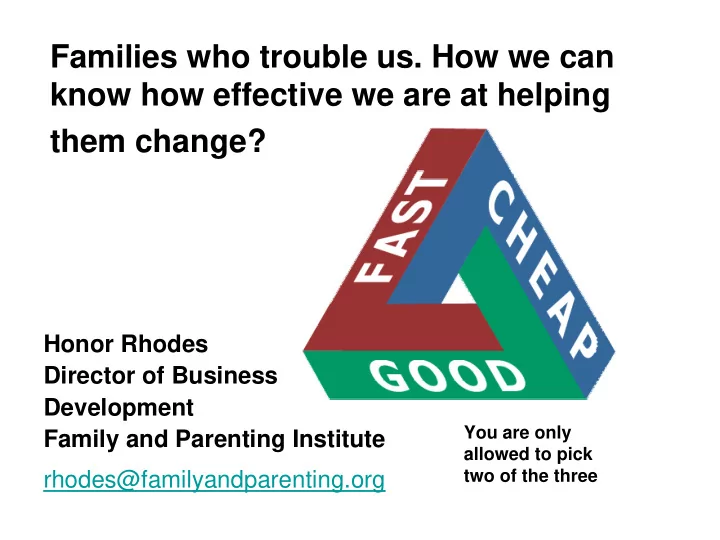
You are only allowed to pick two of the three

slide-2
SLIDE 2

What do you remember about bell curves? The population, its age, its intelligence, its beauty, its problems and issues are spread across a bell curve, like this one that is measuring enthusiasm…where are you on the measuring curve?

slide-3
SLIDE 3

The hardest to help aren’t always the hardest to measure…

  • Rubbish and smells
  • Dogs
  • Violence especially

domestic abuse

  • Too many children
  • Too few parents
  • Teenage pregnancy
  • No sense of

possible change

  • Criminality
  • Petitioning

neighbours

  • Wasted human

potential

This is the Wilson’s ‘Before’ kitchen, you should see it now, I am allowed to show you as they are very proud of how far they have come

slide-4
SLIDE 4
  • Severe/enduring adult

mental health problems

  • Parents with learning

difficulties

  • Long standing physical

illness

  • Domestic violence
  • Substance misuse
  • Lack of regulation, time,

resources and energy

  • Lack of connection to the

world around them

  • Fractured family

relationships

  • Early poor parenting across

at least two generations,

  • ften more

What do we know about the underlying problems? Research tells us…..(but you know this already…)

But how do you know that you did the BEST you could have done for them?

slide-5
SLIDE 5

The measurer, you, the excellent practitioner

  • The cultivation of the

capacity to reflect in action (while doing something) and on action (after you have done it)

  • Knowing that you have

undertaken the most effective intervention possible

  • Developing the capacity

to look after ourselves

  • And, most importantly,

that you have done no harm

slide-6
SLIDE 6

The measuring effect

  • Observing and measuring

make a difference

  • Think about the live

supervision experience

  • A positive focus on areas
  • f difficulty with an

expectation of improvement can produce improvement

  • Subtle communications
slide-7
SLIDE 7

Measuring things

  • Why?
  • What?
  • How?
  • When?
  • Where?
  • With what?

http://www.familyandparenting.org/item/publication/76

slide-8
SLIDE 8

http://www.sdqinfo.com/questionnaires/english/c3.pdf Or just google Goodman SDQ

slide-9
SLIDE 9

Common tools

  • Goodman Strengths

and Difficulties Questionnaire (SDQ)

http://www.sdqinfo.com/b1.html

  • The CORE System

(Clinical Outcomes for Routine Evaluation)

http://www.coreims.co.uk/index.php

We wrote a Briefing sheet to help you find ones that might help you

http://www.familyandparenting.org/ Filestore//Documents/PW2009/mea surement_tools_briefing.pdf

  • Some Triple P tools

Family Background Questionnaire Parenting Scale Parenting Experience Survey Being A Parent Scale Parent Daily Report Checklist Parent Problem Checklist Relationship Quality Index

  • Other useful ones

The Family Assessment Device DoH Family Hassles DoH Family Activity Scale

  • And, sadly, ones that

people have devised themselves…DON’T

slide-10
SLIDE 10

Process stuff…

  • Have a look at the

Goodman SDQ….

  • Even BEFORE thinking

about what families will make of it you need to be considering what will happen when you DO start measuring.

  • What do you do when

you have collected information?

  • Resources hungry

process

slide-11
SLIDE 11
  • Start in the home, don’t summons to an office
  • Build the questionnaire into the starting session
  • Solve a problem that the family want help with,

this is ‘the test’.

  • Map other agencies involvement (or not), bring

them in

  • Use contracts early – they are very effective, and

don’t flinch from naming the difficult

  • Protect workers from scabies and violence
  • Review, reward and sanction immediately
  • Underline change and make it very hard to retreat

back to how things were

Measuring is NOT doing so what works for families with this level of disorder, confusion and trouble?

slide-12
SLIDE 12

Thinking about what does not work with most families? Because?

  • “You should…” get alongside first, get

parents to want your help

  • Letters or any written communications :

Hidden or manifest illiteracy, letter hoarding,

  • ther ways of communicating work better

(photobooks, video, pictorial representations

  • f shopping lists, rules, what should go

where, rotas for basic cleaning)

  • Short term interventions: families are expert

at defeating workers, prepare for the long haul

  • Sanction only interventions: carrots v. sticks
  • Loss of energy/enthusiasm for change: we

all are reluctant to change, workers need energy to sustain the whole system

What are your carrots?
slide-13
SLIDE 13

Persuasion or will parents/children/people allow you to administer a questionnaire?

In all likelihood they will, IF:

  • You are confident that it will be

helpful to them and you

  • You appear to know what you are

doing

  • You appear to believe in its

efficacy

  • You appear to utilise what the

tool(s) tells you

  • You make it seem easy and

unfrightening

  • You give accurate examples of

questions

slide-14
SLIDE 14

What about families who don’t agree to be measured? Well, they can become your experts.

Time of behaviour What was happening BEFORE the behaviour ? Who was in the room or nearby? What started the behaviour ? What was the behaviour ? What happened ? What happened after the behaviour ? Pattern? What is normal or resting state? Family dynamics, relationship to work on? A What needs to change to reduce the behaviour? B Detail about the sequence is helpful, also the extremities, small - large C What allows and supports the behaviour to carry

  • n?
slide-15
SLIDE 15

Measuring relationships, can we help everyone to ask the right questions? What about using simple but highly effective ‘Tools’, ecomaps, geneograms and pictures…

Let’s see who is actually ‘in’ your family and household…and let’s hear your story We wrote a briefing sheet on how to use these

  • tools. Have a look.

http://www.familyandparenting.org/Filestore//Doc uments/publications/Families_in_trouble_assess ment_factsheet.pdf Help in understanding family life cycles

slide-16
SLIDE 16

Do you know how to use a star chart for maximum effect? We wrote a Briefing Sheet to help, http://www.familyandparenting.org/Filestore//Documents/publications/Families_in _trouble_helping_parents_factsheet.pdf

Rewards come in many forms and only need thought and dedicated application

slide-17
SLIDE 17

Our responsibility and ethical dilemmas

  • Do no harm (again)
  • Choose the least intrusive

balanced against the most efficacious

  • Stop when asked and

understand why it was not bearable

  • Learn all the time and

remain curious

  • Accept all information

even when it tells us difficult things

slide-18
SLIDE 18

Get the help you deserve…

  • A place to talk it all through is

VITAL wherever you are in the system

  • These guides was written for

people just like you in mind

  • Briefing sheets on referrals,

helping parents manage children’s behaviour and an assessment of supervisor’s effectiveness tool.

  • Sign up for our email alerts for

new research and policy issues to help you keep connected

  • All there for you to use so try it

and see…and then tell me whether it helped and what more you need

www.familyandparenting.org

slide-19
SLIDE 19

What next in a cold financial climate?

  • Do more measuring
  • Cleverly
  • Persuade your WHOLE

agency to do it too

  • Gather the data and report
  • n it
  • Make it ‘currency’, you will

be able to show how very good you are and why your service must be funded

  • Be an even more reflective,

evidence based and, simply, a better practitioner

  • This matters now more than

ever as more families need

  • ur effective, intelligent,

respectful and good hearted help and support for change