NEDLAC Presentation 8 March 2018 Breakdown Slide 2 This - - PDF document

nedlac presentation 8 march 2018 breakdown
SMART_READER_LITE
LIVE PREVIEW

NEDLAC Presentation 8 March 2018 Breakdown Slide 2 This - - PDF document

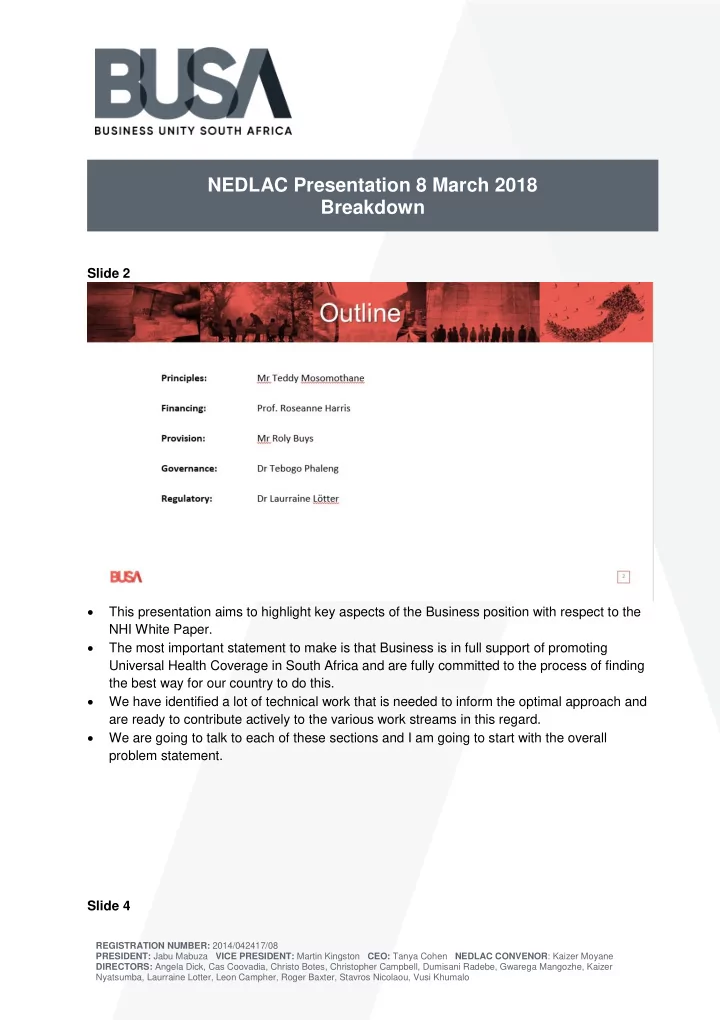
NEDLAC Presentation 8 March 2018 Breakdown Slide 2 This presentation aims to highlight key aspects of the Business position with respect to the NHI White Paper. The most important statement to make is that Business is in full support of


slide-1
SLIDE 1

REGISTRATION NUMBER: 2014/042417/08 PRESIDENT: Jabu Mabuza VICE PRESIDENT: Martin Kingston CEO: Tanya Cohen NEDLAC CONVENOR: Kaizer Moyane DIRECTORS: Angela Dick, Cas Coovadia, Christo Botes, Christopher Campbell, Dumisani Radebe, Gwarega Mangozhe, Kaizer Nyatsumba, Laurraine Lotter, Leon Campher, Roger Baxter, Stavros Nicolaou, Vusi Khumalo

Slide 2

  • This presentation aims to highlight key aspects of the Business position with respect to the

NHI White Paper.

  • The most important statement to make is that Business is in full support of promoting

Universal Health Coverage in South Africa and are fully committed to the process of finding the best way for our country to do this.

  • We have identified a lot of technical work that is needed to inform the optimal approach and

are ready to contribute actively to the various work streams in this regard.

  • We are going to talk to each of these sections and I am going to start with the overall

problem statement. Slide 4

NEDLAC Presentation 8 March 2018 Breakdown

slide-2
SLIDE 2

2

BREAKDOWN OF BUSA NHI PRESENTATION

  • The position that we are presenting is based on these documents.
  • We have also referred to the High-Level Panel on the Assessment of Legislation and the

Acceleration of Fundamental Change that was chaired by former president Kgalema Motlanthe and which made a number of recommendations with respect to the healthcare sector.

  • It is our understanding that the NHI Bill will also be added to this (NEDLAC) process after it

has been subject to public comment, but before it is finalized and signed into law. Slide 5

slide-3
SLIDE 3

3

BREAKDOWN OF BUSA NHI PRESENTATION

  • The problem statement as set out in the White Paper, articulates a number of health

challenges that we are facing as South Africans.

  • Business acknowledges the need for a concerted and co-ordinated effort to address these

challenges.

  • Addressing the disease burden requires a collaborative effort from the public and private

sector.

  • We have significant challenges in both these sectors.
  • In the public sector there is a dire need for operational revitalization and

improvement in service delivery.

  • In the private sector there is great scope for improving efficiency and aligning

incentives for quality of care.

  • In order to have a workable plan for these improvements, there is a need for comprehensive

and accurate data. Given the far-reaching nature of any decisions and actions in this regard, Business believes this process needs to be supported by research and forecasting input and such a framework has been proposed.

  • It is critical to recognize that as a nation, we do not have unlimited resources (financial and

human resources).

  • These resources need to be appropriately and efficiently allocated to address need.
  • The skewness highlighted here is both regionally and in terms of the level of care.
  • The lack of economic growth has also meant that public expenditure has not kept pace with

population growth, thus exacerbating the resource constraints through declining amounts available per person in the population.

  • It is also critical that we ensure that the healthcare sector in South Africa remains viable and

sustainable in terms of having adequate healthcare professionals and sustainable business models for the supply of healthcare goods and services.

slide-4
SLIDE 4

4

BREAKDOWN OF BUSA NHI PRESENTATION

Slide 6

  • Despite these challenges, there have been some gains and it is important to acknowledge

these and build off this base.

  • The World Bank analysis of global health expenditure has specifically looked at catastrophic

health expenditure, defined as the percentage of the population spending more than 10% of their household budget on out-of-pocket health expenses.

  • For South Africa this was found to be just 1.41% (across the whole population).
  • This puts South Africans’ risk of catastrophic health expenditure on a similar level to

people living in the UK (1.64%) or Panama (1.4%).

  • South Africa also has the biggest state-funded anti-retroviral treatment programme

in the world and the implementation of this programme has resulted in major improvements in a number of Sustainable Development Goal (SDG) measures in terms of life expectancy, infant and child mortality, maternity care and the prevention

  • f mother-to-child transmission of HIV.
  • We also have excellent health care resources in our country, although these need to

be better distributed.

  • World class expertise and capacity with respect to data management and analysis,
  • utcomes measurement, and monitoring of quality, healthcare provision is available within

the private healthcare sector.

  • There is a great opportunity for collaboration and partnership between government and the

private healthcare sector in these areas. The private healthcare sector is willing and ready to contribute to contribute these assets and expertise, towards building a sustainable health system in South Africa.

slide-5
SLIDE 5

5

BREAKDOWN OF BUSA NHI PRESENTATION

Slide 7

  • These are the principles set out in the White Paper.
  • The ones highlighted in red are the ones where Business is not in agreement on

interpretation.

  • Constitutional right of access:
  • The right of every citizen to choose the health care provider and health care cover

that is appropriate to their needs and wallets is enshrined in the South African Constitution.

  • Universal Health Care Coverage as recommended by the WHO means access to

affordable healthcare, not necessarily free health care. It is important to note that the WHO does not prescribe that the model to achieve UHC is a single fund model as proposed in the White Paper.

  • Healthcare as a public good:
  • This is a point of terminology rather than disputing the principle.
  • Business’s view is that the use of the following terminology would be more

appropriate in this specific NHI principle: “Health is a vital social investment in terms

  • f protecting public interest and promoting productivity.”
  • The economic definition of a public good includes is that it is non-rivalrous i.e. being

used by one person does not make it unavailable to another.

  • For example, TV signals are non-rivalrous as me using it does not affect your

access, but healthcare does not meet this definition since if I am occupying a hospital bed, you can’t use it and if I am taking medication it is not available to you.

slide-6
SLIDE 6

6

BREAKDOWN OF BUSA NHI PRESENTATION

  • The finite nature of resources therefore means that we need to come up with

prioritization mechanisms to allocate the competing healthcare demands.

  • Health education may meet the criteria of being non-rivalrous but not healthcare

services. Slide 8

  • In terms of the features of the NHI framework identified by the White Paper, Business has

identified a number of these where engagement is required.

  • Comprehensive services:
  • The NHI service benefit package has not been defined.
  • Reference to a comprehensive set of services is potentially very misleading in a

resource-limited environment such as SA.

  • We need to make sure that promises made can be kept and that expectations are

also realistic.

  • Business is stressing the need for a clear definition of services, that could be

introduced incrementally as experience and affordability develops.

  • Lack of proper planning in this regard will likely introduce a significant risk of

worsening inequality through major variations in levels of cover and access across different geographic regions in SA.

  • Single fund:
  • Business recognizes the advantages of the single fund approach as a pooling

mechanism and active purchaser, but it is our position that this is not the most efficient mechanism to achieve this in our current environment.

slide-7
SLIDE 7

7

BREAKDOWN OF BUSA NHI PRESENTATION

  • The policy objective of Universal Healthcare Coverage should remain the core

reference point against which alternative modes of delivery are evaluated.

  • We have noted that a single fund approach is not the only way in which these

principles can be achieved and there is an opportunity to engage on the most

  • ptimal approach.
  • Business is proposing engagement on alternative funding and pooling structures to

make sure the approach is addressing the problem statement in an optimal way.

  • Single payer
  • There is a need to investigate how a multi-payer system can address these

requirements – especially as this would inevitably be SA’s starting point on the transition towards UHC. This needs to involve a collaborative approach between the public and private sectors.

  • Publicly administered
  • There is expertise in the public and private sectors regarding operational and

delivery aspects and accountability mechanisms. Slide 9

  • Finally, from my side, Business is concerned about the long-term nature of the White Paper

when there are urgent needs that can be addressed more immediately.

slide-8
SLIDE 8

8

BREAKDOWN OF BUSA NHI PRESENTATION

  • This includes the need for improved service delivery in the public sector and improved

efficiencies in the private sector. A particularly urgent issue is the proper planning of training of health resources.

  • The Health Market Inquiry has been assessing the need for efficiency improvement in the

private healthcare market and there is an opportunity for this (NEDLAC) process to be informed by the extensive work that has been done during this inquiry.

slide-9
SLIDE 9

9

BREAKDOWN OF BUSA NHI PRESENTATION

FINANCING Slide 11

  • The financing part of this engagement is critical in terms of balancing healthcare needs

and a sustainable framework in the most optimal way.

  • The White Paper does not provide a clearly defined service benefit package, and this

makes it difficult to engage on the extent to which the priority healthcare needs of the South African population are being met and to evaluate the costings presented.

  • It is the Business position that there should be engagement with both these points i.e.

what is to be covered and how do we prioritize the need for various healthcare services to ensure that healthcare is equitably and sustainably delivered?

  • It is the position of Business that there are alternative ways in which Universal

Healthcare Coverage can be achieved and these should be evaluated as part of this

  • process. This includes how, and which services are covered, how these are funded and

where the funding comes from. Business suggested that the recommendations of the Davis Tax Committee is a helpful reference point here.

  • The approach that Business is suggesting is to assess an incremental approach to

benefits, as has been done in other middle-income countries.

  • Business is proposing a rigorous modelling approach to make sure we are

understanding the implications of different scenarios for the services included and funding.

  • The magnitude of this undertaking also suggests that a phased approach is appropriate,

and Business supports the prioritization of vulnerable groups.

  • At the same time, it is important to adopt a collaborative approach and continue to

encourage those who can afford it to provide for themselves. This includes specific

slide-10
SLIDE 10

10

BREAKDOWN OF BUSA NHI PRESENTATION

consideration of more immediate ways of expanding access to affordable cover for lower income earners. Slide 12

  • In order to fully engage with these challenges, it is critical that the decision makers have

access to accurate information regarding the fiscal and financial implications of alternative structures.

  • The costing in the White Paper is presented in 2010 Rand and urgently needs to be
  • updated. It also needs to be clarified as to what benefit package underpins these costs.
  • In the intervening period the level of economic growth has been well below the 3.5% per

annum level assumed. There have also been demographic changes in our population and in healthcare needs and delivery structures, let alone inflation in the costs of medical goods and services. These assumptions all need to be updated with experience and revisited to ensure they are appropriate to the current South African environment.

  • As I noted earlier, the service benefit package needs to be more clearly defined or

mapped so that we can understand the implications of tough choices that need to be

  • made. International experience shows that implementing a poorly or broadly defined

benefit package leads to gross inequality in what different population groups receive.

  • The availability of funding is also an important reality. Business would like to encourage

the move away from global comparisons based on the percentage of GDP rather than the Rands and cents of what healthcare services cost. It does not make sense to compare the percentage of GDP we spend on healthcare to developed countries like the UK or Canada whose GDP capita is many multiples of ours. We need to consider what healthcare services actually cost and this is where the purchasing power parity adjusted comparisons are useful.

slide-11
SLIDE 11

11

BREAKDOWN OF BUSA NHI PRESENTATION

  • We are also faced with a range of challenges in South Africa in terms of promoting

economic growth and particularly social security upliftment. There is a parallel Nedlac process on social security. Business suggests that it makes sense for us to be taking a consistent approach in modelling and evaluation to facilitate these broader considerations.

  • Business is also concerned that there are major structural implications associated with

the centralization of funding and the decentralization of management that is implicit in the White Paper proposals. While this might be appropriate, the risks and implications

  • f this change in fiscal flows away from Provinces, as well as other structural

considerations, need to be properly evaluated. Slide 13

  • This table is from the White Paper and shows health expenditure in South Africa in

2016/7.

  • The government expenditure which includes both National and Provincial expenditure is

just over R190bn. You can see that the bulk of this expenditure is currently at Provincial level and this highlights the magnitude of the envisaged restructure of funding flows.

  • The R190bn government expenditure is from general tax revenue and is approximately

4.3% of GDP.

  • Then we have R198bn in private expenditure. The biggest item here is contributions

paid to medical schemes but also out of pocket expenditure paid to medical service

  • providers. These are both voluntary private amounts. This means that they are paid

from the salaries of employed South Africans.

slide-12
SLIDE 12

12

BREAKDOWN OF BUSA NHI PRESENTATION

  • The R19bn in tax credits is only 11.5% of the medical scheme contributions and so

contributions are largely funded from after tax income. For the lower income earners who are managing to afford medical scheme cover, the tax credits make a big difference to sustainability. But if individuals were not buying medical scheme cover or paying providers, they would have the money to spend on other things. It is not part of central fiscus available for redistribution.

  • Business is concerned that there have been suggestions that the voluntary private

expenditure is available for redistribution, but it is important to note that this can only be accessed by increasing taxes or introducing other levies which would also be considered as taxes.

  • The White Paper presents a costing of NHI in 2025 of R256bn and it is important note

that this is in 2010 Rands. Just increasing this by CPI to 2017 takes it up to R372bn. This is more comparable to the current expenditure figures, but I am sure we are all aware that medical inflation is even higher than CPI.

  • It is difficult to comment on the reasonability of this without understanding the underlying

service benefit package, and how it will be delivered. Business suggests that this is an area for further work.

  • It is clear that there is a large funding shortfall and we need to be realistic about the
  • utlook for economic growth being less than the 3.5% assumed in the White Paper

(alternative scenarios are presented). Although Business does acknowledge that health expenditure has been increasing at a faster rate than economic growth, this may not be sustainable. Slide 14

slide-13
SLIDE 13

13

BREAKDOWN OF BUSA NHI PRESENTATION

  • This slide aims to put these figures into perspective relative to other areas of public
  • expenditure. These figures are the 2010 WP numbers presented in 2015 terms but not

yet updated for changes in the population, actual economic growth or excess medical inflation over CPI.

  • The NHI funding requirement per the White Paper in 2015 terms is larger than the

combined expenditure on the Road Accident Fund, the Compensation Fund, UIF and Social Grants and also exceeds Eskom income.

  • At R19bn the tax credits for medical scheme cover are also very low relative to these

amounts. Slide 15

  • As I noted earlier, it is also important to consider the per capita implications of these

costs.

slide-14
SLIDE 14

14

BREAKDOWN OF BUSA NHI PRESENTATION

  • On the basis of a CPI adjustment, the 2017 amount of the White Paper costing is in the
  • rder of R6 630 per capita for a population of 57 million people.
  • There is work to be done in terms of updating the assumptions used for experience.

Business is also concerned about the implications of removing the tax credits prematurely when they are currently quite instrumental in encouraging lower income earners to purchase their own cover and being able to retain this. Business is particularly concerned by some of the rhetoric suggesting that the removal of the tax credits would make a meaningful contribution to funding the shortfall.

  • It is also important to note that the shortfall is determined relative to the public
  • expenditure. There is an opportunity for a considered transitional approach to ensure

that the voluntary private expenditure is preserved for health funding and that there is some form of risk pooling and cross subsidy. A rigorous modelling approach is vital to assess this, as well as the broader implications of restructuring funding flows. Slide 16

slide-15
SLIDE 15

15

BREAKDOWN OF BUSA NHI PRESENTATION

  • This slide aims to illustrate the sustainability challenge and how important it is that

careful planning is done around what services are provided and how they are delivered.

  • If we consider the R6 630 per capita from the previous slide, this translates to R552 per

person per month. Taking off 10% for operational and management expenses in the NHI structure as well as the operational costs of the National Department of Health, we have in the order of R497 per person per month.

  • We can compare this to average claim costs for open medical schemes as reported by

the Council for Medical Schemes.

  • Of course, we are not suggesting that the NHI service benefit package would be

delivered in the same way medical scheme benefits operate, the comparison of costs gives some perspective on what can be included. The lowest cost quartile of benefit

  • ptions have costs of R726 per person per month while the average is around R1 161

per person per month. And these members still have some out of pocket costs to cover. The R497 is around 42% of this average medical scheme amount.

  • This suggests that not only are there going to need to be efficient delivery mechanisms

in terms of cost and quality of care but also some tough rationing choices in terms of the type of services that can be promised and equitably delivered across the whole population.

  • There are opportunities to achieve efficiencies and this is why Business is suggesting a

collaborative approach underpinned by rigorous modelling, planning and scenario testing. Slide 17

slide-16
SLIDE 16

16

BREAKDOWN OF BUSA NHI PRESENTATION

  • As I noted earlier, it is important to consider the monetary amounts rather than the

percentage of GDP.

  • The UK has a similar percentage of GDP expenditure on health as South Africa, but we

can see that the monetary amounts are much higher.

  • The UK also has the highest public health expenditure proportion.
  • The PPP adjustment here has been done by the WHO and gives some indication of how

relatively expensive or inexpensive health care is. You will note that for SA the PPP adjustment is upward i.e. our services would be more costly internationally.

slide-17
SLIDE 17

17

BREAKDOWN OF BUSA NHI PRESENTATION

Slide 18

  • The White Paper points out that the percentage of expenditure on voluntary private

health expenditure is significantly higher than the OECD average (6x). It is first of all important to note that this does not imply that the cost of private medical cover in South Africa is more than the cost of private health insurance in the OECD. Quite the opposite is true (the Eurostat database indicates an OECD average of around 990 dollars per capita per annum and this still needs to be adjusted for coverage proportion).

  • Business is concerned that this statistic has been presented in a misleading way. What

it actually means is that there is more expenditure on private health insurance than public funding which of course reflects the lower levels of public per capita expenditure. Much lower than the OECD average. And the higher numbers of people who choose to buy cover if they can afford it rather than using the public sector that they are also entitled to use but choose not to.

  • It is about proportions and not about amounts – UK example
  • The other statistic on this graph is the out of pocket expenditure. As the World Bank

report referred to earlier highlights, the levels of particularly catastrophic out of pocket expenditure are low, especially compared to other middle-income countries, and Business would like to stress that this is something we need to preserve as we transition to a system of universal health coverage.

slide-18
SLIDE 18

18

BREAKDOWN OF BUSA NHI PRESENTATION

Slide 19

  • Finally, on the Financing section, we consider the priority health programmes as

identified by the Department of Health in the presentation at the previous meeting.

  • This slide presents the estimated number of lives who will be covered by these specific

programmes and it is certainly a difficult task to rank these critical programmes according to priority.

  • It is the understanding of Business that these programmes currently fall under the ambit
  • f provincial health departments and so there would be a centralization approach to how

these are funded once they fall under an NHI fund.

slide-19
SLIDE 19

19

BREAKDOWN OF BUSA NHI PRESENTATION

Slide 20

  • This slide shows the costing of these programmes as presented by the Department of
  • Health. The annual cost is over R14bn in the first year.
  • The budget allocation to the NHI fund in the February budget speech was R4bn over the

next three years which suggests that there does need to be a prioritization exercise for these programmes.

  • Business is proposing a modeling framework which could be used to inform this process

and to ensure that current levels of cover are preserved or enhanced during the transitional process, as well as looking at an optimal approach for service delivery. PROVISION Slide 22

slide-20
SLIDE 20

20

BREAKDOWN OF BUSA NHI PRESENTATION

  • At the outset it is important to note that the majority of healthcare services are delivered

in the public sector and so quality improvements in public facilities and ensuring delivery

  • f care at the appropriate level need to be implemented.
  • Business suggests that there are multiple opportunities for collaboration between public

and private facilities to improve levels if service delivery. This includes providing capacity for priority projects such as cataracts.

  • The quality assurance functions is vital to ensure that capacity improvement is
  • appropriate. Business suggests that consideration is given to bolstering the current

capacity of the Office for Health Standards Compliance.

  • Overall though, it is important to note that the revitalization of the public healthcare

system does not require the establishment of an NHI Fund to proceed.

  • As noted by the HLP, there is a critical need for accurate information on existing

healthcare infrastructure and resources so that proper planning can be done, and needs addressed efficiently.

  • The human resource planning needs particular attention due to the training timeline to

address areas of need. There is an opportunity to engage with private sector facilities to assist in the training process (in terms of practical training elements rather than higher education elements).

  • The White Paper refers to a procurement and reimbursement framework for contracting

services from the private sector and under the purchaser provider split. Such a framework needs to be realistic as I am going to discuss shortly to ensure that we can attract and retain the necessary skills to deliver excellent healthcare to all South Africans.

slide-21
SLIDE 21

21

BREAKDOWN OF BUSA NHI PRESENTATION

  • We cannot ignore the affordability constraints fiscally and for households. This

necessitates rationing decisions which need to be done in as transparent a way as possible with input from key stakeholders. Slide 23

  • A key challenge in improving healthcare delivery is ensuring adequate resources.
  • A comparison of SA average visit rate to OECD averages gives a clear indication of the

large deficit in terms of health professionals.

  • There is not a quick fix for addressing this deficit due to the training period for medical

professionals.

  • There is also an opportunity for us to attract skills from overseas.
  • In terms of facilities it is important that proper planning takes place to correct inequalities

in the distribution of facilities and equipment.

  • This planning needs to include due consideration of the appropriate level of care to

support the promotion of primary care.

slide-22
SLIDE 22

22

BREAKDOWN OF BUSA NHI PRESENTATION

Slide 24

  • Business suggests that a first step is understanding the existing resourcing. There is an

urgent need for accurate and complete resource data.

  • A further urgent step is to address the practical training requirements to ensure that

there is a pipeline of skills being trained. The private sector have made a number of proposals for training arrangements to support this process. This can include training and registration of health professionals from overseas.

  • In terms of facilities and infrastructure we need data on what we have and where it is.
  • Where there are gaps, these can be addressed by appropriate procurement or

redistribution as well as exploring partnerships with the private sector to enhance capacity (in a sustainable way.)

slide-23
SLIDE 23

23

BREAKDOWN OF BUSA NHI PRESENTATION

Slide 25

  • A key proposal in the White Paper is the purchaser provider split. Business supports

this approach put would like to highlight the need for careful consideration of all implications.

  • This approach requires a sound basis for determining the basis on which public facilities

will be reimbursed for the services delivered.

  • The transition from a budget allocation mechanism to reimbursement model is not

simple and needs to be carefully planned.

  • A key element of this process is the employment of health professionals in both public

and private settings. The HPCSA rules around employment of health professionals are a key constraint in the private sector and may impact on procurement of services. These need to be addressed.

  • There needs to be adequate resources for managing the procurement process as well

as the supply chain process which includes proper provisioning of facilities.

slide-24
SLIDE 24

24

BREAKDOWN OF BUSA NHI PRESENTATION

  • The public-sector facilities are currently not geared up for billing (even where the means

test currently permits it) and it is not a small task to ensure the required procedures are in place.

  • All of this requires high levels of institutional change and public facilities and at provincial

departments of health and such changes are associated with risks that need to be identified and managed. Slide 26

  • The costing of services is a cornerstone of the viability of the proposed framework.
  • Business stresses the requirement for a sound and scientific approach to determine the

costs of services included in the service benefit package using a bottom up costing

  • approach. This requires adequate data and expertise and may also involve

assumptions to be made about efficiency gains.

  • For both public and private service providers, the sustainability of the framework

requires sound principles of cost recovery to be applied.

slide-25
SLIDE 25

25

BREAKDOWN OF BUSA NHI PRESENTATION

  • Business suggests that there is an opportunity to learn from other areas where such

systems have been implemented and where there are similar affordability constraints.

  • Within the South African healthcare sector there is extensive knowledge, expertise and

data in the medical scheme environment that can be drawn upon.

  • It is important that key performance indicators are identified up front to monitor the

processes implemented so that there can be timeous intervention where levels of quality

  • r cost efficiencies required are not being met.
  • We cannot stress highly enough the need for monitoring and evaluation to be built in

and receive adequate resourcing. Slide 27

  • Business is supporting a phased approach to the changes being proposed.
  • A particular concern is that the phasing presented in the White Paper only incorporates

selective contracting from the private sector very late in the process.

slide-26
SLIDE 26

26

BREAKDOWN OF BUSA NHI PRESENTATION

  • We suggest that there is an opportunity to contract immediately with a private sector that

is ready and willing to assist with capacity for priority projects. This can be done on a piloting basis to collect information on the risks and opportunities and further refine the contracting process going forward. Slide 28

  • Finally, on the provision basis, Business supports the approach of using alternative

reimbursement mechanisms and suggests that there is an opportunity for achieving

slide-27
SLIDE 27

27

BREAKDOWN OF BUSA NHI PRESENTATION

immediate efficiency gains in healthcare delivery in South Africa by creating an enabling environment for such methods now.

  • The implementation of these mechanisms needs to ensure an appropriate alignment of

incentives as well as a realistic assessment of underlying costs.

  • This will ensure sustainability of both public-sector facilities (and ongoing quality and

capacity improvements) as well as for private sector contracting.

  • The requisite skills for managing these contracts also need to be in place at public

facilities (per the purchaser provider split).

  • A word of caution on the use of DRGs for hospital reimbursement as referenced in the

White Paper. The development of a DRG based reimbursement framework requires extensive development in terms of an appropriate coding framework for South Africa as well as an independent body to develop and administer such a framework. The step of linking reimbursement to clinical outcomes in addition to activity is a further complex step which needs to be carefully planned. International experience has highlighted some key challenges in this regard.

  • The development of adequate activity-based costings for public facilities under the

purchaser-provider split needs to be rigorous to ensure that there are no funding shortfalls.

  • In addition, specialist services do not appear to have been adequately considered. An

engagement process with the provider community is necessary to ensure a sustainable reimbursement mechanism is developed.

  • Overall, it is important to note that there are risks with the monopsony position of a

single payer system that can affect the willingness of providers to contract and hence the sustainability of service delivery. GOVERNANCE Slide 30

slide-28
SLIDE 28

28

BREAKDOWN OF BUSA NHI PRESENTATION

  • This picture has been adapted from the WHO framework for a well-functioning health

system.

  • It highlights the need for consideration of structure and process i.e. proper planning, to

co-ordinate the elements of the healthcare system with the patient firmly at the centre.

  • The elements include:
  • the service delivery to the patient with the associated quality assurance

requirements;

  • the workforce of medical professionals delivering services who are adequately

trained and where access to the appropriate level of care is managed;

  • efficient procurement of health resources including capacity as well as

equipment, medication and logistics;

  • the collection, management and analysis of data to assess efficiency and quality

in care delivery; and

  • adequate funding to ensure sustainability as well as equitable access across the

patient population.

  • If these elements are underpinned by adequate governance and leadership which holds

these elements together and to accountability, then the desired health outcomes can be achieved.

  • In the South African context, it is important to note that the need is for better health
  • utcomes and timeous addressing of the needs. We need to find the best way to do this

rather than necessarily stating the intention of implementing the particular solution of a single fund model.

slide-29
SLIDE 29

29

BREAKDOWN OF BUSA NHI PRESENTATION

Slide 31

  • We have presented the incremental framework here as adapted from the Taylor

committee report.

  • This framework presents the current delivery which has a base of a tax funded public-

sector system serving the whole population, with some groups having to make a mean tested payment.

  • Currently we have the voluntary private medical cover sitting on top of this in a

duplicative way.

  • Under an incremental framework, the NHI package of services could be at the base. As

we have highlighted, these services need to be clearly defined to promote equitable access and responsible planning.

  • The medical scheme environment is envisaged to continue in a complementary role with

the support of employer funding.

  • Employer mandates would aid the affordability and sustainability of the medical scheme

environment and create the opportunities for virtual risk equalization across these pools. Slide 32

slide-30
SLIDE 30

30

BREAKDOWN OF BUSA NHI PRESENTATION

  • An alternative construct is where the NHI service benefit package is defined as a

minimum package which is included in the benefit package offered by schemes.

  • While there could be some tax funding support, this model enables public funding to be

focused on those who cannot afford to provide for themselves with the additional

  • pportunity to benefit from virtual risk equalization.
slide-31
SLIDE 31

31

BREAKDOWN OF BUSA NHI PRESENTATION

Slide 33

  • Proper governance is vital for an undertaking of the magnitude of the envisaged NHI

framework.

  • The guiding principles of governance, as with healthcare delivery, involve consideration
  • f the adequacy of processes as well as ensuring the desired outcomes are met.
  • From a process perspective we have:
  • Clarity is required of the roles of key stakeholders in the healthcare sector most

notably provincial health departments, public health facilities, private sector providers and medical schemes.

  • The clarity of roles will lay the groundwork for effective engagement between

these stakeholders and there need to be adequate forums for input from all interested parties.

  • We have highlighted the need for accurate data to facilitate planning and

scenario testing throughout this presentation. This data needs to be available to all stakeholders to facilitate engagement.

  • The need for clarity on the service benefit package is critical to achieving equity

in delivery. This needs to be informed by clear prior setting and sustainability requirements.

  • There is also a need for the legislative and regulatory review that will enable the

changes in the requirements.

  • The legislation is also supported by industry standards with respect to elements

such as clinical practice and confidentiality.

  • If these processes are in place, then the desired outcomes become achievable. We

have articulated these here as:

  • Equity in how healthcare services are accessed across the population in a way

that addresses priority needs.

slide-32
SLIDE 32

32

BREAKDOWN OF BUSA NHI PRESENTATION

  • Access also needs to be at the appropriate level of care with adequate referral

mechanisms.

  • The population needs to continue to experience protection from catastrophic

health expenditure

  • And the system needs to be financially stable and sustainable. This includes a

reimbursement framework that encourages risk management.

  • The framework also needs to encourage continuous quality improvement and

adequate quality assessment and related incentives need to be in place.

  • Accountability is a key element of the overarching governance framework and

this will be facilitated by timeous access to appropriate and accurate data.

  • Overall, if the stakeholders are satisfied and having their needs met, the system

is sustainable. Slide 34

  • There are a number of structures currently in place to support the need for quality

assessment and performance.

  • These structures can already be employed to support developments and to improve the

data collection processes we have highlighted.

  • It is important that standard setting is applied uniformly across providers i.e. in both the

public and private sector

  • Further, the authorities engaged with managing and reporting on clinical quality need to

be independent from the process of collecting information on patient satisfaction. This is an important area of stakeholder engagement which is not always aligned i.e. patients

slide-33
SLIDE 33

33

BREAKDOWN OF BUSA NHI PRESENTATION

may give priority to delivery elements that are more related to comfort and convenience than meeting clinical requirements. This is an important dynamic to address under risk management.

  • This information being in the public domain could assist in health education campaigns.
  • The Office for Health Standards Compliance has been doing excellent and rigorous

work on quality and their role needs to be strengthened.

  • The Health Market Inquiry has been focused on the private healthcare market and has

done extensive work to identify opportunities for promoting affordability and efficiency.

  • Business recommends engagement with these entities as part of this process.

Slide 35

  • The Health Market Inquiry of the Competition Commission is still in process and has

released a number of reports and held a number of workshops and hearings. The recommendations are yet to be published. The reports to date have covered the pressure of PMBs on medical scheme claim inflation, invited discussion on the role of price regulation and on creating an enabling environment for alternative contracting mechanisms by addressing the HPCSA rules for employment of doctors.

  • There are immediate opportunities for efficiency improvements in the private sector that

could have a material effect on improving access to affordable cover for low income earners.

  • As noted earlier, the medical scheme environment is voluntary in nature and this means

there is a risk of anti-selection, particularly given the social solidarity framework that has been incompletely implemented. The missing elements are risk equalization (so that medical schemes compete on efficient management of risk rather than selection of risk) and mandatory membership which can be implemented in a phased way based on income.

slide-34
SLIDE 34

34

BREAKDOWN OF BUSA NHI PRESENTATION

  • Addressing the capital requirements for medical schemes will also have an immediate

benefit in terms of affordability.

  • Business welcome the creation of the South African Health Products Regulatory

Authority (SAHPRA) which will regulate the registration of medicines and medical

  • devices. It is hoped that cost effectiveness analysis will be a due consideration to

address inflationary pressures associated with technology.

  • And finally, there is an opportunity to leverage off the work that has been done on

developing a framework for meaningful cover for low income earners with the support of employer subsidies. The low-cost benefit option framework is an immediate opportunity to expand access to healthcare for more people and can pilot initiatives for broader implementation. LEGISLATION Slide 37

  • This presentation has highlighted the need to understand the constitutional provisions

for access to health services and noted that the HLP stated that the World Health Organisation criteria cannot be interpreted as referring only to a single fund approach and to providing free healthcare. The objective of universal health cover can be met through a collaborative approach with those able to afford it, encouraged to provide for themselves.

slide-35
SLIDE 35

35

BREAKDOWN OF BUSA NHI PRESENTATION

  • We have also noted that there are immediate opportunities for improving access to

affordable care by addressing the HPCSA rules as well as a number of other recommendations that have been made to the Health Market Inquiry.

  • The HLP has also made a number of recommendations with respect to the healthcare

system including the need for an accurate data collection process as well as the need to explore alternative models for implementing UHC objectives including mandatory medical scheme membership.

  • There is also a need to consider the legislative and regulatory implications of a number
  • f the White Paper proposals.
slide-36
SLIDE 36

36

BREAKDOWN OF BUSA NHI PRESENTATION

Slide 38

  • Business understands that there are a number of imminent developments that are

relevant to this process. These include:

  • The appointment of the NHI advisory committees which may include

representations from the Nedlac delegations, but which are focused on technical developments.

  • The NHI Bill as mentioned by the President in the SONA which we understand to

be before cabinet. This would be accompanied by a SEIAS.

  • Amendments to the Medical Schemes Act which have not been made available

but which we suggest could include requirements around the beneficiary register, benefit option requirements, PMBs, solvency and could also include the enabling

  • f LCBOs.
  • Amendments to the National Health Act which are required to address the

changes in the roles of different spheres of government.

slide-37
SLIDE 37

37

BREAKDOWN OF BUSA NHI PRESENTATION

slide-38
SLIDE 38

38

BREAKDOWN OF BUSA NHI PRESENTATION

Slide 39

  • The White Paper has noted a number of pieces of legislation that are affected by the

proposals. Slide 40

slide-39
SLIDE 39

39

BREAKDOWN OF BUSA NHI PRESENTATION

  • Business is concerned that legislation has been highlighted where changes may not be

appropriate.

  • The suggestion that COIDA, ODMWA and the RAF will be incorporated under NHI

raises the concern that the liability risk associated with the practices of employers and road users will be transferred to tax payers. There are also a number of other income- related compensation benefits and so this transfer needs to be carefully thought through.

  • The UIF does not include any medical expense benefits and so it is concerning as to

why this is included. Slide 41

slide-40
SLIDE 40

40

BREAKDOWN OF BUSA NHI PRESENTATION

  • We have highlighted that there are immediate opportunities in terms of collaboration with

the private sector for capacity in respect of priority projects and also for human resource development and training.

  • Business is ready and willing to assist with this process as soon as possible.

Slide 42

slide-41
SLIDE 41

41

BREAKDOWN OF BUSA NHI PRESENTATION

  • In summary:
  • Business supports social justice, human rights and democratic values as

enshrined in the Constitution of the Republic of South Africa.

  • The key objective is Universal Healthcare Coverage (UHC), which Business

embraces in principle.

  • We generally agree with the problem statement in the NHI White Paper (2017).
  • Business understands the advantages of a single-payer dispensation (pooling

and purchasing), however not the most efficient mechanism in the current environment – needs a collaborative approach.

  • More clarity is needed on the (incremental) basket of services, in order to meet

expectations and manage affordability.

  • There are resource constraints in the current environment that need to be taken

into consideration.

  • All resources need to be leveraged to attain UHC objectives – we need to start

with what we have as a country.

  • There is an opportunity for the State to enhance its capacity to deliver on its

promise through co-operation with the private sector, by leveraging technical expertise, systems, infrastructure and other related resources available in the private sector.

  • Priority should be given to vulnerable groups for public funding and an enabling

environment created for the expansion of cover over time.

slide-42
SLIDE 42

42

BREAKDOWN OF BUSA NHI PRESENTATION

Slide 43

  • The suggested way forward is to work in terms of the engagement framework under the

four headings of Finance, Provision, Governance and Regulatory.

  • The terms of reference have set out an allocation of sections for consideration under

these headings and the engagement process can start on this basis.

slide-43
SLIDE 43

43

BREAKDOWN OF BUSA NHI PRESENTATION