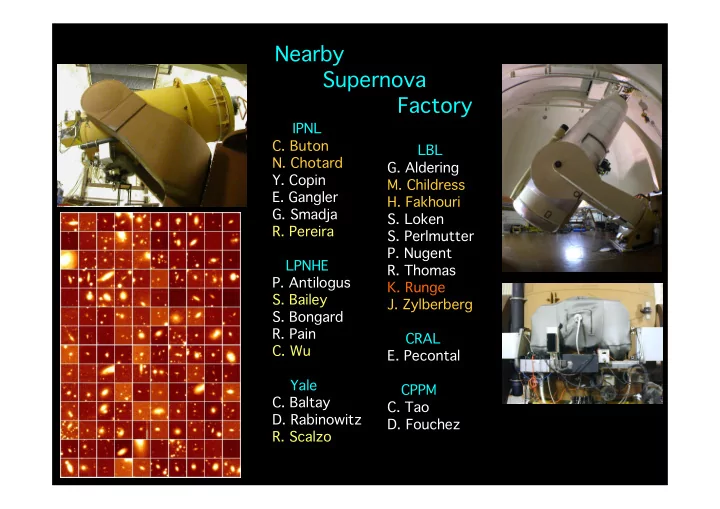
Nearby Supernova Factory IPNL C. Buton LBL N. Chotard G. - - PowerPoint PPT Presentation

nearby supernova factory
SMART_READER_LITE
LIVE PREVIEW

Nearby Supernova Factory IPNL C. Buton LBL N. Chotard G. - - PowerPoint PPT Presentation

Nearby Supernova Factory IPNL C. Buton LBL N. Chotard G. Aldering Y. Copin M. Childress E. Gangler H. Fakhouri G. Smadja S. Loken R. Pereira S. Perlmutter P. Nugent LPNHE R. Thomas P. Antilogus K. Runge S. Bailey J. Zylberberg


slide-1
SLIDE 1

LBL

  • G. Aldering
  • M. Childress
  • H. Fakhouri
  • S. Loken
  • S. Perlmutter
  • P. Nugent
  • R. Thomas
  • K. Runge
  • J. Zylberberg

CRAL

  • E. Pecontal

CPPM

  • C. Tao
  • D. Fouchez

IPNL

  • C. Buton
  • N. Chotard
  • Y. Copin
  • E. Gangler
  • G. Smadja
  • R. Pereira

LPNHE

  • P. Antilogus
  • S. Bailey
  • S. Bongard
  • R. Pain
  • C. Wu

Yale

  • C. Baltay
  • D. Rabinowitz
  • R. Scalzo

Nearby Supernova Factory

slide-2
SLIDE 2

A New Paradigm

  • Search at low redshift just like at high redshift
  • boost discovery rate
  • wide-field, impartial to presence of an associated galaxy
  • find better analogs to high-redshift environment
  • Fully integrate photometry and spectroscopy
  • for photometry:
  • Eliminate K-corrections and S-corrections
  • Tackle dust extinction using more colors
  • Eliminate atmospheric dispersion degeneracies
  • for spectroscopy:
  • Spectroscopy for more SNe
  • Time series of spectra for each SN
  • Properly subtract host galaxy light
  • Eliminate effects of slit losses and atmospheric dispersion
slide-3
SLIDE 3

Abundance Tomography Kinematics Luminosity Indicators

Getting to the Physics with Spectroscopy

slide-4
SLIDE 4

Nearby Supernova Factory Search

+ = +

QUEST Camera Oschin Schmidt HPWREN

+

NERSC

slide-5
SLIDE 5

SNe over 2π of the Sky

More than 1000 SNe in ~28 months of searching during 2005-2008

slide-6
SLIDE 6

SNe over 2π of the Sky

624 SNe w/ spectroscopic types - mostly from the SuperNova Integral Field Spectrograph

UH88 SNIFS

396 SNfactory & 50 IAUC SNe Ia

slide-7
SLIDE 7

We faced fire and brimstone to get the data!

Fire sweeps antenna site at North Peak Fire closes Palomar Observatory Mag 6.7 earthquake hits Mauna Kea

slide-8
SLIDE 8

SNfactory

Type Ia Redshift Distributions

slide-9
SLIDE 9

Library of Spectral Time Series

slide-10
SLIDE 10

Now Several Paths to SN Hubble Diagram

Stretch-Color

R(SiSS)-Color R(642/443)

σ = 0.156 nMAD = 0.153 σ = 0.139 nMAD = 0.140 σ = 0.125 nMAD = 0.110

Bailey Bailey et et al, al, 2009 2009

slide-11
SLIDE 11

SNF20080720-001

R642/443 Handles Difficult Cases

slide-12
SLIDE 12

Stretch-Color Hubble Diagram

0.0 1.0 2.0 Redshift 35 40 45

Miknaitis et al. (2007) Astier et al. (2006) Riess et al. (2006) Knop et al. (2003) Amanullah et al. (2009) Amanullah et al. (2008) Barris et al. (2003) Tonry et al. (2003) Perlmutter et al. (1999) Riess et al. (1998) + HZT Holtzman et al. (2009) Supernova Factory LA Set Hicken et al. (2009) Kowalski et al. (2008) Jha et al. (2006) Riess et al. (1996) Krisciunas et al. (2005) Hamuy et al. (1996)

Note Note -

  • offset
  • ffset still

still blinded! blinded!

courtesy D. Rubin

slide-13
SLIDE 13

Have We Seen the Double-Degenerates?

z = 0.123

slide-14
SLIDE 14

Galaxy Luminosity Galaxy Metallicity

Environmental Clues and Constraints

Mike Childress PhD thesis

slide-15
SLIDE 15

Tunable laser (Opotek) Second harmonic (532 nm) generator Mixer (to 355 nm) 1.06 micron Nd:YAG pulsed laser Tunable downconverer Optical fiber

A/D converter module Photdiode preamp USB extender Integrator electronics Calibrated photodiode Beam launch optics Optical Fiber

Technique:

  • Illuminate flat field screen with

monochromatic laser light from a tunable laser, and take a spectral image at each λ.

  • Deliver a fixed “dose” of light to the system,

as measured by a NIST calibrated photodiode.

  • Measuring the flatfield flux relative to that

seen by the photodiode allows the measurement of the total system throughput, in situ, relative to the well-characterized diode.

Courtesy C. Stubbs

slide-16
SLIDE 16

Work for the Coming Year

  • SNIFS
  • Complete final references for 2005-2008 SNe
  • Follow-up of SNe Ia targeted by HST/STIS
  • Supplement current sample with other interesting SNe
  • Development of absolute color calibration system
  • Cosmology analysis
  • Finalize flux calibration
  • Complete host galaxy redshifts
  • Finalize host subtraction pipeline
  • Spectral analysis
  • Develop new/improved spectral luminosity indicators
  • Abundance tomography
  • Spectral temporal-luminosity model, F(λ,t,s)
slide-17
SLIDE 17

Summary

  • Several fundamentally different standardization methods have been

demonstrated to work well using spectrophotometric data.

  • New methods using spectrophotometry are showing significant

improvement over imaging based methods.

  • Type Ia population dominated by SNe standardizable to 6%.
  • Highly-extincted SNe Ia can be standardized at optical wavelengths

– more examples needed to break intrinsic color - dust degeneracy

  • Oddball SNe Ia and those in low-luminosity hosts help probe progenitor

properties.

  • Deeper understanding of SNe Ia for cosmology demands spectrophotometry