NCWCD Conveyance (Carter Lake Pipeline) Project budget ( 2 0 0 8 -2 - - PowerPoint PPT Presentation

ncwcd conveyance carter lake pipeline
SMART_READER_LITE
LIVE PREVIEW

NCWCD Conveyance (Carter Lake Pipeline) Project budget ( 2 0 0 8 -2 - - PowerPoint PPT Presentation

NCWCD Conveyance (Carter Lake Pipeline) Project budget ( 2 0 0 8 -2 0 0 9 ) $1M Design $25M - Construction For the Carter Lake Pipeline, we have budgeted $1M in 2008 for design and $25 in 2009 for construction. This project is one of only


slide-1
SLIDE 1

1

NCWCD Conveyance (Carter Lake Pipeline)

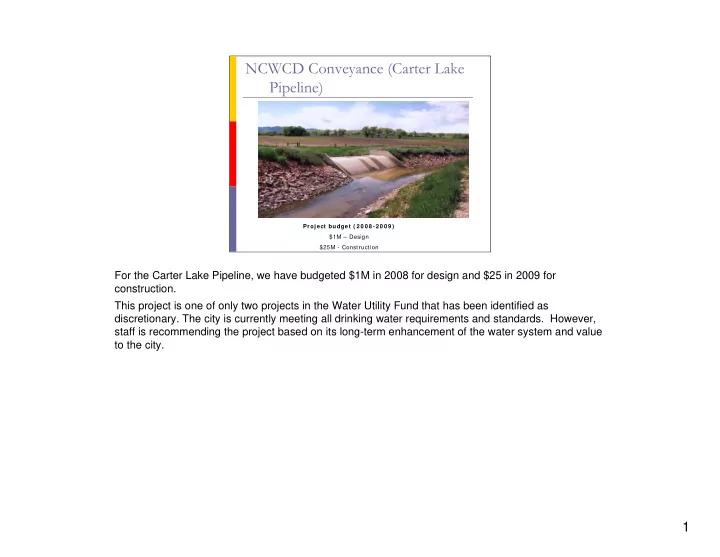
Project budget ( 2 0 0 8 -2 0 0 9 ) $1M – Design $25M - Construction

For the Carter Lake Pipeline, we have budgeted $1M in 2008 for design and $25 in 2009 for construction. This project is one of only two projects in the Water Utility Fund that has been identified as

  • discretionary. The city is currently meeting all drinking water requirements and standards. However,

staff is recommending the project based on its long-term enhancement of the water system and value to the city.

slide-2
SLIDE 2

2

History

Boulder Reservoir/ Feeder Canals - 1950s Boulder Reservoir WTP – 1970s

  • Used as peaking plant through the 1980s
  • Now operates year round
  • Currently 30% of city’s drinking water
  • Will increase to 50% at build-out

First pipeline from Carter Lake - 1990s

Boulder Reservoir/Feeder Canal - 1950s Boulder Reservoir WTP – 1970s

  • Used as a summer peaking plant through the 1980s
  • Now operates year round
  • Currently 30% of city’s drinking water
  • Will increase to 50% at build-out

First pipeline from Carter Lake – early 1990s

slide-3
SLIDE 3

3

Current Issues

Canal Water Quality

  • contaminants (microbial pathogens and micro-

pollutants)

  • spiking events (dumping)
  • proposed recreational trail

Reservoir Water Quality

  • manganese
  • taste and odor
  • total dissolved solids
  • proposed increased recreation activities

Water Supply Vulnerability

Canal Water Quality The quality of the water delivered from Carter Lake through the 21-mile long, open, earthen canal experiences significant degradation.

  • 1. Contaminants
  • microbial pathogens - irrigation return flows, wildlife/domestic animals and adjacent septic systems
  • micro-pollutants – agricultural pesticides and herbicide used along the canal for weed control - We have shut down the treatment plant 4 times this

month because of routine canal maintenance that has used an approved herbicide of low-toxicity.

  • 2. Spiking events
  • rainwater runoff from agricultural land as well as accidental and intentional dumping
  • 3. Proposed recreational trail
  • The Boulder Feeder Canal Recreation Trail CEAP identified concerns about increased recreation and specific short-term conditions (fencing,

restrooms, and construction techniques) were approved, recognizing that a pipeline may be the best long-term solution Reservoir Water Quality Boulder Reservoir is subject to additional degradation primarily from the dissolution of naturally occurring minerals in Boulder Reservoir sediments measured as total dissolved solids including sodium, sulfate and hardness. Other water quality issues include:

  • 1. Manganese – this is a significant problem due to seasonal oxygen depletion that will be addressed by the recommended mid-term treatment

improvements scheduled for 2008-2009

  • 2. Taste and odor – the water occasionally has objectionable tastes and odors that are the result of seasonal algal blooms
  • 3. The approved P&R Master Plan identified the need to increase recreation activity at Boulder Reservoir, thus raising the risk related to water quality

due to body contact and motor boating activities. Water Supply Vulnerability Security Vulnerability Assessment of Boulder’s water supply system, which was done in 2003 as mandated by Public Law 107-188, identified the Boulder Feeder Canal as our most vulnerable supply. Recommended ways to reduce risk would be 24-hour patrols of the canal or a pipeline

slide-4
SLIDE 4

4

Contaminants of Concern

Here is a list of the various contaminants of concern, the corresponding drinking water regulation and symptoms.

slide-5
SLIDE 5

5

50 100 150 200 250 CFU/100mls 97 98 99 '00 '01 '02 '03 '04 '05 '06 Year

Avg month (June-October) Max month (June-October)

Increased Degradation in Canals

Fecal coliform through 2003 E coli 2004 through 2006 480

Degradation increasing – 2006 data is due to large amount of water that was delivered by the NCWCD to agricultural users via the Boulder Feeder Canal that provided contaminant dilution.

slide-6
SLIDE 6

6

Increased Degradation in Boulder Reservoir

40 80 120 160 200 CFU/100mls 97 98 99 '00 '01 '02 '03 '04 '05 '06 Year

Avg month (June-October) Max month (June-October)

Fecal coliform through 2003 E coli 2004 through 2006

Degradation increasing – 2006 data is due to large amount of water that was delivered by the NCWCD to agricultural users via the Boulder Feeder Canal that provided contaminant dilution.

slide-7
SLIDE 7

7

Alternatives Evaluated

  • 1. Mid-term improvements only

(chlorine dioxide - ClO2)

  • 2. ClO2 & ultraviolet (UV) disinfection
  • 3. ClO2 & UV & granular activated

carbon (GAC)

  • 4. ClO2 & membrane filtration
  • 5. ClO2 & ozone
  • 6. ClO2 & Carter Lake Pipeline

Alternatives have been evaluated with differing professional opinions. Mid-term improvements only (chlorine dioxide - ClO2) ClO2 & ultraviolet (UV) disinfection ClO2 & UV & granular activated carbon (GAC) ClO2 & membrane filtration ClO2 & ozone ClO2 & Carter Lake Pipeline

slide-8
SLIDE 8

8

Net Present Cost of Alternatives

$5.2 M $9.28 M $53.41 M $29.25 M $26.65 M $17.12 M

slide-9
SLIDE 9

9

Staff Recommendation – Invest in Carter Lake Pipeline Now

Protects water quality Increases reliability, flexibility and

consistency

Investment in the future Construction costs and financing

Staff recommends that the pipeline planning, design and construction proceed as soon as possible. There does not appear to be any significant community or environmental impacts of the project that cannot be mitigated. Permits will be required from both Larimer and Boulder Counties as a Matter of State Interest (1041J). Staff rational includes first and foremost: Protects water quality

  • 1. Carter Lake water quality is excellent - similar to other city water sources such as Barker and Silver Lake Reservoirs.
  • 2. Prevent pollutants from entering the water – staff’s fundamental belief is that in providing safe drinking water, it is always better to prevent pollutants

from getting into the water (build a pipeline) than to allow the pollutants to get into the water and then try to remove them. Increases reliability, flexibility and consistency

  • 1. Provides a reliable delivery facility from Carter Lake that is essentially immune from the vagaries of the weather, existing land use impacts and future

development that is available for year round delivery of water to the Boulder Reservoir WTP.

  • 2. Provides greater water rights flexibility by allowing for the winter delivery of water directly from the Carter Lake storage pool, freeing up our winter

storage pool in Boulder Reservoir for other water from either Boulder Creek or the District.

  • 3. Provides greater water quality consistency that matches Boulder Creek water sources and allows treatment processes to be better optimized with

less treatment expense. Investment in the future

  • 1. Opportunity to cost share with other providers
  • 2. Available right-of-way - An alignment within the existing right-of-way (ROW) of the pipeline constructed in 1995 from Carter Lake to Broomfield is

currently available. Construction costs and financing

  • 1. Future construction costs and difficulties - During the past five years, heavy construction costs have escalated at 22.5 to 50 percent, based on the

Engineering News Record or Colorado Department of Transportation Construction Cost Indices, respectively. Delaying the construction of the pipeline may result in substantially higher costs at a later date.

  • 2. If the Carter Lake Pipeline is not constructed, it is likely the city will need to invest in additional treatment processes in the future. Although the

treatment processes may not be as costly to construct initially, they require higher on-going operation and maintenance costs and do not have as long a useful life as the pipeline.

  • 3. Current low interest rates - Revenue bonds to fund the project would be issued and, although interest rates are no longer at historic lows, they

remain very favorable.

  • 4. Competitive water rates – the city’s current water rates are very competitive when compared with other front range communities
slide-10
SLIDE 10

10

Investment for the Future

Construction of

Lakew ood Pipeline in 1 9 0 6 and Silver Lake Pipeline in 1 9 19

Purchase of lands in

the Silver Lake W atershed and closure to public access

Purchase of Barker

system fed by land in W ilderness Area w ith w ater carried in pipeline

Previous wise investments in the water system Previous wise investments in the water system include source water protection and pipeline include source water protection and pipeline carriage as a preferred method of providing high carriage as a preferred method of providing high quality drinking water quality drinking water

Previous wise investments in the water system include source water protection and pipeline carriage as a preferred method of providing high quality drinking water:

  • Construction of Lakewood Pipeline and Silver Lake Pipeline
  • Purchase of lands in the Boulder Creek watershed and closure to public access
  • Purchase of Barker water system including pipeline conveyance facilities

The Carter Lake Pipeline Project has been included in the city’s Federal Priorities and lobbying efforts and has received support from several elected officials. While federal funds have not been appropriated for this project, there is still a possibility that federal funds may be appropriated in the next 1-3 year period.

slide-11
SLIDE 11

11

Carter Lake Pipeline Allocation

The city currently has the opportunity to leverage money for construction of the pipeline with several

  • ther agencies including the Left Hand Water District, the Little Thompson Valley Water District and

the Town of Frederick. The city and these agencies recently completed a feasibility study and are currently developing permit applications for the pipeline project through the Northern Colorado Water Conservancy District (NCWCD).As a result of the recent news articles about the pipeline project, Left Hand Water District, one of the other partners, has written NCWCD to say they want to continue with this project even if Boulder elects not to continue.

slide-12
SLIDE 12

12

Front Range Water Bill Comparison

While drinking water is certainly more expensive today than 10 years ago, our 2007 rates (with water budgets) show that, when compared to other front range cities, our single family customers are at the lower end of the spectrum.

slide-13
SLIDE 13

13

WRAB Recommendation

  • Delay Construction of the Carter Lake

Pipeline (3-2 vote):

1.

Construct treatment alternatives (chlorine dioxide, ultra violet disinfection or alternates)

2.

Implement canal bypasses and other best management practices for the Boulder Feeder Canal

3.

Wait until bonded indebtedness has been significantly reduced

The WRAB did not agree with the staff recommendation and voted 3-2 at their June 28 meeting to delay construction of Boulder’s portion of the Carter Lake Pipeline and consider it as a future phase for implementation, after the following actions have occurred: Construction of planned treatment improvements at the WTP have been completed (anticipated to be 2010) Reduction or elimination of existing discharges from adjacent properties into the Boulder Feeder Canal A significant reduction of the existing bonded indebtedness (existing revenue bonds are scheduled to be paid off in 2016, 2019, 2020 and 2021). The WRAB’s primary concern was the rate increases that would be necessary to fund the pipeline when the water currently meets regulatory standards. Dissenting board members supported the staff recommendation and indicated that the pipeline is a necessary improvement to protect the safety of the water and it is better not to delay the project.

slide-14
SLIDE 14

14

Planning Board Recommendation

Supported staff recommendation to

proceed with construction of Carter Lake Pipeline (6-0 vote)

Planning Board supported staff recommendation to proceed with construction of Carter Lake Pipeline (6-0 vote):

slide-15
SLIDE 15

15

Projected Rate Increases

no Pipeline w ith Pipeline

2 0 0 9 5% 10% 2 0 1 0 5% 10% 2 0 1 1 6% 12%

This slide shows the projected rate increases in the years 2009-2011 with and without the pipeline.

slide-16
SLIDE 16

16

Next Steps

  • 2008 budget process - $1M for design
  • nly (would only be spent contingent on

Community and Environmental Assessment Process (CEAP) approval

  • Complete CEAP in early 2008
  • 2009 budget process – $25M

construction funding

  • Issue revenue bonds and begin

construction – late 2009

The next step would be to complete the Community and Environmental Assessment Process (CEAP) with money already appropriated in the existing 2007 budget. Although staff is requesting that City Council appropriate $1 million in the 2008 budget for design of the pipeline, these funds would not be spent until the CEAP is approved by City Council. In addition, the projected expense of $25 million in 2009 is also conditional on approval of the CEAP and final City Council action to issue revenue bonds.

slide-17
SLIDE 17

17

Questions for Council:

1.

Would Council like to schedule a separate study session or public hearing to consider more information regarding this issue?

2.

Should staff proceed with the Community and Environmental Assessment Process (CEAP) with money appropriated in the existing 2007 budget?

  • 1. Would Council like to schedule a separate study session or public hearing to consider more

information regarding this issue?

  • 2. Should staff proceed with the Community and Environmental Assessment Process (CEAP) with

money appropriated in the existing 2007 budget?

slide-18
SLIDE 18

18

Questions for Council:

3.

Should $1 million for design of the Carter Lake Pipeline be budgeted in 2008 with the understanding that no design money will be spent until the CEAP is approved?

4.

What additional information does Council need to make this decision?

5.

Should staff continue to pursue Federal funding for the pipeline?

  • 3. Should $1 million for design of the Carter Lake Pipeline be budgeted in 2008 with the

understanding that no design money will be spent until the CEAP is approved?

  • 4. What additional information does Council need to make this decision?
  • 5. Should staff continue to pursue Federal funding for the pipeline?