Natural Ester Dielectric Fluid Overview Envirotemp FR3 NWPPA - - PowerPoint PPT Presentation

natural ester dielectric fluid overview
SMART_READER_LITE
LIVE PREVIEW

Natural Ester Dielectric Fluid Overview Envirotemp FR3 NWPPA - - PowerPoint PPT Presentation

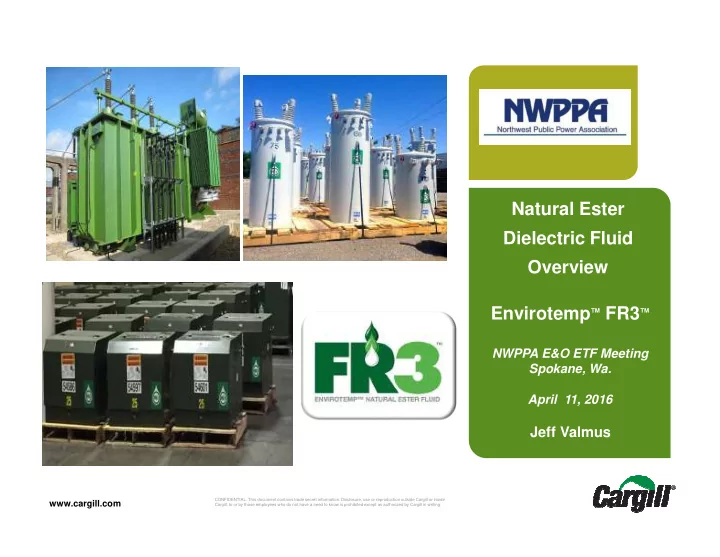
Natural Ester Dielectric Fluid Overview Envirotemp FR3 NWPPA E&O ETF Meeting Spokane, Wa. April 11, 2016 Jeff Valmus CONFIDENTIAL. This document contains trade secret information. Disclosure, use or reproduction outside Cargill


slide-1
SLIDE 1
  • CONFIDENTIAL. This document contains trade secret information. Disclosure, use or reproduction outside Cargill or inside
Cargill, to or by those employees who do not have a need to know is prohibited except as authorized by Cargill in writing.

Envirotemp™ FR3™

NWPPA E&O ETF Meeting Spokane, Wa. April 11, 2016

www.cargill.com

Natural Ester Dielectric Fluid Overview

Jeff Valmus

slide-2
SLIDE 2
  • Natural ester (dielectric fluid) insulating liquid is made

from the oil of naturally grown vegetables

  • Several different varieties have been made but the most

widely used is FR3 which is made from soybean oil

  • Initially designed to be an environmentally friendly

alternative to less flammable dielectric fluids like PCBs and High Molecular Weight Hydrocarbons

  • Commercially began using in transformers in 1996

8

What is Natural Ester Dielectric Fluid?

2

slide-3
SLIDE 3

Validated by industry

Meets IEEE and IEC standards

  • More than 250 series of tests

conducted on FR3 fluid

  • IEEE C57.154 and IEC 60076-14

High temperature insulation system standard enables up to 85 rise new transformer designs

Classified as a less flammable fluid (K-class)

  • Underwriters Laboratory
  • FM Global

Environmental testing

  • Carbon neutral according to BEES 4.0

lifecycle analysis

  • Ultimately biodegradable by EPA
  • Non-toxic and non-hazardous in soil and

water by OECD

Industry recognition

  • 2013 Presidential Green Chemistry Award
  • 2013 EPA Design for the Environment (DfE)

designation (SaferChoice label)

  • USDA BioPrefered Program
  • EPA Environmental Technology Verification

California Environmental Technology Certification

  • FERC ruling – Retrofills with FR3 fluid may

be capitalized

3 Cargill FR3™ fluid overview

slide-4
SLIDE 4

Over 1,000,000 natural ester fluid- filled transformers in service globally

25,000 medium & large power transformers

15,000 indoor units

50,000 substations

10,000 retrofills

FR3 fluid approved for transformers up to 500kV

¯ HV testing validates usage through 500kV ¯ Siemens 420kV loaded in 2013, Germany ¯ 500kV transmission line for Electronorte, Brazil ¯ 345KV transmission line for Bureau of Reclamation, US

Over 100 utilities, including many complete adapters

  • PGE, EWEB, SCL, PG&E, SMUD, etc.
  • Many Munis, Coops, and RECs

Over 100 global OEMs applying and promoting technology Types of installations

− Industrial/Commercial − Utility − Network transformers − New and retrofill applications

Proven, global installations

10

slide-5
SLIDE 5

How are Natural Esters different from mineral oil

  • Fire safety
  • No fires, cleanup, downtime, or replacement costs
  • Protects nearby equipment and buildings
  • Greatly reduced risk to personnel
  • Reduced clearance requirements and preventative equipment
  • Optimized transformer performance
  • Insulation system up to 8X* extended lifespan
  • Transformer asset extended lifespan
  • Increased overload capability
  • Enables smaller, lighter (75-85C rise) designs
  • Environmental
  • FR3 fluid produced from domestic soybeans
  • Environmental safety (no hazardous fumes, fires, reduced

spill mitigation)

  • Petroleum independent
  • Reduced carbon emissions
  • Biodegradable/non-toxic, recyclable, and sustainable

5

slide-6
SLIDE 6
  • Natural ester dielectric fluid fire point = 360oC
  • Zero fire history in natural ester fluid filled

transformers*

  • UL Classified and FM Approved*
  • Eliminate deluge systems and fire walls
  • Reduced clearances
  • Simplified containment designs

6

Fire point is most critical factor for transformer fire safety

slide-7
SLIDE 7

Fire wall Natural ester simplified border Mineral oil containment and suppression rocks

Mineral oil transformer Natural ester fluid transformer

Automatic fire suppression system Building Reduced clearance

7

slide-8
SLIDE 8

Simpler containment system

Typical Containment system for Mineral Oil

Designed to 110% of larger equipment oil volume + rain water + fire fighting system water, automatic or manual

Rocks for flame suppresion Sump

Oil + Rocks volume

Oil / Water separation tank Simplified sump proposed for Envirotemp FR3 (if required)

Designed for larger equipment oil volume + rain water Manual or Automatic draining system Fluid volume + rain water 8

slide-9
SLIDE 9

Natural ester fluid is a better choice for the communities you serve

9

  • Made from a renewable resource
  • >98% vegetable oil
  • Carbon neutral*
  • Contains no petroleum, halogens, silicones or sulfurs
  • Non-toxic, non-hazardous in water and soil
  • OECD oral and aquatic toxicity test
  • Biodegrades in 28 days or less
  • Ultimately biodegradable according Environmental Protection Agency (EPA)
  • Recyclable and Sustainable

* According to BEES 4.0 lifecycle analysis

slide-10
SLIDE 10

Biodegradable Non-toxic

FR3 fluid is biodegradable and non-toxic on both soil and water.

Best-in-class environmental properties

10

slide-11
SLIDE 11

Using FR3 fluid results in simpler, less costly spill remediation

11

Mineral Oil

– Low viscosity – Fast seepage (infiltration) – May reach water reservoir – Biodegradation very slow – Very high remediation cost – Causes a sheen

Water Soil Tap Water

FR3 fluid

– Non toxic – Seepage very slow – Ready and complete biodegradation – Very low remediation cost – No sheen

Water Soil Tap Water

slide-12
SLIDE 12

Industry recognized best-in-class environmental fluid

12

slide-13
SLIDE 13

Transformer Design and Operational Optimization

13

slide-14
SLIDE 14

Improve reliability: Extend insulation and asset life 5-8x longer than mineral oil

Unique chemistry of FR3™ fluid protects insulating paper by:

  • il

14

  • Hydrolysis of natural ester

“consumes” the water and produces fatty acids. This process removes dissolved water

  • FR3™ Fluid is in essence

‘self drying.’ Water concentrations in the fluid will be reduced due to hydrolysis

  • ver time.
  • FR3 fluid can absorb

significantly more water than mineral oil

  • FR3 fluid has 10 times the

water saturation (PPM) than mineral

Protecting life of insulation paper is the number

  • ne factor that determines asset life
slide-15
SLIDE 15

Life “Triangle” flexibility extends transformer life or increases load capacity

15

  • IEEE C57.154 High temperature

insulation system standard

− Current standard 110oC hot spot with 65 AWR limits transformer capability − FR3 fluid in TR designed for MO will extend insulation system life − Envirotemp™ FR3™ fluid-based insulation systems can be run 20oC warmer without degrading life

S.E.E. Overhead Distribution Committee Meeting, April 30, 2015

1 3 2

slide-16
SLIDE 16

Life Extension and Improved Reliability

  • Insulation system will not be

transformer failure mode

  • Improved reliability and reduced

catastrophic failure potential

  • Extend residual life of transformer,

while gaining fire and environmental safety

16

slide-17
SLIDE 17

Life Extension:

SMUD achieves total cost savings through extended asset life

17 Transformer description Purchase price PV TOC with mineral oil dielectric (30-year life) PV TOC with FR3 fluid (40-year life) PV TOC difference Present value benefit over purchase price

15kVA Pole Type $385 $1,317 $1,187 $130

34%

50kVA 1 Phase Pad $1,102 $3,001 $2,688 $313

28%

150kVA 3 Phase Pad $4,385 $7,967 $7,026 $941

21%

COMPARE MINERAL OIL 30-YEAR LIFE WITH 40-YEAR EXTENDED LIFE WITH FR3 FLUID

slide-18
SLIDE 18

ALL DISTRIBUTION PAD/POLE MINERAL OIL FR3 FLUID NET PRESENT COST OF INVESTMENT (1ST COST) $25,635,713 $21,203,178 NET PRESENT COST OF LOSSES (COL) $164,032,188 $159,729,498 NET PRESENT TOTAL OWNING COST (TOC) $189,667,902 $180,932,676 NET PRESENT SAVINGS ON FIRST COSTS $4,432,535 FIRST YEAR % INCREASED FIRST COST 7.87% % NET PRESENT SAVINGS ON FIRST COSTS 28.77% NET PRESENT SAVINGS ON TOC $8,735,226 % NET PRESENT TOTAL SAVINGS (FC&TOC ON INVESTMENT WITH FR3) 56.70% 5 NET PRESENT SAVINGS TO CUST (COL WITH FR3 VS COL WITH MINERAL OIL 2.62% 1P OVERHEAD POLE TX MINERAL OIL FR3 FLUID NET PRESENT COST OF INVESTMENT (1ST COST) $11,965,954 $9,868,006 NET PRESENT COST OF LOSSES (COL) $68,696,825 $68,539,242 NET PRESENT TOTAL OWNING COST (TOC) $80,862,779 $78,407,248 NET PRESENT SAVINGS ON FIRST COSTS $2,097,948 FIRST YEAR % INCREASED FIRST COST 7.29% % NET PRESENT SAVINGS ON FIRST COSTS 35.50% NET PRESENT SAVINGS ON TOC $2,255,530 % NET PRESENT TOTAL SAVINGS (FC&TOC ON INVESTMENT WITH FR3) 40.24% 5 NET PRESENT SAVINGS TO CUST (COL WITH FR3 VS COL WITH MINERAL OIL 0.23% 1P AND 3P PAD MOUNT TX MINERAL OIL FR3 FLUID NET PRESENT COST OF INVESTMENT (1ST COST) $13,669,760 $11,335,173 NET PRESENT COST OF LOSSES (COL) $95,335,363 $91,190,225 NET PRESENT TOTAL OWNING COST (TOC) $109,005,123 $102,525,428 NET PRESENT SAVINGS ON FIRST COSTS $2,334,587 FIRST YEAR % INCREASED FIRST COST 8.36% % NET PRESENT SAVINGS ON FIRST COSTS 24.17% NET PRESENT SAVINGS ON TOC $6,479,695 % NET PRESENT TOTAL SAVINGS (FC&TOC ON INVESTMENT WITH FR3) 67.09% 5 NET PRESENT SAVINGS TO CUST (COL WITH FR3 VS COL WITH MINERAL OIL 4.35%

FINANCIAL ANALYSIS SUMMARY – Tampa Electric

56% SAVINGS OVER 40 YEARS. $8.7MILLION PER YEAR
slide-19
SLIDE 19

Overload Capability

  • Existing transformer

land-locked (footprint)?

  • At or above rated load?
  • Ability to handle

increased load with same equipment

19

slide-20
SLIDE 20

SDG&E Overload Study

20

  • In comparing a 50kVA unit at 65AWR MO allows for a four hour peak
  • verload of 149% versus FR3 at 178% and 8 hour peak of 130%

compared to 154%.

  • A 50kVA FR3 unit at 75AWR allows for a 4 hour overload of 158% versus

149% for MO at 65AWR. Unit can be designed smaller and still have greater overload capacity.

  • OEMs Conclusion:

“FR3 65C increases overload by 25-30% over Mineral Oil 65C and FR3 75C increases overload by 5-10%.”

slide-21
SLIDE 21

OEM Loading Capability of 50kVA Distribution Transformers Solar PV Peak Load Capability HECO

21

MO and FR3 50kVA 65C Rise

MO FR3

Extra LOL per day 0.00% 0.00% Base Equivalent Load 50% 50% Peak Overload Duration (hrs) 1 244% 282% 2 204% 235% 3 181% 209% 4 167% 193% 5 157% 181% 6 150% 173% 7 144% 166% 8 140% 161% 24 112% 130%

  • FR3 is capable of 20-30% higher overloads than MO

without sacrificing insulation life.

slide-22
SLIDE 22

Transformer Optimization

  • Reduce the size of

the footprint

  • Reduce first cost
  • Reduce no load

losses and optimize $/kv

22

slide-23
SLIDE 23

Example: Achieve first cost savings without sacrificing reliability

50 kVA 37.5 kVA 37.5 kVA Fluid MO FR3 MO AWR 65 75 75 Price 100% 89.4% 79.1% NLL/LL 96/571 81/438 74/480 Weight (kg) 100% 78.9% 75.5% Expected Life 1.0 1.6 0.3

23

  • Smaller installed kVA
  • Improved Loss profile
  • Less size and weight
  • Longer life potential
  • Improved reliability
  • Assumptions:

– $4.00/NL Watt – $0.50/LL Watt – TOC for FR3 fluid favorable

Current Behavior

Cargill FR3™ fluid overview

slide-24
SLIDE 24

Total Owning Cost v. Loading

$0.00 $500.00 $1,000.00 $1,500.00 $2,000.00 $2,500.00 $3,000.00 25% 50% 75% 100% 125% 150% 175% 37.5 FR3 65 C 50 M 65 C 37.5 FR3 75 C

Loading T O C

MO 100% Load = 1.0 (Service Life approx. 20 years) FR3 100% Load @ 65C= 7.4X MO Life FR3 100% Load @ 75C= 3.2X MO Life

slide-25
SLIDE 25

CPFL in Brazil reduced first cost with more efficient distribution transformer design

25

Conventional Three-Phase Transformer Power: 45 KVA Tensions at HT: 11400 V a 13800 V Tensions at LT: 127/ 220V Weight: 959 lbs.. (435kg) Liters: 24 gal. (90 liters) Price/kVA: R$ 84.40 Green Three-Phase Transformer Power: 88 KVA Tensions at HT: 11400 V a 13800 V Tensions at LT: 127/220 V Weight: 772 lbs.. (350kg) Liters: 21 gal. (81 liters) (biodegradable oil) Price/kVA (estimated): R$ 53.40 BRAZIL’S LARGEST PRIVATELY-OWNED ELECTRICITY COMPANY MIGRATING ITS ENTIRE NETWORK TO FR3 FLUID. 5,000 GREEN TRANSFORMERS ALREADY IN OPERATION.

slide-26
SLIDE 26

In Conclusion: Natural Ester Dielectric Fluid

26

  • Prevents fires from occurring in operating transformers
  • Is environmentally friendly, renewable, recyclable and sustainable
  • Is applicable for new and retrofill transformers and voltage regulators
  • Provides for extended life and a lower overall cost with positive NPV
  • Allows for smaller kVA installation with lower losses and initial costs
  • Overload capability without additional loss of life
slide-27
SLIDE 27

Thank You

27

slide-28
SLIDE 28

Appendix

28

slide-29
SLIDE 29

Fluid Comparison

29

slide-30
SLIDE 30

Dielectric fluid comparison

30

Mineral Oil Natural Ester Synthetic Ester Silicone Oil Diagnostic Capability Yes Yes Yes Less Fire point 160oC 360oC 310oC 340oC Biodegradability No Ultimately Readily No Toxicity Toxic Non-toxic Less toxic Toxic Biobased No Yes No No Oxidation Good Limited (non-free

breathing)

Good Good Aging Average Best Better Average Cost $ $$ $$$ $$

slide-31
SLIDE 31

Fluid differences impact performance

31

Fluid Characteristics Mineral Oil FR3™ Fluid

Transformer performance 65 AWR 110ºC hottest spot 85 AWR 130ºC hottest spot Allows for overload or life extension Reliability-dielectric strength Dielectric strength declines as heat increases due to water saturation Ability to hold 10 times more water Retains dielectric strength as heat increases Self Drying Hydrolysis “consumes” the water Fire safety Flash point 155ºC Fire point 160ºC Flash point 330ºC Fire point 360ºC Environmental footprint Non-biodegradable Costly spill remediation Non toxic, non-hazardous in soil and water Carbon neutral Biodegradable in 28 days Field experience 120 years of field experience 20 years of field experience

SPCAA Presentation – May 13, 2014

slide-32
SLIDE 32

Technology Comparative Summary

MINERAL OIL

  • Low Temperatures
  • Diagnostic Testing Capability
  • Fires when happen major hazard
  • Fire Hazard in Sensitive Areas
  • Increasing Environmental Regulation
  • Instability of Supply & Price
  • Lowest Cost

CAST RESIN DRY TYPE

  • Main use Indoor Locations (susceptible to

dirt/moisture)

  • Higher Temperatures & Losses
  • Sensitive to Overload & Harmonics
  • Regular Cleaning Required
  • Minimal Diagnostic Testing
  • Service Life Concerns
  • Large size
  • Highest Initial & Operating Cost

SILICONE

  • Good Fire Safety & Overall Reliability
  • Low Temperature
  • Not above 36kV
  • Less Diagnostic Testing Capability
  • Inferior Coolant & Dielectric
  • Not Suitable as Switching Medium
  • Not Biodegradable
  • Higher Cost

NATURAL ESTER (FR3 FLUID)

  • 100% Fire Safety
  • Readily Biodegradable
  • Sustainable, Renewable Supply
  • Superior Moisture Tolerance
  • Extends solid insulation lifespan
  • Sealed transformer only
  • Diagnostic testing capability
  • Higher cost

SYNTHETIC ESTER

  • 100% Fire Safety
  • Readily Biodegradable
  • Best Moisture Tolerance
  • Low Temperature
  • Superior Oxidation resistance
  • Diagnostic testing capability
  • Applicable in true free-breathing

transformers

  • Highest Cost
slide-33
SLIDE 33

FR3 fluid-filled transformer advantages versus dry-type transformers

  • Lower noise
  • Lower temperature
  • Higher efficiency
  • Longer life
  • Higher over loadability
  • Higher BIL
  • Full diagnostic capability
  • Contamination resistance
  • Improved fire safety
  • Smaller footprint
  • Lower initial price

Dry type transformers do burn!

33 33

slide-34
SLIDE 34

Dry-type vs. less flammable liquid filled: Practical size comparisons

34

slide-35
SLIDE 35

2500 kVA transformer

Transformer energy efficiency is determined by dividing its nameplate rating by the sum of its nameplate rating plus its total losses A small difference in energy efficiency can be significant when valued over the life of the transformer

Comparative transformer performance

EFFICIENCY

35

slide-36
SLIDE 36

Liquid Cast Dry Total Losses @ 50% Load (kW): 6.76 12.18 12.25 kW⋅h Billing Rate: x $0.06 $0.06 $0.06 Annual Hours: x 8760 8760 8760 Cost of Energy for Losses: = $3,553 $6,402 $6,439 Excess Annual Energy Costs: Base $2,849 $2,886 10-Yr* Excess Energy Costs: Base $28,488 $28,855

ALSO: transformers losses are dissipated as heat, which must be removed from a controlled temperature environment by air conditioning. For both examples the 10-year air conditioning cost difference is ~$14,000

Comparative transformer performance

EFFICIENCY

36

slide-37
SLIDE 37

History

37

slide-38
SLIDE 38
  • Natural ester insulating liquid
  • Vegetable Oil

¯ A wide variety available

¯ Not all “edible” ¯ Biobased, sustainable supply ¯ Key is to find balance between properties

8

What Is Envirotemp™ FR3™ fluid?

slide-39
SLIDE 39

39

FR3 Fluid Formulation Developed

ASTM Standard Published Envirotemp Dielectric Fluids Business Purchased by Cargill 19Jun12

FR3 Fluid Applied to 1st Transformer FR3 Fluid Commercially Available

IEC Standard Published IEEE Standard Published High Temp Insulation System Standards Published 1990 1995 2000 2005 2010 2015 DGA Standard Published

FR3 fluid timeline

slide-40
SLIDE 40

Free Breathing Designs Sealed Designs Thermally Upgraded Kraft Natural Esters

1880 1900 1930 1960 1990 2010 Common failure mode: mineral oil (sludge, a bi-product of oxidation) impacted heat transfer/dissipation Diagnostics put into practice 2020 High temperature materials standards Common failure mode: shifted to solid insulation; constrained by operating temperature Common failure mode: solid insulation; operating temperature increased 85oC AWR, 130oC HST 55oC AWR, 95oC HST 65oC AWR, 110oC HST Common failure mode: solid insulation; operating temperature increased

Transformer history (1890-present)

slide-41
SLIDE 41

Dielectric Fluid Functions:

  • 1. Electrical Insulator
  • 2. Coolant

Diagnostic capabilities

41 Dielectric Fluid

(fills inside of tank)

Dielectric fluid is used inside of transformers

slide-42
SLIDE 42

Hottest Spot Temperature (℃) Average Winding Rise (K)

(Top Temp - Bottom Temp)/2

Transformer insulation system is primary failure mode

  • Degrades over time, based upon temperature,

loading degree/cycle, & contaminants (water &

  • xygen)

Design limits defined by insulation system hot spot temperature (HST)

  • FR3 fluid demonstrates 20oC additional thermal

capability (compared to MO)

Economic value & opportunity

  • FR3 fluid’s thermal capability enables lower cost

per kVA, longer life, reduced transformer price, and positive NPV.

42

Transformer Design Constraints – Insulation System

slide-43
SLIDE 43

Standards

43

slide-44
SLIDE 44

Natural Esters Mineral Oil New Oil ASTM D6871 ASTM D3487 IEC 62770 IEC 60296 Use and Maintenance IEEE C57.147 IEEE C57.106 IEC 60422 Transformers IEEE C57.12.00 IEEE C57.12.00 IEC 60076 series IEC 60076 series IEEE C57.154 IEEE C57.154 IEC 60076-14 IEC 60076-14 Loading Guide (use MO std) IEC 60076-7 Dissolved Gases IEEE C57.155 IEEE C57.104 IEC 60599 Fire

– FM Global Property Loss Prevention Data Sheets, 5-4 Transformers – IEC 61936-1 Power installations exceeding 1 kV a.c. – Part 1: Common rules

Current List of Standards

4

slide-45
SLIDE 45

Table 2a. Separation Distance Between Outdoor Liquid Insulated Transformers and Buildings Liquid Approved Transformer

  • r Equivalent

Liquid Volume gal (m3) Two Hour Fire Resistant Construction ft (m) Noncombustible Construction ft (m) Combustible Construction ft (m) Vertical Distance ft (m) Yes N/A 5 (1.5) ≤ 10,000 (38) 25 (7.6) 25 (7.6) > 10,000 (38) 50 (15.2) 50 (15.2) < 500 (1.9) 5 (1.5) 15 (4.6) 25 (7.6) 25 (7.6) 500-5,000 (1.9-19) 15 (4.6) 25 (7.6) 50 (15.2) 50 (15.2) > 5,000 (19) 25 (7.6) 50 (15.2) 100 (30.5) 100 (30.5) 1) All transformer components must be accessible for inspection and maintenance. Table 2b. Outdoor Fluid Insulated Transformers Equipment Separation Distance1 Liquid Approved Transformer

  • r Equivalent

Liquid Volume gal (m3) Distance ft (m) Yes N/A 3 (0.9) ≤ 10,000 (38) 5 (1.5) > 10,000 (38) 25 (4.6) < 500 (1.9) 5 (1.5) 500-5,000 (1.9-19) 25 (4.6) > 5,000 (19) 50 (7.6) 1) All transformer components must be accessible for inspection and maintenance. Mineral Oil (or unapproved fluid) N/A distance from containment edge Less Flammable (Approved Fluid) distance from transformer No distance from transformer distance from containment edge Less Flammable (Approved Fluid) Mineral Oil (or unapproved fluid) No N/A Horizontal Distance1 3 (0.9) 5 (1.5) 15 (4.6)

Fire safety: FM Global risk mitigation

45

slide-46
SLIDE 46

FR3 fluid in application

46

slide-47
SLIDE 47

BASED ON THE PERFORMED TESTS AND SEVERAL PUBLISHED PAPERS, SEVERAL CONCLUSIONS CAN BE MADE:

Envirotemp FR3 Fluid Mineral Oil Transformer Design turn-to-turn = = coil-to-coil = = bushing-to-tank wall = = creep = = tap changer selector rod = = In-Service water contamination +++

  • particulate

contamination cellulose ++

  • copper

+

  • streaming electrification

++

  • bubble formation

+++

  • + better = the same – worse

Envirotemp FR3 Fluid Mineral Oil Electrode Geometry – Oil Gap uniform = = mildly divergent = = strongly divergent

  • +

Electrode Geometry – Creep mildly divergent = = strongly divergent

  • +

FR3 fluid has equivalent or superior dielectric strength to mineral oil

47

slide-48
SLIDE 48

LIST BELOW SHOWS MATERIALS TESTED AND APPROVED WITH FR3 FLUID

FR3 fluid is compatible with common transformer materials

48

slide-49
SLIDE 49

Overload Capability:

49

SDG&E Loading Calcs DOE 2016 designs, 65C Nameplate 12kV with taps, 120/240 Conventional

4hr Peak Load -Normal LOL 8 hr Peak Load -Normal LOL kVA Actual AWR 65C kVA Mineral Oil FR3 Mineral Oil FR3 10 28.9 17.5 244% 280% 217% 252% 15 40.2 20.9 198% 229% 176% 203% 25 54.5 28.3 167% 195% 146% 171% 37.5 62.3 38.6 149% 176% 131% 155% 50 64.6 50.2 149% 178% 130% 154% 50 75.0 n/a n/a 158% n/a 138% 75 63.8 76.0 151% 180% 132% 156% 75 75.0 n/a n/a 158% n/a 138% 100 64.7 100.3 153% 184% 132% 157% 100 75.0 n/a n/a 162% n/a 140% 167 64.9 167.2 150% 181% 131% 156% 167 75.0 n/a n/a 162% n/a 140%

slide-50
SLIDE 50

Loading Capability of Distribution Transformers 50kVA Solar PV Peak Load Capability HECO

50

50kVA Design Current MO 65C FR 65C MO 55C FR 55C MO 45C Actual Winding Rise (C) 64.8 63.3 63.3 54.0 54.5 43.7 Peak Load with normal LOL 126 136 177 165 200 200 Peak Load with 5-10X LOL 167 173 200 200 228 234 Weight (lbs.) 630 604 604 650 625 742 Height (in) 40 40 40 44 42 44

  • Neither FR3 or MO 65AWR design could reach 200 percent overload for 4 hours without

LOL.

  • FR3 at 55AWR or MO at 45AWR could achieve desired overload conditions with LOL.

Mineral oil unit would have to be taller and heavier than the FR3 designed unit

slide-51
SLIDE 51

Loading Capability of Distribution Transformers 25kVA Solar PV Peak Load Capability HECO

51

25kVA Design Current MO 65C FR 65C MO 45C Actual Winding Rise (C) 58.4 49.0 49.0 37.5 Peak Load with normal LOL 131 170 200 213 Peak Load with 5-10X LOL 177 200 232 261 Weight (lbs.) 365 378 378 454 Height (in) 44 42 42 42

  • In the 25kVa design FR3 at 65 AWR could meet the design requirement.
  • Would require MO unit to be designed at 45 AWR to achieve desired results.
  • Weight of MO unit would be much heavier than FR3 unit.
slide-52
SLIDE 52

Testing

52

slide-53
SLIDE 53

Performance Test Modification FR3 fluid vs. MO result Notes (Refer G2300 p13) Dielectric Breakdown Voltage Stand time 30 minutes, ASTM: 2mm gap, IEC: 2.5 mm gap Same None Water Content Use relative saturation to compare different type of dielectric fluids Higher Maintains dielectric strength at higher absolute water contents Viscosity None Higher Indicator of oxidation

FR3 fluid performance and diagnostic testing is similar to MO with a few modifications

  • Some traditionally acceptable indicator of mineral oil performance may not apply

(interfacial tension)

  • BDV and DDF are the best parameters to evaluate the general contamination
  • FR3 fluid is a mixture of relatively polar triglycerides (long-chain fatty ester

molecules)

  • Have unsaturation and ability to form hydrogen bonds
  • Mineral oil is non-polar and hydrophobic
  • Difference in basic chemistry accounts for disparate values

RULE OF THUMB – “WHAT DO YOU DO WITH MINERAL OIL?”

53

slide-54
SLIDE 54

Diagnostic testing results and modifications

Diagnostic test Test modification requirements FR3 fluid vs. MO result Notes (Refer G2300 p14-17) Water Content None Higher Helps dry transformer insulation Dissipation Factor None – meticulously clean cell if using for FR3 and MO Higher Higher transformer power factor Acid Number None Higher FR3 fluid generates long chain fatty acids that are mild and non-corrosive Interfacial Tension None Lower Not useful for FR3 fluid – use dissipation factor Resistivity None Lower Lower transformer insulation resistance Pour Point Heat fluid to 50C, cool to room temp Higher Effects low temperature mechanical movement Gassing Tendency None NA NA Oxidation Inhibitor Use GC instead of IR method Use DSC to evaluate inhibitor additives NA Replenish inhibitor if content falls below 0.12% Oxidation Stability Use IEC 62770 method NA NA PCB Content Packed column, sulfuric acid treatment None Not found in vegetable oils Flash and Fire Points None Higher Upgrades fire safety Dissolved Gas Analysis None Different Stray gases differ from mineral oil Corrosive Sulfur None None Not found in vegetable oils Furanic Compound None - for new FR3 fluid Different Interferences from degradation products Particle Count Dilute FR3 fluid 75% with filtered heptane or hexane NA Air bubbles in FR3 fluid may not dissipate and are detected as particles

54

slide-55
SLIDE 55
  • 1. Refer to IEEE C57.155 for stray gassing levels
  • If only one data set, use IEEE C57.104 “Condition” method as first

best guess (account for stray gassing)

  • If Condition warrants it, take another sample
  • 2. Check gassing rate
  • Gassing rate low: done
  • Gassing rate significant: continue to 3
  • 3. Use IEEE “Key Gases” method and Duval triangle method to diagnose
  • 4. Use additional methods as needed

Dissolved gas analysis in a nutshell

55

slide-56
SLIDE 56

Cold Temperature

  • FR3 fluid-filled transformers are currently

energized and operating admirably in numerous “cold weather” locations

  • Northern Canada
  • Alaska, International Falls
  • Scandinavia
  • Cold Start, Storage & Handling Guides

Available

  • Use recommended mineral oil ‘cold start

procedures’

Missoula, Montana; FR3 fluid retrofill completed at -25oC. 56

slide-57
SLIDE 57

FR3 fluid maintains dielectric strength regardless of ambient temperature

Inside of a transformer, the temperature of the fluid is dependent upon:

  • Ambient temperature
  • Volume of Fluid
  • Time at Ambient Temperature
  • Rate of Cooling

Energizing cold FR3 fluid transformer at full rated load causes no unusual temperatures FR3 fluid breakdown voltage is maintained to at least -50 ˚C

POUR POINT DOES NOT DETERMINE FLUID PERFORMANCE IN COLD TEMPERATURES

57

slide-58
SLIDE 58
  • Mineral oil contains free water

– Use cold start procedure required used to avoid dielectric failure (heat slowly to dissolve water)

  • FR3 fluid maintains dielectric strength

however may thicken in extended transformer inactivity

– Use cold start procedure required to regain viscosity (may hamper mechanical movement)

  • The time required to gel is variable,

dependent on volume of fluid, temperature and rate of cooling

– E.g. Honey zone = -20°C for at least 2 weeks – No clear transition solid-liquid

Follow IEEE cold start procedures

SAME COLD START PROCESS AS MINERAL OIL. DIFFERENT REASONS.

58

slide-59
SLIDE 59

Oxidation Stability

  • FR3 is recommended in all non-free

breathing transformers

  • Both mineral oil and natural esters oxidize

– takes years, not days

  • The fluids oxidize differently
  • Products of mineral oil oxidation form sludge

precipitates

  • Products of natural ester oxidation form oligomers

(larger molecules) that stay in solution

  • Thin film polymerization is an avoidable concern

that must be accounted for in handling procedures

  • The long term effect on the transformer is

the same: less efficient heat transfer

59

slide-60
SLIDE 60

Drying Process

  • Drying of new materials (not yet impregnated)
  • No restrictions regarding oven types
  • Drying of impregnated materials
  • Clean the surfaces using a compatible solvent

(kerosene, alcohol or warm mineral oil)

  • Keep all insulation material immersed in

insulation fluid or nitrogen gas

  • Wrap the windings and insulation materials

completely using plastic film (stretch) for preventing contact with ambient air

  • Dry impregnated coils using hot FR3 fluid,

kerosene vapors or nitrogen

DO NOT USE HOT AIR (DRYING) OVENS FOR IMPREGNATED ASSEMBLIES

Hot air oven is not recommended for previously impregnated materials, due to oxidation of thin films of FR3

60

slide-61
SLIDE 61

REDUCE EXPOSURE TO AIR TO MINIMINZE POTENTIAL FOR THIN FILM POLYMERIZATION

  • For smooth surfaces (e.g. steel), limit the

exposure to air and UV to 7 calendar days

  • For porous surfaces (e.g. paper), limit the

exposure to air and UV to 20 calendar days

  • Clean the surfaces using a compatible solvent

(kerosene, alcohol or warm mineral oil, temp. >60°C)

  • Keep all insulation material immersed in

insulation fluid or

  • Wrap the windings and insulation materials

completely using plastic film (stretch) for preventing contact with ambient air

  • Avoid hot air (drying) ovens

Oxidation stability is a consideration for routine maintenance

61

slide-62
SLIDE 62

The Transformation

62

slide-63
SLIDE 63

Tata Power: Designs 20MVA with capacity of 28MVA, 16% savings

THIRD LARGEST UTILITY IN INDIA – 2 20MVA TRANSFORMERS WILL BE PLACED IN FINANCIAL DISTRICT AS PART OF GOVERNMENT “SMART CITY” INITIATIVE New transformer design

  • Increased capacity by 8 MVA, while reducing the footprint by 17%
  • Yields cost-savings of about 16%
  • Reduces noise levels from 73 decibels to 59
  • Increases fire safety
  • Enhances the transformers’ environmental profile

Presentation Title-Date 63

Next steps

  • Exploring high temperature capabilities with new designs for

greater performance efficiencies

  • Incorporate first-ever pad-mounts in India (already converted power

and distribution to FR3)

First power transformer with FR3 fluid for Tata Power

slide-64
SLIDE 64

Advantages available today and new advancements on the horizon

  • 100 kVA
  • 65°C AWR
  • 110°C HST
  • 20.55 years
  • Insulation system likely failure mode
  • 155°C fire point
  • Petroleum based fluid
  • Limited overload potential
  • 100 kVA
  • 75°C AWR
  • 120°C HST
  • >20.55 years
  • Improved reliability -

Robust insulation system

  • Improved fire safety -

360°C fire point

  • Best in class environmental

properties

65C AWR/110 HST MO Insulation failure mode

  • 64
  • 100 kVA
  • 85°C AWR
  • 130°C HST
  • 20.55 years
  • Improved reliability -

Robust insulation system

  • Improved fire safety –

360°C fire point

  • Best in class environmental

properties

  • Reduced initial price

In the past Available today Working towards

75C AWR/120 HST FR3 Increased load capability 85C AWR/130 HST FR3 Reduced size/footprint