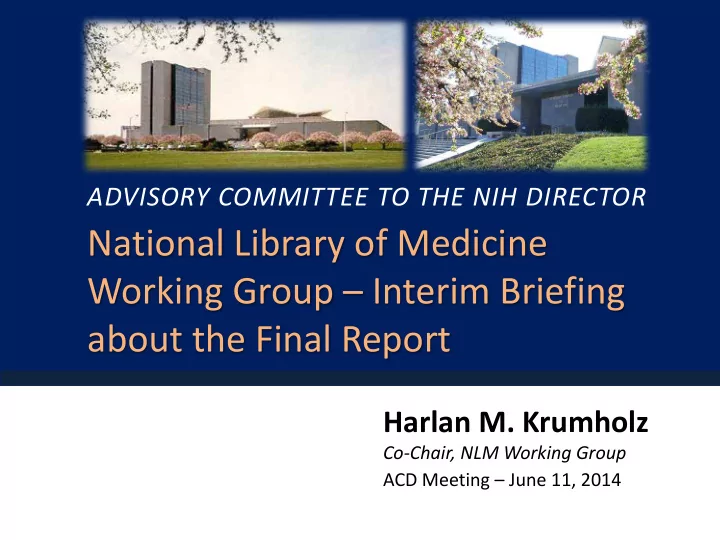
SLIDE 1 ADVISORY COMMITTEE TO THE NIH DIRECTOR
National Library of Medicine Working Group – Interim Briefing about the Final Report
Harlan M. Krumholz
Co-Chair, NLM Working Group ACD Meeting – June 11, 2014
SLIDE 2
The Context
NLM has the opportunity to play a critical role during an unprecedented era in biomedical research…
SLIDE 3
- Data science is expanding rapidly
- Computational power is increasing
- Breadth/depth of digital health data undergoing
unprecedented and accelerating growth
The Context
SLIDE 4
- Movement towards more interdisciplinary
work and team science
- Broad commitment to open science is
becoming increasingly adopted
- Demand for services to support informed
public expanding
The Context
SLIDE 5
NLM leadership: Don Lindberg retired after 35 yrs of remarkable leadership; Appointed in 1984!
The Context (cont.)
SLIDE 6 Today’s Focus
- Report live today
- Can be found at
http://acd.od.nih.g
SLIDE 7
Report
SLIDE 8 Charge to the NLM Working Group
- Review the current mission, organization,
and programmatic priorities of the NLM
- Articulate a strategic vision for the NLM
to ensure that it remains an international leader in biomedical and health information
SLIDE 9 Charge: Assess How NLM Should
- Continue to meet biomedical community’s
rapidly evolving scientific & technological needs
- Lead the development and adoption of
information technologies
- Facilitate the collection, storage, and use of
biomedical data by the biomedical and health research communities
SLIDE 10 Charge: Assess How NLM Should
- Continue to lead in promoting open access models
for biomedical data and scientific literature
- Balance computational methods and human-based
approaches for indexing
- Maximize utilization and cost-efficiency of the
NLM’s National Network of Libraries of Medicine
SLIDE 11 Charge: Assess How NLM Should
- Maximize the usefulness of the NLM’s other
- utreach and exhibits programs in the context
- f future opportunities
- Interface effectively with the broader and
expanding NIH efforts in data science
- Directly contribute to addressing the major
data science challenges facing the biomedical research enterprise
SLIDE 12 NLM Working Group Membership
Eric Green, NIH (co-chair) Harlan Krumholz, Yale (co-chair) Russ Altman, Stanford Howard Bauchner, JAMA Deborah Brooks, MJF Foundation Doug Fridsma, AMIA Steven Goodman, Stanford Eric Horvitz, Microsoft Research Trudy MacKay, NC State U Alexa McCray, Harvard Chris Shaffer, OHSU David Van Essen, Wash U Joanne Waldstreicher, J&J James Williams, II, U Colorado, Boulder
EX OFFICIO MEMBERS
Kathy Hudson, NIH
EXECUTIVE SECRETARY
Lyric Jorgenson, NIH
SLIDE 13 Deliberative (and Rapid) Process
- Launched in January, 2015
- Met via 4 conference calls and 2 in-person
meetings
– Reviewed mission, organization, and programs – Met with NIH and NLM leadership – Evaluated NLM’s strengths and weaknesses – Identified emerging opportunities and challenges
SLIDE 14 Listen and Learn from Community
- RFI to listen to the broader community
– 650 responses to 5 different areas of inquiry
SLIDE 15
OBSERVATIONS
“The remarkable work of NLM has generated international goodwill and reflected positively on the NIH and the United States. In fact, for many, NLM is the most visible face of NIH.”
SLIDE 16
Observations
Given the breadth of functions and activities, it is not surprising that NLM has many stakeholders – many of whom express resounding support for its mission
SLIDE 17 What We Heard…
- Sharing quality health information to the
public (easily and freely)
- Critical partner in advancement of library
science innovation and established expertise and leadership in the collection, organization, curation, dissemination of biomedical data
SLIDE 18 What We Heard…
- Relied upon for many programs and
resources including health information, data services, and training programs, … such as…
SLIDE 19
Resources
SLIDE 20 Observations: NLM has Challenges
- Broad range of users creates diverse needs
for NLM programs and tools
- Integration of programs into a coherent,
forward-looking framework
SLIDE 21 Observations: NLM has Challenges
- Rapid expansion of the field of data science
and biomedical informatics in the face of
- ngoing budget constraints
- Definition of role in broader NIH efforts
SLIDE 22
RECOMMENDATIONS
“NLM’s path forward must build upon its prior successes, leverage existing strengths, and capitalize on emerging opportunities.”
SLIDE 23
Recommendation #1: ‘General Scope’
NLM must continually evolve to remain a leader in assimilating and disseminating accessible and authoritative biomedical research findings and trusted health information to the public, healthcare professionals, and researchers across the world
SLIDE 24 Recommendation #1: ‘General Scope’
- Coordinate with others on the collection,
interpretation, and access of biomedical and healthcare-related information… and iterative process of resource creation, maintenance, and evaluation
- Connect disparate data sources and streams
to enable improved knowledge integration and generation
SLIDE 25 Recommendation #1: ‘General Scope’
- Understand, integrate, and leverage the
complementarity of its resources and services with the access and availability of biomedical and health information via search engines and browsing of other sources of health information on the Internet
SLIDE 26
Recommendation #1: ‘General Scope’
“NLM should also play a leadership role in harmonizing, connecting and improving international databases…”
SLIDE 27
Recommendation #1: ‘General Scope’
“…For example, one could envision a future in which ClinicalTrials.gov plays a key role in the global harmonization of requirements and standards, while also expanding in scope to accommodate hosting of metadata and even participant level data.”
SLIDE 28
Recommendation #2: ‘Open Science’
NLM should lead efforts to support and catalyze open science, data sharing, and research reproducibility, striving to promote the concept that biomedical information and its transparent analysis are public goods.
SLIDE 29 Recommendation #2: ‘Open Science’
- Serve as locus of expertise for managing and
evaluating NIH databases and knowledge bases
- Engage in bioethical considerations of sharing
biomedical data
SLIDE 30 Recommendation #2: ‘Open Science’
- Promulgate and implement best practices in
- pen source, open science, standards, and
data harmonization
- Collaborate with developer communities
SLIDE 31
Recommendation #2: ‘Open Science’
“NLM should be an active participant in the design and oversight of programs that incentivize and celebrate the open sharing of data and resources.”
SLIDE 32 Recommendation #2: ‘Open Science’
“Tools and resources should be disseminated using industry standards for data sharing and programmatic access (e.g. well documented APIs
- r SPARQL endpoints) to enable reuse by
researchers and other stakeholders.”
SLIDE 33
Recommendation #3: ‘Data Science’
NLM should be the intellectual and programmatic epicenter for data science at NIH and stimulate its advancement throughout biomedical research and application
SLIDE 34 Recommendation #3: ‘Data Science’
- Become programmatic and administrative
home for the BD2K Initiative and take lead in defining subsequent data science efforts; coordinate data science programs across ICs
SLIDE 35 Recommendation #3: ‘Data Science’
- Promulgate intramural and/or extramural
expertise, knowledge generation and dissemination, and leadership in areas of data science that are critical to the NIH mission
SLIDE 36
Recommendation #3: ‘Data Science’
“NLM should lead the coordination of data science programs (and programs with large data science components) conducted at other NIH Institutes/Centers, in order to maximize synergies and minimize redundancies.”
SLIDE 37 Recommendation #3: ‘Data Science’
“…nurture talent in the science and engineering
- f EHRs, analysis of biomedical text, integration
- f diverse and multimodal datasets, application
- f novel computational and statistical methods
to extract knowledge, and future domains that involve extracting data and producing knowledge from digital health sources.”
SLIDE 38
Recommendation #4: ‘Training’
NLM should strengthen its role in fostering the future generation of professionals in biomedical informatics, data science, library sciences, and related disciplines through sustained and focused training efforts
SLIDE 39 Recommendation #4: ‘Training’
- Develop and support new, comprehensive,
and coordinated strategic training initiatives related to professional development across multiple spheres
- Be center for nurturing the core science and
methodologies of biomedical informatics, data science, and library science through research and training programs
SLIDE 40 Recommendation #4: ‘Training’
“…also nurture partnerships with other NIH programs, Federal agencies, and outside
- rganizations in which informatics and
biostatistics are a core component.”
SLIDE 41
Recommendation #5: ‘History’
NLM should maintain, preserve, and make accessible the nation’s historical efforts in advancing biomedical research and medicine, thereby ensuring that this legacy is both safe and accessible for long-term use
SLIDE 42 Recommendation #5: ‘History’
- Lead and form partnerships to advance the
core professional domains of data and knowledge capture
- Develop and implement a strategic
preservation and access plan for medical knowledge in all formats
SLIDE 43
Recommendation #5: ‘History’
*All formats includes ephemeral forms that are increasingly dominating medical communication (e.g., online journals, blogs, and databases)
SLIDE 44 Recommendation #6: ‘Further Evaluation’ New NLM leadership should evaluate what talent, resources, and
- rganizational structures are required to
ensure NLM can fully achieve its mission and best allocate its resources
SLIDE 45 Recommendation #6: ‘Further Evaluation’
- Evaluate the current NLM portfolio of
databases, resources, and services
- Review and potentially reorganize the
structure and functions of NLM to ensure that they align with the contemporary vision and mission
SLIDE 46
CONCLUDING REMARKS
“NLM has the opportunity to modernize the conceptualization of a library.”
SLIDE 47 A Robust NLM is Vital
- NLM has an exemplary history of excellence,
both in terms of accomplishments and world-wide reputation in the research and health sciences communities
SLIDE 48 A Robust NLM is Vital
- NLM must now evolve to seize this critical
moment in biomedical history and be a trustworthy source of biomedical data and information, an advocate for open science, a promoter of the next generation of data scientists, a protector of the legacy of the past, and a vital partner for those generating biomedical knowledge for future
SLIDE 49 Questions?
http://acd.od.nih.gov/meetings.htm