Name of material: Care of self, others and the environment - - PDF document

name of material
SMART_READER_LITE
LIVE PREVIEW

Name of material: Care of self, others and the environment - - PDF document

Name of material: Care of self, others and the environment Image(s): Photo(s) courtesy of Montessori Child. Visit www.montessorichild.com.au to purchase this material. Video : Point(s) of interest: The appeal of using high quality, smaller


slide-1
SLIDE 1

Name of material:

Care of self, others and the environment

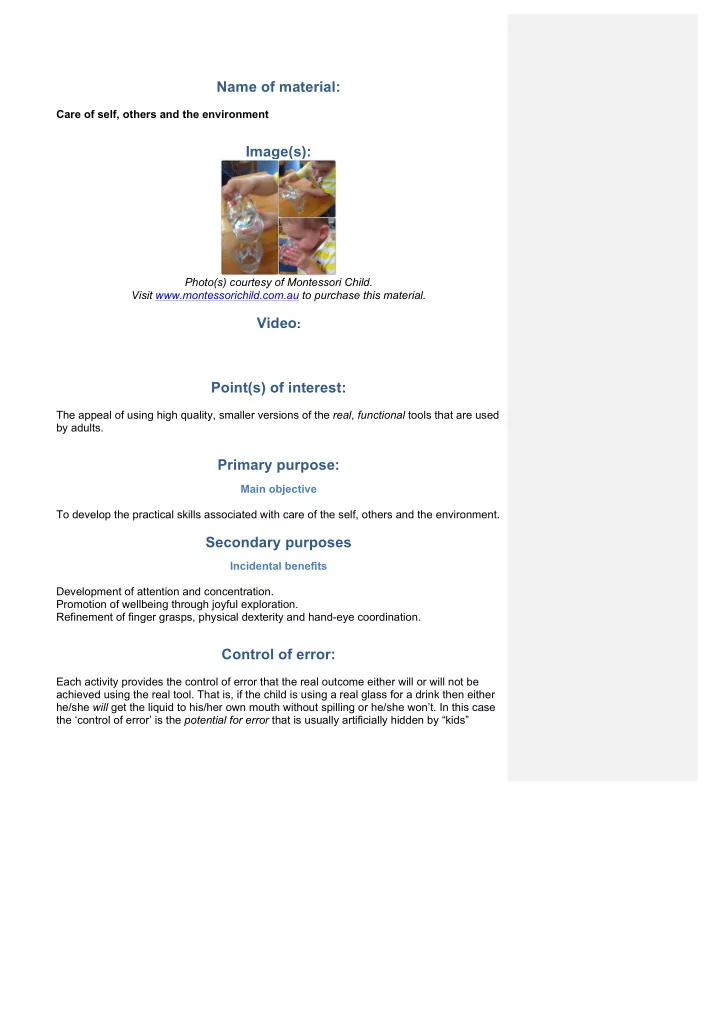
Image(s):

Photo(s) courtesy of Montessori Child. Visit www.montessorichild.com.au to purchase this material.

Video: Point(s) of interest:

The appeal of using high quality, smaller versions of the real, functional tools that are used by adults.

Primary purpose:

Main objective To develop the practical skills associated with care of the self, others and the environment.

Secondary purposes

Incidental benefits Development of attention and concentration. Promotion of wellbeing through joyful exploration. Refinement of finger grasps, physical dexterity and hand-eye coordination.

Control of error:

Each activity provides the control of error that the real outcome either will or will not be achieved using the real tool. That is, if the child is using a real glass for a drink then either he/she will get the liquid to his/her own mouth without spilling or he/she won’t. In this case the ‘control of error’ is the potential for error that is usually artificially hidden by “kids”

slide-2
SLIDE 2

equipment or by pretend play. For instance, plastic ‘sippy cups’ prevent spills artificially, and empty cups in a pretend ‘tea party’ will not spill, even if the child’s movements are not

  • careful. In these examples the child does not receive the input of the ‘spill’ as a prompt to

alter his/her movements. Therefore when using real tools for their true purpose in the Care

  • f Self/Others/Environment lessons the potential for error is the control of error.

EYLF Outcome 1.2: Children develop their emerging autonomy, inter-dependence, resilience and sense of agency by engaging in exploration, problem-solving and self- correction (rather than relying on an adult to identify the error and suggest the answer).

Presentation:

Please ¡note: ¡ ¡ Presentations ¡for ¡infants ¡and ¡toddlers ¡(0-­‑3) ¡tend ¡to ¡be ¡much ¡less ¡formal ¡then ¡the ¡lessons ¡given ¡ to ¡pre-­‑school ¡age ¡children ¡(3-­‑6). ¡ ¡ The ¡Care ¡of ¡Self/Others/Environment ¡activities, ¡however, ¡do ¡benefit ¡from ¡a ¡direct ¡initial ¡

  • presentation. ¡The ¡presentation ¡is ¡helpful ¡partly ¡because ¡many ¡of ¡the ¡required ¡movements ¡are ¡

difficult ¡to ¡discern ¡through ¡independent ¡experimentation. ¡ ¡ Preparation:

  • The educator observes the child wishing to engage in care of the

self/others/environment and prepares the corresponding activity (eg. the child expresses thirst so the educator presents the use of a drinking glass).

  • The educator briefly identifies the name of the material and provides a brief

demonstration of its use. This is not always necessary as some children are able to proceed directly to identifying the purpose independently.

  • The teacher sits/stands to the right of the child if the adult is right-handed and to the

left of the child if the adult is left-handed (this avoids the issue of having the adult’s hand/arm block the field of vision of the child). Lesson 1: Eating utensils (Care of the self) Spoon

  • The educator models how to hold the spoon in the dominant hand, then scoop it

down and through the food. Fork

  • The educator models how to hold the fork in the dominant hand, then push it into a

piece of food. Knife

  • The educator models how to hold the fork in the non-dominant hand, with the knife

in the dominant hand.

  • The educator pushes the fork into the food to hold it steady then uses the knife to

cut through.

  • Alternatively, the educator can show how to make a ‘bridge’ over the food with the

non-dominant hand or to hold the end of the piece of food.

slide-3
SLIDE 3

Lesson 2: Drinking (Care of the self) Pouring water

  • The educator models how to place the dominant hand around the handle of the jug.
  • The non-dominant hand is placed under the ‘lip’ of the jug.
  • The jug is lifted slightly and then slowly tipped towards the vessel.
  • When the water starts flowing the angle of the jug is maintained, or corrected if the

flow is too fast.

  • When the vessel is nearly full the jug is carefully tipped back towards being straight.

Drinking from a glass

  • The educator models how to take the glass in the dominant hand and lift it towards

the lips before tilting it back gently. Lesson 3: Care of activities/materials (Care of others) Holding tray

  • The educator models how to place one hand on the centre point of each end of the

tray.

  • If the tray has handles the educator models how to slide the fingers into the cavity
  • f the handle and hold them tightly.

Replacing activities

  • The educator models how to reset the pieces of the activity (such as putting the ball

back into the Object Permanence box) and placing it back on the shelf where it was first found. Using a mat

  • The educator models how to take a mat from the shelf and spread it on the floor by

pulling at the corners and edges to make it flat.

  • After use the educator models how to take one side of the mat and pull it across to

match the other edge, then take the top edge and bring it down to the bottom edge so it is folded before replacing it to the basket/box. Lesson 4: Gardening (Care of the environment) Watering plants

  • The educator models how to pick up the watering can using the dominant hand on

the side handle and the non-dominant hand to support the spout (or hold the top handle if one is present).

  • The watering can is carried to the tap and placed on the ground.
  • The tap is turned on to a low flow.
  • If the water is not flowing into the watering can then the educator models how to lift

the can up to catch the water flow.

  • When the watering can is half full the tap is turned off.
  • The educator models how to carry the can (dominant hand on side handle, non-

dominant hand on top handle or supporting spout) to the plants.

  • The educator models how to hold the watering can close to the base of the plant

and aim the end of the spout at the roots of the plant. Cutting flowers

  • The educator models how to separate one stem from the bush/tree.
slide-4
SLIDE 4
  • The educator shows how to snip the base of the stem to remove the flower.

Flower arranging

  • The educator models how to remove the excess leaves from the stem.
  • The educator models how to fill the vase (using the careful pouring technique
  • utlined under Pouring Water).
  • The educator models how to place the stem carefully into the vase (and to trim it

with scissors if necessary). Lesson 5: Cleaning tools (Care of the environment) Using a dustpan and brush

  • When a solid spill occurs (crumbs, papers etc) the educator models how to collect

the dustpan and brush.

  • The educator shows how to separate the dustpan and brush and lift the brush in the

dominant hand and the pan in the non-dominant hand.

  • If the spill is on the floor the educator shows how to place the dustpan edge flat

against the ground and hold it steady.

  • If the spill is on the table the educator shows how to place the dustpan at the edge
  • f the table and hold it steady.
  • The educator then shows how to push the bristles of the brush against the spill and

guide them towards the lip of the dustpan.

  • When the dustpan is full the educator demonstrates how to hold it flat and carry it to

a bin before gently tipping the crumbs off the pan. Using a sponge and bowl

  • When a liquid spill occurs the educator models how to collect a sponge and bowl.
  • The educator places the sponge on top of the spill to soak it up (moving it in a

circular motion if the spill is larger than the sponge).

  • The educator lifts the sponge, holds it over the bowl and squeezes it in one hand to

release the drips (for larger sponges, or cloths, the educator shows how to hold one end in each hand to ‘wring’ the drips out).

  • The educator repeats as necessary until the spill is dry.

Using a broom

  • The educator models how to draw a small target on the floor using chalk.
  • The educator models how to place two hands on the broom handle and hold the

bristles flat against the floor.

  • The educator uses the bristles to push the crumbs towards the target.
  • When the crumbs are collected the educator shows how to collect them with a

dustpan and wipe away the target with a sponge. Conclusion:

  • When the child has completed his/her exploration you may use model some

language relating to the experience.

  • Ask the child, or assist him/her, to place the material back on the shelf.

This contributes towards the creation of a learning environment and promotes EYLF Outcome 4.4: Children resource their own learning through connecting with people, place, technologies and natural and processed materials.

slide-5
SLIDE 5

Links to the Early Years Learning Framework Outcomes:

Participating in the Care of the self/others/environment exercises with the presence, interaction or support of an educator helps the child progress towards the following Learning Outcomes; 1.1: Children feel safe, secure and supported by the peaceful, nurturing presence of a trusted adult. 1.4: Children learn to interact in relation to others with care, empathy and respect by absorbing the importance of caring for the environment and the classroom. 2.1: Children develop a sense of belonging to groups and communities and an understanding of the reciprocal rights and responsibilities necessary for active community participation by learning skills and processes that help to create an orderly environment. 5.1: Children interact verbally and non-verbally with others for a range of purposes by engaging with the educator through observation, imitation and conversation. Revisiting the Care of the self/others/environment Exercises for independent attempts helps the child progress towards the following Learning Outcomes; 3.1: Children become strong in their social and emotional wellbeing by enjoying the joy of discovery and mastery. 3.2: Children take increasing responsibility for their own health and physical wellbeing by learning practical life skills that will assist with caring for their own needs. 4.4: Children resource their own learning through connecting with people, place, technologies and natural and processed materials by making active, self-motivated and meaningful choices from the prepared environment.

Observation and assessment for learning:

When the child is working independently the educator can gather and analyse information about what the child knows, can do and understands by observing the following: Indicators of progress;

  • The child collects the right tool to respond to his/her needs (eg. a glass when thirsty,

a sponge when a liquid spill is made) but is unsure of how to implement the tools. This indicates conceptual understanding but not procedural memory. Present the demonstration with the tool when the child collects it.

  • The child uses a tool effectively when the teacher is present but does not

independently initiate the use of this tool. This indicates procedural memory but not conceptual understanding. Highlight the connection between the need/action and the tool (eg. “You seem to be thirsty, would you like to collect a glass from the cupboard?” or “You spilled some water on the table, you can collect the sponge from the shelf.”

  • The child uses a tool effectively when the teacher is present, and suggests

knowledge of its purpose in relation to specific needs (eg. feels thirsty and says “glass!” or spills water and says “sponge!”) but does not show awareness of where

slide-6
SLIDE 6

to access this tool in the environment. Consider how the environment is arranged to identify whether the tool is somehow obscured or if its location is inconsistent. Ensure that it is placed prominently and that it remains in its ‘home’ consistently. Indicators of mastery;

  • The child confidently collects and uses a tool in relation to a particular need.
  • The child assists other children with collecting and utilising tools.

If the child demonstrates the aforementioned skills the educator can engage in intentional teaching by modelling the use of the next material in sequence or the more challenging variation. If the child does not yet demonstrate the aforementioned skills the educator can show responsiveness to children by scaffolding the exploration with the presentation tips mentioned above. Questions for reflective practice: After presenting this material the educator might ask,

  • Are there other theories or knowledge that could help me to understand better what

I have observed or experienced? What are they? How might those theories and that knowledge affect my practice?

  • Who is advantaged when I work in this way? Who is disadvantaged?

Extensions/Variations:

There are countless opportunities for young children to engage in meaningful examples of Care of the Self, Care of Others and Care of the Environment. These include, but are not limited to;

  • Care of Self:
  • Using kitchen tools (tongs)
  • Using food preparation tools (vegetable peelers, graters, juicers etc)
  • Washing and drying hands effectively
  • Folding and using a tissue (and disposing of it before washing hands)
  • Care of Others:
  • Offering a tissue to a friend
  • Pouring water for a friend (or group)
  • Setting the table
  • Care of Environment:
  • Washing/scrubbing tables/chairs
  • Using a vacuum
  • Planting seeds
  • Picking fruits/vegetables from the garden

Support ¡at ¡home ¡ ¡ Partnerships ¡with ¡families ¡

Andrew Matheson 8/3/2015 4:59 PM Comment [1]: Words ¡in ¡italics ¡could ¡link ¡ externally ¡to ¡the ¡relevant ¡section ¡of ¡the ¡ EYLF ¡document ¡(if ¡possible). ¡ ¡ ¡

slide-7
SLIDE 7

At this stage in a child’s development he/she is developing practical life skills required to care for the self, care for others and care for the environment. A parent/relative could reinforce this and support continuity of learning and transitions by;

  • Gathering and presenting activities as suggested in the ‘Extensions/Variations’

above.

  • Role modelling the tools and processes used for Care of the Self, Others and the

Environment at home and taking care to slowly, deliberately present these to your child.

  • Reinforcing the language associated with practical life work, including the nouns

relating to the tools (eg. “duster”) and the verbs associated with the tasks (eg “dusting”).

  • Investing in high-quality and functional tools that your child can use (such as small

brooms, watering cans and so on) and ensuring that these are kept in places where the child can independently access them.

To ¡learn ¡more ¡visit ¡Pinterest ¡