(Name ailment, distribute items and discuss how it causes a senior to - - PDF document

name ailment distribute items and discuss how it causes a
SMART_READER_LITE
LIVE PREVIEW

(Name ailment, distribute items and discuss how it causes a senior to - - PDF document

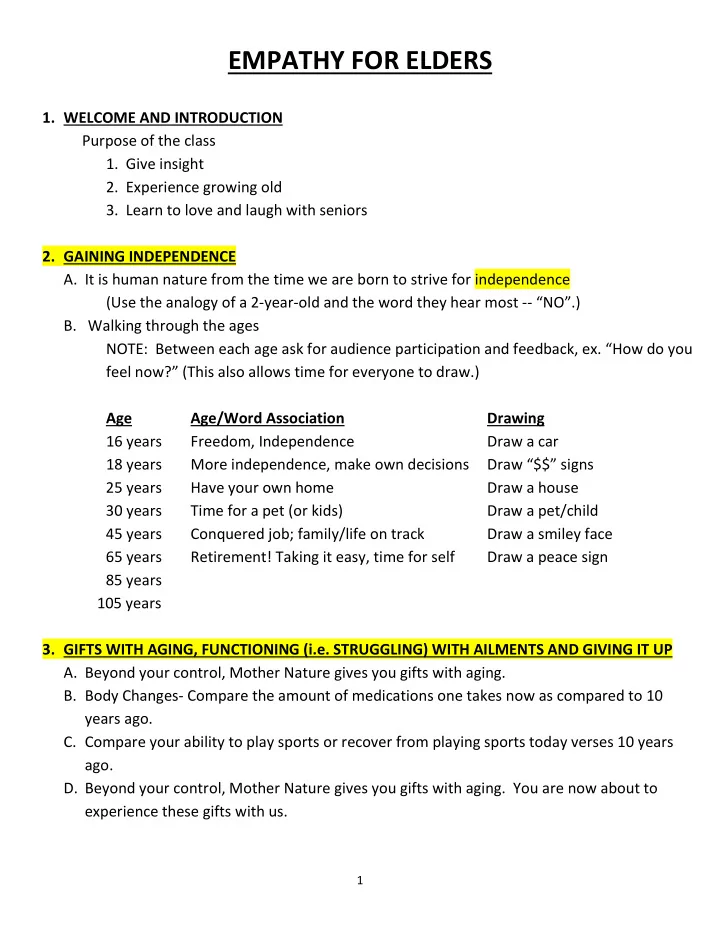
EMPATHY FOR ELDERS 1. WELCOME AND INTRODUCTION Purpose of the class 1. Give insight 2. Experience growing old 3. Learn to love and laugh with seniors 2. GAINING INDEPENDENCE A. It is human nature from the time we are born to strive for


slide-1
SLIDE 1

1

EMPATHY FOR ELDERS

  • 1. WELCOME AND INTRODUCTION

Purpose of the class

  • 1. Give insight
  • 2. Experience growing old
  • 3. Learn to love and laugh with seniors
  • 2. GAINING INDEPENDENCE
  • A. It is human nature from the time we are born to strive for independence

(Use the analogy of a 2-year-old and the word they hear most -- “NO”.)

  • B. Walking through the ages

NOTE: Between each age ask for audience participation and feedback, ex. “How do you feel now?” (This also allows time for everyone to draw.) Age Age/Word Association Drawing 16 years Freedom, Independence Draw a car 18 years More independence, make own decisions Draw “$$” signs 25 years Have your own home Draw a house 30 years Time for a pet (or kids) Draw a pet/child 45 years Conquered job; family/life on track Draw a smiley face 65 years Retirement! Taking it easy, time for self Draw a peace sign 85 years 105 years

  • 3. GIFTS WITH AGING, FUNCTIONING (i.e. STRUGGLING) WITH AILMENTS AND GIVING IT UP
  • A. Beyond your control, Mother Nature gives you gifts with aging.
  • B. Body Changes- Compare the amount of medications one takes now as compared to 10

years ago.

  • C. Compare your ability to play sports or recover from playing sports today verses 10 years

ago.

  • D. Beyond your control, Mother Nature gives you gifts with aging. You are now about to

experience these gifts with us.

slide-2
SLIDE 2

2

(Name ailment, distribute items and discuss how it causes a senior to struggle. As ailments progress freedom and independence is lost. Have audience cross off items on their list as their freedoms are lost).

  • Ailment: Loss of Mobility
  • Item to represent: Tape one participant’s leg to the leg of the chair; writing with

non-dominant hand to mimic effects of stroke

  • Struggling with Ailment: Stay in your position, do not break the tape around your leg
  • Freedom Lost:
  • Home.
  • Hard to get around house to clean
  • Hard to get around house to care for self
  • Financial Control $.
  • Expense to modify car, home, etc. to meet needs of ailment
  • Pet.
  • Hard to care for pet’s needs
  • Car.
  • Challenging to get in car
  • Challenging to get in and out at travelled-to locations
  • May need to modify (chair lift, hand controls, etc.)
  • Ailment: Loss of eyesight
  • Item to represent: Glasses, eye sight disorder cards, 3D glasses
  • Struggling with Ailment: Discuss Macular Degeneration (loss of central vision), notice

the difficulty to see people’s faces, TV

  • Freedoms Lost:
  • Financial Control $$.
  • Problem seeing checkbook or bank statement to balance
  • Problem seeing to shop for necessities of life
  • Problem identifying money to pay
  • Expense of modifying home, etc. to accommodate new challenges
  • Home.
  • May be best to stay in familiar surroundings but will need to make

modifications to facilitate new challenges

slide-3
SLIDE 3

3

  • Car.
  • Can’t drive if they can’t see
  • Pet
  • Challenging to care for/walk/etc.
  • Ailment: Breathing Problems - Chronic Obstructive Pulmonary Disorder (COPD).
  • Definition: The diagnosis of COPD is often used as a catch–all phrase to include

emphysema, chronic bronchitis and asthma. An individual may have only one component or a portion of all three.

  • Item to represent: Straws
  • Struggling with Ailment: Notice how difficult it is to get enough air through the small

hole

  • Freedoms Lost:
  • Home.
  • No longer able to walk around, clean, cook on oxygen
  • Car.
  • Medication restrictions may prohibit driving
  • Challenges of getting oxygen in and out of way to drive
  • Movement from parking into venue.
  • Can’t exert the energy/breath to walk/care for pet
  • Ailment: Loss of Hearing
  • Item to represent: Cotton balls to place in ears
  • Struggling with Ailment: Have your neighbor verbally spell a word to you to see if

you can figure it out

  • Freedoms Lost:
  • Home.
  • Can’t hear smoke alarms, things on stove, etc.
  • Modifications to facilitate new challenges (lights that flash for door bell,

special phone, etc.)

  • Financial Control $$.
  • Can’t make phone calls to check on bills
  • May have to quit job/volunteer opportunity
  • Expense of modifying home, etc. to accommodate new challenges
slide-4
SLIDE 4

4

  • Children
  • Can’t communicate over the phone to out of town relatives
  • Ailment: Arthritis
  • Item to represent: Gardening gloves and pill bottles
  • Struggling with Ailment: Put cotton balls in the tips of the fingers of each glove.

After glove is on the participant’s hand insert a popsicle stick up the middle of the palm to simulate stiffness. Open your pill bottle, count out 3 pills place on table and then one by one put back in bottle.

  • Freedom Lost:
  • Home.
  • Challenging to take care of the needs of home maintenance
  • Challenging to handle day to day tasks of life
  • Challenging to care for self (dressing, shoes, brushing hair, etc.)
  • Pet
  • Possible challenges with caring for/walking/etc.
  • Ailment: Symptoms of Dementia
  • Definition: Dementia is a condition in which there is a gradual loss of brain function;

it is a decline in cognitive/intellectual functioning. The main symptoms are usually loss of memory, confusion, problems with speech and understanding, changes in mood/personality/behavior and an increased reliance on others for the activities of daily living. It is not a disease in itself, but rather a group of symptoms which may result from brain injury, disease, vitamin or hormone imbalance, or drugs or alcohol.

  • Dementia is not a normal part of aging. The loss of mental functions must be severe

enough to interfere with daily living. Confusion and disorientation may be present.

  • Item to represent: Tape over mouth (or communicate w/o words) or tell them they

can no longer use nouns (as nouns are the first word structure that a person with dementia looses).

  • Struggling with Ailment: Tell your neighbor exactly what you want for dinner,

without speaking, and see if they understand you (loss of communication). Sign your name with your opposite hand. Or tell your neighbor what you want for dinner without using nouns.

slide-5
SLIDE 5

5

  • Freedoms Lost:
  • Financial Control $.
  • With cognitive deficiencies in certain areas of the brain such as the

hippocampus or frontal lobes individuals are easily confused and loose the ability to concentrate. (The hippocampus is one part of the limbic system in the brain. The limbic system is a group of brain structures that surround the brain stem. The brain structures that make up this system play an important role in the experience of certain emotions (for example, fear and anger, motivations, and memory). The hippocampus is specifically responsible for our ability to store and retrieve memories.)

  • Balancing a check book and managing bill payments will become too

difficult for them to perform successfully.

  • Home.
  • As the disease progresses a person’s abilities become limited. There will

be a point when they will not remember how to cook and use the kitchen, let alone how to maintain it as well as the rest of the house.

  • If they do keep their home they will need to hire help to assist in its

maintenance as well as with their own personal care needs.

  • Car.
  • If the occipital lobes (the parts of the brain containing the visual center)

are damaged, there is loss of depth perception and peripheral vision.

  • If the hippocampus is not working properly then remembering where

you are can be challenging.

  • Reaction time is slower for people with dementia. Driving will become

more dangerous when other factors such as road hazards and careless drivers are taken into account.

  • Pet.
  • As dementia progresses, a person will begin to lose the ability to care for
  • themselves. Poor Fido/Garfield will need to learn to fend for
  • themselves. This can become very unsanitary especially if litter boxes

are left unkempt or if interior spaces are used as potty spots. Finish off with asking the audience, “How do you feel now?”

  • Mark off your “Smiley Face” and “Peace Sign”.
  • Loss of independence and chronic ailments lead to depression and anger.
slide-6
SLIDE 6

6

  • Depression in the elderly is a widespread problem that is often not diagnosed and

frequently undertreated. Many older people will not admit to the signs and symptoms

  • f depression, for fear that they will be seen as weak or crazy. Some older people may

be aware of their depression but believe that nothing can be done about it. (http://healthtools.aarp.org/adamcontent/depression-elderly)

  • Elderly depression is all too common. The estimated rate of geriatric depression ranges

from one to five percent of the senior population (anyone over the age of 65). Senior depression rates are higher in geriatric hospital patients (11.5 percent) and highest in seniors who require in home healthcare (13.5 percent). (http://patient-health- education.suite101.com/article.cfm/elderly_depression_and_mental_illness) (Statistics confirmed at http://www.ehow.com/facts_6027259_depression-senior- citizens.html)

  • Some seniors seem angry, many times anger is depression turned outward.
  • For anyone who expresses anger, concerned that you may be a danger to yourself
  • r others, the police will be called and you will be “Baker Acted”. You will be

institutionalized for 72 hours and all rights will be taken away.

  • If there is a concern about you being able to handle your own affairs, DCF will be

called and you will be deemed no longer competent and will be assigned a guardian.

  • So, cross out everything gained in life.
  • 4. HOW CAN YOU HELP IMPROVE DIGNITY?
  • Loss of Mobility (If tape has not been broken, can break their tape now.)
  • Don’t move people in a wheelchair without preparing them 1st
  • Ask person if they are comfortable and if they need assistance shifting
  • Put yourself at their eye level when speaking to them
  • Loss of Eye Sight
  • Do not yell (they are blind not deaf)
  • They may not be able to see dirty clothes or meal in front of them (Binocular Visual)
  • Use clock method when serving meals
  • Always knock 1st, then announce who you are
  • Describe what you are doing when assisting a person with impaired vision
  • Loss of Hearing
  • Pitch is usually the problem with not hearing. (Demonstrate high pitch verses low
  • pitch. Low pitch is best.)
slide-7
SLIDE 7

7

  • Yelling is not communicating. (Demonstrate yelling and draw attention to your face
  • expression. Yelling makes your face look angry.)
  • Bend down to ear level to speak
  • Look at person when speaking, the other senses will help connect the dots
  • Be aware of body language when communicating
  • Arthritis
  • Don’t grab hands to assist
  • Velcro and zippers are much easier for them to use on clothing and shoes
  • Use larger storage items (easier to open)
  • Symptoms of Dementia
  • Always approach a person from the front
  • Always approach with a smile
  • Limit choices to 1 or 2
  • Use short phrases
  • Break down tasks
  • 80% of effective communication is non-verbal. Lead by modeling the task.
  • Use touch to help communicate
  • Allowing Seniors to Keep their Dignity
  • Always knock and announce before entering a room
  • Don’t drag someone when assisting with walking
  • Be aware of “Employee only” socializing
  • Acknowledge resident with at least a smile when passing them in the hall
  • Learn not to take certain behaviors personally
  • Ask yourself how I would feel if I were a resident in my building
  • 5. CONCLUSION
  • Question and answers
  • Mention “Ask the Experts” section at www.blfspolk.com for more information
  • Refer them to BLFS materials (rack cards, directories, business cards)
  • Closing Remarks: On behalf of BLFS, thank you for your participation.
  • Remind them they will be a senior someday, treat others as you would want to be

treated.