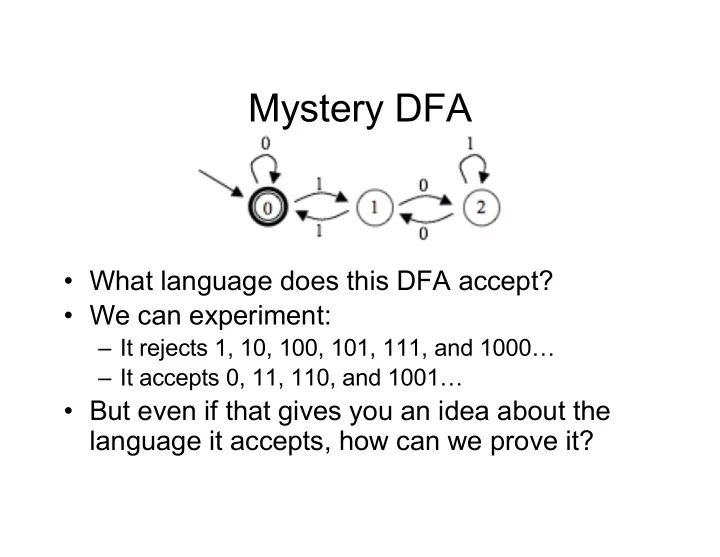
Mystery DFA
- What language does this DFA accept?
- We can experiment:
– It rejects 1, 10, 100, 101, 111, and 1000… – It accepts 0, 11, 110, and 1001…
- But even if that gives you an idea about the
Mystery DFA What language does this DFA accept? We can - - PowerPoint PPT Presentation
Mystery DFA What language does this DFA accept? We can experiment: It rejects 1, 10, 100, 101, 111, and 1000 It accepts 0, 11, 110, and 1001 But even if that gives you an idea about the language it accepts, how can we
– δ(0, 0) = 0 = (2×0+0) mod 3 – δ(0, 1) = 1 = (2×0+1) mod 3 – δ(1, 0) = 2 = (2×1+0) mod 3 – δ(1, 1) = 0 = (2×1+1) mod 3 – δ(2, 0) = 1 = (2×2+0) mod 3 – δ(2, 1) = 2 = (2×2+1) mod 3
Proof: by induction on |x|. Base case: when |x| = 0, we have: δ*(0, x) = δ*(0, e) (since |x| = 0) = 0 (by definition of δ*) so in this case x ∈ L(M) and val(x) mod 3 = 0. Inductive case: when |x| > 0, we have: δ*(0, x) = δ*(0, yc) (for some symbol c and string y) = δ(δ*(0, y), c) (by definition of δ*) = ??? The proof gets stuck here: our inductive hypothesis is not strong enough to tell us what δ*(0, y) is, when val(y) is not divisible by 3
L(M) = {x | val(x) mod 3 = 0}
δ*(0,x) = val(x) mod 3
Proof: by induction on |x|. Base case: when |x| = 0, we have: δ*(0, x) = δ*(0, ε) (since |x| = 0) = 0 (by definition of δ*) = val(x) mod 3 (since val(x) mod 3 = val(ε) mod 3 = 0) Inductive case: when |x| > 0, we have: δ*(0, x) = δ*(0, yc) (for some symbol c and string y) = δ(δ*(0, y), c) (by definition of δ*) = δ(val(y) mod 3, c) (using the inductive hypothesis) = (2(val(y) mod 3)+c) mod 3 (by Lemma 3.5.1) = 2(val(y)+c) mod 3 (using modulo arithmetic) = val(yc) mod 3 (using binary arithmetic: val(yc) = 2(val(y))+c) = val(x) mod 3 (since x = yc)
string, divided by 3, has remainder i
numbers divisible by 3
– It rejects 1, 10, 100, 101, 111, and 1000… – It accepts 0, 11, 110, and 1001…