CPSC 121: Models of Computation Trace the operation of a DFA - - PowerPoint PPT Presentation

cpsc 121 models of computation
SMART_READER_LITE
LIVE PREVIEW

CPSC 121: Models of Computation Trace the operation of a DFA - - PowerPoint PPT Presentation

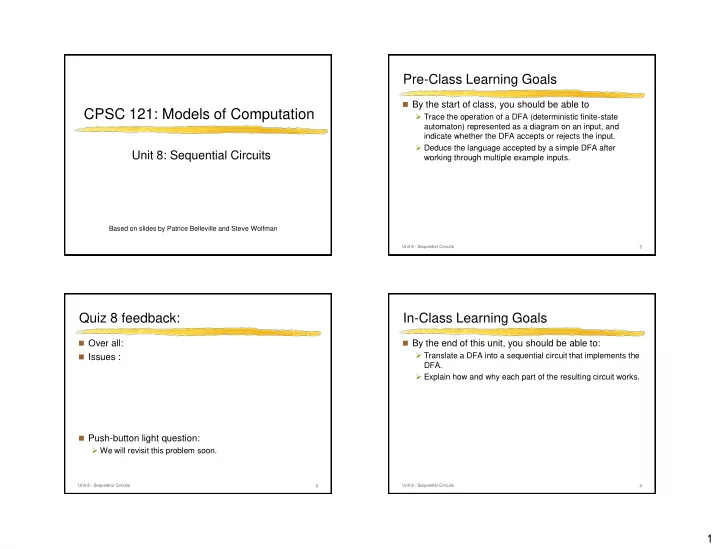
Pre-Class Learning Goals By the start of class, you should be able to CPSC 121: Models of Computation Trace the operation of a DFA (deterministic finite-state automaton) represented as a diagram on an input, and indicate whether the DFA


slide-1
SLIDE 1

1

Based on slides by Patrice Belleville and Steve Wolfman

CPSC 121: Models of Computation

Unit 8: Sequential Circuits

Pre-Class Learning Goals

 By the start of class, you should be able to

  • Trace the operation of a DFA (deterministic finite-state

automaton) represented as a diagram on an input, and indicate whether the DFA accepts or rejects the input.

  • Deduce the language accepted by a simple DFA after

working through multiple example inputs.

Unit 8 - Sequential Circuits 2

Quiz 8 feedback:

 Over all:  Issues :  Push-button light question:

  • We will revisit this problem soon.

Unit 8 - Sequential Circuits 3

In-Class Learning Goals

 By the end of this unit, you should be able to:

  • Translate a DFA into a sequential circuit that implements the

DFA.

  • Explain how and why each part of the resulting circuit works.

Unit 8 - Sequential Circuits 4

slide-2
SLIDE 2

2

Related to CPSC 121 Bib Questions

 How can we build a computer that is able to

execute a user-defined program?

  • Computers execute instructions one at a time.
  • They need to remember values, unlike the circuits you

designed in labs 1, 2, 3 and 4.  NOW: We are learning to build a new kind of

circuits with memory that will be the key new feature we need to build full-blown computers!

Unit 8 - Sequential Circuits 5

? ?

Unit Outline

 Sequential Circuits :Latches, and flip-flops.  DFA Example  Implementing DFAs

 How Powerful are DFAs?

 Other problems and exercises.

Unit 8 - Sequential Circuits 6

Problem: Light Switch

 Problem:

  • Design a circuit to control a light so that the light changes

state any time its “push-button” switch is pressed.

Unit 8 - Sequential Circuits 7

? DFA for Push-Button Switch

light

  • ff

pressed pressed This Deterministic Finite Automaton (DFA) isn’t really about accepting/rejecting; its current state is the state of the light.

?

8

light

  • n
slide-3
SLIDE 3

3

Problem: Light Switch

Problem: Design a circuit to control a light so that the light

changes state any time its “push-button” switch is pressed.

Identifying inputs/outputs: consider these possible inputs and outputs: Input1: the button was pressed Input2: the button is down Output1: the light is on Output2: the light changed states Which are most useful for this problem? a. Input1 and Output1

  • b. Input1 and Output2

c. Input2 and Output1

  • d. Input2 and Output2

e. None of these

9

?

Departures from Combinational Circuits

 MEMORY:

We need to “remember” the light’s state.

 EVENTS:

We need to act on a button push rather than in response to an input value.

10

How Do We Remember?

 We want a circuit that:

  • Sometimes… remembers its current state.
  • Other times… loads a new state and remembers it.

 Sounds like a choice.  What circuit element do we have for modelling

choices?

11

“Mux Memory”

 How do we use a mux to store a bit of memory?  We choose to remember on a control value of 0 and to

load a new state on a 1.

12

We use “0” and “1” because that’s how MUXes are usually labelled.

1

  • utput

??? new data control

slide-4
SLIDE 4

4

“Mux Memory”

 How do we use a mux to store a bit of memory?  We choose to remember on a control value of 0 and to

load a new state on a 1.

13

This violates our basic combinational constraint: no cycles.

1

  • utput (Q)

new data (D) control (G)

  • ld output (Q’)

Truth Table for “Muxy Memory”

Fill in the MM’s truth table:

G D Q' 1 1 1 1 1 1 1 1 1 1 1 1

  • a. b.
  • c. d. e.

Q 1 1 1 1 Q 1 1 1 1 Q 1 1 X X 1 Q 1 1 1 1

None

  • f

these

14

Truth Table for “Muxy Memory”

Worked Problem: Write a truth table for the MM:

G D Q' Q 1 1 1 1 1 1 1 1 1 1 1 1 1 1 1 1

Like a “normal” mux table, but what happens when Q'  Q?

15

Truth Table for “Muxy Memory”

Worked Problem: Write a truth table for the MM:

G D Q' Q 1 1 1 1 1 1 1 1 1 1 1 1 1 1 1 1

Q' “takes on” Q’s value at the “next step”.

16

slide-5
SLIDE 5

5

D Latches

 We call a "mux-memory" a D-latch ( recall from lab #5)

  • When G is 0, the latch retains its current value.
  • When G is 1, the latch loads a new value from D.

Unit 8 - Sequential Circuits 17

1

  • utput (Q)
  • ld output (Q’)

new data (D) control (G)

D Latch

When G is 0, the latch maintains its memory. When G is 1, the latch loads a new value from D.

  • utput (Q)

new data (D) control (G)

18

D Q G

D-Latch

 A D-latch looks like  Why does the D Latch have two inputs and one output

when the mux inside has THREE inputs and one

  • utput?
  • A. The D Latch is broken as is; it should have three inputs.
  • B. A circuit can always ignore one of its inputs.
  • C. One of the inputs is always true.
  • D. One of the inputs is always false.
  • E. None of these (but the D Latch is not broken as is).

19

  • utput (Q)

new data (D) control (G) D G Q

Using the D Latch for Circuits with Memory

Problem: What goes in the cloud? What do we send into G?

Combinational Circuit to calculate next state

input ??

20

We assume we just want Q as the output. D G Q

slide-6
SLIDE 6

6

Push-Button Switch

 What signal does the button generate?

Unit 8 - Sequential Circuits 21

low high

Using the D Latch for Our Light Switch

Problem: What do we send into G?

  • a. T if the button is down, F if it’s up.
  • b. T if the button is up, F if it’s down.
  • c. Neither of these.

22

D G Q

  • utput

?? current light state

Using the D Latch for Our Light Switch

Problem: What should be the next state of the light?

23

D G Q

  • utput

?? current light state “pulse” when button is pressed button pressed

Using the D Latch for Our Light Switch

Problem: Will this work?

24

D G Q

  • utput

?? current light state “pulse” when button is pressed button pressed

slide-7
SLIDE 7

7

Push-Button Switch

 What is wrong with our solution?

  • A. We should have used XOR instead of NOT.
  • B. As long as the button is down, D flows to Q, and it flows

through the NOT gate and back to D...which is bad!

  • C. The delay introduced by the NOT gate is too long.
  • D. As long as the button is down, Q flows to D, and it flows

back to Q... and Q (the output) does not change!

  • E. There is some other problem with the circuit.

Unit 8 - Sequential Circuits 25

A Timing Problem

 This toll booth has a similar problem.  What is wrong with this booth?

Unit 8 - Sequential Circuits 26

From MIT 6.004, Fall 2002

P.S. Call this a “bar”, not a “gate”, or we'll tie ourselves in (k)nots.

A Timing Solution

 Is this OK?

Unit 8 - Sequential Circuits 27

From MIT 6.004, Fall 2002

A Timing Problem

Problem: What do we send into G?

“pulse” when button is pressed button pressed As long as the button is down, D flows to Q flows through the NOT gate and back to D... which is bad!

28

D G Q

  • utput

current light state

slide-8
SLIDE 8

8

A Timing Solution (Almost)

button pressed

29

D G Q

  • utput

D G Q Never raise both “bars” at the same time.

A Timing Solution

The two latches are never enabled at the same time (except for the moment needed for the NOT gate on the left to compute, which is so short that no “cars” get through).

30

D G Q

  • utput

D G Q ??

A Timing Solution

button pressed

31

D G Q

  • utput

D G Q button press signal

Button/Clock is LO (unpressed)

LO

32

We’re assuming the circuit has been set up and is “running normally”. Right now, the light is off (i.e., the output of the right latch is 0).

D G Q

  • utput

D G Q 1 1 1

slide-9
SLIDE 9

9

Button goes HI (is pressed)

33

This stuff is processing a new signal. D G Q

  • utput

D G Q HI 1 1 1 1

Propagating signal.. left NOT, right latch

34

This stuff is processing a new signal. D G Q

  • utput

D G Q HI 1 1 1 1

Propagating signal.. right NOT (steady state)

35

Why doesn’t the left latch update?

  • a. Its D input is 0.
  • b. Its G input is 0.
  • c. Its Q output is 1.
  • d. It should update!

D G Q

  • utput

D G Q HI 1 1 1

Button goes LO (released)

36

This stuff is processing a new signal. D G Q

  • utput

LO 1 1 D G Q

slide-10
SLIDE 10

10

Propagating signal.. left NOT

37

This stuff is processing a new signal. D G Q

  • utput

D G Q LO 1 1 1

Propagating signal.. left latch (steady state)

38

And, we’re done with one cycle. How does this compare to our initial state? D G Q

  • utput

D G Q LO 1 1

Master/Slave D Flip-Flop Symbol + Semantics

When CLK goes from 0 (low) to 1 (high), the flip-flop loads a new value from D. Otherwise, it maintains its current value.

39

  • utput

(Q) new data (D) control

  • r

“clock” signal (CLK) D G Q D G Q

Master/Slave D Flip-Flop Symbol + Semantics

When CLK goes from 0 (low) to 1 (high), the flip-flop loads a new value from D. Otherwise, it maintains its current value.

40

  • utput

(Q) new data (D) control

  • r

“clock” signal (CLK) D G Q D G Q

slide-11
SLIDE 11

11

Master/Slave D Flip-Flop Symbol + Semantics

When CLK goes from 0 (low) to 1 (high), the flip-flop loads a new value from D. Otherwise, it maintains its current value.

41

  • utput

(Q) new data (D) control

  • r

“clock” signal (CLK)

Master/Slave D Flip-Flop Symbol + Semantics

 When CLK goes from 0 (low) to 1 (high), the flip-flop loads

a new value from D.

 Otherwise, it maintains its current value.

42

We rearranged the clock and D inputs and the output to match Logisim. Below we use a slightly different looking flip-flop.

new data clock signal D Q

  • utput

Push-Button Switch: Solution

 Using a D- flip-flop

Unit 8 - Sequential Circuits 43

Why Abstract?

Logisim (and real circuits) have lots of flip-flops that all behave very similarly:

  • D flip-flops,
  • T flip-flops,
  • J-K flip-flops,
  • and S-R flip-flops.

They have slightly different implementations… and one could imagine brilliant new designs that are radically different inside. Abstraction allows us to build a good design at a high-level without worrying about the details.

44

Plus… it means you only need to learn about D flip-flops’ guts. The others are similar enough so we can just take the abstraction for granted.

slide-12
SLIDE 12

12

Unit Outline

 Sequential Circuits :Latches, and flip-flops.  DFA Example  Implementing DFAs

 How Powerful are DFAs?

 Other problems and exercises.

Unit 8 - Sequential Circuits 45

Finite-State Automata

There are two types of Finite-State Automata:

 Those whose output is determined solely by the final

state (Moore machines).

  • Used to match a string to a pattern.
  • Input validation.
  • Searching text for contents.
  • Lexical Analysis: the first step in a compiler or an

interpreter.

  • (define (fun x) (if (<= x 0) 1 (* x (fun (- x 1)))))

Unit 8 - Sequential Circuits 46

( define ( fun x ) ( if ( <= x 0 ) 1 ( * x ( fun ( - x 1 ) ) ) ) )

Finite-State Automata

 Those that produce output every time the state

changes (Mealy machines).

  • Examples:
  • Simple ciphers
  • Traffic lights controller.
  • Predicting branching in machine-language programs

 A circuit that implements a finite state machine of

either type needs to remember the current state:

  • It needs memory.

Unit 8 - Sequential Circuits 47

DFA Example

 Suppose we want to design a Finite State Automaton

with input alphabet {a, b} that accepts the sets of all strings that contain exactly two b's. How many states will the DFA have?

  • A. 2
  • B. 4
  • C. 8
  • D. Another value less than 8.
  • E. Another value larger than 8.

Unit 8 - Sequential Circuits 48

slide-13
SLIDE 13

13

The DFA

Unit 8 - Sequential Circuits 49

Can you check that it is correct? Can we design a circuit for it?

Unit Outline

 Latches, toggles and flip-flops.  DFA Example  Implementing DFAs  How Powerful are DFAs?  Other problems and exercises.

Unit 8 - Sequential Circuits 50

Abstract Template for a DFA Circuit

 Each time the clock “ticks” move from one state to the

next.

51

input clock compute next state store current state

Template for a DFA Circuit

 Each time the clock “ticks” move from one state to the

next.

52

Each of these lines (except the clock) may carry multiple bits; the D flip-flop may be several flip-flops to store several bits. Combinational circuit to calculate next state/output

input CLK D Q

slide-14
SLIDE 14

14

Implementing DFAs in General

(1) Number the states and figure out b: the number of

bits needed to store the state number.

(2) Lay out b D flip-flops. Together, their memory is the

state as a binary number.

(3) For each state, build a combinational circuit that

determines the next state given the input.

(4) Send the next states into a MUX with the current

state as the control signal: only the appropriate next state gets used!

(5) Use the MUX’s output as the new state of the flip-

flops.

Unit 8 - Sequential Circuits 53

With a separate circuit for each state, they’re often very simple!

Implementing the example: Step 1

What is b (the number of 1-bit flip-flops needed to represent the state)? a. 0, no memory needed b. 1 c. 2 d. 3 e. None of these

As always, we use numbers to represent the inputs: a = 0 b = 1

54

Just Truth Tables...

Current State input New state 1 1 1 1 1 1 1 1 1 1 1 1 1

What’s in this row? a. 0 0 b. 0 1 c. 1 0 d. 1 1 e. None of these.

55

Reminder: a = 0 b = 1

Just Truth Tables...

Current State input New state 1 1 1 1 1 1 1 1 1 1 1 1 1 1 1 1 1 1 1 1 1 1

56

Reminder: a = 0 b = 1

slide-15
SLIDE 15

15

Implementing the example: Step 2

We always use this pattern. In this case, we need two flip-flops.

Let’s switch to Logisim schematics...

57

D Q

Combinational circuit to calculate next state/output

input CLK D Q

Implementing the example: Step 3

58

D

??

input CLK D Q

input

Implementing the example: Step 4

59

???

sleft sright input

Implementing the example: Step 5 (easier than 4!)

60

The MUX “trick” here is much like in the ALU from lab! What is the next state for each current state??

slide-16
SLIDE 16

16

What is the next state for each current state??

Implementing the example: Step 4

61

In state number 0, what should be the new value of sleft? Hint: look at the DFA, not at the circuit! a. input b. ~input c. 1 d. e. None of these.

sleft sright input sleft' sright' 1 1 1 1 1 1 1 1 1 1 1 1 1 1 1 1 1 1 1 1 1 1

Implementing the example : Step 4

62

In state number 1, what’s the new value of sleft? a. input b. ~input c. 1 d. e. None of these. What is the next state for each current state??

sleft sright input sleft' sright' 1 1 1 1 1 1 1 1 1 1 1 1 1 1 1 1 1 1 1 1 1 1

Implementing the example : Step 4

63

In state number 2, what’s the new value of sleft? a. input b. ~input c. 1 d. e. None of these. What is the next state for each current state??

sleft sright input sleft' sright' 1 1 1 1 1 1 1 1 1 1 1 1 1 1 1 1 1 1 1 1 1 1

Implementing the example : Step 4

64

In state number 3, what’s the new value of sleft? a. input b. ~input c. 1 d. e. None of these. What is the next state for each current state??

sleft sright input sleft' sright' 1 1 1 1 1 1 1 1 1 1 1 1 1 1 1 1 1 1 1 1 1 1

slide-17
SLIDE 17

17

Just Truth Tables...

sleft sright input sleft' sright' 1 1 1 1 1 1 1 1 1 1 1 1 1 1 1 1 1 1 1 1 1 1

65

Implementing the example : Step 4

66

Current State input New state 1 1 1 1 1 1 1 1 1 1 1 1 1 1 1 1 1 1 1 1 1 1

In state number 0, what’s the new value of sright? a. input b. ~input c. 1 d. e. None of these.

Implementing the example: Complete

67

Outline

 Sequential Circuits :Latches, and flip-flops.  DFA Example  Implementing DFAs  How Powerful are DFAs?  Other problems and exercises.

68

slide-18
SLIDE 18

18

How Powerful Is a DFA?

DFAs can model situations with a finite amount of memory, finite set of possible inputs, and particular pattern to update the memory given the inputs. How does a DFA compare to a modern computer?

a.

Modern computer is more powerful.

b.

DFA is more powerful.

c.

They’re the same.

69

Where We’ll Go From Here...

 We’ll come back to DFAs again later in lecture.  In lab you have been and will continue to explore what

you can do once you have memory and events.

 And, before long, how you combine these into a

working computer!

 Also in lab, you’ll work with a widely used

representation equivalent to DFAs: regular expressions.

70

Unit Outline

 Sequential Circuits :Latches, and flip-flops.  DFA Example  Implementing DFAs  How Powerful are DFAs?  Other problems and exercises.

Unit 8 - Sequential Circuits 71

Exercises

 Real numbers:

  • We can write numbers in decimal using the format

(-)? d+ (.d+)?

  • where the ( )? mean that the part in parentheses is optional,

and d+ stands for “1 or more digits”.

  • Design a DFA that will accept input strings that are valid real

numbers using this format.

  • You can use else as a label on an edge instead of listing

every character that does not appear on another edge leaving from a state.

Unit 8 - Sequential Circuits 72

slide-19
SLIDE 19

19

Exercises

 Real numbers (continued)

  • Then design a circuit that turns a LED on if the input is a valid real

number, and off otherwise.

  • Hint: Logisim has a keyboard component you can use.
  • Hint: my DFA for this problem has 6 states.

 Design a DFA with outputs to control a set of traffic lights.

Thought: try allowing an output that sets a timer which in turn causes an input like our “button press” when it goes

  • ff.

 Variants to try:

  • Pedestrian cross-walks
  • Turn signals
  • Inductive sensors to indicate presence of cars
  • Left-turn signals

Unit 8 - Sequential Circuits 73

Quiz #9

 Due Date: Check Announcements.  Reading for the Quiz

Textbook sections:

  • Epp, 4th edition: 5.1 to 5.4
  • Epp, 3rd edition: 4.1 to 4.4
  • Rosen, 6th edition: 4.1, 4.2
  • Rosen, 7th edition: 5.1, 5.2

Unit 8 - Sequential Circuits 74