Mycotoxins in Animal Feed: Risks to Animal & Human Health - - PowerPoint PPT Presentation

mycotoxins in animal feed risks to animal amp human health
SMART_READER_LITE
LIVE PREVIEW

Mycotoxins in Animal Feed: Risks to Animal & Human Health - - PowerPoint PPT Presentation

Mycotoxins in Animal Feed: Risks to Animal & Human Health Felicia Wu, PhD John A. Hannah Distinguished Professor Department of Food Science & Human Nutrition Department of Agricultural, Food, and Resource Economics Michigan State


slide-1
SLIDE 1

Mycotoxins in Animal Feed: Risks to Animal & Human Health

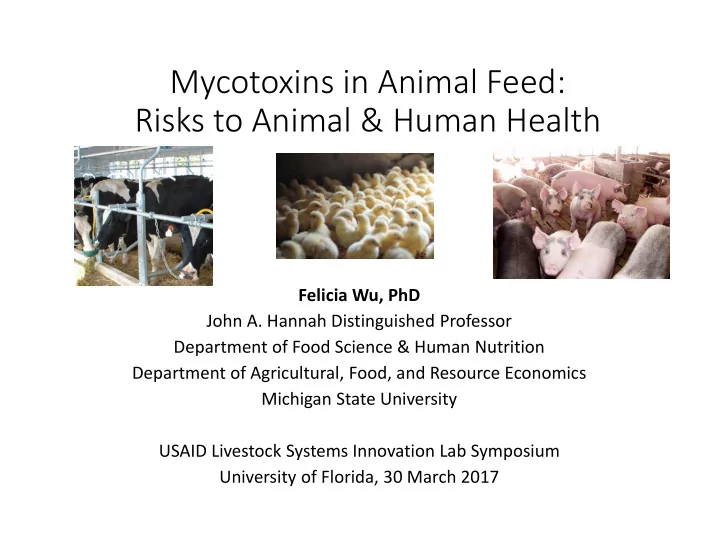
Felicia Wu, PhD John A. Hannah Distinguished Professor Department of Food Science & Human Nutrition Department of Agricultural, Food, and Resource Economics Michigan State University USAID Livestock Systems Innovation Lab Symposium University of Florida, 30 March 2017

slide-2
SLIDE 2

Presentation outline

  • What are mycotoxins?
  • Key agricultural mycotoxins in animal feed
  • US regulations: mycotoxins in animal feed
  • Animal health effects
  • Potential human health effects
  • What can we do about it?
slide-3
SLIDE 3

3

Mycotoxins: What are they?

  • Toxic & carcinogenic chemicals produced

by fungi

  • Long history of mycotoxins affecting

society

  • Leviticus 14:37
  • 11th c.: Claviceps purpurea produces ergot in

rye  St. Anthony’s Fire

  • Mysterious human & animal deaths in 1930s

(Great Depression horses)

  • 1960 aflatoxin discovery: UK turkey deaths
  • Today: several dozen mycotoxins identified

slide-4
SLIDE 4

Major classes of mycotoxins, associated foods & health effects, & species affected

Mycotoxin Produced by Chemical structure Contaminated products Animals affected Clinical effects Aflatoxin Aspergillus flavus;

  • A. parasiticus

Corn, peanuts, cottonseed, tree nuts, dairy products Swine, dogs, fish, cattle, poultry, humans Liver lesions, liver cancer, growth impairment Fumonisin Fusarium spp Corn, silage Swine, horses, humans Pulmonary edema, leukoencephalomalacia (horses), neural tube defects, growth impairment Ochratoxin Aspergillus, Penicillium spp Cereals (esp.

  • ats), nuts,

coffee, grapes Swine, humans Kidney and liver damage, cancer Deoxynivale nol (vomitoxin) Fusarium spp Wheat, barley,

  • ats, corn

Swine, cattle, poultry, horses, humans Feed refusal, anorexia, vomiting, reduced growth
slide-5
SLIDE 5

Class of Animal Industry guideline Ruminating beef and feedlot cattle

  • lder than 4

months 10 ppm Chickens 10 ppm Swine & all other animals 5 ppm All other animals 5 ppm Class of Animal Action level Finishing beef cattle 300 ppb Beef cattle, swine or poultry 300 ppb Finishing swine 200 ppb Breeding cattle & swine, mature poultry 100 ppb Dairy animals, pets 20 ppb Class of Animal Industry guideline Swine and Catfish 10 ppm Breeding Ruminants, Poultry, Mink 15 ppm Ruminants >3 months; Mink for pelt production 30 ppm Poultry for Slaughter 50 ppm Horses 5 ppm

Aflatoxin (action levels)

US Food & Drug Administration mycotoxin regulations, animal feed

Fumonisin (industry guidelines) DON (industry guidelines)

slide-6
SLIDE 6

Occurrence of mycotoxins in animal feed

Parameters AF DON FUM OTA Percent positive (%) 40 60 72 36 Average level (μg/kg) 7 280 687 5 Maximum (μg/kg) 1,165 9,903 10,282 595 Worldwide mycotoxin survey in >25,000 finished feed samples: 81% samples contaminated with at least 1 mycotoxin (Marugesan et al. 2015) Economic impacts:

  • >$1 billion annual loss in 2017 USD from mycotoxins in

US crops (Vardon et al. 2003)

  • Economic losses due to effects on livestock productivity

and costs of meeting regulatory requirements Animal health Impacts:

  • Reduced feed efficiency
  • Gastrointestinal dysfunction
  • Immune system dysfunction
slide-7
SLIDE 7

Mycotoxins reduce animal feed efficiency

At mycotoxin doses found in real animal feed, mycotoxicoses can cause 30% reduction in growth, 85% of which is attributable to feed inefficiency (meta-analysis of swine data).

  • Why might this be happening?

Source: Pastorelli et al. 2012, 6:952–61

slide-8
SLIDE 8

Mycotoxins cause gastrointestinal dysfunction (cytokine expression)

  • Cytokine expression within the intestine of mammals due to exposure to DON and

fumonisin [FB] (Bracarense et al. 2012). Aflatoxin has similar effects (Turner et al. 2007).

Source: Bracarense et al. Br. J. Nutr. 2012, 107:1776–86

slide-9
SLIDE 9

Mycotoxins change intestinal epithelium, increasing animal susceptibility to infectious diseases

  • DON acts as a predisposing factor by damaging

the intestinal mucosa, leading to leakage of nutrients into the intestinal lumen

  • Broiler chickens fed a diet contaminated with 5

mg DON/kg of feed were found to be more prone to develop necrotic enteritis lesions compared to controls in a normal diet (Antonissen et al. 2014)

  • Moreover, swine exposed to aflatoxin in feed

experienced increased proinflammatory cytokines, but reduced vaccine efficacy (Meissonnier et al. 2008)

Antonissen et al. Toxins. 2014, 6, 430-452

The impact of DON and T-2 toxin on a Salmonella Typhimurium infection in pigs

slide-10
SLIDE 10

If livestock consume mycotoxins, what is human health impact?

  • Dairy animals that consume aflatoxin B1

secrete aflatoxin M1 (AFM1) in milk

  • AFM1 has 10% cancer potency of AFB1

(JECFA 2001)

  • FDA regulates AFM1 at 0.5 ug/kg allowable

in dairy (EU: 0.05 ug/kg)

  • Ochratoxin A bioaccumulates in animal

blood and (to limited extent) swine muscle meat

  • OTA risk highest for populations that

consume blood sausage, black pudding, other blood products; and to limited extent, pork

  • Some kidney toxicity risk

Country Sample % AF-positive samples Min–Max (μg/kg) Kuwait White cheese 80 0.024–0.45 Turkey Cheese 94 0.012–0.38 Yoghurt 56 0.0025–0.078 Dairy dessert 52 0.0015–0.08 Butter 100 0.01–7.0 Cream cheese 99 0–4.1 Yoghurt 88 0.01–0.48 Iran White cheese 80 0.052–0.75 Cream cheese 72 0.058–0.79 Livan cheese 65 0.03–0.31 Cheese 53 0.082–1.25 White cheese 60 0.041–0.37 Feta cheese 83 0.15–2.4 Libya Cheese 75 0.11–0.52 Brazil Cheese 30 0.091–0.3 Greece Feta cheese – Pakistan White cheese 78 0.004–0.6 Cream cheese 59 0.004–0.46 Butter 45 0.004–0.41 Yoghurt 61 0.004–0.62 Serbia Milk products 38 0.27–0.95

Occurrence of AFM1 in dairy products globally

Becker-Algeri et al. J Food Sci. 2016; 81:R544-52

slide-11
SLIDE 11

What causes mycotoxin in proble lems in in anim imal l feed?

  • Climate factors
  • Warmer temperatures favor certain

fungi

  • Drought, rainfall
  • Environmental factors
  • Insect pests
  • Suitability of hybrid for region
  • Crop & livestock grower practices
  • Harvesting when wet, rather than

allowing crop to “dry down”

  • Insufficient drying
  • Wet, warm, pest-ridden storage

conditions

  • Long periods of animal feed storage

Risk maps for aflatoxin contamination in maize at harvest in 3 different climate scenarios, present, +2 ℃,+5℃

Battilani et al. Sci Rep. 2016;6:24328

slide-12
SLIDE 12

Interventions to reduce mycotoxin risk

  • Preharvest
  • Good agricultural

practices

  • Genetically enhancing

plants’ resistance

  • Biocontrol
  • Postharvest
  • Improved sorting,

drying, food storage  Dietary

 Improved dietary variety  Dietary enterosorbents

(binders)

 NovaSil used commonly

in US animal feed

 Dietary chemoprevention

 Chlorophyll, chlorophyllin  Compounds in cruciferous

& Allium vegetables

 Triterpenoids (in grasses,

herbs, apple peels)

slide-13
SLIDE 13

Summary ry

  • Mycotoxins have posed a danger to human &

animal health for millennia

  • Mycotoxins occur frequently in animal feed

worldwide

  • Despite regulations, animals can still suffer adverse

health effects

  • Interventions exist to reduce the mycotoxin

problem