Museum of New Zealand 20 years of advances in fire modelling What - - PowerPoint PPT Presentation

museum of new zealand
SMART_READER_LITE
LIVE PREVIEW

Museum of New Zealand 20 years of advances in fire modelling What - - PowerPoint PPT Presentation

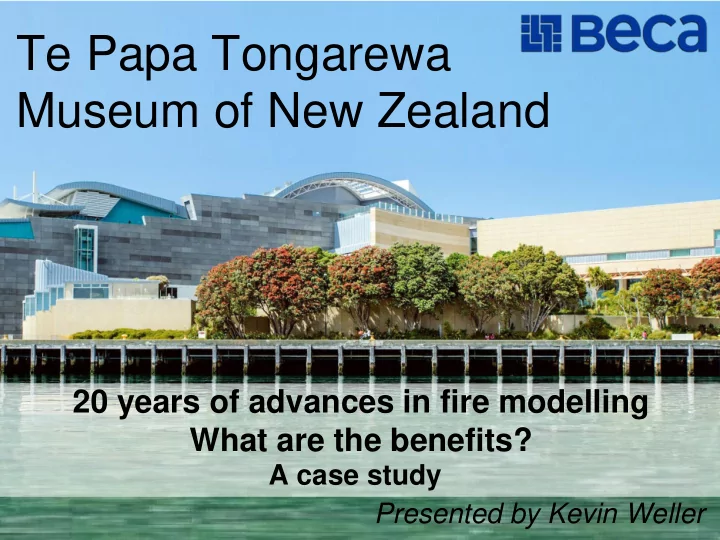
Te Papa Tongarewa Museum of New Zealand 20 years of advances in fire modelling What are the benefits? A case study Presented by Kevin Weller About Te Papa Built 1996 5 hectares 6 floors Large atriums Single compartment


slide-1
SLIDE 1

Te Papa Tongarewa Museum of New Zealand

A case study

20 years of advances in fire modelling What are the benefits?

Presented by Kevin Weller
slide-2
SLIDE 2

About Te Papa

  • Built 1996
  • 5 hectares
  • 6 floors
  • Large atriums
  • Single compartment
slide-3
SLIDE 3

Smoke Control System

slide-4
SLIDE 4

Building Code

Then

  • ‘Acceptable Solution’
  • Large atriums

→Alternate solution →10 minutes to evac. →Indefinite tenability

slide-5
SLIDE 5

Now

  • Compliance Document
  • ASET vs RSET

– Set performance requirements

Building Code

slide-6
SLIDE 6

Engineering tools

  • FIRE SIMULATOR

–Zone model

  • EVACNET+

–Nodal model

slide-7
SLIDE 7
  • FDS

–Revit –PyroSim –Smokeview

  • Pathfinder

–Revit

Engineering tools

slide-8
SLIDE 8

Then vs Now

a greater understanding

  • r

additional complexity?

What are the benefits?

slide-9
SLIDE 9

Entrance Atrium Fire

  • 22m ceiling
  • Four levels
  • Protected by

– Smoke extract – Deluge + Flame detection

slide-10
SLIDE 10
  • FIRE SIMULATOR
  • Single Room
  • 4MW fire
  • Design layer height + Safety Factor

Entrance Atrium Fire

slide-11
SLIDE 11

Spill Plume vs. Atrium Fire

slide-12
SLIDE 12

Now

  • FDS
  • 1.5MW fire.
  • Spill Plume Fire

Entrance Atrium Fire

  • FDS
  • 1.5MW fire
  • Spill Plume Fire
slide-13
SLIDE 13

Entrance Atrium Fire

  • FDS
  • 1.5MW fire
  • Spill Plume Fire
  • Failed Tenability
slide-14
SLIDE 14

Entrance Atrium Fire

slide-15
SLIDE 15

EVACNET+

  • 1 model
  • 4200 people
  • All exits available
  • 10 minute limit
  • 520 s Evac

Evacuation Modelling

slide-16
SLIDE 16

Evacuation Modelling

  • Pathfinder
  • 3500 people
  • 460 s to safe place
  • 610s to outside
slide-17
SLIDE 17
  • 520s for 4500 people

vs

  • 610s for 3500 people

Evacuation Modelling

slide-18
SLIDE 18
  • Blocked Exit
  • 1400 people
  • 1200 s Evac

Evacuation Modelling

slide-19
SLIDE 19

Acceptance Criteria

  • Maintained tenability
  • Evacuation under 10 minutes
  • ASET vs RSET
slide-20
SLIDE 20
slide-21
SLIDE 21

Conclusion

Now

  • More detailed
  • More complex
  • Better

understanding

Benefit: a safer building Then

  • Safety factors
  • Limited

assessment

  • Little detail
slide-22
SLIDE 22

Questions?