Muscles bones and muscles. Bones and muscles work together to - - PDF document

muscles
SMART_READER_LITE
LIVE PREVIEW

Muscles bones and muscles. Bones and muscles work together to - - PDF document

Like a machine, your body consists of many parts that move. Those parts are your Muscles bones and muscles. Bones and muscles work together to provide a structural framework for movement. Muscle Action - Voluntary Muscle Action


slide-1
SLIDE 1

1

Muscles

Bones and muscles work together to provide a structural framework for movement.

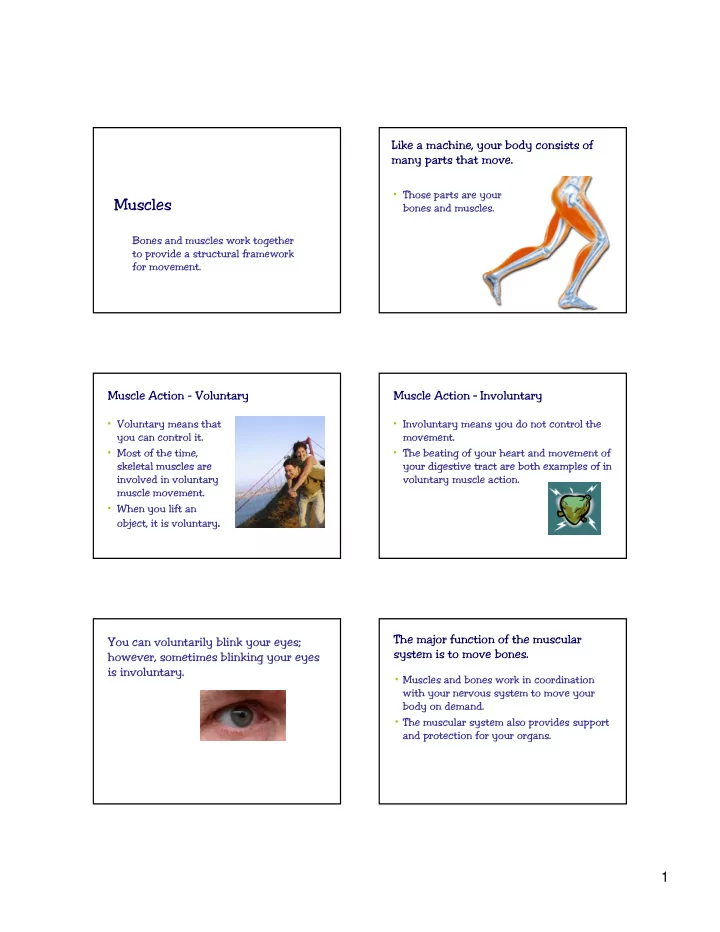
Like a machine, your body consists of many parts that move.

  • Those parts are your

bones and muscles.

Muscle Action - Voluntary

  • Voluntary means that

you can control it.

  • Most of the time,

skeletal muscles are skeletal muscles are involved in voluntary muscle movement.

  • When you lift an
  • bject, it is voluntary.

Muscle Action – Involuntary

  • Involuntary means you do not control the

movement.

  • The beating of your heart and movement of

your digestive tract are both examples of in your digestive tract are both examples of in voluntary muscle action.

You can voluntarily blink your eyes; however, sometimes blinking your eyes is involuntary. The major function of the muscular system is to move bones.

  • Muscles and bones work in coordination

with your nervous system to move your body on demand. y

  • The muscular system also provides support

and protection for your organs.

slide-2
SLIDE 2

2

Skeletal, smooth, cardiac muscle, and tendons make up the muscular system. y Tendons

  • Tendons attach the muscles to bones

allowing muscles and bones to work in coordination with your nervous system to move your body on demand.

The three types of muscle in the muscular system are skeletal, cardiac, and smooth. Skeletal muscles are made of skeletal muscle tissue.

  • Skeletal muscle tissue is

made up of thousands of cylindrical muscle fibers y

  • ften running the entire

length of the muscle.

Bundles of fibers are bound together by connective tissue.

  • Blood vessels and

nerves run through the connective tissue.

slide-3
SLIDE 3

3

Muscle fibers contain long muscle cells each with thousands of mitochondria for energy.

  • During a muscle

contraction, a complex reaction p causes muscle fibers to shorten.

  • When the muscle

relaxes, muscle fibers return to their

  • riginal position.

Label the muscles Muscles usually work in pairs called flexors and extensors.

  • If a muscle bends

part of your body, it is called a flexor.

  • If a muscle

straightens part of your body, it is called an extensor.

  • Flexor and extensor

pairs provide almost all the movement of your skeleton. During a muscle contraction, the muscle fibers get shorter.

Muscles require movement and exercise to remain strong.

  • Resistance exercise

requires muscles to

  • vercome

resistance (weight).

  • Resistance exercise

increases muscle size and strength.

slide-4
SLIDE 4

4

Aerobic exercise like running, swimming laps, and cycling strengthens the strengthens the heart and increases the endurance of skeletal muscle.