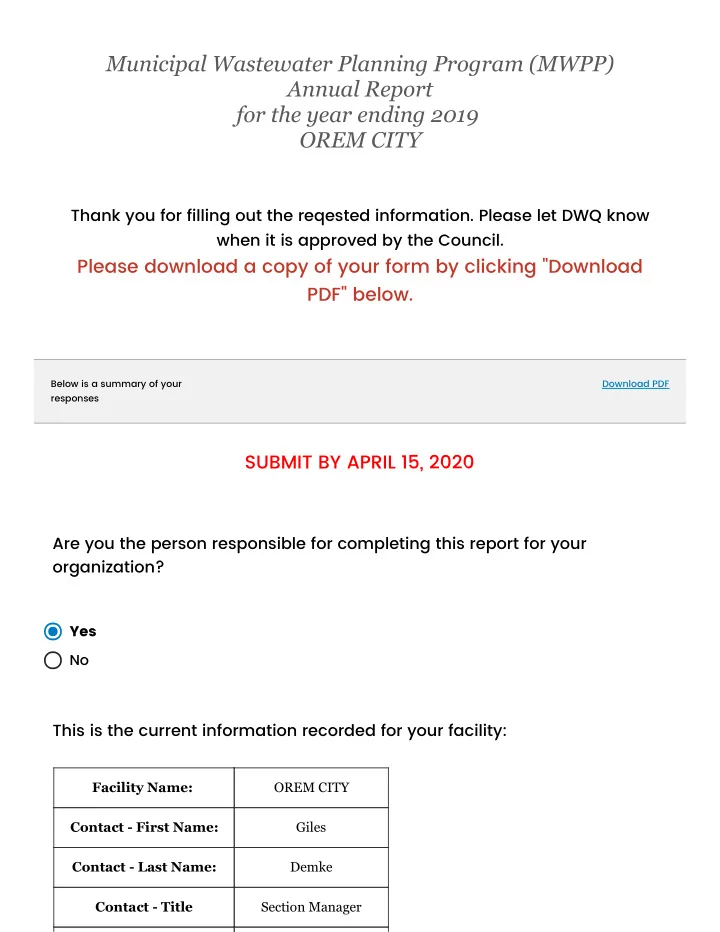
SLIDE 1 Municipal Wastewater Planning Program (MWPP) Annual Report for the year ending 2019 OREM CITY
Below is a summary of your responses Download PDF
Thank you for filling out the reqested information. Please let DWQ know when it is approved by the Council.
Please download a copy of your form by clicking "Download PDF" below. SUBMIT BY APRIL 15, 2020
Are you the person responsible for completing this report for your
This is the current information recorded for your facility:
Facility Name: OREM CITY Contact - First Name: Giles Contact - Last Name: Demke Contact - Title Section Manager
Yes No
SLIDE 2
Contact - Phone: 801-229-7475 Contact - Email: gedemke@orem.org
Is this information above complete and correct? Your wastewater system is described as Collection, Mechanical Treatment & Financial: Classification: COLLECTION Grade: IV (if applicable) Classification: TREATMENT Grade: IV Is this correct? WARNING: If you select 'no', you will no longer have access to this form upon clicking Save & Continue. DWQ will update the information and contact you again. Click on a link below to view examples of sections in the survey: (Your wastewater system is described as Collection, Mechanical Treatment & Financial) MWPP Collection System.pdf MWPP Discharging Lagoon.pdf MWPP Financial Evaluation.pdf MWPP Mechanical Plant.pdf MWPP Non-Discharging Lagoon.pdf
Yes No Yes No
SLIDE 3
Will multiple people be required to fill out this form?
Financial Evaluation Section
Form completed by:
Part I: GENERAL QUESTIONS
What was the User Charge16 for 2019?
Yes No Giles Demke
Yes No
Are sewer revenues maintained in a dedicated purpose enterprise/district account?
Yes No
Are you collecting 95% or more of your anticipated sewer revenue? Are Debt Service Reserve Fund6 requirements being met? 312
SLIDE 4 Do you have a water and/or sewer customer assistance program * (CAP)?
Part II: OPERATING REVENUES AND RESERVES Part III: CAPITAL IMPROVEMENTS REVENUES AND RESERVES
Yes No
Yes No
Are property taxes or other assessments applied to the sewer systems15?
Yes No
Are sewer revenues14 sufficient to cover
- perations & maintenance costs9, and repair &
replacement costs12 (OM&R) at this time? Are projected sewer revenues sufficient to cover OM&R costs for the next five years? Does the sewer system have sufficient staff to provide proper OM&R? Has a repair and replacement sinking fund13 been established for the sewer system? Is the repair & replacement sinking fund sufficient to meet anticipated needs?
Yes No
Are sewer revenues sufficient to cover all costs
- f current capital improvements3 projects?
SLIDE 5 Part IV: FISCAL SUSTAINABILITY REVIEW
2019 Impact Fee =
- f current capital improvements3 projects?
Has a Capital Improvements Reserve Fund4 been established to provide for anticipated capital improvement projects? Are projected Capital Improvements Reserve Funds sufficient for the next five years? Are projected Capital Improvements Reserve Funds sufficient for the next ten years? Are projected Capital Improvements Reserve Funds sufficient for the next twenty years?
Yes No Yes No
Have you completed a Rate Study11 within the last five years? Do you charge Impact fees8? 846.90 for City 4876.90 for Southwest Quardrant
Yes No
Have you completed an Impact Fee Study in accordance with UCA 11-36a-3 within the last five years? Do you maintain a Plan of Operations10? Have you updated your Capital Facility Plan2 within the last five years?
SLIDE 6
Describe the Asset Management System (check all that apply) 2019 Replacement Cost =
Yes No
Do you use an Asset Management1 system for your sewer systems? Spreadsheet GIS Accounting Software Specialized Software Other
Yes No
Do you know the total replacement cost of your sewer system capital assets? 390000000
Yes No
Do you fund sewer system capital improvements annually with sewer revenues at 2% or more of the total replacement cost? What is the sewer/treatment system annual asset renewal* cost as a percentage of its total
SLIDE 7
What is the sewer/treatment system annual asset renewal * cost as a percentage of its total replacement cost?
Part V: PROJECTED CAPITAL INVESTMENT COSTS
Cost of projected capital improvements
This is the end of the Financial questions
To the best of my knowledge, the Financial section is completed and accurate.
Collections System Section
asset renewal* cost as a percentage of its total replacement cost?
Yes No
6000000
Cost Purpose of Improvements Please enter a valid numerical value Replace/Restore New Technology Increase Capacity 2020 5053328 2020 thru 2024 26195884 2025 thru 2029 14952152 2030 thru 2034 25000000 2035 thru 2039 25000000
Yes
SLIDE 8
Form completed by:
May Receive Continuing Education /units (CEUs)
Part I: SYSTEM DESCRIPTION
What is the largest diameter pipe in the collection system (diameter in inches)? What is the average depth of the collection system (in feet)? What is the total length of sewer pipe in the system (length in miles)? How many lift/pump stations are in the collection system? What is the largest capacity lift/pump station in the collection system (design capacity in gallons per minute)? Do seasonal daily peak flows exceed the average peak daily flow by 100 percent or more?
Giles Demke 42 8 325 7 1200
SLIDE 9
What year was your collection system first constructed (approximately)? In what year was the largest diameter sewer pipe in the collection system constructed, replaced or renewed? (If more than one, cite the oldest)
PART II: DISCHARGES
How many days last year was there a sewage bypass, overflow or basement flooding in the system due to rain or snowmelt? How many days last year was there a sewage bypass, overflow or basement flooding due to equipment failure (except plugged laterals)? The Utah Sewer Management Program defines two classes of sanitary sewer overflows (SSOs): Class 1- a Significant SSO means a SSO or backup that is not caused by a private lateral obstruction or problem that: (a) affects more than five private structures; (b) affects one or more public, commercial or industrial structure(s); (c) may result in a public health risk to the general public; (d) has a spill volume that exceeds 5,000 gallons, excluding those in
Yes No 1940 1957
SLIDE 10
(d) has a spill volume that exceeds 5,000 gallons, excluding those in single private structures; or (e) discharges to Waters of the state. Class 2 - a Non-Significant SSO means a SSO or backup that is not caused by a private lateral obstruction or problem that does not meet the Class 1 SSO criteria. Below include the number of SSOs that occurred in year: 2019 Please indicate what caused the SSO(s) in the previous question. Please specify whether the SSOs were caused by contract or tributary community, etc.
Part III: NEW DEVELOPMENT
Did an industry or other development enter the community or expand production in the past two years, such that flow or wastewater loadings to the sewerage system increased by 10% or more?
Number
Number of Class 1 SSOs in Calendar year Number of Class 2 SSOs in Calendar year n/a n/a Yes No
SLIDE 11
Are new developments (industrial, commercial, or residential) anticipated in the next 2 - 3 years that will increase flow or BOD5 loadings to the sewerage system by 25% or more? Number of new commercial/industrial connections in the last year Number of new residential sewer connections added in the last year Equivalent residential connections7 served
Part IV: OPERATOR CERTIFICATION
How many collection system operators do you employ? Approximate population served State of Utah Administrative Rules requires all public system operators considered to be in Direct Responsible Charge (DRC) to be appropriately certified at least at the Facility's Grade.
Yes No 16 844 24987 9 98000
SLIDE 12
certified at least at the Facility's Grade. List the designated Chief Operator/DRC for the Collection System below: List all other Collection System operators with DRC responsibilities in the field, by certification grade, separate names by commas: List all other Collection System operators by certification grade, separate names by commas:
Name Grade Email First and Last Name Please enter full email address Chief Operator/DRC Ryan Johnson
IV
rjjohnson@orem.org Name separate by comma SLS17 Grade I: Collection Grade I: Collection Grade II: Collection Grade III: Collection Grade IV: Joseph Jamison, Terrance Harris, Name separate by comma SLS17 Grade I: Collection Grade I: Collection Grade II: Collection Grade III: Collection Grade IV: Jay Connelly, Chad Johnson, Daniel Shorten, Dylan Hanseen No Current Collection Certification: John Olsen, Rulon Waite, Chris Bingham
SLIDE 13 Is/are your collection DRC operator(s) currently certified at the appropriate grade for this facility?
Part V: FACILITY MAINTENANCE Part VI: SSMP EVALUATION
No Current Collection Certification: John Olsen, Rulon Waite, Chris Bingham Name
Yes No
Yes No
Have you implemented a preventative maintenance program for your collection system? Have you updated the collection system
- perations and maintenance manual within
the past 5 years? Do you have a written emergency response plan for sewer systems? Do you have a written safety plan for sewer systems? Is the entire collections system TV inspected at least every 5 years? Is at least 85% of the collections system mapped in GIS?
Yes No
Has your system completed a Sewer System Management Plan (SSMP)? Has the SSMP been adopted by the permittee’s governing body at a public
SLIDE 14
During 2019, was any part of the SSMP audited as part of the five year audit? Have you completed a System Evaluation and Capacity Assurance Plan (SECAP) as defined by the Utah Sewer Management Program?
Part VII: NARRATIVE EVALUATION
This section should be completed with the system operators.
Describe the physical condition of the sewerage system: (lift stations, etc. included) What sewerage system capital improvements3 does the utility need to implement in the next 10 years?
permittee’s governing body at a public meeting? Has the completed SSMP been public noticed? During the annual assessment of the SSMP, were any adjustments needed based on the performance of the plan?
Yes No
Yes No Yes No There are approximately 325 miles of sewer pipe and over 6,400 manholes in the Orem City Sewer system. Assets are cataloged in a GIS database system. 80 percent of the pipe in the system is 8 inches in diameter. there are 7 sewer lift stations that are owned and operated by the City
SLIDE 15 What sewerage system problems, other than plugging, have you had over the last year? Is your utility currently preparing or updating its capital facilities plan 2? Does the municipality/district pay for the continuing education expenses of
Is there a written policy regarding continuing education and training for wastewater operators? Any additional comments?
1) Replace 6,850 feet of existing 10-inch line with 18-inch line in 1400 South (Chambery to Springwater). 2) Install 2,700 feet 6-inch force main parallel to existing 10-inch force main from Springwater Lift Station. 3) Replace 1,260 feet of existing 27-inch/20-inch line with 36 inch line along College Drive at 800 South. 4) Replace 820 feet of existing 12-inch pipe with 15-inch pipe along College Drive at 1200 South. Directional bore through a service lateral that required a new main line connection to be installed in a major roadway right-of-way. Yes No 100% Covered Partially cover Does not pay Yes No The number of equivalent residential connections served was reduces to reflect capped or removed connections that have been removed from the GIS system.
SLIDE 16
This is the end of the Collections System questions
To the best of my knowledge, the Collections System section is completed and accurate.
Mechanical Plant Section
Form completed by:
May Receive Continuing Education /units (CEUs)
Part I: INFLUENT INFORMATION
Please provide the average influent flow rate and average influent BOD5 and TSS loading rates listed below for your facility.
Part II: EFFLUENT INFORMATION
How many Notices of Violation (NOVs) did you receive for this facility in the review year?
capped or removed connections that have been removed from the GIS system. Yes Giles Demke
Average Daily Flow (MGD) Average Daily BOD5 Load (lb/day) Average Daily TSS Load (lb/day)
Design Basis or Rated Capacity
13.5 39404 39404
2019 Average
8.56 15349 16063
SLIDE 17
How many days in the past year was there a bypass or overflow of wastewater at the facility due to high flows?
Part III: FACILITY AGE
In what year were the following process units constructed, upgraded or renewed?
Note: If a unit process does not apply to your system enter the Evaluation Year under Construction or Upgrade Year.
PART IV: DISCHARGES
How many days in the last year was there a bypass or overflow of wastewater at the facility due to equipment failure?
Evaluation Year Construction or Upgrade Year Age
Headworks
2019 2008 11
Primary Treatment
2019 2012 7
Secondary Treatment
2019 2012 7
Tertiary Treatment
2019 2019
Solids Handling
2019 1994 22
Disinfection
2019 2014 3
Land Application/Disposal
2019 1994 22
SLIDE 18
PART V: BIOSOLIDS HANDLING
Biosolids Disposal (check all that apply)
Part VI: NEW DEVELOPMENT
Number of new commercial/industrial connections in the last year Number of new residential sewer connections added in the last year Equivalent residential connections7 served
Part VII: OPERATOR CERTIFICATION
How many treatment system operators do you employ?
Yes No
Landfill Land Application Give Away/Other Distribution 16 844 24987
SLIDE 19
How many treatment system operators do you employ? State of Utah Administrative Rules requires all public system operators considered to be in Direct Responsible Charge (DRC) to be appropriately certified at least at the Facility's Grade. List the designated Chief Operator/DRC for the Wastewater Treatment System below: List all other Wastewater Treatment System operators with DRC responsibilities in the field, by certification grade, separate names by commas: List all other Wastewater Treatment System operators by certification grade, separate names by commas:
16
Name Grade Email First and Last Name Please enter full email address Chief Operator/DRC Giles Demke
IV
gedemke@orem.org Name separate by comma SLS17 Grade I: Treatment Grade I: Treatment Grade II: Treatment Grade III: Treatment Grade IV: Ned Miner, Dan Shorten Name separate by comma
SLIDE 20 Is/are your DRC operator(s) currently certified at the appropriate grade for this facility? Part VIII: FACILITY MAINTENANCE Identify the types of treatment equipment and processes installed at your facility.
separate by comma SLS17 Grade I: Treatment Grade I: Treatment Grade II: Treatment Grade III: Treatment Grade IV: Norm Atkin, Blair Blonquist Name separate by comma
Yes No
Yes No
Have you implemented a written preventative maintenance program for your treatment system? Have you updated the treatment system
- perations and maintenance manual within
the past 5 years?
Yes No
Screens Grit Removal Primary Clarifiers Imhoff Tanks
SLIDE 21
This is the end of the Mechanical Plant questions
To the best of my knowledge, the Mechanical Plant section is completed
Fixed Film Reactor Activated Sludge Aerobic Suspend Growth Variations Anaerobic Suspended Growth variations Physical-chemical systems for organic removal w/o secondary treatment Physical-chemical systems for organic removal following secondary treatment Membrane Filtration Suspended-growth Nitrification and Denitrification Air Stripping Phosphorus Removal - Chemical Phosphorus Removal - Biological Ion Exchange Reverse Osmosis Media Filtration Dissolved Air Flotation Micro Screens Chlorine Disinfection UV Disinfection Effluent use/Reuse
Yes No
SLIDE 22
To the best of my knowledge, the Mechanical Plant section is completed and accurate. I have reviewed this report and to the best of my knowledge the information provided in this report is correct. Has this been adopted by the council? If no, what date will it be presented to the council? What date will it be presented to the council?
Date format ex. mm/dd/yyyy
Please log in.
Yes
×
clear
Yes No 04/28/2020 Email gedemke@orem.org PIN
SLIDE 23
NOTE: This questionnaire has been compiled for your benefit to assist you in evaluating the technical and financial needs of your wastewater systems. If you received financial assistance from the Water Quality Board, annual submittal of this report is a condition of that assistance. Please answer questions as accurately as possible to give you the best evaluation of your facility. If you need assistance, please send an email to wqinfodata@utah.gov and we will contact you as soon as possible. You may also visit our Frequently Asked Questions page.
Powered by Qualtrics A