Multistate tax You must be vigilant in managing your state and local - - PDF document

multistate tax
SMART_READER_LITE
LIVE PREVIEW

Multistate tax You must be vigilant in managing your state and local - - PDF document

including up-front sample period negotiation, detailed review and analysis of Provide experienced negotiation services for all types of tax settlements, including high-risk controversies. Personal income tax, ment of certain high-risk


slide-1
SLIDE 1

mcdonaldhopkins.com Chicago | Cleveland | Columbus | Detroit | Miami | West Palm Beach

Multistate tax

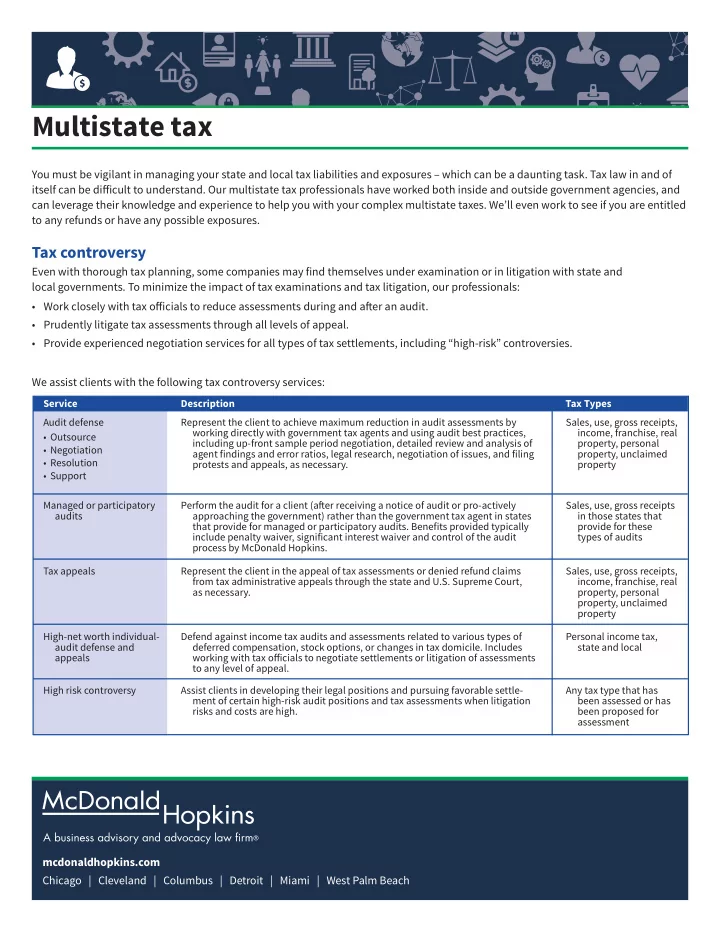
You must be vigilant in managing your state and local tax liabilities and exposures – which can be a daunting task. Tax law in and of itself can be difgicult to understand. Our multistate tax professionals have worked both inside and outside government agencies, and can leverage their knowledge and experience to help you with your complex multistate taxes. We’ll even work to see if you are entitled to any refunds or have any possible exposures.

Tax controversy

Even with thorough tax planning, some companies may find themselves under examination or in litigation with state and local governments. To minimize the impact of tax examinations and tax litigation, our professionals:

  • Work closely with tax ofgicials to reduce assessments during and afuer an audit.
  • Prudently litigate tax assessments through all levels of appeal.
  • Provide experienced negotiation services for all types of tax settlements, including “high-risk” controversies.

We assist clients with the following tax controversy services:

Service Description Tax Types Represent the client to achieve maximum reduction in audit assessments by working directly with government tax agents and using audit best practices, including up-front sample period negotiation, detailed review and analysis of agent findings and error ratios, legal research, negotiation of issues, and filing protests and appeals, as necessary. Audit defense

  • Outsource
  • Negotiation
  • Resolution
  • Support

Sales, use, gross receipts, income, franchise, real property, personal property, unclaimed property Perform the audit for a client (afuer receiving a notice of audit or pro-actively approaching the government) rather than the government tax agent in states that provide for managed or participatory audits. Benefits provided typically include penalty waiver, significant interest waiver and control of the audit process by McDonald Hopkins. Managed or participatory audits Sales, use, gross receipts in those states that provide for these types of audits Represent the client in the appeal of tax assessments or denied refund claims from tax administrative appeals through the state and U.S. Supreme Court, as necessary. Tax appeals Sales, use, gross receipts, income, franchise, real property, personal property, unclaimed property Defend against income tax audits and assessments related to various types of deferred compensation, stock options, or changes in tax domicile. Includes working with tax ofgicials to negotiate settlements or litigation of assessments to any level of appeal. High-net worth individual- audit defense and appeals Personal income tax, state and local Assist clients in developing their legal positions and pursuing favorable settle- ment of certain high-risk audit positions and tax assessments when litigation risks and costs are high. High risk controversy Any tax type that has been assessed or has been proposed for assessment

slide-2
SLIDE 2

McDonald Hopkins Multistate tax

Tax evaluation

The myriad of multistate tax laws can be difgicult to comply with on a consistent basis. Our professionals assist clients with evaluating their current multistate tax positions to determine if they are entitled to any refunds or have any possible exposures. Our professionals:

  • Partner with our clients to analyze tax filings and tax payments made to vendors to determine if the appropriate amount
  • f tax has been paid.
  • Work with the applicable multistate and local taxing jurisdiction to obtain refunds of any overpayments.
  • Develop strategies to resolve any exposures identified as part of the evaluation.
  • Assist clients with addressing the causes of the refunds or exposures so they can be in compliance prospectively.

We assist clients with the following tax evaluation services:

Service Description Tax Types Provide a “reverse” tax audit service designed primarily to identify refund and

  • verpayment opportunities, secondarily to identify areas of significant risk.

R.A.C.E.

TM-Refund Analysis

& Compliance Evaluation Sales, use, gross receipts, income, franchise, real property, personal property, unclaimed property Conduct a proactive analysis of a client’s Ohio Commercial Activity Tax (CAT) payments and filings to determine optimal filing positions, identify potential refunds, and mitigate future exposure. CAT scanTM Sales, use, gross receipts, income, franchise Analyze a client’s activities to determine those states in which the client has filing requirements (i.e., nexus) and an estimated tax risk computation. Multistate nexus review Sales, use, gross receipts, income, franchise, real property, personal property, unclaimed property Negotiate with state and local jurisdictions to mitigate historical tax obligations for a client that has failed to file for various taxes where an obligation exists. Benefits typically include penalty waiver and limited look-back periods. Voluntary disclosure Sales, use, gross receipts, income, franchise, real property, personal property, unclaimed property Design and deliver a customized sales and use tax training program specific to the client’s industry and work environment. The client benefits by avoiding tax

  • verpayments and unexpected tax liabilities in the future.

In-house training Sales, use Analyze a target’s tax audit exposure and potential successor liability issues relating to the client’s purchase of target. Due diligence Sales, use, gross receipts, income, franchise, real property, personal property, unclaimed property Research and complete an easy to use, determination tool for use in tax compliance by the client’s accounting and/or tax personnel. Provides management with the necessary back-up for more in-depth analysis when necessary and allows for efgicient updating for future law/regulatory changes. Tax compliance matrix Sales, use, gross receipts, income, franchise 2

slide-3
SLIDE 3

McDonald Hopkins Multistate tax

Tax planning

We believe that even in an environment of increased scrutiny of tax structures and increased enforcement efgorts by government tax ofgicials, significant tax saving opportunities still exist. We work proactively with clients to:

  • Identify and implement tax reduction strategies consistent with business operations.
  • Review existing tax planning structures to ensure their integrity upon examination.
  • Minimize multistate tax consequences of business transactions.

We assist clients with the following tax planning services:

Service Description Tax Types Review a client’s operations, identify alternative legal structures, and implement those structures to take advantage of state tax benefits. Multistate tax planning Sales, use, gross receipts, income, franchise, real property, personal property, unclaimed property Perform an analysis of the impact of changing one’s tax domicile, especially in light of the sale of a business or pending retirement of a high-ranking company leader. Assist individual clients with the specific steps necessary to efgectively establish tax domicile in another state. Residency planning Personal income taxstate and local Simplify and lower the cost of a client’s use tax compliance by developing an efgective tax rate agreement with the state taxing authority. UCO-Use Tax Compliance Optimizer-efgective rate agreements Use Analyze (on a proactive basis) multijurisdictional opportunities and exposures associated with business expansion (gross business volume, new products, new marketing methods or new locations). Business expansion planning All appropriate taxes for industry Review client’s tax filings to determine the availability of unclaimed state and local tax credits or incentives. Assist a company with obtaining tax incentives when expanding an existing facility or building a new facility. State and local credits and incentives All appropriate taxes for industry as well as

  • ther non-tax

incentives Analyze and compare state and local tax costs related to alternate locations being considered by a client. Relocation analysis All appropriate taxes for industry 3

slide-4
SLIDE 4

McDonald Hopkins Multistate tax mcdonaldhopkins.com Chicago | Cleveland | Columbus | Detroit | Miami | West Palm Beach

Tax policy

Businesses today struggle with ever-changing tax laws and government policies in multiple jurisdictions. Our multistate tax professionals have a wealth of experience in dealing directly with government leaders in most states and Washington D.C. to address tax policy matters. Working closely with professionals in our Government Afgairs Practice, we work with clients to:

  • Develop and advocate strategic tax policy positions.
  • Monitor and impact tax law developments and trends.
  • Negotiate valuable tax incentives to support business expansion and growth.

We assist clients with the following tax policy services:

Service Description Tax Types Drafu legislation language and lobby state and local ofgicials to enact legislation that protects the interests of our client, promotes a more positive tax environ- ment, or clarifies applicability of existing tax laws. Tax policy advocacy All taxes Develop a white paper analysis related to current or proposed tax laws which apply to an industry for consideration by government policy makers. Industry tax impact analysis All taxes Operate as “special tax counsel” for a business association, which includes moni- toring and analyzing state legislative and tax developments. Association tax counsel All taxes 4

Multistate Tax Services Team: McDonald Hopkins Honor Banvard 614.484.0032 hbanvard@mcdonaldhopkins.com David D. Ebersole 614.484.0716 debersole@mcdonaldhopkins.com David M. Kall 216.348.5812 dkall@mcdonaldhopkins.com

slide-5
SLIDE 5

mcdonaldhopkins.com Chicago | Cleveland | Columbus | Detroit | Miami | West Palm Beach

Multistate tax CAT scan™

Ohio Commercial Activity Tax (CAT) check-up

Ohio’s CAT creates a unique set of symptoms for you to diagnose when complying with your state and local tax burden. It’s difgicult to navigate, even for the experienced tax professional. Adding to the complexity of the tax structure, the Ohio Department of Taxation (ODT) agressively audits for CAT with

  • ver 70 trained auditors.

To assist you in making important compliance and planning decisions related to the CAT, our multistate tax practice ofgers

  • ur own type of CAT Scan.

Reduce the symptoms of unhealthy tax costs

Our CAT Scan™ is a minimally invasive, comprehensive one-day process, specifically designed to provide a proactive analysis

  • f a client’s business structure and activities, along with their

CAT compliance, to determine optimal filing positions, identify potential refunds, and mitigate future exposure.

  • 1. Initial Exam

Our experienced tax professionals will review the operations

  • f the business to gain an understanding of its principal

transactions and legal structure.

  • 2. CAT Scan™

We will review important aspects of the CAT law with the company’s tax stafg, including a detailed discussion of the CAT’s compliance requirements.

  • 3. Diagnosis

By comparing the company’s operation with the CAT law, we will work with the company to identify important decision points that should be addressed in order to maximize the healthy aspects and minimize the unhealthy aspects of the tax law. Multistate Tax Services Team: McDonald Hopkins Honor Banvard 614.484.0032 hbanvard@mcdonaldhopkins.com David D. Ebersole 614.484.0716 debersole@mcdonaldhopkins.com David M. Kall 216.348.5812 dkall@mcdonaldhopkins.com

slide-6
SLIDE 6

mcdonaldhopkins.com Chicago | Cleveland | Columbus | Detroit | Miami | West Palm Beach

Multistate tax R.A.C.E.™– Refund Analysis & Compliance Evaluation

Sometimes it feels like state and local tax compliance is an all out competition!

Trying to keep up with state and local tax law changes, understanding new services

  • r products being sold or purchased by your business, and managing state and local

tax audits seems like a never ending race. McDonald Hopkins’ Multistate Tax Services Practice can help you win that race with our R.A.C.E.-Refund Analysis & Compliance Evaluation service!

Benefits of running a R.A.C.E.

Recovering overpayments with little risk and efgort is the main benefit from running a R.A.C.E. R.A.C.E. is a win-win because the overpayments recovered can be used to pay for the consulting services. At a minimum, R.A.C.E. provides a “check-up” for your compliance practices and positions. R.A.C.E. may also identify underpayments that you may resolve prior to discovery by a state tax auditor who may assess the tax with penalties and interest. Finally, R.A.C.E. provides the basis for continued future savings by identifying the root causes of the non-compliance.

Who is a good candidate for R.A.C.E.?

If you are paying substantial state and local taxes (right column), then you are a good candidate forR.A.C.E. Successful R.A.C.E.s have been run for businesses in the following industries: manufacturing, retail, construction, insurance, banking, leasing, restaurant, hotel, printing, transportation, distribution and wholesale. If you are currently under audit (or have recently been audited), then you are a perfect candidate for R.A.C.E. as we can work with the state tax auditors to potentially ofgset any identified liability. Even if you have never been audited, you are a perfect candidate since the R.A.C.E. will give you a “check-up” on your past compliance. R.A.C.E. is completed based on a partnership with our clients with the goal of identifying and recovering any

  • verpaid tax with a minimal efgort on
  • ur clients’ part. We also will notify you
  • f any unpaid tax discovered during our
  • analysis. Afuer the R.A.C.E. is won, we can

work with you to fix the root causes of the

  • verpayments/underpayments so we only

need to run the R.A.C.E. once. R.A.C.E. can be performed for the following taxes:

  • Sales
  • Use
  • Real property
  • Personal property
  • Gross receipts
  • Income
  • Franchise
  • Unclaimed property

Multistate Tax Services Team: McDonald Hopkins Honor Banvard 614.484.0032 hbanvard@mcdonaldhopkins.com David D. Ebersole 614.484.0716 debersole@mcdonaldhopkins.com David M. Kall 216.348.5812 dkall@mcdonaldhopkins.com

slide-7
SLIDE 7

McDonald Hopkins Multistate tax – R.A.C.E.- Refund Analysis & Compliance Evaluation mcdonaldhopkins.com Chicago | Cleveland | Columbus | Detroit | Miami | West Palm Beach

Stages of a R.A.C.E.

R.A.C.E. is performed in three stages to ensure the maximum amount of value is provided with the minimum amount of your time and resources. Stage 1: Initial exam Our experienced tax professionals will review the operations

  • f the business to gain an understanding of its principal

transactions, legal structure, past compliance procedures, internal controls, past and current audit history, and past refund history. The goal of Stage 1 is to estimate any potential overpayments or underpayments to determine how we will run the rest of the R.A.C.E. We will move to Stage 2 when there is mutual agreement regarding the issues to pursue. Stage 2: Documentation review Based on Stage 1, we will develop and implement an action plan to review and capture the appropriate detail to document the amounts to be requested as part of any refund claim. All refund claims will need your approval before we proceed to Stage 3. Stage 3: Refund management Based on Stage 2, we will complete and file the necessary refund claims or amended returns along with the necessary support documentation. Our focus is to provide the appropriate information to the taxing jurisdiction so that it can make informed decisions without needing additional

  • documentation. We will monitor the refund claims to ensure

they are processed as expeditiously as possible.

Why choose McDonald Hopkins?

Professionals from McDonald Hopkins’ Multistate Tax Services Practice are uniquely qualified to run your R.A.C.E. as they have experience working in industry and tax consulting. Our professionals have the necessary experience to quickly understand your business, assist in identifying refunds, and communicating with state and local tax department ofgicials to expedite the recovery of your refunds. To further discuss the benefits of or to schedule a R.A.C.E., please contact your McDonald Hopkins professional or a member of our Multistate Tax Services Practice.

slide-8
SLIDE 8

Multistate Tax Update

mcdonaldhopkins.com Chicago | Cleveland | Columbus | Detroit | Miami | West Palm Beach

McDonald Hopkins

As it currently stands, federal tax rules allow individuals who itemize their deductions to deduct the full amount of their state and local tax (SALT) income tax payments from the taxable income on their federal

  • returns. But the new regimen, the Tax Cuts and Jobs Act set forth in

HR 1, which President Donald Trump signed into law on Dec. 22, 2017, limits the deduction for income, sales or property taxes to $10,000, or $5,000 in the case of a married individual filing a separate return, for tax years 2018 through 2025. There are many reasons to dislike this development, but one that has not been widely covered is the harm it does to legacy cities. Legacy cities, according to Matthew J. Rossman, a Case Western Reserve University School of Law professor, are “places in the Northeast and Midwest where industry and manufacturing once flourished and supported thriving residential communities.” In his Dec. 15, 2017 guest editorial in Cleveland.com, Rossman explained that “[a] slew of economic, political and social forces dramatically changed the fortunes of these cities, causing them to bleed employers and good-paying jobs, lowering their standard of living and reversing population growth.” This depleted the tax base, because afgluent residents moved to more prosperous areas. In turn, the legacy cities were lefu to struggle with less money to “support aging public infrastructure, deteriorating housing stock and poorer residents…all the while striving to reinvent themselves to compete in the 21st-century economy.” As it is, legacy cities usually impose higher local tax rates than newer suburbs and exurbs, and their existence is part of what makes upper-middle-income households in high-tax states “the biggest losers” of the new SALT deduction limits. “They earn enough and live in expensive enough houses to make the proposed doubling of the standard deduction an inadequate trade for losing much of their SALT deduction.” Rossman is concerned that citizens will simply move to avoid the increased tax burdens. “Assuming that people take into account local taxes when deciding where to live (and, honestly, do you know many people who don’t?), scaling back SALT in concert with doubling the standard deduction may very well choke demand for housing in legacy cities.” We have addressed this question a number of times this year. In our most recent article, just two weeks ago, we asserted that the idea

  • f people moving just to avoid higher taxes has been a persistent, if

debunkable myth, but that the real estate company Redfin’s 900-person survey may reveal a new mood. 33 percent of those interviewed said they are “seriously thinking” about “shifuing their home searches to locations where they will be less exposed to tax increases” if Congress eliminates the SALT deduction. Rossman also worries about the domino efgect of the SALT deduction cap on legacy cities. Even if a tax credit for people who buy homes and live in legacy cities would be a better mechanism for mitigating escalating housing costs in legacy cities, ”simply casting aside a century-old deduction like SALT without considering the resulting impact on U.S. communities and neighborhoods is short-sighted and haphazard.” Rossman is not the only one who fears the impact of the new SALT deduction cap. An early December article on Citylab.com conceded the regressive nature of the deduction in the first place, but charged that eliminating it “could be even worse for America.”

POSSIBLE SOLUTIONS

Citylab agreed that high-tax areas will be hurt, but suggested that the hardship would actually be more widespread: “cities, which lev[y] taxes of their own to pay for goods and services that their constituents need, are also likely to see a negative efgect on their bottom lines…. [the cap would have a] systemic impact on cities and states, which must navigate the politics of raising local revenue from the same residents who also pay federal taxes.” To cope, Citylab pointed out that cities could start to depend on other revenue sources, like licensing fees and fines, though this is a solution that is both regressive and not especially efgective. In California, one- third of taxpaying households, or 6 million people, will feel the pinch from the SALT deduction cap. A Dec. 19, 2017 report titled The Games They Will Play: Tax Games, Roadblocks, and Glitches Under the New Legislation, which contains the insights of a number of tax scholars, practitioners and analysts, listed several additional potential work-arounds for states, such as using employee payroll taxes in place of a state income tax. The employer would be subject to this tax, who would still be able to deduct the taxes. Another is the imposition of a business franchise tax on pass-through entities; states could link up the franchise tax system to their individual income tax systems, for instance, which would reduce individual income tax liability based on franchise tax payments. In the end, the report claims, the complex rules set forth in the new tax law “will allow new tax games and planning opportunities for well- advised taxpayers, which will result in unanticipated consequences and costs.” income tax liability based on franchise tax payments. In the end, the report claims, the complex rules set forth in the new tax law “will allow new tax games and planning opportunities for welladvised taxpayers, which will result in unanticipated consequences and costs.”

SALT deduction cap will harm legacy cities encourage tax games

DEC 28, 2017

slide-9
SLIDE 9

Multistate Tax Update

mcdonaldhopkins.com Chicago | Cleveland | Columbus | Detroit | Miami | West Palm Beach

McDonald Hopkins

A provision of the budget bill signed into law over the summer established a tax amnesty program that will run from Jan. 1, 2018, to Feb. 15, 2018, and the Ohio Department of Taxation is selling it with vigor. In a publication titled Ohio Tax Amnesty Starts Soon!, the department explained that “[i]f you have unpaid taxes, Ohio Tax Amnesty could help you avoid 100 percent of penalties and 50 percent of interest due.” The publication ofgers a link to a savings calculator for taxpayers “to see potential savings with Ohio Tax Amnesty. This opportunity ends Feb. 15, 2018 -don’t miss your chance to save!” A difgerent page of OhioTaxAmnesty.gov points out that a taxpayer can apply for amnesty if he or she “has unreported or underreported taxes that were due and payable as of May 1, 2017.” Unreported taxes are those that the taxpayer knows he or she owes, but for which the Department has not yet contacted the taxpayer. Amnesty is available for only the following types of unpaid taxes:

  • Individual income tax
  • Individual school district income tax
  • Employer withholding tax
  • Employer withholding school district Income tax
  • Pass-through entity tax
  • Sales tax
  • Use tax
  • Commercial activity tax (CAT)
  • Financial institutions tax
  • Cigarette or other tobacco products tax
  • Alcoholic beverage taxes

The Ohio Department of Taxation reserves the right to deny amnesty for any of the following reasons:

  • The application submitted was for taxes that do not qualify for

amnesty.

  • Eligible taxes were not due and payable as of May 1, 2017.
  • The Ohio Department of Taxation has issued a billing or

assessment notice for the taxes on the application.

  • The Ohio Department of Taxation has already started an audit
  • f the taxes for which the taxpayer requested amnesty.
  • Failure to include the correct application, complete return(s)

and full payment. The department will mail a letter to taxpayers who requested amnesty indicating whether the application was approved or denied within 30 days afuer receipt of the application. According to the department, “[n]ot only will you get a fresh start, you could save significantly on penalties and interest. Ohio Tax Amnesty is a great opportunity to move forward and settle your unpaid taxes.” The excitement with which the department is presenting its program is curious, because amnesty in general is controversial, as we have discussed in the past. For example, one of our March articles referenced the information hub TaxLinked. net, which addressed the pros and cons of such programs. It pointed out that tax amnesty can reduce auditing costs, increase government revenue, and give taxpayers a chance to correct mistakes they have made due to unduly complex tax laws. On the other hand, some say that it is unfair to compliant taxpayers, and sends the message that it is acceptable to fail to pay one’s

  • taxes. This may be why Ohio is the only state that has scheduled

an amnesty program for 2018 as of yet.

Ohio: Tax amnesty starts January 1

Driver’s license reinstatement amnesty in the works

DEC 28, 2017

slide-10
SLIDE 10

mcdonaldhopkins.com Chicago | Cleveland | Columbus | Detroit | Miami | West Palm Beach

McDonald Hopkins

DRIVER’S LICENSE REINSTATEMENT AMNESTY

Earlier this month, House lawmakers passed a difgerent kind of amnesty program. According to a post on the Majority Caucus Blog, the driver’s license Reinstatement Fee Amnesty Initiative, set forth in HB 336 and passed on Dec. 13, 2017, “would establish a temporary six-month debt reduction and waiver program for individuals who had their licenses suspended for a variety of reasons, with the exception of ofgenses involving alcohol, drugs

  • r a deadly weapon.”

The blog post describes the program’s intention: “to help indigent Ohioans who are unable to afgord the reinstatement fee or fines that they have accrued throughout their license suspension…many of these individuals continue to drive, risking further financial repercussion for either themselves or other drivers on the road.” HB 336 contemplates these eligibility requirements for a fee reduction or total waiver:

  • An individual’s suspension must have been in efgect for at least

18 months.

  • The individual must be indigent.
  • The individual must have completed all court-ordered

sanctions other than paying the reinstatement fee. The goal is “to create a reasonable, practical, and measured attempt to make sure that Ohioans are legal to drive with a valid driver’s license and insurance while driving through our neighborhoods and on our interstates.” The driver’s license Reinstatement Fee Amnesty Initiative is a Buckeye Pathway bill. Buckeye Pathway is a House of Representatives agenda, rooted in conservative principles, that focuses “on policies that improve the economic environment, enhance opportunities for all Ohioans, and strengthen families and communities throughout the state.” The agenda’s details flow from four policy pillars: competitiveness, education systems, healthcare and energy. The Buckeye Pathway cornerstones are:

  • Improving the Economic Environment by way of tax certainty,

regulatory fairness, and modernization of infrastructure, among other things.

  • Enhancing opportunities, by focusing on matters such as

success in the classroom and licensure reform.

  • Strengthening families and communities with access to quality

health care, purpose driven sentencing reform, and the like. Even though Buckeye Pathway is a republican blueprint, the driver’s license Reinstatement Fee Amnesty Initiative passed the house nearly unanimously, by a vote of 92 to 1.

slide-11
SLIDE 11

Multistate Tax Update

mcdonaldhopkins.com Chicago | Cleveland | Columbus | Detroit | Miami | West Palm Beach

McDonald Hopkins

Close to 140 municipalities in Ohio are plaintifgs in a lawsuit against Joseph Testa and Mike DeWine, the state’s tax commissioner and attorney general, respectively. Josh Mandel, Ohio’s treasurer, was dismissed as a defendant two weeks ago, and defendant Timothy Keen, the director of the ofgice of budget and management, was dismissed last week. The 11 count complaint, filed on Nov. 16, 2017, alleges that the so-called municipal income tax provisions contained in the 3,384 page budget that Gov. John Kasich signed into law

  • ver the summer, H.B. 49, as well as certain enforcement

provisions contained in H.B. 5, which became law in 2015, are legally impermissible. The plaintifgs allege that the bills unconstitutionally infringe upon local control over taxation, and ultimately deprive them of a portion of their own tax revenues. The complaint contains a litany of assertions pertaining to the particular deprivations that HB 49 put into play, many of which flow from provisions allowing municipal non-individual net-profits tax filers to elect to file returns and remit payments with the Ohio Department of Taxation instead of the localities, resulting in a monthly “rationing” of net tax profits; and designating the tax commissioner as the administrator of all municipal net profits taxes for taxpayers making this election. More specifically, the complaint alleges that HB 49 and HB 5:

  • Violate the Ohio Constitution’s Home Rule Amendment and the

single subject rule.

  • Impair contractual relationships and obligations.
  • Constitute a “wrongful exercise of dominion over property to

the exclusion of the rights of the owner.”

  • Constitute a governmental taking of tax revenues without just •

compensation.

  • Deprive the plaintifgs of property “through confiscation and

loss of tax revenue.” At its core, the complaint contends is that HB 49 “funds the State’s takeover of municipal net profits tax administration by skimming from the top of municipal net profits tax proceeds, and only appropriates additional funds to administer these taxes if the amount taken from municipalities’ net profit tax revenues is insufgicient to cover the State’s administrative expenses.” Similarly, HB 5, among other things, “dictates the composition, powers, and procedures of local boards of tax review,” and establishes the interest rates and penalties for unpaid taxes. As of now, the trial is set for Dec. 3, 2018.

Ohio: Municipalities claim that budget bill harms local control over taxation

DEC 21, 2017

slide-12
SLIDE 12

Multistate Tax Update

mcdonaldhopkins.com Chicago | Cleveland | Columbus | Detroit | Miami | West Palm Beach

McDonald Hopkins

In the 2015 case Cunningham v. Testa, the Ohio Supreme Court addressed whether a taxpayer’s express claim that he was not domiciled in Ohio bound the Ohio Tax Commissioner without regard for the taxpayer’s other statements and actions showing that he was domiciled in Ohio. The Court determined that the Tax Commissioner could review other evidence to determine whether the taxpayer was indeed domiciled in Ohio for income tax purposes. The Ohio General Assembly is now considering legislation passed by its House of Representatives earlier this month to modify that rule as discussed in Cunningham.

BACKGROUND

The Ohio Supreme Court in Cunningham applied the criteria set forth in Ohio Revised Code section 5747.24(B)(1) and ultimately held that the taxpayer at issue, Kent Cunningham, was domiciled in Ohio. The statute preserves the common law of domicile and establishes presumptions and burdens of proof to determine whether the available evidence shows that a taxpayer is domiciled in Ohio. At common law, residence and domicile distinctly difgerent, yet related, concepts. A “residence” is merely a place where someone may dwell for a period

  • f time. “Domicile,” on the other hand, is a residence where someone

“intends to reside permanently or at lease indefinitely.” Per Ohio Rev. Code Section 5747.24(D), taxpayers are presumed to be domiciled in Ohio if they have 213 or more “contact periods” with the State, but the taxpayer may rebut that presumption with “clear and convincing” evidence showing non-Ohio domicile. If taxpayers have fewer than 213 contacts periods with Ohio, the taxpayer is still presumed to be domiciled in Ohio, but may rebut that presumption if he or she satisfies the lesser “preponderance of the evidence” standard (i.e. more likely than not). O.R.C. 5747.24(C). A taxpayer establishes a “contact period” with Ohio by spending portions of two consecutive days in Ohio. The Ohio statute, however, shifus the presumption of an Ohio domicile such that the taxpayer has an “irrebuttable presumption” of non-Ohio domicile, if the taxpayer satisfies each of the following requirements:

  • The taxpayer has 212 or fewer contact periods during the taxable

year (182 or fewer under the former version of the statute at issue in Cunningham).

  • The taxpayer has an out-of-state abode (i.e. place of residence).
  • The taxpayer files statement attesting to having a non-Ohio domicile

and at least one non-Ohio abode. In Cunningham, the Ohio Supreme Court recognized that the taxpayer,

  • Mr. Cunningham, presented uncontroverted evidence that they had

182 or fewer contact periods (the threshold under the former version of the statute) with Ohio during the 2008 tax year at issue. But the court also ruled that the Tax Commissioner could investigate whether the taxpayer’s statement claiming a non-Ohio domicile was true or false. To Mr. Cunningham, the statement was true because he believed that the Ohio statute abrogated the common law of domicile and they had satisfied each of the statutory requirements for a non-Ohio domicile. The court, however, ruled that the statute, R.C. 5747.24, did not abrogate the common law of domicile. Because Mr. Cunningham and his wife Sue admitted in briefing that they were common law domiciliaries in Ohio during the tax year at issue, and the evidence showed the same, the court held that they were domiciled in Ohio for income tax purposes. The court considered the following evidence in rendering its decision: This concession [of common law domicile in Ohio] is supported by various facts, including that Kent and Sue were both born, raised, and educated in Ohio; that they were married in Ohio; that they have lived in Ohio throughout their entire marriage up to the time of the BTA hearing in 2012 (except for several years in the 1970s); that their mail was generally delivered to their Cincinnati home and not forwarded to the Tennessee address; that they have lived in the Cincinnati area and raised a family there in three houses, including the home that they currently own in Indian Hill; and that they held Ohio driver’s licenses and voted in Ohio in 2008, the tax year at issue. The court also noted that the Cunninghams claimed a “homestead exemption” for property tax purposes on their Cincinnati home, which exemption is available only to Ohio domiciliaries. The court thus held that the Tax Commissioner had a substantial factual basis for rejecting Cunningham’s claim of non-Ohio domicile. In making its ruling, the court reversed the Board of Tax Appeals’ holding that the taxpayer was “irrebuttably presumed to be not domiciled in Ohio for Ohio individual income tax purposes.” The reversal rendered the taxpayer liable for $9,225.81 in Ohio income taxes, interest and penalties. The court’s investigation of the factual record shows that the Ohio income tax residency determination is very fact specific under the current law. That is, whether a taxpayer is domiciled in Ohio for income tax purposes depends on all the facts and circumstances.

Ohio: House passes legislation modifying the residency test

Nov 16, 2017

slide-13
SLIDE 13

mcdonaldhopkins.com Chicago | Cleveland | Columbus | Detroit | Miami | West Palm Beach

McDonald Hopkins

NEW LEGISLATION

Many taxpayers seeking bright line residency requirements were unhappy with the Cunningham decision. On the first day of Nov., 2017, the Majority Caucus blog for the Ohio House of Representatives announced that new legislation, HB 292, would “remedy the problem posed by” the Cunningham case. According to the blog, Cunningham was overbroad, and opened the door for the tax commissioner to use other criteria to determine domicile: “Right now, snowbirds and other non-Ohio residents are open to literally dozens of common law factors that can cause their out-of- state residency —for state income tax purposes—to be questioned, making it challenging for these individuals to know how to comply.” HB 292 “will provide much-needed clarity to factors that can be examined” by the Ohio Department of Taxation (ODT). HB 292 modifies the statute, O.R.C. 5747.24, that governs whether an individual is considered an Ohio or out-of-state resident for Ohio income tax purposes. The bill would provide an “irrebuttable” to taxpayers who filed a statement with the Tax Commissioner stating that they met the following requirements:

  • 1. The individual had no more than 212 contact periods with the State
  • f Ohio during the tax year.
  • 2. The individual had at least one abode outside the State during the

entire tax year.

  • 3. The individual did not claim a federal depreciation deduction for an
  • ut-of-state residence that is considered their primary domicile for

federal tax purposes.

  • 4. The individual did not hold a valid Ohio driver’s license or

identification card at any time during the tax year.

  • 5. The individual did not receive the benefit of an Ohio homestead

exemption for their primary residence real property tax purposes for that tax year.

  • 6. The individual did not receive a out-of-state tuition discount based
  • n residency for attending an Ohio institution of higher education

during that tax year. The bill includes language that the presumption of non-Ohio domicile is “irrebuttable” unless the taxpayer statement filed with the Tax Commissioner discussed above “is false.” The bill also extends the deadline for taxpayers to file the statement to the 15th day of the tenth month following the close of the taxable year.

BILL SPONSOR’S RATIONALE

According to the bill’s lead sponsor, State Representative Gary Scherer (R-Circleville), who has spent the majority of his career as a CPA, contends that HB 292 will add precision because the four new conditions, along with those already in the statute, will create an “irrefutable presumption of non-Ohio domicile. Individuals are still able to be determined a non-Ohio resident if they do not meet all the criteria, however having all of the above-listed conditions ensures that the individual’s residency cannot be challenged.” The Ohio Society of CPA’s, Ohio State Bar Association, and the Ohio Department of Taxation worked together on the legislation.