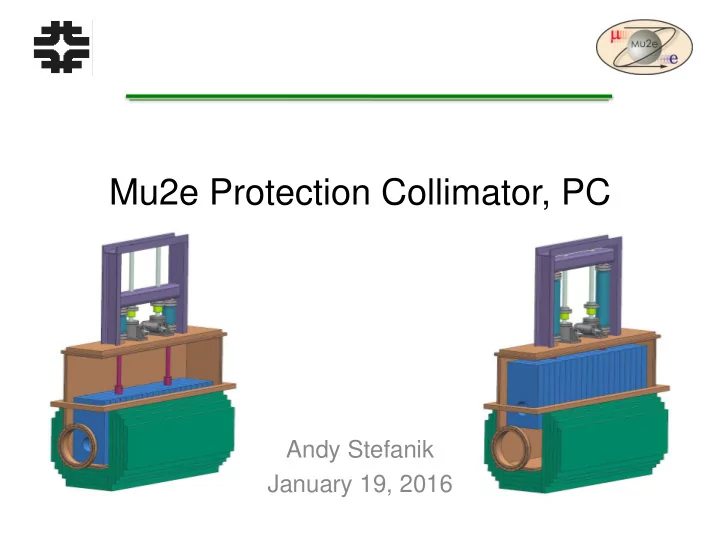
Mu2e Protection Collimator, PC Andy Stefanik January 19, 2016 - - PowerPoint PPT Presentation

mu2e protection collimator pc
SMART_READER_LITE
LIVE PREVIEW

Mu2e Protection Collimator, PC Andy Stefanik January 19, 2016 - - PowerPoint PPT Presentation

Mu2e Protection Collimator, PC Andy Stefanik January 19, 2016 Topics Requirements Basic Physics Engineering Integration Protection Collimator, PC Stand Installation Schedule To-do list January 19, 2016 2


slide-1
SLIDE 1

Mu2e Protection Collimator, PC

Andy Stefanik January 19, 2016

slide-2
SLIDE 2

Topics

  • Requirements
  • Basic Physics
  • Engineering
  • Integration
  • Protection Collimator, PC
  • Stand
  • Installation
  • Schedule
  • To-do list

January 19, 2016 2

slide-3
SLIDE 3

Requirements

  • PHYSICS:
  • Mu2e Document 2897. http://mu2e-docdb.fnal.gov:8080/cgi-bin/ShowDocument?docid=2897
  • The Compliance Report is Mu2e Document 6513.

http://mu2e-docdb.fnal.gov:8080/cgi-bin/ShowDocument?docid=6513

  • The PC complies with these requirements.
  • ENGINEERING:
  • Mu2e Document 2902. http://mu2e-docdb.fnal.gov:8080/cgi-bin/ShowDocument?docid=2902
  • The PC complies with the requirements that are not

marked TBD.

January 19, 2016 3

slide-4
SLIDE 4

Integration

  • PC physical integration into the experiment is

accomplished using the Mu2e CAD Integration Model, F10002515.

January 19, 2016 4

slide-5
SLIDE 5

PC cross sections

January 19, 2016

  • Initial concept…
  • Went from this to…

5

slide-6
SLIDE 6

PC cross sections

January 19, 2016

  • Moveable core “in” Moveable core “out”

Stationary core Moveable core Vacuum vessel Up-down drive

6

slide-7
SLIDE 7

PC core dimensions

January 19, 2016

8 cm (3.15”) 50 cm (19.7”)

7

slide-8
SLIDE 8

PC core dimensions

January 19, 2016

101.6 cm (40”)

8

slide-9
SLIDE 9

Beam scan aperture dimensions

January 19, 2016

CF ID 19.84 cm (7.812”) 22.22 cm (8.75”) 20.955 cm (8.25”) The requirement is 20.83 cm (8.2”).

9

Beam scan aperture is centered on the beam.

slide-10
SLIDE 10

Stationary core

  • The stationary core is outside the vacuum vessel.
  • 316L stainless steel weldment.
  • Weight: 2,200 pounds.
  • Overall dimensions (W x H x L): 515 x 454 x 1,016 mm

(20.25” x 17.875” x 40”)

January 19, 2016 10

slide-11
SLIDE 11

Moveable core

  • The moveable core is inside the vacuum vessel.
  • 316L stainless steel weldment.
  • Weight: 1,245 pounds.
  • Overall dims (W x H x L): 209.55 x 355.6 x 1,031.1 mm

(8.25” x 14” x 40.6”)

January 19, 2016 11

slide-12
SLIDE 12

Vacuum vessel

  • Outside dimensions (W x H x L): 254 x 654 x 1,162 mm

(10” x 25.75” x 45.75”)

  • 316L weldment.
  • 770 pounds.

January 19, 2016 12

slide-13
SLIDE 13

Vacuum vessel - Fabrication

  • Box
  • 635 pounds.
  • 100% seal welded inside.
  • Intermittent welds outside.
  • Notched edges all around.

January 19, 2016 13

slide-14
SLIDE 14

Vacuum vessel: Fabrication

  • Top
  • 135 pounds.
  • Edge welded to the box.
  • Not shown: A small port on top. Might use it for a gauge,

leak checking.

  • Option: Bolted top with indium seal.

January 19, 2016 14

slide-15
SLIDE 15

Vacuum vessel: Loads

  • Design:
  • Full external vacuum, 15 psi, with blank-off flanges on all of the

ports, including the two beam ports.

  • Weight of the vacuum vessel, moveable core, and up-down drive

components, ~ 2.200 pounds, reacted along the two long surfaces of the center reinforcing plate.

  • Lifting:
  • Weight of the vacuum vessel, moveable core, and up-down drive

components, ~ 2,220 pounds, reacted at the lift points.

  • Operating:
  • Same as the Design Loads except for the vacuum load on the

two beam ports.

January 19, 2016 15

slide-16
SLIDE 16

Vacuum vessel: Bellows

  • Edge welded with CF flanges
  • Bellows: 347 stainless steel
  • CF Flanges: 304L stainless steel
  • Gasket: copper
  • 3” OD x 2” ID. The diameter might decrease in the final

design.

  • Extended length per segment: 1.05
  • Compressed length per segment: 0.2
  • Stroke per segment: 1.05 – 0.2 = 0.85”
  • Required stroke: 8.25”

January 19, 2016 16

slide-17
SLIDE 17

Vacuum vessel: Bellows

  • Required number of segments: 8.25”/0.85” per segment =

9.7 → Use 10 segments.

  • Ultimate number of cycles with 10 segments: 10,000
  • Expected number of cycles in the Mu2e experiment: 50

the first year and then roughly 1 per month after that. So the expected number of cycles is 100 to 200 over the lifetime of the experiment. Thus, we have a large margin

  • n the number of cycles using the standard bellows.
  • If we do not operate the bellows over its maximum range

by using 12 segments and operating over the 10 segment range, the ultimate number of cycles remains at 10,000.

January 19, 2016 17

slide-18
SLIDE 18

Vacuum vessel: Bellows

  • From the vendor: The bellows will not squirm while under

vacuum provided the flanges on the ends of the bellows are secure. However, if you vent the bellows to atmosphere while it is compressed, it will squirm.

  • We will discuss bellows squirm with the beamline vacuum

group and follow-up with the vendor. We will add an internal cylindrical guide in each bellows to prevent squirm if needed in the beamline vacuum system.

  • Bellows diameter might decrease. Connecting rod

diameter might increase.

January 19, 2016 18

slide-19
SLIDE 19

Vacuum vessel: up-down drive

  • Try to use a commercial linear lifter.
  • MDC – 20 pounds maximum.

January 19, 2016

  • LSM Ballscrew (Kurt J Lesker):

Maximum axial load is 250 N (55 pounds) with a 6” clear bore and with a 300 mm maximum stroke. The full vacuum load is 425 pounds. The total lifting capacity of the lifter is 480 pounds which is less than half the moveable core weight.

  • At this point, we are designing our
  • wn up-down drive. We continue to

look for a commercial unit.

19

slide-20
SLIDE 20

Vacuum vessel: up-down drive

  • We are currently using a stainless steel screw jack.
  • Other options are a scissors jack or a four-post jack. I

have not found either of these jacks in stainless steel and with sufficient capacity yet and I don’t think I will.

  • The screw jack is lubricated with grease. We need to

purchase the jack with the rad-approved grease used in

  • ur beamlines or replace the OEM grease with our

grease after we get it. Alternatively, we can purchase the jack with a rad-hard grease that is the vendor standard.

January 19, 2016 20

slide-21
SLIDE 21

Vacuum vessel: up-down drive

  • Core in the beam-on position

January 19, 2016 21

Edge-welded bellows Worm gear machine screw jack with travelling nut Jack cross beam Frame Guards attach to the frame Spherical washer Connecting rod with pin connection at each end Extra internal volume at each beamline port to aid pump down

slide-22
SLIDE 22

Vacuum vessel: up-down drive

  • Core in the beam-scan position

January 19, 2016 22

54.8 cm (21.6”)

slide-23
SLIDE 23

Vacuum vessel: up-down drive

  • January 19, 2016

Chart courtesy of Nook Industries Column strength for stainless steel jacks: PC load on one jack = 700 pounds max with 20” max screw length.

23

CAUTION: Chart does not include a design factor.

slide-24
SLIDE 24

Vacuum vessel: up-down drive

  • Jack info:
  • Capacity: 0.66 tons = 1,320 pounds.
  • Gear ratio: 24:1 (20:1 or greater ratio ACME machine screw jacks

can be considered self-locking in the absence of vibration.)

  • Turns of the worm gear per inch of travel: 96
  • Torque to raise 1 pound: 0.015 in-Lbs
  • Lifting screw diameter: 1”
  • Maximum allowable input: 0.5 horsepower
  • Maximum input torque: 14 in-Lbs
  • Maximum load at 1750 rpm: 1320
  • Duty cycle limit: 25% (75% time off)

January 19, 2016 24

slide-25
SLIDE 25

Vacuum vessel: up-down drive

  • Horsepower required to operate the jack with no

arrangement of gearbox efficiencies included:

  • Load per jack: 700 Lbs
  • Input rpm: (96 turns of the worm gear per inch of travel) x (8.25

inches of travel) / 10 minutes = 80 rpm

  • Torque: (0.015 in-Lbs/Lb) x (700 Lbs) = 10.5 in-Lbs
  • Horsepower per jack: 0.013 (0.006 hp with the 6:1 gear ratio)

January 19, 2016 25

slide-26
SLIDE 26

Vacuum vessel: up-down drive

  • Driver options:
  • Electric motor
  • Pneumatic motor
  • Pneumatic cylinder
  • The pc environment:
  • Magnetic field: 350 gauss
  • Radiation level: TBD
  • Residual radiation: TBD

January 19, 2016 26

slide-27
SLIDE 27

Vacuum vessel: up-down drive

  • The current plan is to use an electric motor to drive the

jacks.

  • Working with others on the motor:
  • Dan Schoo: “We can supply you with the limit switches, a motor

controller and a means of controlling it through ACNET. Once the motor is specified we can help find one and order it.”

  • Dan Schoo: “I have never done any research or read any data on
  • perating AC induction motors in a strong magnetic field. I

suspect that a 350 gauss field would freeze any motor.”

  • Nikolai Andreev (TD, mech eng) is looking at motors for the

rotating collimator mid-way through the Transport Solenoid that work near the solenoid, so he might be able to help us on motor selection or solutions

January 19, 2016 27

slide-28
SLIDE 28

Vacuum vessel: up-down drive

  • Using a motor in the 350 gauss magnetic field is not

settled yet. In the end, we may have to locally shield it.

  • The motor might be equipped with a brake.
  • A torque-limiting coupling will be used.

January 19, 2016 28

slide-29
SLIDE 29

Vacuum vessel: Details

  • The center of the aperture bore in the moveable core will

be referenced to alignment fiducials on the stationary core.

  • The PC will have brackets to mount Beam Loss Monitors.
  • AD will pump down the PC along with the beamline. We

have started working with the AD vacuum group on a plan. We might have to add a large pump-out port on the vacuum vessel.

  • The PC has extra internal volume at the beam line ports to

aid pump down, as shown on slides 20 and 21.

  • The vacuum vessel is located to the stationary core.

January 19, 2016 29

slide-30
SLIDE 30

Vacuum vessel: Assembly

  • The connecting rod is seal welded to the upper conflat
  • flange. The seal weld must be cut out to replace a bellows.

January 19, 2016 30

Seal weld Bellows diameter might

  • decrease. Connecting rod

diameter might increase

slide-31
SLIDE 31

PC Lift Points

  • The stationary core has two lift points. These lift points are

designed to lift the completely assembled PC.

  • The vacuum vessel will either have one integral lift point or

two separate lift points. The lift point(s) are designed for the weight of the vacuum vessel, the moveable core, and the up-down drive. The stationary core shall not be connected to the vacuum vessel when using the vacuum vessel lift points.

January 19, 2016 31

At two points on the vacuum vessel.

slide-32
SLIDE 32

Stand

  • January 19, 2016

32

  • We will use the stand

design that AD has for the beamline magnets. Rob Reilly sent me this photo of the stand. The stand is black in the photo.

  • The PC stand will be

made with 6061-T6 aluminum.

  • The PC stand will have

its own Engineering Note.

Miniboone line

slide-33
SLIDE 33

Stand

  • The AD magnet stands will have an adjuster on top; the

adjuster is shown below. The PC will not have the adjuster.

January 19, 2016 33

slide-34
SLIDE 34

Installation

  • The PC will be installed in the same way as the magnets

will be installed.

  • From Rob Reilly: “I intend to have these on stands with

Hilman rollers, to bring the magnets in on the monorail and set them on their stands in the aisle, then roll them into place. Since we have to move the M4 line magnets in two directions I will have them on rotating rollers.”

  • The protection collimator will be installed on its stand,

rolled into the beamline, and aligned using the fiducials

  • n the stationary core.
  • After alignment, the electrical will be hooked up and the

up-down drive will be tested.

January 19, 2016 34

slide-35
SLIDE 35

Schedule

  • January 19, 2016

35

slide-36
SLIDE 36

To-do List

  • Review all of the final requirements.
  • Continue working with the AD Groups.
  • Complete PC final design.
  • Internal Project review of the PC final design.
  • Review the schedule.
  • Analysis and Engineering Note for the PC.
  • Analysis and Engineering Note for the stand.
  • Analysis and Engineering Note for the vacuum vessel

spreader bar if it has two lift points.

  • Complete the Fermilab Engineering Manual Risk

Assessment.

January 19, 2016 36