mTBI: Whats all the Fuss About? 2.5-3.8 million mTBI estimated - - PDF document

mtbi what s all the fuss about
SMART_READER_LITE
LIVE PREVIEW

mTBI: Whats all the Fuss About? 2.5-3.8 million mTBI estimated - - PDF document

MTBI and PCS: Scientific Update Mild Traumatic Brain Injury & Postconcussion Syndrome: New Evidence Base for Evaluation and Management Michael McCrea, PhD, ABPP Professor of Neurosurgery and Neurology Director of Brain Injury Research C


slide-1
SLIDE 1

MTBI and PCS: Scientific Update Michael McCrea, PhD, ABPP-CN 1

Mild Traumatic Brain Injury & Postconcussion Syndrome:

New Evidence Base for Evaluation and Management

Michael McCrea, PhD, ABPP

Professor of Neurosurgery and Neurology Director of Brain Injury Research

Concussion Research Consortium (CRC)

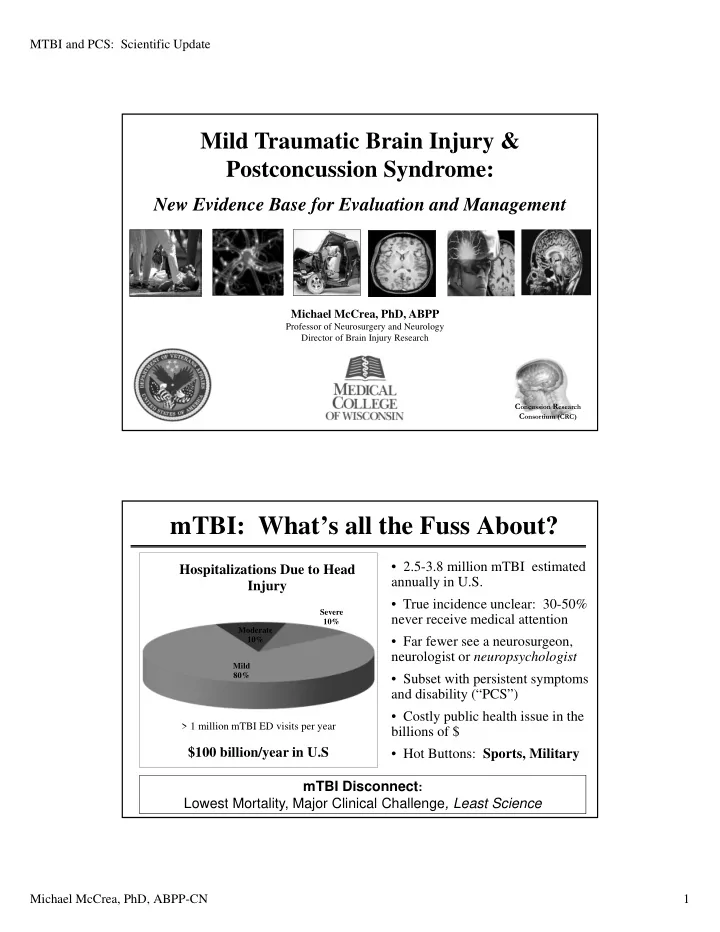
mTBI: What’s all the Fuss About?

Mild 80% Moderate 10% Severe 10%

Hospitalizations Due to Head Injury

  • 2.5-3.8 million mTBI estimated

annually in U.S.

  • True incidence unclear: 30-50%

never receive medical attention

  • Far fewer see a neurosurgeon,

neurologist or neuropsychologist

  • Subset with persistent symptoms

and disability (“PCS”)

  • Costly public health issue in the

billions of $

  • Hot Buttons: Sports, Military

$100 billion/year in U.S mTBI Disconnect: Lowest Mortality, Major Clinical Challenge, Least Science

> 1 million mTBI ED visits per year

slide-2
SLIDE 2

MTBI and PCS: Scientific Update Michael McCrea, PhD, ABPP-CN 2

Clinical Challenges in mTBI

  • Was the accident sufficient to cause the patient to

sustain a traumatic brain injury?

  • What are the effects of this injury on brain

function?

  • How long should it take for the patient to recover?
  • Is the cause of their persistent symptoms “organic”
  • r “mental”?

Historically, all hampered by lack of science

Challenges in mTBI Research:

One Reason It’s So Hard

Comorbidities in mTBI Patients Presenting to Level I Trauma Center

Mechanism of Injury (n=1,566)

MVC Fall Assault Trauma MCC 55.4% 19.1% 11.8% 10.0% 3.8% 10% 15% 15% 18% 44% 66%

0% 10% 20% 30% 40% 50% 60% 70%

Pre-Admission Narcotics DSM Axis I Diagnosis Alcohol on Admission Psychotropic Medication Narcotics Given in ED At Least One Comorbidity

  • L. Nelson et al., TCN 2013
slide-3
SLIDE 3

MTBI and PCS: Scientific Update Michael McCrea, PhD, ABPP-CN 3

Research Challenges in mTBI: The Denominator Problem

All Occurrences of mTBI/Concussion Hospital ED Visits/Admissions Neuroscience Specialists Neuropsychologists

PCS

Ongoing Follow-up

Significant Impact on Epidemiology and Clinical Science of mTBI Prospective, Population-Based

Retrospective, Clinic Samples

“Dad, I want to be a scientist” “That’s great, honey. Just stay out of the weeds and pick something other than mTBI to study.”

Do As I Say…

slide-4
SLIDE 4

MTBI and PCS: Scientific Update Michael McCrea, PhD, ABPP-CN 4

Sports Laboratory Assessment Model (SLAM)

Alternative Paradigms for mTBI Research

Sports Concussion: mTBI Laboratory

(Barth, 2001)

  • Large sample at risk
  • Defined Exposure Period
  • Preinjury Baseline Measures
  • Eye Witness Account: AIC’s
  • Immediate Assessment
  • Serial Testing/Continuity
  • Normal Controls
  • Repetitive Concussion
  • Chronic Exposure
  • Longterm follow-up

How Can We Inform the Broader Science of mTBI?

slide-5
SLIDE 5

MTBI and PCS: Scientific Update Michael McCrea, PhD, ABPP-CN 5

Lessons Learned

1. Wealth of data on acute clinical effects and recovery after SRC & mTBI. 2. Emerging research on acute physiological effects and recovery after SRC & mTBI. 3. Movement toward an integrated, evidence-based neurobiopsychosocial model of mTBI recovery.

New Understanding of mTBI Rethinking Postconcussion Syndrome

Scientific Advances in mTBI: Acute Effects & Recovery

TRUE NATURUAL HISTORY Driving Evidence Based Diagnosis, Assessment and Management

Clinical Recovery:

How long does it take for sign & symptoms to recover?

Physiological Recovery:

How long does the brain take to recover?

+

MECHANISM

Minimum Threshold:

How much is enough to cause brain injury?

slide-6
SLIDE 6

MTBI and PCS: Scientific Update Michael McCrea, PhD, ABPP-CN 6

Biomechanics of TBI

Ommaya & Gennarelli, Brain, 1974 The Tried & True

Long Road of Clinical Translation

mTBI Laboratory!

slide-7
SLIDE 7

MTBI and PCS: Scientific Update Michael McCrea, PhD, ABPP-CN 7

Measure and record blows to the head:

  • Impact location
  • Impact

magnitude

  • Impact duration
  • Linear and

angular acceleration components

  • Exact times of

impacts

  • Sync w/ video

Biomechanics of mTBI in Humans:

How Much is Enough to Cause Brain Injury?

HITS Studies: Concussion Threshold?

MORE THAN A “DING”

  • > 250K impacts in 100 players
  • 19 concussion with HITS
  • Ave. impact of concussive events:

103g (33) (<1% of NC impacts > 95g)

  • Controlling for rotational

acceleration, location of impact on the head, concussion:

– 17x more likely if PLA >100g – 15x more likely if PRA > 5000r/sec2

Pellman et al: peak acceleration-concussion 98 g (+/- 28), non-concuss 60 g (+/- 24) Zhang (2004): Probability of MTBI – 25% at 66g, 50% at 82g, 80% at 106 g Brolinson (2006): Average peak acceleration 103.3 g (range 56-118 g)

Guskiewicz et al, UNC

slide-8
SLIDE 8

MTBI and PCS: Scientific Update Michael McCrea, PhD, ABPP-CN 8

What Does That Mean in Real Life?

  • 100 g PLA equivalent to 25 mph MVA into brick wall, striking head

against dash (unhelmeted)

  • Significant rotational acceleration component
  • Highlights significance of head impacts in SRC (not so mild)
  • Provides context for interpretation of injury mechanisms

Progress in mTBI Research:

Acute Effects & Recovery

TRUE NATURAL HISTORY OF RECOVERY New Evidence Base to Guide Diagnosis, Assessment and Management Clinical Recovery:

How long does it take for signs & symptoms to recover?

Physiological Recovery:

How long does it take for the brain to recover?

+

Giza & Hovda, 2010

INJURY MECHANISMS Threshold/Dynamics:

How much is enough to cause brain injury?

slide-9
SLIDE 9

MTBI and PCS: Scientific Update Michael McCrea, PhD, ABPP-CN 9

JAMA 2003; 290:2556-2563

Over 25,000 Athlete Seasons, 1,500 Concussions Studied

Can we measure the acute effects of... …What does early recovery look like?

slide-10
SLIDE 10

MTBI and PCS: Scientific Update Michael McCrea, PhD, ABPP-CN 10

Symptom Recovery After mTBI

Not tonight, honey, I have a concussion.

Higher score indicates more severe symptoms; error bars represent 95% CI

McCrea et al., JAMA 2003

Symptom Recovery after Sport-Related Concussion

slide-11
SLIDE 11

MTBI and PCS: Scientific Update Michael McCrea, PhD, ABPP-CN 11

How Long Does it Take to Recover?

2013 (n=94): Mean Symptom Recovery 5.75 Days (4.48) 90% Recover in 10 Days or Less, 2% > 30 days Rate of Postinjury Recovery in HS and College Athletes (n=790) Total (%) Cumulative Total (%) Rapid (< 1 day) 21.1 21.1 Gradual (> 1 day, < 7 days) 64.3 85.4 Prolonged (1 week – 1 month) 11.9 97.3 Persistent (> 1 month) 2.7 100.0

  • 10% take > 7 days to recover
  • Acute severity predicts recovery
  • 2.5% symptomatic > 45 days
  • No impairment on objective

measures at Day 45 relative to BL

slide-12
SLIDE 12

MTBI and PCS: Scientific Update Michael McCrea, PhD, ABPP-CN 12

Translational Research?

How Do the Findings Apply to Other Populations at Risk of mTBI?

SRC Civilian mTBI

Militar

  • Prospective study of 123 mTBI

patients, 100 TC’s

  • Evaluated in ED, follow-up at 7

days, 3 mos

  • PCS scale and cognitive testing,

SF-36, MINI Psychiatric screening, HADS, PTSD CL

  • Elevated PCS scores in mTBI

group at Day 7, not different from TCs at 3 mos

  • PCS at 3 mos predicted by

preinjury physical problems and concurrent psychosocial factors, not by mTBI

  • Cognitive measures not predictive
  • f PCS at 7 days or 3 mos

Civilian Symptom Recovery

slide-13
SLIDE 13

MTBI and PCS: Scientific Update Michael McCrea, PhD, ABPP-CN 13

Symptoms after Military mTBI

  • 298 blast, 92 non-blast mTBI

patients

  • NSI and PCL administered
  • Symptoms higher in mTBI < 1

mo ago vs. > 1 mo ago, and with higher PTSD sx’s

  • PCS not predicted by

mechanism or acute characteristics of mTBI

  • Symptom reporting most

strongly associated with emotional distress

Is Symptom Recovery Really Recovery: Performance-Based mTBI Assessment

It must be a

  • concussion. He

didn’t get even 1 question right.

What is an isosceles triangle? In what year was the Great Wall of China built? Who invented dental floss?

Hot Pursuit of Better Signal Detection

slide-14
SLIDE 14

MTBI and PCS: Scientific Update Michael McCrea, PhD, ABPP-CN 14

Lower score indicates more severe cognitive impairment; error bars = 95% CI

McCrea et al., JAMA 2003

p < .001

p < .001 p < .001

p < .001 Neuropsychological Test Battery: No differences beyond Day 7 postinjury

Cognitive Recovery after Sport-Related Concussion

  • Meta-analysis: 21 studies, 790

concussions, 2014 controls

  • Acute effects (w/n 24 hrs)

greatest for delayed memory (d=1.00), memory acquisition (d=1.03), and global cognitive functioning (d=1.42)

  • Overall ES (d=0.49)

comparable to non-sports (d=0.54)

  • No residual neuropsych

impairment > 7 days postinjury

Cognitive Recovery: SRC

slide-15
SLIDE 15

MTBI and PCS: Scientific Update Michael McCrea, PhD, ABPP-CN 15

ACUTE (24 HR) COGNITIVE EFFECT SIZES:

  • 0.81 (LARGE)

SYMPTOMS:

  • 3.31

BALANCE:

  • 2.56

Broglio et al., 2008

SUBACUTE (14 DAYS) COGNITIVE EFFECT SIZES:

  • 0.26 (SMALL)

SYMPTOMS:

  • 1.09

BALANCE:

  • 1.16

Cognitive Effects of SRC

27.24 24.68 27.5 23.83 26.92 23.55 14 16 18 20 22 24 26 28 30

College Control (n=77) College SRC (n=128) Trauma Control (n=55) Civ mTBI (n=57) Mil Control (n=544) Mil mTBI (n=186)

SAC Total Score

Acute Sports vs. Civilian vs. Military mTBI:

Cognitive Test Performance on Day of Injury

Sport Concussion Civilian mTBI Military mTBI

slide-16
SLIDE 16

MTBI and PCS: Scientific Update Michael McCrea, PhD, ABPP-CN 16

  • 56 MSM w/ mTBI in OEF/OIF

– 21 non-blast, 35 blast+blunt

  • Neurocognitive battery and PAI

4.4 (4.1) months post-injury

  • PAI: no group differences on

any scales; medium ES for Dep (.49), Stress (.47) (Blast+ > NB)

  • No group differences on any

cognitive measures after controlling for Dep, Stress

  • Little evidence to suggest that

blast+blunt results in worse cognitive or psych recovery than blunt

Military mTBI

Cognitive Recovery: Civilian mTBI

slide-17
SLIDE 17

MTBI and PCS: Scientific Update Michael McCrea, PhD, ABPP-CN 17

Effect Sizes: 0.2 Small, 0.5 Medium, 0.8 Large

< 0.3 Difficult to detect in individual patients; large overlap b/n patients and control group

Effect Sizes (d)

Neurocognitive Effects of mTBI

Meta-Analytic Studies and Reviews:

Frencham, 2004; Belanger et al., 2005; Schretlin & Shapiro, 2005; Broglio et al 2008; Iverson, 2011; Rohling et al 2011

Adapted from Iverson, 2011

Effect Sizes: 0.2 Small, 0.5 Medium, 0.8 Large < 0.3 Difficult to Detect in Individual Patients; large

  • verlap b/n patients and control group

Non-specificity of Neurocognitive Performance

0.2 0.4 0.6 0.8 1 1.2

Effect Sizes: 0.2 Small, 0.5 Medium, 0.8 Large < 0.3 Difficult to Detect in Individual Patients; large overlap b/n patients and control group Iverson, 2005

slide-18
SLIDE 18

MTBI and PCS: Scientific Update Michael McCrea, PhD, ABPP-CN 18

mTBI Clinical Recovery & Outcome

World Health Organization (2004):

  • 120 “best evidence” studies on mTBI

prognosis

  • Symptoms temporary after MTBI, with full

recovery in days to weeks in overwhelming majority of kids and adults

  • Sound evidence for favorable prognosis
  • Little evidence of residual cognitive,

behavioral or academic deficits

  • Persistent symptoms (i.e., PCS) may be

attributable to non-injury factors (demographic, psychosocial, medical, situational factors)

(Carrol et al., 2004)

More overlap than discrepancy in evidence on acute effects and recovery after SRC, Civilian and Military mTBI

Progress in mTBI Research:

Acute Effects & Recovery

TRUE NATURAL HISTORY OF RECOVERY New Evidence Base to Guide Diagnosis, Assessment and Management Clinical Recovery:

How long does it take for signs & symptoms to recover?

Physiological Recovery:

How long does it take for the brain to recover?

+

Giza & Hovda, 2010

INJURY MECHANISMS Threshold/Dynamics:

How much is enough to cause brain injury?

slide-19
SLIDE 19

MTBI and PCS: Scientific Update Michael McCrea, PhD, ABPP-CN 19

Pursuit of the Perfect “Biomarker”

MRI (3-T) / Functional MRI Magneto Encephalography (MEG) Scanner Trans-Cranial Doppler Ultrasound Diffusion Tensor Imaging (DTI)

When is the brain fully recovered from mTBI?

McAllister et al., Neurology, 1999, 53, 1300-8.

fMRI: Brain Activation Changes after mTBI

slide-20
SLIDE 20

MTBI and PCS: Scientific Update Michael McCrea, PhD, ABPP-CN 20

FUNCTIONAL MRI: ACUTE SRC

DESIGN & PROTOCOL:

  • 12 FB concussed FB players, 12

matched controls studied 13 hr, 45 d PI

  • Clinical testing, event-related fMRI

(load dependent WM task) CLINICAL EFFECTS/RECOVERY:

  • Acute symptoms and cognitive

impairments (RT, WM) at 13 hours

  • No impairments at 45 days

fMRI ACTIVATION STUDIES:

  • 13 HR: Decreased activation of RH

attentional networks in SRC group

  • Correlate with cog deficits, symptoms
  • 45 D: Reversed pattern (SRC>NC)

(compensatory increase=recovery)

IOG IFG SMA INS INS SFG AG SFG INS IFG