msb( x ) in O(1) steps using 5 multiplications [M.L. Fredman, D.E. - - PowerPoint PPT Presentation

msb x in o 1 steps using 5 multiplications
SMART_READER_LITE
LIVE PREVIEW

msb( x ) in O(1) steps using 5 multiplications [M.L. Fredman, D.E. - - PowerPoint PPT Presentation

msb( x ) in O(1) steps using 5 multiplications [M.L. Fredman, D.E. Willard, Surpassing the information theoretic bound with fusion trees , Journal of Computer and [ , , p g f f , p System Sciences 47 (3): 424436, 1993] Word size n =


slide-1
SLIDE 1

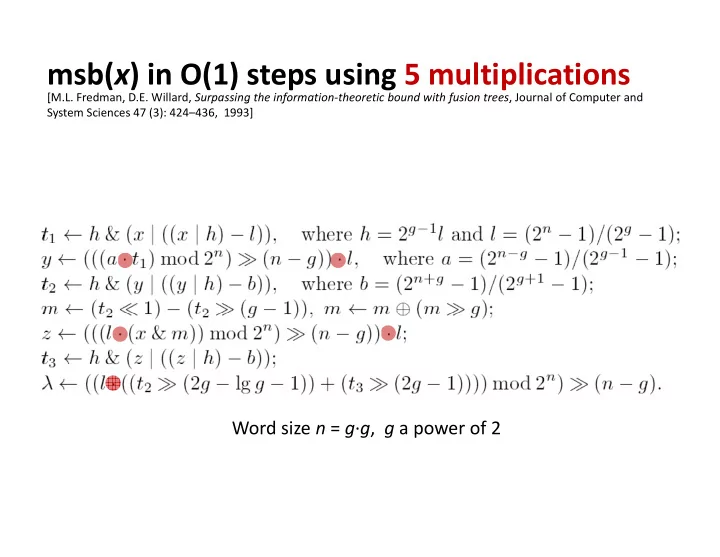
msb(x) in O(1) steps using 5 multiplications

[M.L. Fredman, D.E. Willard, Surpassing the information‐theoretic bound with fusion trees, Journal of Computer and [ , , p g f f , p System Sciences 47 (3): 424–436, 1993]

Word size n = g∙g, g a power of 2

slide-2
SLIDE 2

RAM model (Random Access Machine)

bi

0 010100111010101 1 001010101010111

w bits

CPU, O(1) registers

1 001010101010111 2 110101010101001 3 111010100101010 4 110110101010101

Me ‐ XOR + shift‐left OR write

. 111100011110101 . 111100011111101 111010101010101 111010100101010

emory, in NOT shift‐right AND * + read

111010100101010 110110101010101 111100010000101 111010100101010 110110101010101

nfinite

not an AC0 operation 110110101010101 100010011110101 000000011111101 100010011110101

# reads C l i i

2

000000011111101 000011111111101 111111111111111

Complexity = + # writes + # instructions performed

slide-3
SLIDE 3

Radix Sort

w bits w/log n x COUNTING‐SORT = O(n∙w/log n)

1 010100111010101 2 001010101010111 3 110101010101001 4 111010100101010

GOAL: Design algorithms with complexity independent of w (trans‐dichotomous)

4 111010100101010 . 110110101010101 . 111100011110101 111100011111101 111010101010101

[M.L. Fredman, D.E. Willard, Surpassing the information‐theoretic bound with fusion trees, Journal of Computer and System Sciences 47 (3): 424–436, 1993]

111010101010101 111010100101010 110110101010101 111100010000101 111010100101010 110110101010101

n 100010011110101

000000000000000 000000000000000 000000000000000 000000000000000

3

000000000000000 000000000000000 [Cormen et al. 2009]

slide-4
SLIDE 4

Sorting

Comparison

O(n∙log n)

Radix‐Sort

O(n∙w/log n)

[T96]

O(n∙loglog n) ( √l l )

[M Thorup On RAM Priority Queues ACM‐SIAM Symposium on Discrete Algorithms 59‐67 1996]

[HT02]

O(n∙√loglog n) exp.

[AHNR95]

O(n) exp., w ≥ log2+ε n

[M. Thorup, On RAM Priority Queues. ACM SIAM Symposium on Discrete Algorithms, 59 67, 1996] [Y. Han, M. Thorup, Integer Sorting in 0(n √log log n) Expected Time and Linear Space, IEEE Foundations of Computer Science, 135‐144, 2002] [A. Andersson, T. Hagerup, S. Nilsson, R. Raman: Sorting in linear time? ACM Symposium on Theory of Computing, 427‐ 436, 1995]

Priority queues (Insert/DeleteMin)

Comparison

O(log n)

[T96]

O(loglog n)

[T96,T07]

O(√loglog n) exp.

[M Thorup On RAM Priority Queues ACM SIAM Symposium on Discrete Algorithms 59 67 1996]

4

[M. Thorup, On RAM Priority Queues. ACM‐SIAM Symposium on Discrete Algorithms, 59‐67, 1996] [Y. Han, M. Thorup, Integer Sorting in 0(n √log log n) Expected Time and Linear Space, IEEE Foundations of Computer Science, 135‐144, 2002] [Mikkel Thorup, Equivalence between priority queues and sorting, J. ACM 54(6), 2007]
slide-5
SLIDE 5

Dynamic predecessor searching (w dependent)

[vKZ77]

O(log w)

[BF02]

O(log w/loglog w)

[P. van Emde Boas, R. Kaas, and E. Zijlstra, Design and Implementation of an Efficient Priority Queue, Mathematical Systems Theory 10, 99‐127, 1977] [P. Beame, F.E. Fich, Optimal Bounds for the Predecessor Problem and Related Problems. J. Comput. Syst. Sci. 65(1): 38‐72, 2002] [M. Patrascu, M. Thorup, Time‐space trade‐offs for predecessor search, ACM Symposium on Theory of Computing, 232‐240, 2006] [ , p, p ff f p , y p y p g, , ]

Dynamic predecessor searching (w independent)

Comparison

O(log n)

[FW93]

O(log n/loglog n) √ /

[AT07]

O(√log n/loglog n)

[M.L. Fredman, D.E. Willard, Surpassing the information‐theoretic bound with fusion trees, Journal of Computer and System Sciences 47 (3): 424 436 1993]

5

System Sciences 47 (3): 424–436, 1993] [A. Andersson, M. Thorup, Dynamic ordered sets with exponential search trees. J. ACM 54(3): 13, 2007]

slide-6
SLIDE 6

Sorting two elements in one word... without comparisons ...without comparisons

X Y

1 1 1 1 1 1 1

X Y

test bit

b w bits

6

slide-7
SLIDE 7

Finding minimum of k elements in one word... without comparisons ...without comparisons

x1 x2 x3 x4

w bits

0 0 0 0 0 0 0 0 0 0 0 0 0 0 0 0 0 0 0 0 0 min(x1...x4)

Searching a sorted set...

7

slide-8
SLIDE 8

Batcher’s bitonic merger

[K.E. Batcher, Sorting Networks and Their Applications, AFIPS Spring Joint Computing Conference 1968: 307‐314] [ a c e , So g e

  • s a d

e pp ca o s, S Sp g Jo

  • pu

g o e e ce 968 30 3 ] [S. Albers, T. Hagerup, Improved Parallel Integer Sorting without Concurrent Writing, ACM‐SIAM symposium on Discrete algorithms, 463‐472, 1992]

word implementation, O(log #elements) operations increasing sequence q decreasing sequence

8

Round 1 Round 2 Round 3 Round 4 Remark: Sorting networks recently revived interest for GPU sorting

slide-9
SLIDE 9

van Emde Boas (the idea in the static case)

[P. van Emde Boas, R. Kaas, and E. Zijlstra, Design and Implementation of an Efficient Priority Queue, Mathematical

0,13

Systems Theory 10, 99‐127, 1977]

min,max 0,2 0,2 13,13 13,13 0,0 0,0 2,2 2,2 13,13 13,13 1 2 3 4 5 6 7 8 9 10 11 12 13 14 15

Universe U ≤ 2w Universe U ≤ 2

Predecessor search = find nearest yellow ancestor b h h (l l )

9

= binary search on path O(loglog U)

Space O(U)

slide-10
SLIDE 10

van Emde Boas (addressing)

[P. van Emde Boas, R. Kaas, and E. Zijlstra, Design and Implementation of an Efficient Priority Queue, Mathematical

0,13

Systems Theory 10, 99‐127, 1977]

min,max array indexing roots by msb bits 0,2 0,2 13,13 13,13 002 012 102 112 0,0 0,0 2,2 2,2 13,13 13,13 1 2 3 4 5 6 7 8 9 10 11 12 13 14 15

Universe U ≤ 2w Universe U ≤ 2

10

slide-11
SLIDE 11

van Emde Boas (dynamic)

[P. van Emde Boas, R. Kaas, and E. Zijlstra, Design and Implementation of an Efficient Priority Queue, Mathematical Systems Theory 10, 99‐127, 1977]

1 recursive top‐structure and √U bottom structures

  • f the most and least significant log U/2 bits
  • f the most and least significant log U/2 bits

Keep min & max outside structure ⇒ 1 recursive call

min=0, max=13

O(loglog U)

9 = 2 ∙ 4 + 1

O(loglog U) search & update

002 012 102 112

11

slide-12
SLIDE 12

van Emde Boas (pseudo code)

[P. van Emde Boas, R. Kaas, and E. Zijlstra, Design and Implementation of an Efficient Priority Queue, Mathematical

succ(i) { i = a√n + b } if i > max then return +∞ insert(i) if size = 0 then max := min := i if size = 1 then

Systems Theory 10, 99‐127, 1977]

if i ≤ min then return min if size ≤ 2 then return max if bottom[a]. size > 0 and bottom[a].max ≥ b then return a√n + bottom[a].succ(b) if i < min then min := i else max := i if size ≥ 2 then if i < min then swap(i, min) if i > max then swap(i, max) else if top.max ≤ a then return max c := top.succ(a + 1) return c√n + bottom[c].min { i = a√n + b } if bottom[a].size = 0 then top.insert(a) bottom[a].insert(b) size := size + 1 delete(i) if size = 2 then if i = max then max := min else min := max if size > 2 then if i = min then i := min := top.min ∙ √n + bottom[top.min].min else if i = max then i := max := top.max ∙ √n + bottom[top.max].max { i = a√n + b }

O(loglog U)

12

bottom[a].delete(b) if bottom[a].size = 0 then top.delete(a) size := size – 1

slide-13
SLIDE 13

van Emde Boas (linear space)

[P. van Emde Boas, R. Kaas, and E. Zijlstra, Design and Implementation of an Efficient Priority Queue, Mathematical Systems Theory 10, 99‐127, 1977]

i 13 9 2 4 + 1 min=0, max=13 9 = 2 ∙ 4 + 1

002 012 102 112

Buckets = lists of size O(loglog U), store only bucket minimum in vEB (Perfect) Hashing to store all O(n) non‐zero nodes of vEB

13

(Perfect) Hashing to store all O(n) non zero nodes of vEB O(n) space, O(loglog U) search

slide-14
SLIDE 14

O(n∙loglog n) Sorting

[M. Thorup, On RAM Priority Queues. ACM‐SIAM Symposium on Discrete Algorithms, 59‐67, 1996] [ p, y Q y p g , , ]

loglog n recursive levels of vEB ⇒ bottom of recursion log u / log n bit elements ⇒ bottom of recursion log u / log n bit elements subproblems of k elements stored in k/log n words ⇒ mergesort O(k ∙ log k ∙ loglog n / log n) ⇒ mergesort O(k log k loglog n / log n)

merging 2 words #elements per word merge‐sort

O(loglog n) priority queue

[M. Thorup, On RAM Priority Queues. ACM‐SIAM Symposium on Discrete Algorithms, 59‐67, 1996]

S d li f i 2i i ≤ log n min in single word vEB

14

Sorted lists of size 2i in 2i /w words

slide-15
SLIDE 15

O(√log n) Dynamic predecessor searching

[A Andersson Sublogarithmic Searching Without Multiplications IEEE Foundations of Computer Science 655 663 1995] [A. Andersson, Sublogarithmic Searching Without Multiplications. IEEE Foundations of Computer Science, 655‐663, 1995]

vEB ‐ √log n recursive levels w / 2√log n bit elements packed B‐tree of degree Δ= 2√log n and height log n / log Δ = 2√log n

... ... ...

O(1) ti i ti t d

degree Δ search keys sorted in one word

15 15

O(1) time navigation at node

slide-16
SLIDE 16

S ti i O( ) ti ? Sorting in O(n) time ?

16