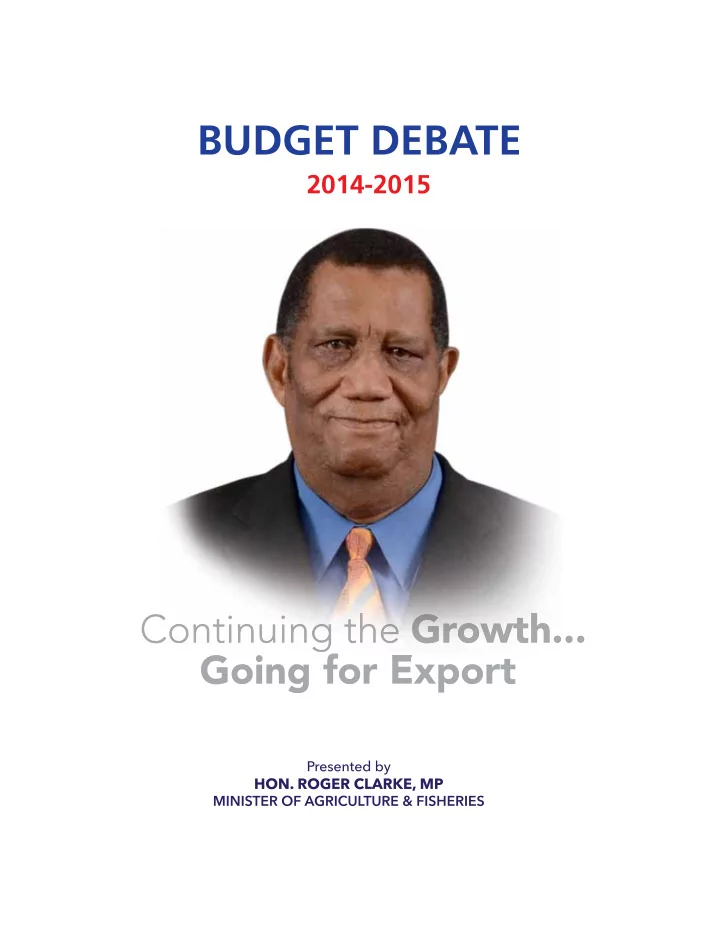
Mr. Speaker , this Government was elected on the mandate of people - - PDF document

mr speaker this government was elected on the mandate of
SMART_READER_LITE
LIVE PREVIEW

Mr. Speaker , this Government was elected on the mandate of people - - PDF document

Continuing the Growth Going for Export Mr. Speaker , this Government was elected on the mandate of people power . For us, this is not merely a slogan, but a summons to a greater level of accountability. It is within this context,


slide-1
SLIDE 1
slide-2
SLIDE 2

Continuing the Growth – Going for Export

1

BUDGET PRESENTATION

  • HON. ROGER CLARKE
  • Mr. Speaker, this Government was elected on the mandate of “people

power” . For us, this is not merely a slogan, but a summons to a greater level

  • f accountability. It is within this context, therefore, that I intend to present

my scorecard to this Honourable House, in respect to the commitments I made in this House last year in the Sectoral Debate. It is my intention, fur- ther, to outline the critical programmes and strategies that the Ministry of Agriculture and Fisheries will employ in the current financial year, to move the sector forward.

  • Mr. Speaker, given the amount of work covered by the Ministry in the last

financial year, the number of new initiatives and our many successes, it would be difficult to speak to everything in this presentation. I have there- fore tabled today 13 Ministry Papers, detailing our activities and successes.

  • Mr. Speaker, Sir, I am pleading with members of this House and the general

public to read these Ministry Papers.

  • Mr. Speaker, before I go on to the specifics, allow me to present an over-

view of the performance of the agricultural sector. Mr. Speaker, it is well known that Hurricane Sandy impacted the country in October 2012, and this affected production performance for both the third quarter of 2012 and the first quarter of 2013. It is also a matter of record that severe drought conditions affected the entire island for the first six months of 2013. It is therefore not surprising that in the first two quarters of 2013, the overall agricultural sector declined by 11.3% and 6.3%, respectively. The decline in the domestic food crop sector was correspondingly 12.1% and 5.5%, respectively. But, Mr. Speaker, the resilience of the farmers of this country is remark-

  • able. Undaunted by the ravages of Sandy, and the devastating impacts of

the prolonged drought, our farmers soldiered on, and I am proud to report that by the third quarter of 2013 the sector returned to its positive growth trajectory, with the overall sector growing by 5.9% and 13.1%, respectively, in the third and fourth quarters of 2013. The corresponding figures for the domestic food crop sector are 8.4% and 14, respectively.

  • Mr. Speaker, I have more news! Our preliminary estimates for the first

quarter of 2014 are indicating approximately 18.7% growth in the domestic food crop sub-sector. I must pause to acknowledge and salute the resilience and tenacity of our small farmers who are the main drivers of this growth.

  • Mr. Speaker, Agriculture’s contribution to GDP in 2013 was 6.7%. This

nominal contribution, however, does not encompass the significant linkage between Agriculture, Manufacturing and Tourism.

slide-3
SLIDE 3

Continuing the Growth – Going for Export

2

BUDGET PRESENTATION

  • HON. ROGER CLARKE

Our manufacturing sector is significantly based on the processing of agricultural raw material and our sugar industry, for instance, is the most vertically integrated industry in Jamaica. It is also the case that agriculture significantly supports the tourism industry. The multiplier effect of the agricultural sector is greater than any other sector in Jamaica, supporting rural life in every single area – transport, shops, boosting attendance at school, barbers, shoemakers, traders, mechanics, you name it! A typical fortnight pay bill at Frome, for instance, releases over $75M into the economy of Sav-la-Mar and environs.

  • Mr. Speaker, do you know what this means to a rural town?

So apart from its direct economic contribution, agriculture is the bedrock

  • f rural life, contributing to social stability and arresting the rural-urban drift.

The real contribution of agriculture to GDP is therefore, much greater than the nominal 6.7%. It would be unwise for any Government to ignore this critical sector in its strategic national development and growth programme.

EXPORT/IMPORT PERFORMANCE

  • Mr. Speaker, notwithstanding the weather-related challenges I highlighted

earlier, I am happy to report to this Honourable House, that non-traditional food exports increased by 5.7% to US$152.7M, thanks to increased yam exports (13.3%), ackee (12.0%), sauces (3.2%), conch and lobster (23.3%), sweet potato (25.6%) and pumpkin (33.3%). Earnings from Select Non-Traditional Food Exports 2013

Item 2012 US$’000 2013 US$’000 Percentage Change Yams 19,610 22,221 13.3% Ackee 13,873 15,543 12% Sauces 14,572 15,042 3.2% Animal Feed 9,470 11,665 23.3% Fish, Crustaceans and Molluscs 8,928 10,998 23.2% Sweet Potato 2,838 3,565 25.6% Meat and meat preparation 3,862 4,964 28.5% Dasheen 1,658 1,563

  • 5.7%

Pumpkins 531 708 33.3%

Source: Adapted from data presented by the Statistical Institute of Jamaica, Prelimi- nary International Merchan- dise Trade Bulletin.

slide-4
SLIDE 4

Continuing the Growth – Going for Export

3

BUDGET PRESENTATION

  • HON. ROGER CLARKE
  • Mr. Speaker, unfortunately, notwithstanding the commendable perfor-

mance of the non-traditional export sector, overall agricultural exports decreased by 12% due mainly to the 43.5% decline in sugar exports, as reported by the Statistical Institute of Jamaica (STATIN). This decline in sugar exports, however, must be juxtaposed to the increased consumption

  • f locally produced sugar last year, replacing a significant portion of the

importation of sugar that would have occurred in 2012.

  • Mr. Speaker, in terms of imports, preliminary figures from STATIN show

that food imports increased marginally by 1.5% from the revised figure of US$948M in 2012, to US$962M in 2013.

  • Mr. Speaker, I would have been happier if food imports had moved down.

However, what we are seeing, instead, is a stabilization of imports as the increase over the period 2012-2013 was also marginal at 1%. The truth is, Mr. Speaker, that we will only begin to see sustained decline in the import bill when we would have significantly restructured the sector. For example, cereals for animal feeds, which constitute 30% of our import bill, can only be reduced when we make some significant breakthrough in developing indigenous substitutes. There were also other factors. The sustained drought in 2013 significantly affected local forage production and increased our reliance on concentrate feed to sustain the livestock sector.

  • Mr. Speaker, within the context of this structural challenge, the agro-park

initiative becomes even more imperative, as we seek to restructure the sector to be the major driver of social and economic transformation in Jamaica through import substitution, increased exports, greater linkages with the tourism sector, increased rural incomes and stronger, more prosperous rural communities.

  • Mr. Speaker, I sincerely appreciate the contribution of our small farmers

who, for decades, have fed us and have been driving the growth in the sector. However, our development challenge dictates that we must make a quantum leap in agricultural production and productivity. In this regard, Mr. Speaker, the agro-parks are intended to attract large farmers with the capital, expertise and technological savvy to engage best practices in order to significantly increase production and productivity so as to enhance agricultural competitiveness. We have to pursue this goal with the greatest vigour, whilst maintaining support to our small farmers.

  • Mr. Speaker, simply put, the agro-parks must be a game-changer!
slide-5
SLIDE 5

Continuing the Growth – Going for Export

4

BUDGET PRESENTATION

  • HON. ROGER CLARKE

SUB-SECTORAL PERFORMANCE GINGER

  • Mr. Speaker, last year, I highlighted the phenomenal performance of this

sub-sector which moved production from 444 tonnes in 2011 to 1,082 tonnes in 2012, by increasing the area under production from 162 hectares (405 acres) to 219 hectares (547 .5 acres). In that report, I indicated that in 2013 we would have established some 283 hectares (707 .5 acres). Mr. Speaker, we have in fact established, last year, 248 hectares (620 acres), but this was sufficient to cause a 10% increase in production.

  • Mr. Speaker, the 2014 crop, which is now being reaped, is projected to yield

approximately 3,000 metric tonnes of ginger, representing a 25-year record. These results have been achieved because of targeted interventions by the Ministry in relation to research, supply of clean planting material and other input support, as well as a guaranteed market.

  • Mr. Speaker, to be frank, Sir, we have now become the victims of our own

success, as the current levels of production are challenging the handling capacity of our Export Division.

  • Mr. Speaker, this is a revolution! This is a promise kept, delivered and

exceeded!

IRISH POTATO

  • Mr. Speaker, I spoke to Irish potato last year. At that time, reporting for

2012, I stated that we had achieved 79% self-sufficiency in Irish potato. I was modest in indicating that the target for 2013 was the same 79%.

500 1000 1500 2000 2500 3000 3500 2008 2009 2010 2011 2012 2013 2014 Production (Mt) & Acreage (Ha)

Ginger Production Trend

MT Acreage

slide-6
SLIDE 6

Continuing the Growth – Going for Export

5

BUDGET PRESENTATION

  • HON. ROGER CLARKE
  • Mr. Speaker, I was wrong! Working with the farmers, the buyers (former

importers) and our RADA team; and, with intensive training and the provi- sion of critical input, we were able to move Irish potato self-sufficiency to 86.9%.

  • Mr. Speaker, another promise kept, delivered and exceeded!

Minister of Agriculture & Fisheries, Hon. Roger Clarke (right), and RADA staff members (from left) Sheldon Scott, Percival Shaw and Recorgo Holt view Irish potatoes.

slide-7
SLIDE 7

Continuing the Growth – Going for Export

6

BUDGET PRESENTATION

  • HON. ROGER CLARKE

AGRO-PARKS

  • Mr. Speaker, last year, I highlighted in some amount of detail, activities and

projections for our agro-park initiative. I am reporting today that seven of

  • ur nine parks are up and running.

I have noticed that over the last few months, interest in agro-parks has

  • heightened. On the positive side, I am happy that, finally, almost every

section of society seems to have conceded that agriculture is pivotal to changing the economic fortunes of this country. It is also universally acknowledged that within this context, the agro-parks play a central role. On the other hand, however, critics have come down hard on what they deem a “debacle” in Plantain Garden River.

  • Mr. Speaker, allow me to put things into true perspective. Last year, we

reported that the agro-park in Plantain Garden River (PGR) comprised 48 hectares (120 acres). Based on the farmers’ enthusiasm and their clamouring for more lands, I personally intervened to ensure that the park now has 117 hectares (290 acres) with 61 farmers. Irrigation infrastructure has been installed to cover some 54 hectares (133 acres) at a cost of $14M. Unfortunately, the exuberance at PGR resulted in 16 hectares (40 acres) of onion being planted ahead of the completion of the irrigation infrastructure. This resulted in sub-optimal production.

  • Mr. Speaker, the 220,000 farmers of this country, from time to time, face

challenges of this nature, but with amazing resilience they get up and move

  • n, without the fanfare and the media hype that this particular incident
  • evoked. Given the level of enthusiasm among the PGR farmers, the Minis-

try provided a grant of $7 .5M to execute an agreed resuscitation plan to put them back in a position to be able to earn and fulfill their obligation to the Credit Union, who took the extraordinary risk of lending to small farmers without insistence on the need for adequate collateral.

  • Mr. Speaker, an additional 23 hectares (50 acres) of land was prepared,

crops identified to be planted, with markets secured by the Ministry, and chemicals and other inputs secured. I am at a loss as to why the resuscita- tion plan was abandoned!

  • Mr. Speaker, far from the fallacy being perpetuated, the PGR Agro-Park

remains a vibrant and viable enterprise, capable of transforming Eastern St. Thomas, especially against the background of the demise of bananas in that

  • area. What has not been reported about the PGR Agro-Park is that, as we

speak, the farmers are reaping ginger. They have already harvested 17 ,733

  • lb. so far from a projected production of 170,000 lb. What has also not been

reported is the 31,900 lb. of pumpkins harvested; 2,800 lb. of cucumber; 800 lb of pepper and 200 lb. of Irish potato.

slide-8
SLIDE 8

Continuing the Growth – Going for Export

7

BUDGET PRESENTATION

  • HON. ROGER CLARKE
  • Mr. Speaker, if the farmers had stuck to the resuscitation plan, they would

have produced 15 acres of Scotch Bonnet peppers, 10 acres of West Indian Red peppers and five acres of callaloo with a projected income of $23.1M.

  • Mr. Speaker, as Minister of Agriculture, I cannot, nor can the Ministry, hold

malice with farmers. The infrastructure that we have installed at a cost of $163.6M; the fact that we have leased some 14 hectares (35 acres) to a large farmer who will es- tablish a packing house and contract with the farmers, indicate to me that there is nothing stopping this agro-park from performing to its full potential. The Ministry stands ready to continue to support them.

  • Mr. Speaker, the Plantain Garden Agro-Park is a promise kept,

delivered and exceeded!

  • Mr. Speaker, it would take me some time to go through the details of

the activities and successes recorded in the other six agro-parks that are up and running. I therefore refer the Honourable House to the Ministry Paper entitled Agro-Parks Development Programme which outlines this

  • information. Suffice it to say, however, that we have so far leased 1,115

hectares (2,756 acres) of the 2,267 hectares (5,604 acres) owned by the Agro Investment Corporation, and engaged another 543 hectares (1,341 acres) of private lands in our agro-parks. We have so far spent over $231M to install critical infrastructure in these agro-parks. The fact that some of the parks have not fully utilized the available lands, relate to the pace at which the Government has been moving to install the

  • infrastructure. I wish, however, to advise this Honourable House that, as

we speak, contracts amounting to $620M are on their way to the Cabinet in respect of installing drainage, roads and a packing house in New Forest/Duff House; a comprehensive irrigation scheme to service over 1,214 hectares (3,000 acres) of land in Spring Plain and Ebony Park, as well as drain- age works, roadways, drainage and a packing house in Yallahs. When this infrastructure would have been installed, there will be a massive increase in

  • production. Given our modest start in 2013, we have been able to engage

some 225 farmers producing a range of crops – sorghum, hay, onion, ginger, vegetables, fruits and tubers, and significantly, created employment for 824 persons.

  • Mr. Speaker, can you imagine the multiplier effect and the impact on rural

development?

  • Mr. Speaker, our agro-parks…another promise signed, sealed and

delivered!

slide-9
SLIDE 9

Continuing the Growth – Going for Export

8

BUDGET PRESENTATION

  • HON. ROGER CLARKE

YOUTH IN AGRICULTURE

  • Mr. Speaker, we will only achieve renewal and continuity in the agricul-

tural sector to the extent that we can attract youths to and retain them in the sector. This is particularly important against the background of an aged farming population, and if we are going to infuse modern technology into the sector. Within this context, we have to be deliberate in attracting and retaining

  • youths. Last year, I announced that we would reserve, on a pilot basis,

some 40 hectares (100 acres) of land in our agro-parks exclusively for young people with agricultural knowledge and expertise.

  • Mr. Speaker, I am pleased to announce that we have selected 20 young

people and we have allocated to each of them five acres in the Ebony Park Agro-Park. We have further secured from the private sector and the University of the West Indies (UWI) commitments to provide working capital to these young entrepreneurs, who will be producing various crops under secured marketing

  • arrangements. They will commence production as soon as we roll out the

irrigation infrastructure this year in the earmarked section of Ebony Park.

Prime Minister the Most Hon. Portia Simpson Miller joins Minister Roger Clarke and MP James Robertson in the Commissioning of the Yallahs Irrigation System and Launch of the Yallahs Agro-Park on January 23. Farmer Gary McLean looks at his onion field at the agro-park. Over 20, 000

  • lb. of onions have already been reaped from the Yallahs Agro-Park.
slide-10
SLIDE 10

Continuing the Growth – Going for Export

9

BUDGET PRESENTATION

  • HON. ROGER CLARKE
  • Mr. Speaker, in the meantime, we have sought to deliberately engage our

young people in our Irish Potato Programme. Some 40 hectares (100 acres) have been reserved for women and youths involving some 176 beneficiar- ies, including 59 males under 39 years, 64 females under 35 years, and 53 females over 35 years. Under this programme, the Ministry, in partnership with a number of private sector entities, provided working capital support to undertake the full cost of land preparation, planting material and pesticides. So far, a quarter of the area has been reaped, yielding over 150 tonnes of Irish potato. The Ministry would like to place on record our gratitude to the participating private sector firms: Newport-Fersan (Jamaica) Limited, Agro Grace Limited, Glastonbury Potato, St. Jago Farm Store and T . Geddes Grant (Distributors)

  • Limited. Mr. Speaker, the intent is that from this modest start, these young

people will be able to continue their farming enterprise in a sustainable manner.

  • Mr. Speaker, another promise kept - signed, sealed and delivered.

SCHOOL FEEDING PROGRAMME

  • Mr. Speaker, I think we are all sold, in this Honourable House, on the critical

importance of including more locally produced food in our School Feeding Programme, to increase nutritional levels in our children, and enhance the livelihood of our farmers. I am happy to report that since October 2013, Nutrition Products Limited (NPL) has been using liquid eggs in their solid snacks as partial substitution for imported margarine and vegetable oil. This egg is being supplied by the Jamaica Egg Processors Limited, which has since supplied some 2,151 kg of liquid eggs, valued at about $1.340M and used in the production of over 476,000 bullas. Additionally, NPL has considerably diversified its solid snack offerings, to include banana and carrot cakes and banana muffins. All the carrots and ba- nanas for these products have been sourced locally. The banana purchased to date is 2,925 kg, valued at $163,607 , while the total volume of carrots purchased is 1,905 kg valued at some $92,444.

  • Mr. Speaker, this might be a modest beginning, but we have broken the

back of a dream that has long eluded us. We are now moving to align the needs of the School Feeding Programme to production in our agro-parks, and we expect greater results in this financial year.

  • Mr. Speaker, this is indeed another promise kept; another promise

delivered.

slide-11
SLIDE 11

Continuing the Growth – Going for Export

10

BUDGET PRESENTATION

  • HON. ROGER CLARKE

THE TRADITIONAL SUB-SECTOR SUGAR

  • Mr. Speaker, sugar production in 2012 was 126,000 tonnes. I indicated last

year that the relatively poor performance of Pan Caribbean Sugar Company Limited, which is responsible for 70% of the industry’s capacity, resulted in this low production.

  • Mr. Speaker, I was sufficiently concerned about the issues relating to Pan

Caribbean to lead a delegation to China last July. Resulting from that visit, we have seen a change in the management of Pan Caribbean and active investments in field, factory, tractors and machinery, amounting to approx- imately US$200M. This level of activity in Pan Caribbean, coupled with the continued performance of the rest of the industry, will result in sugar production in the current 2013/2014 crop year ending at approximately 140,000 tonnes.

  • Mr. Speaker, given the level of replanting that has been taking place in

the industry, we expect a more significant increase in production in the 2014/2015 crop year. For example, under the Ministry’s Cane Expansion Fund Loan Scheme, over 500 loans were approved, facilitating an additional 3,346 hectares (8,365 acres) of new cane. This does not include expansion

  • n the estates which is estimated at over 4,000 hectares (10,000 acres) -

another promise kept, delivered and exceeded.

  • Mr. Speaker, not only has Pan Caribbean stepped up its investments, but

as I indicated last year, the Government has also stepped up to its own

  • bligation to separate some workers from the Jamaica Public Service Com-

pany’s lines that supply Pan Caribbean operations. We are in the middle of this activity in 13 project areas, and are at various stages of completion. An expenditure of $221M is earmarked.

  • Mr. Speaker, I will deliberately defer speaking of the tremendous success

we have attained in our Sugar Transformation Programme in relation to Barracks Relocation and other social projects. The Most Honourable Prime Minister will address that. Let me indicate, however, that we are undertaking an economic transfor- mation in sugar-dependent areas on lands reserved and vested in the Sugar Company of Jamaica (SCJ) Holdings Limited, which were not the subject

  • f divestment.
  • Mr. Speaker, we have leased over 8,000 hectares (20,000 acres) of these

lands to nearly 200 private farmers who are projected to earn over $800M in cane sales in the current 2013/2014 crop year. This is in addition to generating direct employment of over 2,000 persons.

slide-12
SLIDE 12

Continuing the Growth – Going for Export

11

BUDGET PRESENTATION

  • HON. ROGER CLARKE
  • Mr. Speaker, in divesting, we deliberately ensured that the small man had

a stake in the industry. Additionally, we have leased some 4.8 hectares (12 acres) of the Innswood lands, the old Innswood Sugar Factory compound, to a local investor for the development of an industrial park to include a range of activities such as a machine shop operation, food packing, small appliance assembly,

Above: Steelfield Meadows, the new housing development, constructed under the Sugar T ransformation Programme for sugar workers in T relawny. A football game in session at Toll Gate Sports Complex in Clarendon, recently renovated under the Sugar Transformation Programme.

slide-13
SLIDE 13

Continuing the Growth – Going for Export

12

BUDGET PRESENTATION

  • HON. ROGER CLARKE

solar panel assembly, foam manufacturing, rum bottling and the provision

  • f warehouse space. This is scheduled to come on stream by the end of

June this year.

  • Mr. Speaker, I am confident and optimistic that based on the investment

in field and factory rehabilitation and new planting by both the estate and independent cane farmers, we are going to achieve significantly more sugar production in the short to medium term. We must, however, not lose sight

  • f the critical imperative to step up our diversification efforts into the many

co-products that the sugar can produce – refined sugar, co-generation, ethanol, etc. We must also look at our regional markets in light of the cessation of guar- anteed prices in the European market after 2017 . Many of our lower-cost competitors are now gaining the same duty-free and quota-free access we now have with the EU market. Our salvation rests in satisfying the demand

  • f our local and regional markets. The region, for instance, consumes over

300,000 tonnes of refined sugar, all supplied from external sources when, in fact, we have the capacity to produce that very same amount here in Jamaica.

COFFEE

  • Mr. Speaker, last year I indicated that the Government intended to divest

its holding in the coffee industry through the sale of assets of Wallenford Coffee Company (WCC) Limited. I am pleased to announce that, further to Cabinet’s Decision in August 2013, the Government executed a Memo- randum of Understanding between Portland Private Equity/AIC Caribbean Fund, and on September 12, 2013, the said company assumed possession

  • f WCC.

With this transaction, the Government of Jamaica is no longer in the business

  • f coffee production. Our role will be to facilitate production through effective

regulation to ensure the maintenance of quality standards, as well as to protect our invaluable brands. Although we are out of the production business, we have a keen interest in the continued development of the sector. In this regard, I wish to highlight the continued threat of the Coffee Leaf Rust Disease which is a clear and present danger. After consultations with the coffee industry, it has been confirmed that the coffee market is now rebounding and there is again a huge demand for Jamaican coffee at premium prices. We now have the challenge of increasing production and dealing with the Leaf Rust problem. We have therefore achieved consensus with the industry to impose a cess on imported cof- fee, the proceeds of which will be used for the general development of the

slide-14
SLIDE 14

Continuing the Growth – Going for Export

13

BUDGET PRESENTATION

  • HON. ROGER CLARKE

industry, including combatting the Leaf Rust problem. The cess on imported coffee is only fair, since every pound of locally produced coffee is already subject to a cess, which is used to regulate the industry. The Ministry will pursue this vigorously in this financial year.

  • Mr. Speaker, the level of coffee imports is frightening (1,362 tonnes over

the last 2 years). Our high quality coffee is exported, and we import lower quality coffee for the local market. I want to reverse that. I want to increase production to satisfy both our export demand, as well as to allow Jamaicans to be able to consume our own local Blue Mountain coffee.

  • Mr. Speaker, notwithstanding the issues facing the sector, with the com-

plete privatization of the industry, coffee production increased in 2013 by 4.8%, from 6,687 tonnes to 6,984 tonnes. Mr. Speaker, another promise kept, delivered and exceeded.

COCOA

  • Mr. Speaker, it is projected that cocoa production for the current 2013/2014

crop will be in the region of 750 tonnes. While this falls below our projec- tion of 850 tonnes, it is certainly above the 2012/2013 out-turn of over 400 tonnes.

  • Mr. Speaker, as we speak, advertisements are out in respect to the divest-

ment of Government’s commercial holdings in the cocoa industry. Although the bids will close on May 12, 2014, the Government is heartened at the

  • verwhelming expressions of interest so far, with some 20 bid packages

having been purchased already. In fact, Mr. Speaker, I have had countless meetings with a range of investors, local and foreign-based, who all want a piece of the action. This is not surprising, Mr. Speaker, as Jamaica boasts

  • ne of the finest flavoured cocoa in the world.
  • Mr. Speaker, I am positively excited about the prospects of the cocoa in-

dustry and anxiously await the investment that will come with privatization. In tandem with the divestment, we are working assiduously to restructure the regulatory framework so that appropriate licences will be issued to po- tential and future traders of cocoa.

  • Mr. Speaker, we have almost doubled production in the 2013/2014 crop

year - another promise kept and delivered.

BANANA

  • Mr. Speaker, as I indicated last year, the full impact of Hurricane Sandy on

banana production would have been felt in 2013. It is not surprising, there- fore, that production in 2013 was 33,295 tonnes, down from 47 ,473 tonnes in the previous year. Despite the decline, in the circumstances, we believe that this was a remarkable come-back within a one-year period. It speaks to

slide-15
SLIDE 15

Continuing the Growth – Going for Export

14

BUDGET PRESENTATION

  • HON. ROGER CLARKE

the resilience and commitment on the part of our small farmers. It speaks also to the success of the interventions by the Ministry.

  • Mr. Speaker, the Banana Accompanying Measures resources from the

European Union in the amount of 5 Million Euros is now available to the

  • Ministry. We are now busy providing support through these resources

to the All-Island Banana Growers’ Association to bolster their capacity to supply inputs to the industry. We are also working on a major programme to increase the supply of exports to the region and to re-enter the British market, on a fair trade niche market basis, using containers.

CATTLE

  • Mr. Speaker, milk production in 2013 is estimated at 12.34 million litres.
  • Mr. Speaker, we did not achieve the 10% increase in milk production that

was envisaged. Mr. Speaker, the modest decline must be viewed in light

  • f the crippling drought in the first half of the year which severely affected

fodder production. We, however, remain determined to increase milk production, as this is an important source of protein, and as a nation we are consuming less than the World Health Organization’s (WHO) recommended daily amount.

Head of Delegation of the European Union to Jamaica, Ambassador Paola Amadei (seated 4th left), presents the contract documents for the provision

  • f some $600M under the Banana Accompanying Measures (BAM)

programme to Minister of Agriculture & Fisheries, Hon. Roger Clarke, to the delight of (l-r seated) Janet Conie of the Banana Board; Donovan Stanberry, Permanent Secretary in the Ministry of Agriculture & Fisheries; and Lenworth Fulton, CEO of the Rural Agricultural Authority (RADA). Standing (l-r) are Grethel Sessing, Chairman, All-Island Banana Growers Association; H.E. David Fitton, British High Commissioner; H.E. Godlieve Vandenbergh, Ambassador of Belgium; H.E. Josef Beck, Ambassador of the Federal Republic of Germany; H.E. Celsa Nuño, Ambassador of Spain; and Shaun Baugh, Project Manager of the European Banana Support Programme, at the Ministry of Agriculture & Fisheries.

slide-16
SLIDE 16

Continuing the Growth – Going for Export

15

BUDGET PRESENTATION

  • HON. ROGER CLARKE
  • Mr. Speaker, notwithstanding the above, we are pressing on with initiatives

to increase milk production and structurally change the production base. In this regard, the Jamaica Dairy Development Board, from its cess resources, has allocated some $28M which has supported the expansion of fodder production by 40 hectares (100 acres), including 24 hectares (60 acres) in

  • ur Bodles/Hounslow Research Stations that would be used as a model.

Additionally, we have procured and made available to dairy farmers, critical equipment valued at approximately $17M for the preparation of fodder. Some $20M has been used to purchase some 300 dairy heifers that were destined for slaughter, with the objective of distributing said heifers to tertiary institutions and select farmers to support an increase in milk production. With respect to the institutions, the Jamaica Dairy Development Board is committed to work with the College of Agriculture, Science and Education, Ebony Park HEART Academy and the Knockalva and Sydney Pagon Agricultural Schools to revamp and upgrade their dairy programme, with equipment, technical support and stock.

  • Mr. Speaker, we must return our agricultural tertiary institutions to a state

where they not only train competent and functional agricultural specialists, but expose them to entrepreneurship. This is particularly poignant for the dairy industry, which is experiencing an alarming attrition of older farmers with no replacement in sight.

  • Mr. Speaker, let us recall that it was approaches like these, under N.W.

Manley in the 1950s - that is, targeting students and converting them into dairy farmers through the provision of lands and stock - that saw the birth

  • f Rhymesbury, Vernamfield and Cabbage Valley Dairies.

FISHERIES

  • Mr. Speaker, let me say that my biggest disappointment as Minister of

Agriculture and Fisheries is our failure to enact a new Fisheries Bill that has been in the making for several years now. Whilst I appreciate and commend this Honourable House for passing a record 42 Bills in the last Parliament, we have to bring the Fisheries Bill into this Parliamentary Year. This Bill will provide the framework for the proper regulation of the sector and efficient and effective management of our fisheries resources. The challenges to our marine resources due to overexploitation are well

  • documented. We therefore continue to support the maintenance of our 14

declared sanctuaries, and I am advised that already we are seeing a rejuve- nation of the stock in these protected areas.

slide-17
SLIDE 17

Continuing the Growth – Going for Export

16

BUDGET PRESENTATION

  • HON. ROGER CLARKE
  • Mr. Speaker, in an effort to bolster our surveillance and monitoring of our

vast marine space, and also to increase safety at sea, the Ministry is in consultation with the Jamaica Defence Force Coast Guard and the Marine Police to acquire two drones. These drones will be fitted with cameras and be deployed as necessary, and will have the capacity to transmit data back to base which will assist in detecting and deterring poachers, as well as assist with search and rescue at sea. This is to be funded by a private sector entity.

  • Mr. Speaker, so important is the management of our marine resources,

that even as we await the completion of our new Fisheries Bill, we were forced to seek Cabinet’s approval for amendments to the current Fisheries Act to significantly increase fines and deal with other urgent matters relat- ing to the management of our fisheries resources.

  • Mr. Speaker, within the context of the above, as I indicated last year, we

now have to put the accent on the aquaculture sub-sector. Last year, I out- lined some initiatives in relation to aquaculture. Today I want to report as follows:

  • The Aquaculture Development Strategy, as promised, has been com-
  • pleted. Consistent with this strategy we have obtained the approval
  • f the Ministry of Finance and Planning to suspend, for one year, the

duties applicable to floating fish feed.

  • We are taking concrete steps to introduce new, more productive spe-

cies into the sector.

  • We are currently engaged in the procurement process in relation to

restoration of some 12 ponds in our Aquaculture Branch as well as increasing their capacity to produce fingerlings to satisfy the needs of the industry.

  • The Ministry is also working closely with Rainforest Seafoods to

expand the marketing outlets for inland fish farmers.

slide-18
SLIDE 18

Continuing the Growth – Going for Export

17

BUDGET PRESENTATION

  • HON. ROGER CLARKE
  • Mr. Speaker, I refer you to our Ministry Paper on Agro-Parks which details

the fulfillment of our commitment to introduce aquaculture in the Hill Run and Meylersfield Agro-Parks.

  • Mr. Speaker, I turn now to the vexing issue of the Pedro Cays. This Hon-
  • urable House is well aware of the furore that was created in the public

domain as a result of some exposure in the media about conditions on the cays. The Ministry of Agriculture and Fisheries immediately moved to provide some $34.5M from the Fisheries Management Development Fund to deal with the management of the cays, including some $16.6M allocated for solid waste management of which over $4M has already been expended.

  • Mr. Speaker, working in conjunction with the Jamaica Defence Force Coast

Guard and the Marine Police, the Fisheries Division has stepped up, con- siderably, its enforcement and monitoring activities on the cays, resulting in the removal of a number of unlicensed persons. Significantly, Mr. Speaker, the Ministry has commissioned a census and a Carrying Capacity Study to determine the optimum number of persons that the cays can accommodate, as well as the infrastructure required to support such. Mr. Speaker, I am happy to report that this study has been completed by UWI, and we are now in the process of submitting the find- ings and recommendations to the Cabinet. The intention is that an Inter-Ministerial Committee will use this study as the basis for formulating, once and for all, a sustainable management plan for the cays, with the role and responsibilities of all relevant agencies clearly defined.

  • Mr. Speaker, another promise kept, delivered and exceeded.

EXTENSION SERVICES

  • Mr. Speaker, it is critical that we maintain support to our 220,000 farmers

in order to sustain the growth momentum. It is therefore heartening that even with the overall reduction in the Ministry’s budget, this Government has been able to increase allocation to the Rural Agricultural Development Authority (RADA) from $936M in 2013/2014 to just over $1B in the current

  • year. This, Mr. Speaker, is a significant statement of our commitment to

the farmers of this country.

  • Mr. Speaker, we are re-inventing the concept of extension by infusing a

greater level of technology in the provision of extension services. Last year, for instance, I reported on the provision of tablets to all our extension officers.

slide-19
SLIDE 19

Continuing the Growth – Going for Export

18

BUDGET PRESENTATION

  • HON. ROGER CLARKE

We have advanced further with the use of technology in 2013. We have created, in partnership with the Mona School of Business and Manage- ment, two Apps – the CLIP App and the Harvest API App. The Harvest API App will enhance the information exchange among players in the agriculture value chain with respect to farm-gate prices and volumes. This will increase transparency, empower our farmers and provide the kind of information that will improve the management of the marketing of goods. In relation to the CLIP App, this will enable the police to have instant and mobile access to RADA ’s Farmer Registration database via cellular phones. This will make a critical difference to our capacity to combat praedial larceny.

  • Mr. Speaker, we have developed the framework for open participatory

technology development, that is, our databases are now open to allow for the development of other information technology solutions to solve con- crete problems in the sector.

RESTRUCTURING INITIATIVES

  • Mr. Speaker, last year we updated this Honourable House on the progress

in relation to the rationalization of the regulatory function of the Coffee, Cocoa and Coconut Boards as well as the Export Division. Mr. Speaker, I am happy to report this year that we have made significant progress with this initiative. The consultant has devised a new structure for the amalga- mated body which is to be nomenclatured the Agriculture Commodities Regulatory Agency (ACRA). Drafting instructions have already been prepared and, as we speak, are en route to Cabinet, and we will endeavour to bring the new Bill to Parliament this year. In relation to the restructuring of the Sugar Industry Authority (SIA) and Sugar Industry Research Institute (SIRI), I am to announce that the Cabinet has signed off on the recommendations of PricewaterhouseCoopers, and we are now implementing the recommendations. The SIA will have a new structure, with the post of the Executive Chairman abolished, and posts for a Non-executive Chairman and a Chief Executive Officer established. Significantly, the extension arm of SIRI is being transferred to the All-Island Jamaica Cane Farmers’ Association, leaving SIRI to focus exclusively on research.

  • Mr. Speaker, another promise kept and delivered.

RESEARCH AND DEVELOPMENT

  • Mr. Speaker, given our paucity of resources and our small size, I indicated

last year that our agricultural research is only going to be effective, through

slide-20
SLIDE 20

Continuing the Growth – Going for Export

19

BUDGET PRESENTATION

  • HON. ROGER CLARKE

strategic alliances with academia and the private sector to undertake collaborative research. I therefore charged the Ministry last year to immedi- ately accelerate the formation of such partnerships.

  • Mr. Speaker, I draw your attention to the Ministry Paper entitled

Strengthening Agriculture Education and Research that outlines fairly comprehensively the number of such partnerships established. In the interest of time, I will only highlight our current partnership with the UWI and CLAYUCA of Colombia to conduct research on cassava production and processing. As part of this arrangement, the Government of Colombia has donated a cassava processing plant to Jamaica which will be managed by the UWI. This plant will produce cassava and sweet potato flour for sale to the baking industry, which has committed to purchase those products to mix with wheat flour in the formulation of a range of baking goods.

  • Mr. Speaker, how can I fail to mention our co-operation with Diageo to use

locally grown cassava in their beer formulation, thus replacing imported barley? Mr. Speaker, as we speak the first 26 acres of cassava have been planted and we are working with Diageo to establish best practices to

  • btain maximum yields, before the project is rolled out to our farmers.
  • Mr. Speaker, as we increase our collaboration with academia we must also

recognize the fact that the various curricula in our agricultural tertiary institu- tions are not aligned with the needs of the sector. In this regard, I am working closely with my colleague Minister of Education to totally revamp the content and offering of these institutions and to position them to make a significant contribution to our food security objectives, given their land resources.

PRAEDIAL LARCENY

  • Mr. Speaker, praedial larceny continues to be a vexing issue. Given the

interest of a wide range of stakeholders in this issue, we convened a Stake- holders’ Strategy Workshop to look holistically at this issue. Mr. Speaker, the attendance at the workshop was overwhelming and the participation was excellent. On the basis of those consultations we emerged with a four-pronged approach to the treatment of this matter. Mr. Speaker, we have identified and agreed on a comprehensive slew of amendments to the Agricultural Produce Act and the Praedial Larceny Prevention Act, to directly place penalties for Praedial Larceny under this principal legisla- tion, to simplify the procedures for licensing all actors along the food chain as well as to impose stiffer fines. The necessary drafting instructions are being finalized to be presented to Cabinet for approval of the issuing of drafting instructions.

slide-21
SLIDE 21

Continuing the Growth – Going for Export

20

BUDGET PRESENTATION

  • HON. ROGER CLARKE

In terms of institutional support, I am happy to report that for the first time, at last, the Ministry now has a dedicated allocation in its budget to set up a praedial larceny unit. The necessary job descriptions have been formulated and dispatched to the Cabinet Office, so that these posts can be estab- lished and filled with dispatch. Additionally, the Commissioner of Police has advised that he is also putting in place a dedicated unit within the Force to provide the concentrated focus required to deal with this matter. A key responsibility of the Praedial Larceny Coordinator in this Ministry will be to work closely with the proposed

  • perational unit in the Jamaica Constabulary Force as well as our Veterinary

Services Division, the Ministry of Health and the Trade Board to coordinate and accelerate compliance efforts, with special emphasis on end users.

  • Mr. Speaker, the most potent weapon against praedial larceny is a fool-

proof traceability system, which has the additional benefit of facilitating and enhancing agriculture trade and food safety. In this regard, I am pleased to announce the rolling out of an exciting and game-changing programme relating to the tagging of our entire cattle population. Under this programme, every single head of cattle will be tagged and issued a passport. The passport will contain critical information about the animal and will be mandatory for movement of the animal. Concomitant with this is the development of a DNA database of all tagged animals.

  • Mr. Speaker, this is not a gimmick. We have already developed the relevant

database and are in the procurement process for the tags, which will arrive in time to facilitate the commencement of tagging in the second quarter of this year.

National Animal Identification and Traceability system coming.

slide-22
SLIDE 22

Continuing the Growth – Going for Export

21

BUDGET PRESENTATION

  • HON. ROGER CLARKE
  • Mr. Speaker, I further draw your attention to the Ministry Paper on the

Agro-Parks that details our initiative to partner with a private entity to es- tablish a first class multi-species abattoir in western Jamaica. That abattoir is currently under construction and the Ministry proposes to fund specific elements of this initiative. We are currently proceeding, consistent with the Public Private Partnership Procurement requirements established by the Government.

  • Mr. Speaker, notwithstanding all the above initiatives to combat praedial

larceny, we cannot emphasize enough that in the final analysis, farmers have to watch out for each other. We have to be our brother’s keeper, as some of the activities of these praedial thieves could not have gone unno- ticed given their scale and magnitude.

  • Mr. Speaker, given the economic impact of praedial larceny, we feel that it

is important that we have a better understanding of the nature and scope

  • f this phenomenon and how it impacts rural livelihoods. Against this back-

ground, the Economic Commission of Latin America and the Caribbean (ECLAC) has agreed to fund a study on the socio-economic impact of praedial larceny in Jamaica. This work has already begun, and will be concluded in June.

NEW INITIATIVES ROOM FOR THE PRIVATE SECTOR

  • Mr. Speaker, I now shift my attention to the strategic direction towards

which the Ministry will be moving in this financial year. We are determined that the growth momentum will be maintained and even accelerated.

  • Mr. Speaker, I spoke earlier glowingly about the tremendous success we

have achieved in our ginger and Irish potato programmes. The truth is, we could not have achieved those levels of production without the active inter- vention in providing planting material and other inputs, as well as providing an enabling environment through our extension and marketing support. The fact is, Mr. Speaker, as proud as we are of these interventions, we cannot sustain them on account of our fiscal challenges.

  • Mr. Speaker, the policy environment we have created in giving preemi-

nence to local production over imports; the strong extension support that we offer, and the market guarantees that we provide in respect to ginger, should provide the necessary stimulus to the private sector to come on board to provide willing farmers with the working capital support they so desperately desire. For instance, in our ginger programme, from the surplus that the Export Division makes on processing and trading ginger, we provided some $150M in the last two (2) years in pre-financing farmers through the provision of clean planting material and other inputs.

slide-23
SLIDE 23

Continuing the Growth – Going for Export

22

BUDGET PRESENTATION

  • HON. ROGER CLARKE

Apart from working capital, the Ministry invested substantially in building

  • ut the infrastructure to provide the industry with clean planting material.

Our capacity to provide this material is way below the demand for such, and this has been the major limiting factor to an even more rapid expansion in ginger production. On the processing side, the scale of production this year has seriously chal- lenged the capacity of the Export Division to wash and dry the volume of ginger produced. We therefore had to out-source a portion of the washing.

  • Mr. Speaker, we are speaking about a commodity that is of the best quality

in the world that can be marketed effortlessly abroad at premium prices. We have willing farmers. Why does the Government have to be so involved?

  • Mr. Speaker, if we are going to realize the full potential of the ginger indus-

try, including value-added and utilize this to create wealth for our farmers and our people, it is time for the private sector to get on board. We have to accept the reality – our farmers will never be able to access financing from

  • ur traditional financial institutions with the kind of ease that is required for

efficient production.

A farmer at Plantain Garden River Agro-Park in St. Thomas packaging ginger for export.

slide-24
SLIDE 24

Continuing the Growth – Going for Export

23

BUDGET PRESENTATION

  • HON. ROGER CLARKE

I am therefore indicating to this Parliament that the Ministry of Agriculture and Fisheries, working closely with JAMPRO, is in the middle of discussions with a major private investor out of Switzerland who is extremely fasci- nated by the model of small farmers working in contractual relationships with a guaranteed market. It is our expectation that we will soon wrap up an agreement with the investor to provide venture capital support to this industry.

  • Mr. Speaker, with an export market potential of some 21,000 tonnes of

ginger, valuing US$105M, there is room for many more such investors.

  • Mr. Speaker, the situation with Irish potato is analogous. It is the Ministry
  • f Agriculture and Fisheries that created the environment for local produc-

tion to flourish and we have championed the campaign to get our consum- ers to choose locally grown Irish potatoes. I want to publicly congratulate and thank the erstwhile importers who have now been fully converted into growers, buyers and distributors of local Irish potato. But, Mr. Speaker, even though the model has proven to be workable over the last four - five years, we still have challenges with financing the farmers, necessitating the Ministry’s intervention in providing input support. This model is viable and sustainable without the Ministry’s intervention and we need the further participation of the private sector.

  • Mr. Speaker, this is a call to action!
  • Mr. Speaker, the same could be said of a range of strategically selected

crops, for example onion, sweet potato, yam, hot pepper, honey and small ruminants, to name a few. The agro-park model that we are perfecting, pro- vides the critical framework to link market opportunities with production, reduce the risk of failure through proper infrastructure to ensure consistent production and to champion best practices through concentrated technical

  • support. This mechanism will not only ensure higher levels of productiv-

ity but ought to cause a re-evaluation of the risk associated with financing participating farmers. Therefore, the private sector can be reasonably comfortable in coming on board. I use the opportunity to quote Mr. Richard Byles, Co-Chairman of the Economic Programme Oversight Committee (EPOC), who only last week asserted that “…both the private sector and the Government need to work together in a conscious, organized, collaborative effort to try to get some significant growth this year. ” He further asserted “ ..that whilst the market conditions are better for growth, it needs much more than just the magical hand of the market to drive growth. ”

slide-25
SLIDE 25

Continuing the Growth – Going for Export

24

BUDGET PRESENTATION

  • HON. ROGER CLARKE
  • Mr. Speaker, given our collaboration with Diageo, Mr. Byles knows what

he is talking about and he is certainly walking the walk.

EXPORT FOCUS

We have done well with our Import Substitution Programme in many areas such as Irish potato, onion, pork, poultry, etc. However, we are near- ing the point where any further quantum increase in the production of cer- tain commodities can only be channelled into export in order to obviate a

  • crisis. Separate and apart from avoiding gluts and crises, export-oriented

agriculture is something to be pursued with as much vigour as import sub- stitution.

  • Mr. Speaker, a number of our commodities have serious potential for

export – dasheen, yam, sweet potato, pepper, pumpkin, Irish potato, herbs and spices, ginger, poultry products, vienna sausages, etc.

  • Mr. Speaker, we must not forget that even our traditional exports such as

coffee, cocoa and even bananas, still have potential for expansion. The export of non-traditional produce and products has proceeded for years without any defined supporting structure from the State. We commend

  • ur exporters who have built an infrastructure to purchase produce from

farmers at farm gate, consolidate, and ship principally to a diaspora market.

Permanent Secretary Donovan Stanberry views sweet potato destined for export. Others from left are Mikelle Burrell, Supervisor, Sir P Food & Fruits; and Tracy-Ann Wright and Lorna Green (background) of the National Food Safety Modernisation Act Committee.

slide-26
SLIDE 26

Continuing the Growth – Going for Export

25

BUDGET PRESENTATION

  • HON. ROGER CLARKE

However, in many instances, this effort has been like shooting in the dark. Usually, the importer on the other side is similarly a consolidator who buys products from all over and sells to a distributor. The dynamics of the diaspo- ra market has now shifted, as most of our products are no longer positioned in ethnic markets, but in the mainstream. Our exporters face considerable risk of non-payments and have no control most times over the fate of their shipment once it arrives at its destination. The end result is that we have been operating sub-optimally to our export potential.

  • Mr. Speaker, in addition to providing the facilitation of our Health Certification

System and our Pre-clearance Facility, the State must now move to create an export platform to facilitate sustained expansion in exports. An export platform is a framework that facilitates exchange between suppliers and buyers and is underpinned by the three critical components

  • f training and exposure to international business practices, training in

marketing and negotiation skills and product validation through participation in trade fairs and missions.

  • Mr. Speaker, the Ministry of Agriculture and Fisheries is collaborating with

the Inter-American Institute for Cooperation on Agriculture (IICA) under the

Agricultural Competitiveness Programme to create this platform that other countries have successfully used to promote and expand their exports. Within weeks we will roll out this programme with IICA personnel visiting Jamaica to identify and train farmers, existing and potential exporters, and thereafter, taking them into the marketplace to liaise directly with buyers/distributors.

  • Mr. Speaker, given the huge potential to expand current non-traditional exports, it

might even be beneficial for the State or the Jamaica Exporters’ Association (JEA) to put personnel in our main markets to coordinate all the logistics, ensure pay- ment and trace the goods from port to distributors. This arrangement is similar to what existed in the Banana Export Company (BECO) in our heyday of banana export.

  • Mr. Speaker, given the potential for increasing the exports of yam and sweet

potato to North America and the United Kingdom (UK) based on concrete interest in these products, even whilst we are setting up the export platform, we are im- mediately linking buyers/distributors in the export markets with exporters/farmers in Jamaica. In fact, Mr. Speaker, we are following strong interests from the Fresh Produce Consortium of the UK, whose representatives were here in Jamaica two weeks ago to explore the possibilities of acquiring supplies of sweet potato from Jamaica.

slide-27
SLIDE 27

Continuing the Growth – Going for Export

26

BUDGET PRESENTATION

  • HON. ROGER CLARKE

The Fresh Produce Consortium is an association of fresh produce importers based in Britain with a current membership of over 700 businesses including retailers, distributors, importers, wholesalers, processors, packers and food service com- panies.

  • Mr. Speaker, we have already identified some large farmers in our agro-park who

are now negotiating contracts with buyers in the Fresh Produce Consortium to supply sweet potato. We have gone further to source planting material for the variety of sweet potato required by the Consortium. Our pledge is to work with these farmers to ensure that they conform to good agricultural practices, so critical for exports to the UK.

  • Mr. Speaker, in 2014/2015 we are about lifting exports.

Our tourism industry is in fact an export industry. We have been speaking ad nauseam about moving more Jamaican products into the hotel trade.

  • Mr. Speaker, for the first time, at last, we now have the mechanism in the form of

the Tourism Linkage Programme, to accurately define the needs of the hotel sec- tor and align these needs with our production. I highly commend my colleague Minister of Tourism and Entertainment for his tremendous insight, vision and lead- ership in this regard.

  • Mr. Speaker, our agro-parks are sufficiently equipped with lands, farmers and the

necessary infrastructure such as packing houses to make this happen. Govern- ment has provided facilitation, private investors must now step up to the plate.

  • Mr. Speaker, it is impossible to complete this presentation without addressing

the matter of climate change. The latest projections from the Inter-Governmental Panel on Climate Change is absolutely frightening but, unfortunately, credible. Im- pending rising temperatures portend disaster for the agricultural sector if we do

  • nothing. If we doubt it, recall that in recent years we have been having annual

droughts of nearly half year duration, not to mention the frequency and intensity

  • f hurricanes in the last decade or so.
  • Mr. Speaker, this Government simply does not have the luxury of doing nothing.

The agricultural sector has lost directly nearly $30B to hurricanes in the last 25

  • years. In fact, major development agencies are now discounting their growth

projection for the Caribbean to account for the impact of climate change.

  • Mr. Speaker, within this context, the Honourable Prime Minister should be con-

gratulated for her vision in singling out climate change as a subject within her portfolio arrangements. Mr. Speaker, the Government, in response to climate change has spent over $5B to install new irrigation systems in the last 10 years, to ensure sustainable agriculture through the reduction of our dependence on rain-

  • fall. Two of these schemes were commissioned only last year – New Forest and

Yallahs, around which we have created two (2) agro-parks.

  • Mr. Speaker, under the Government of Jamaica Adaptation Fund Programme, the

Ministry of Agriculture and Fisheries is implementing a number of activities in our effort to mitigate and adapt to climate change.

slide-28
SLIDE 28

Continuing the Growth – Going for Export

27

BUDGET PRESENTATION

  • HON. ROGER CLARKE

These activities include the setting up of Rainwater Harvesting Systems, the training in climate smart agriculture, proper water and land management and promoting more efficient use of water through drip irrigation systems. Our allocation for this project is $64M in this financial year.

  • Mr. Speaker, under our Cane Expansion Fund, we have to date provided grants

totaling $40M to 15 farmers for the installation of drip irrigation systems. We con- tinue even with our limited budget to provide resources to the National Irrigation Commission for the lining of earthen canals in a bid to lessen water loss.

  • Mr. Speaker, the great challenge is to mainstream climate change adaptation and

mitigation in all our farming practices. We commit to work with the Planning Institute of Jamaica and the Ministry of Water, Land, Environment and Climate Change, Ministry of Foreign Affairs & Foreign Trade, to mobilize more resources for climate change adaptation in the sector.