Movements of satellite-tagged false killer whales around the main - - PowerPoint PPT Presentation

movements of satellite tagged false killer whales around
SMART_READER_LITE
LIVE PREVIEW

Movements of satellite-tagged false killer whales around the main - - PowerPoint PPT Presentation

Movements of satellite-tagged false killer whales around the main Hawaiian Islands: implications for management Robin W. Baird 1 , Gregory S. Schorr 1 , Daniel L. Webster 1 , Daniel J. McSweeney 2 , M. Bradley Hanson 3 , and Russel D. Andrews 4 1


slide-1
SLIDE 1

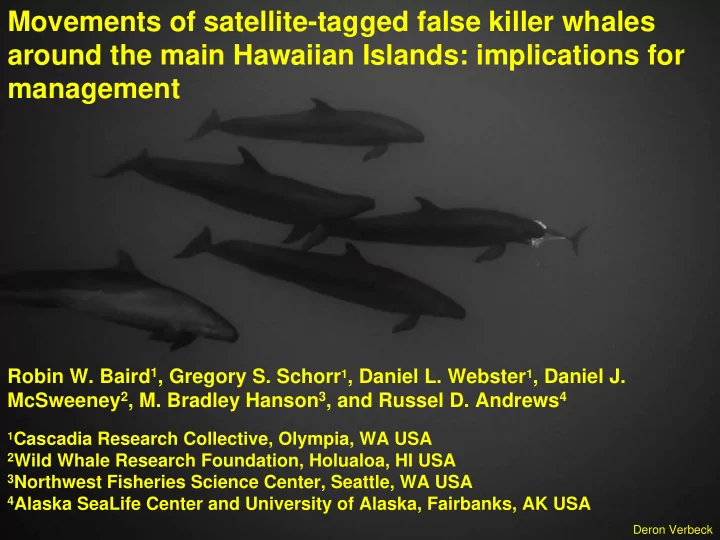
Movements of satellite-tagged false killer whales around the main Hawaiian Islands: implications for management

Robin W. Baird1, Gregory S. Schorr1, Daniel L. Webster1, Daniel J. McSweeney2, M. Bradley Hanson3, and Russel D. Andrews4

1Cascadia Research Collective, Olympia, WA USA

2Wild Whale Research Foundation, Holualoa, HI USA 3Northwest Fisheries Science Center, Seattle, WA USA 4Alaska SeaLife Center and University of Alaska, Fairbanks, AK USA Deron Verbeck

slide-2
SLIDE 2

Funding support

Southwest Fisheries Science Center Northwest Fisheries Science Center Pacific Islands Fisheries Science Center U.S. Navy (via WHOI, SWFSC, Scripps) Wild Whale Research Foundation Dolphin Quest

Other assistance/photos

  • J. Aschettino, J. Barlow, A. Bendlin, T. Cullins, M. Deakos, A.

Douglas, A. Gorgone, D. Holzer G. Legay, E. Oleson, D. Perrine, D. Roberts, M. Sakai, D. Salden

Deron Verbeck

slide-3
SLIDE 3

Background on false killer whales in Hawai‘i

  • Smallest abundance estimate of 18 species of
  • dontocetes in Hawaiian waters (Barlow 2006)
  • Two genetically isolated populations (island-

associated and open-ocean; Chivers et al. 2007)

  • Island-associated population small (estimated

123 individuals, CV = 0.73; Baird et al. 2005)

  • Multiple lines of evidence suggest the island-

associated population has declined substantially

  • ver the last 20 years (Reeves et al. 2009)
  • Causes unknown, but….

Deron Verbeck

slide-4
SLIDE 4
  • Feed primarily on large game fish that are the

target of commercial and recreational fisheries

  • Regularly take fish off lines

Jamie Barlow/PIFSC

Prey observed taken in Hawai‘i: Skipjack tuna Wahoo/Ono Mongchong Yellowfin tuna Mahimahi Threadfin jack Swordfish Both insular and offshore

slide-5
SLIDE 5

Evidence for fishery interactions

Three individuals from insular population (3.75% of catalog) with major dorsal fin disfigurements Disfigurement rates in 13 populations of 8 species ranged from 0.0 to 0.85% (median = 0.0%), indicating Hawai‘i insular population rates of fishery interactions high (Baird and Gorgone 2005)

slide-6
SLIDE 6

20 40 60 80 100 120 140 160 1986 1988 1990 1992 1994 1996 1998 2000 2002 2004 2006 2008 Y ear # longline vesels # longline vessels

Hawaiian longline fishery

  • Largest fishery in Hawai‘i
  • Rapid expansion in late 1980s/early 1990s
slide-7
SLIDE 7

Hawaiian longline fishery

  • Largest fishery in Hawai‘i
  • Rapid expansion in late 1980s/early 1990s
  • Only fishery with observer program - 20%
  • bserver coverage in deep-set (tuna) fishery

since 2001, 100% in shallow-set (swordfish) fishery since 2001

20 40 60 80 100 120 140 160 1986 1988 1990 1992 1994 1996 1998 2000 2002 2004 2006 2008 Y ear # longline vesels 5 10 15 20 25 # hooks (millions) # longline vessels # hooks total (million)

~4%

slide-8
SLIDE 8

Hawaiian longline fishery

  • Fishery exclusion zone put in place in 1992
  • Boundary contracts 4 months of the year
  • ~25% of boundary within 45-50 km during

October through January

18 19 20 21 22 23 24

  • 162
  • 161
  • 160
  • 159
  • 158
  • 157
  • 156
  • 155
  • 154

Longitude (degrees W ) Latitude (degrees N) F eb-Sep long-line exclusion boundary O ct-Jan long-line exclusion boundary Year-round long-line exclusion boundary E E Z boundary

slide-9
SLIDE 9

2 4 6 8 10 12 14 16 18 20 22 24 26 28 30 32

  • 183 -181 -179 -177 -175 -173 -171 -169 -167 -165 -163 -161 -159 -157 -155 -153 -151 -149 -147

Longitude (degrees W ) Latitude (degrees N) Johnston Atoll E E Z P almyra Atoll E E Z H awaiian Islands E E Z

Bycatch in the longline fishery 1997-2009

  • False killer whale most

frequently ‘taken’ species

  • Bycatch rates have

exceeded sustainable level (PBR) since first available (2000)

  • Estimated 124 killed in

Hawai‘i EEZ waters from 1997-2007

  • Bycatch under-

estimated: some individuals not identified to species, and lost gear

  • Bycatch by foreign

vessels outside of U.S. waters

False killer whale serious injuries, mortalities, and non- serious injuries in longline fishery

slide-10
SLIDE 10

Offshore population (known or suspected) Insular population (known)

18.5 19 19.5 20 20.5 21 21.5 22 22.5

  • 161
  • 160
  • 159
  • 158
  • 157
  • 156
  • 155

Longitude (degrees W) Latitude (degrees N ) K aua'i O 'ahu Maui H awai'i

What do we know about movements?

  • Island-associated individuals move regularly among islands (rate unknown)
  • Nothing known about movements/use of windward sides
  • Furthest offshore island-associated population documented 32 km

Sightings and effort from surveys 2000-2009, 52,320 km effort

slide-11
SLIDE 11

Three main questions

Examine movements of false killer whales to assess:

  • what biases might exist for mark-recapture estimates using

photo-identification data from different islands?

  • do individuals from the insular population move far enough
  • ffshore to interact with the offshore long-line fishery?
  • does the range of the insular population overlap with the
  • ffshore (“pelagic”) population?

18 19 20 21 22 23 24

  • 162
  • 161
  • 160
  • 159
  • 158
  • 157
  • 156
  • 155
  • 154

Longitude (degrees W ) Latitude (degrees N) F eb-Sep long-line exclusion boundary O ct-Jan long-line exclusion boundary Year-round long-line exclusion boundary E E Z boundary

slide-12
SLIDE 12

Tag design based on Andrews et al. 2008 Wildlife Computers Spot 5 ARGOS-linked location only 42 grams Medical grade titanium darts Transmitting 7-18 hours/day Deployed by pneumatic rifle Dorsal fin or dorsal ridge Range 2-10 m

slide-13
SLIDE 13

Photos compared to long-term catalog to confirm population identity Tag data processed through Douglas Argos-Filter to remove unrealistic locations (based on rate and bearing of movements) Filtered data processed in Arc GIS to assess habitat use (depth, distance from shore, distance from 200 m isobath) on windward and leeward sides and among islands

After tagging

slide-14
SLIDE 14

False killer whales satellite tagged

Period tagged # individuals # days span # days locations Population identity Aug 2007 3 32 29 Insular Jul 2008 7 76 76 Insular Dec 2008 1 54 54 Insular Oct 2009 5* 45* 45 Insular

Doug Perrine

*Three still transmitting

Apr 2008 1 15 5 Offshore

slide-15
SLIDE 15

Movements of false killer whales (1 per group)

Doug Perrine

Period tagged Distance from shore (km) Median (range) Depth (m) Median (range) Minimum distance traveled (km) Maximum distance moved from tagging location (km) Aug 07 14.1 (1.6 – 95.9) Jul 08 20.5 (0.9 – 83.1) Dec 08 22.7 (2.7 – 87.3) Apr 08 122.8 (62.1 – 210.0)

slide-16
SLIDE 16

Movements of false killer whales (1 per group)

Doug Perrine

Period tagged Distance from shore (km) Median (range) Depth (m) Median (range) Minimum distance traveled (km) Maximum distance moved from tagging location (km) Aug 07 14.1 (1.6 – 95.9) 597 (46 – 4,833) Jul 08 20.5 (0.9 – 83.1) 827 (46 – 4,767) Dec 08 22.7 (2.7 – 87.3) 1,052 (94 – 4,847) Apr 08 122.8 (62.1 – 210.0) 3,844 (1,474 – 4,747)

slide-17
SLIDE 17

Movements of false killer whales (1 per group)

Doug Perrine

Period tagged Distance from shore (km) Median (range) Depth (m) Median (range) Minimum distance traveled (km) Maximum distance moved from tagging location (km) Aug 07 14.1 (1.6 – 95.9) 597 (46 – 4,833) 2,612 Jul 08 20.5 (0.9 – 83.1) 827 (46 – 4,767) 3,010 Dec 08 22.7 (2.7 – 87.3) 1,052 (94 – 4,847) 5,653 Apr 08 122.8 (62.1 – 210.0) 3,844 (1,474 – 4,747)

slide-18
SLIDE 18

Movements of false killer whales (1 per group)

Doug Perrine

Period tagged Distance from shore (km) Median (range) Depth (m) Median (range) Minimum distance traveled (km) Maximum distance moved from tagging location (km) Aug 07 14.1 (1.6 – 95.9) 597 (46 – 4,833) 2,612 420.1 Jul 08 20.5 (0.9 – 83.1) 827 (46 – 4,767) 3,010 329.9 Dec 08 22.7 (2.7 – 87.3) 1,052 (94 – 4,847) 5,653 330.7 Apr 08 122.8 (62.1 – 210.0) 3,844 (1,474 – 4,747)

slide-19
SLIDE 19

Offshore false killer whale satellite tagged in April 2008

18.8 19 19.2 19.4 19.6 19.8 20 20.2 20.4

  • 158.2
  • 157.8
  • 157.4
  • 157.0
  • 156.6
  • 156.2
  • 155.8

Longitude (degrees W ) Latitude (degrees N) H awai'i Jaggar S eamount Apr 25 M ay 5 Apr 23 Apr 24 Apr 22 P M Apr 22 AM Long-line fishery boundary P cTag4

Group genetically confirmed as offshore population

Tagged 123.8 km offshore Locations on 5 days over 15 day span Closest point to shore 62.1 km Furthest distance offshore 210 km Moved inshore of longline fishery boundary

slide-20
SLIDE 20

H IPc107 50 100 150 200 250 300 350 400 450 10 20 30 40 50 D ays since deployment Distance from deployment (km) H IPc209 50 100 150 200 250 300 350 400 450 10 20 30 40 50 D ays since deployment Distance from deployment (km) 50 100 150 200 250 300 350 400 450 10 20 30 40 50 D ays since deployment Distance from deployment (km)

18 19 20 21 22 23

  • 161
  • 160
  • 159
  • 158
  • 157
  • 156
  • 155
  • 154

Longitude (degrees W ) Latitude (degrees N) F eb-Sep long-line exclusion boundary O ct-Jan long-line exclusion boundary Year-round long-line exclusion boundary 18 19 20 21 22 23

  • 161
  • 160
  • 159
  • 158
  • 157
  • 156
  • 155
  • 154

Longitude (degrees W ) Latitude (degrees N) F eb-Sep long-line exclusion boundary O ct-Jan long-line exclusion boundary Year-round long-line exclusion boundary 18 19 20 21 22 23

  • 161
  • 160
  • 159
  • 158
  • 157
  • 156
  • 155
  • 154

Longitude (degrees W ) Latitude (degrees N) F eb-S ep long-line exclusion boundary O ct-Jan long-line exclusion boundary Year-round long-line exclusion boundary

Aug/Sep 2007 Jul-Sep 2008 Dec 2008- Feb 2009
slide-21
SLIDE 21

18 19 20 21 22 23

  • 161
  • 160
  • 159
  • 158
  • 157
  • 156
  • 155
  • 154

Longitude (degrees W ) Latitude (degrees N) F eb-Sep long-line exclusion boundary O ct-Jan long-line exclusion boundary Year-round long-line exclusion boundary

Individual tagged during longline boundary contraction moved closest to boundary (~16 km)

Dec 2008 – Feb 2009

slide-22
SLIDE 22

Other islands only Hawai'i only

5000 4000 3000 2000 1000

Depth (m)

HIPc272

Other islands only Hawai'i only

5000 4000 3000 2000 1000

Depth (m)

HIPc172

Individuals use different habitats off different islands

  • D. Perrine/SeaPics.com
slide-23
SLIDE 23

The longline boundary contracts on the windward side, so do they use windward and leeward sides of the islands differently?

Leeward (west) sides

  • 58% of time
  • Median depth = 674 m
  • Median distance from

shore = 14.0 km Windward (east) sides

  • 42% of time
  • Median depth = 608 m
  • Median distance from

shore = 11.1 km

18 19 20 21 22 23 24

  • 162
  • 161
  • 160
  • 159
  • 158
  • 157
  • 156
  • 155
  • 154

Longitude (degrees W ) Latitude (degrees N) F eb-S ep long-line exclusion boundary O ct-Jan long-line exclusion boundary Year-round long-line exclusion boundary E E Z boundary

slide-24
SLIDE 24

October 2009 5 individuals tagged off O‘ahu, 5 different days, 3 still transmitting link by association to insular population ~1.5 days of movements through November 4, 2 AM HST

Acting as four different groups

slide-25
SLIDE 25

October 2009 10 days of movements 3 individuals 9 days of movements 1 individual 8 days of movements 1 individual

All groups move among islands Movements among islands rapid Furthest offshore ~110 km

slide-26
SLIDE 26

Take-home messages

  • Movements among islands rapid and frequent, thus

biases from using photos from different islands probably not important in mark-recapture analyses

  • The offshore individual moved to 62 km from shore,

thus populations likely overlap

  • All groups of island-associated individuals tagged

did different things, therefore sample size insufficient to characterize island usage

  • All groups of island-associated individuals moved

far (83-110 km) offshore, furthest distance offshore during contraction of longline fishery exclusion boundary, thus island-associated population likely

  • verlaps with longline fishery

www.cascadiaresearch.org/hawaii/falsekillerwhale.htm