Motor Carrier Claims for Negligent Entrustment, Hiring and Retention - - PowerPoint PPT Presentation

motor carrier claims for negligent entrustment hiring and
SMART_READER_LITE
LIVE PREVIEW

Motor Carrier Claims for Negligent Entrustment, Hiring and Retention - - PowerPoint PPT Presentation

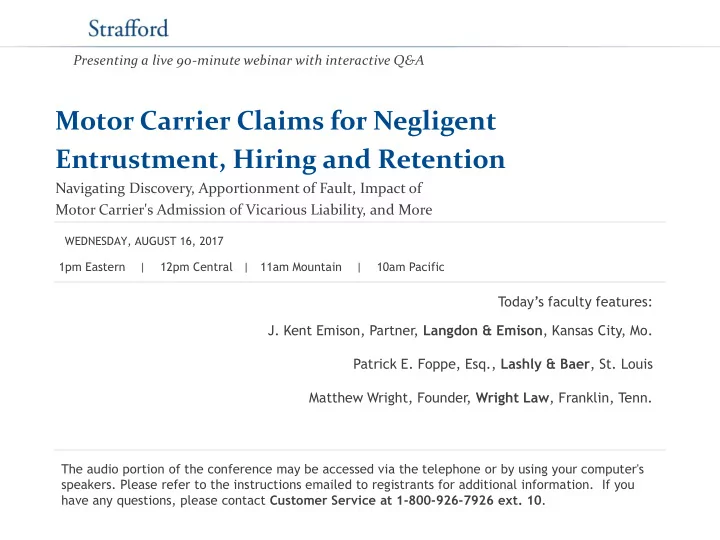
Presenting a live 90-minute webinar with interactive Q&A Motor Carrier Claims for Negligent Entrustment, Hiring and Retention Navigating Discovery, Apportionment of Fault, Impact of Motor Carrier's Admission of Vicarious Liability, and More


slide-1
SLIDE 1

The audio portion of the conference may be accessed via the telephone or by using your computer's

  • speakers. Please refer to the instructions emailed to registrants for additional information. If you

have any questions, please contact Customer Service at 1-800-926-7926 ext. 10.

Presenting a live 90-minute webinar with interactive Q&A

Motor Carrier Claims for Negligent Entrustment, Hiring and Retention

Navigating Discovery, Apportionment of Fault, Impact of Motor Carrier's Admission of Vicarious Liability, and More

Today’s faculty features:

1pm Eastern | 12pm Central | 11am Mountain | 10am Pacific WEDNESDAY, AUGUST 16, 2017

  • J. Kent Emison, Partner, Langdon & Emison, Kansas City, Mo.

Patrick E. Foppe, Esq., Lashly & Baer, St. Louis Matthew Wright, Founder, Wright Law, Franklin, Tenn.

slide-2
SLIDE 2

Tips for Optimal Quality

Sound Quality If you are listening via your computer speakers, please note that the quality

  • f your sound will vary depending on the speed and quality of your internet

connection. If the sound quality is not satisfactory, you may listen via the phone: dial 1-866-869-6667 and enter your PIN when prompted. Otherwise, please send us a chat or e-mail sound@straffordpub.com immediately so we can address the problem. If you dialed in and have any difficulties during the call, press *0 for assistance. Viewing Quality To maximize your screen, press the F11 key on your keyboard. To exit full screen, press the F11 key again.

FOR LIVE EVENT ONLY

slide-3
SLIDE 3

Continuing Education Credits

In order for us to process your continuing education credit, you must confirm your participation in this webinar by completing and submitting the Attendance Affirmation/Evaluation after the webinar. A link to the Attendance Affirmation/Evaluation will be in the thank you email that you will receive immediately following the program. For additional information about continuing education, call us at 1-800-926-7926

  • ext. 35.

FOR LIVE EVENT ONLY

slide-4
SLIDE 4

Program Materials

If you have not printed the conference materials for this program, please complete the following steps:

  • Click on the ^ symbol next to “Conference Materials” in the middle of the left-

hand column on your screen.

  • Click on the tab labeled “Handouts” that appears, and there you will see a

PDF of the slides for today's program.

  • Double click on the PDF and a separate page will open.
  • Print the slides by clicking on the printer icon.

FOR LIVE EVENT ONLY

slide-5
SLIDE 5

MOTOR CARRIER CLAIMS FOR NEGLIGENT ENTRUSTMENT, HIRING AND RETENTION

Presenters: Patrick E. Foppe Matthew E. Wright Kent Emison

slide-6
SLIDE 6

About your Presenter

Patrick E. Foppe frequently defends claims involving commercial motor vehicle accidents. He conducts rapid response investigations to serious accidents as part of Lashly & Baer’s Rapid Response Team. Patrick serves on the Defense Research Institute’s (DRI) Trucking Law Committee’s Steering Committee and is the Chair of Publications. He also serves on the Transportation Lawyers Association’s (TLA) Executive Committee and is Vice-Chair of its Membership Committee. He has received numerous awards for his pro bono work, community service, and professional accomplishments. Patrick is also a regular author and is an invited speaker by many industry groups. Patrick and his wife Kate have seven children. Lashly & Baer, P .C. 714 Locust Street

  • St. Louis, Missouri 63101

pfoppe@lashlybaer.com 314-621-2939

6

slide-7
SLIDE 7

Presentation Outline

I. Derivative Liability A. Elements of Various Causes of Action B. Majority and Minority Rule C. Punitive Damages Exception II. Where Does the Rubber Meets the Road?

  • III. Discovery Strategies

I. FMCSR Implications II. Key Documents and Deposition Considerations

  • IV. Trial Strategies and Practical Tips

7

slide-8
SLIDE 8

Overview of “Derivative” Liability

  • Negligent entrustment, hiring, retaining, training or supervising claims
  • Often used to introduce evidence, which is not directly related to the

accident, against the motor carrier or others

  • Seeks to hold a principal/entrustor directly liable for negligently hiring,

retaining, training or supervising its agent/entrustee who causes injury to another

  • Unlike respondeat superior liability, which simply holds a principal vicariously

liable for the wrongful acts of its agent, deriviate claims mainly focus on the principal/entrustor’s conduct ― the proximate cause of the plaintiff’s injury is the principal/entrustor’s negligence in entrusting, hiring, retaining, training or supervising the agent/entrustee

  • Imposing liability on the principal/entrustor requires a finding of culpability

by the agent/entrustee in causing an injury to a third party; thus, liability is “derivative”

8

slide-9
SLIDE 9

Overview of the FMCSR

  • The FMCSR generally apply to all “employers” and “commercial motor vehicles,”

which transport property or passengers in interstate commerce. See FMCSR § 390.3(a).

  • An “employer” is generally a person engaged in a business affecting interstate

commerce that owns or leases a “commercial motor vehicle” in connection with that business, or assigns employees to operate it. Id.

  • Every employer shall be knowledgeable of and comply with all the regulations

contained in the FMCSR which are applicable to that motor carrier’s operations. See FMCSR § 390.3(e)(1).

  • Every driver and employee shall be instructed regarding, and shall comply with, all

applicable regulations contained in the FMCSR. See FMCSR § 390.3(e)(1).

  • Whenever under the FMCSR a duty is prescribed for a driver or a prohibition is

imposed upon the driver, it is the duty of the motor carrier to require observance

  • f such duty or prohibition. See FMCSR § 390.11.

9

slide-10
SLIDE 10

Duties Imposed Upon Motor Carriers Under the FMCSR

  • § 383 – duty to have a CDL;
  • § 382 – duty to drug and alcohol test;
  • § 391.11 – duty to ensure the qualifications of the driver (i.e. valid

drivers license, list of violations, etc.);

  • § 391.21 – duty to have a proper application for employment;
  • § 391.23 – duty to do background investigation;
  • § 391.27 – duty to provide a record of violations;
  • § 391.31 – duty to take a road test and secure a certificate of driver’s

road test;

  • § 391.41 – duty to secure a medical examiner’s certificate;

10

slide-11
SLIDE 11

Duties Imposed Upon Motor Carriers Under the FMCSR

  • § 391.51 – duty to maintain driver qualification file;
  • § 391.53 – duty to maintain driver investigation history file;
  • § 392.3 – duty to drive while not ill or fatigued;
  • § 392.4 – duty to drive while not under the influence of drugs;
  • § 392.6 – duty to provide schedules to conform with speed limits;
  • § 395.3 – duty to conform to “hours of service” rules or maximum

driving time;

  • § 395.8 – duty to maintain driver logs;
  • § 396.3 – duty to maintain inspection, repair, and maintenance

records ; and

  • § 396.11– duty to maintain driver vehicle inspection reports.

11

slide-12
SLIDE 12

Negligent Entrustment - Elements

1. The entrustee (driver) was incompetent by reason of age, inexperience, habitual recklessness or otherwise; 2. The entrustor (motor carrier or others) knew or had reason to know of the entrustee’s incompetence; 3. There was entrustment of the chattel (tractor and/or trailer); and 4. The negligence of the entrustor concurred with the conduct of the entrustee to cause the plaintiff’s injuries. Restatement (2nd) of Torts § 390: ― One who supplies directly or through a third person a chattel for the use

  • f another whom the supplier knows or has reason to know to be likely

because of his youth, inexperience, or otherwise, to use it in a manner involving unreasonable risk of physical harm to himself and others whom the supplier should expect to share in or be endangered by its use, is subject to liability for physical harm resulting to them.

12

slide-13
SLIDE 13

Negligent Entrustment - Considerations

  • Generally, an employer-employee relationship need not be proven.
  • Implicit is that the harm must have resulted from the use of the

tractor (or trailer?).

  • Entrustment can be shown through the giving of express or implied
  • permission. Rainey by & Through Rainey v. Pitera, 651 N.E.2d 747

(1st Dist. 1995).

  • Plaintiff must generally prove that entrustor actually knew or had

reason to know the driver was incompetent or reckless in driving. Halford v. Alamo Rent-a-Car, LLC, 921 So. 2d 409 (Ala. 2005).

  • In theory, a driver is not required to have a spotless driving record to

be considered a competent driver. See e.g., Askew v. R & L Transfer, Inc., 676 F . Supp. 2d 1298 (M.D. Ala. 2009).

13

slide-14
SLIDE 14

Negligent Entrustment - Considerations

  • Typically, the plaintiff must prove that the entrustor knew or should

have known of the driver’s incompetence by showing “evidence of precious acts of negligent or reckless driving . . . previous accidents,

  • r previous acts of driving while intoxicated.” Id.
  • In the context of a trucking case, the driver’s driving record becomes

central to the analysis as motor carriers have an obligation under the FMCSRs to investigate their driver’s records (more later).

  • In a case where the claims against the driver are the only claims in

the lawsuit, his driving record may not be admissible as it is prejudicial character evidence.

  • However, where the claims against the employer are joined with

those against the driver, the driving record may be admissible notwithstanding the potential for prejudice. See Bruck v. Jim Walter Corp., 470 So. 2d 1141 (Ala. 1985).

14

slide-15
SLIDE 15

Negligent Hiring/Retention - Elements

  • 1. The employer knew or should have known that the

employee had a particular unfitness for the position so as to create a danger of harm to third persons;

  • 2. Such particular unfitness was known or should have

been known at the time of the employee’s hiring or retention; and

  • 3. This particular unfitness proximately caused the

plaintiff’s injury.

See e.g., Van Horne v. Muller, 705 N.E.2d 898 (Ill. 1998).

15

slide-16
SLIDE 16

Negligent Hiring/Retention - Considerations

  • Implicit to cause of action for negligent hiring and retention is a

threshold requirement that plaintiff prove that employer-employee relationship existed between the employer and negligent driver.

  • Some jurisdictions require the negligent driver to be acting within

the course and scope of his/her employment to pursue these claims.

  • Other States, like Missouri, only require employer to have played

some role in bringing the offending employee into contact with the injured party. Hare v. Cole, 25 S.W.3d 617 (Mo. App. W.D. 2000).

  • In some jurisdictions, the “particular unfitness” language is replaced

by “dangerous proclivity”.

  • The “particular unfitness” element is particularly important: the

tortious conduct of the driver must be consistent with the known particular unfitness/dangerous proclivity.

16

slide-17
SLIDE 17

Negligent Supervision – Elements

  • Some jurisdictions use the same basic elements as negligent retention/hiring above.
  • Other States simply require the plaintiff to prove that: (1) an employer had a duty to

supervise its employees, (2) the employer negligently supervised an employee, and (3) such negligence proximately caused the plaintiff's injuries. See e.g., Mueller v. Community Consolidated School District 54, 678 N.E.2d 660 (1st Dist. 1997).

  • Still other States have adopted the Restatement (2nd) of Torts § 317:

A master is under a duty to exercise reasonable care so to control his servant while acting outside the scope of his employment as to prevent him from intentionally harming others or from so conducting himself as to create an unreasonable risk of harm to them, if: ― The servant is using a chattel of the master; and ― The master knows or has reason to know that he has the ability to control his

servant; and

― The master knows or should know of the necessity and opportunity for exercising such control.

  • See e.g., Truck Ins. Exch. v. Prairie Framing, LLC, 162 S.W.3d 64, 82 (Mo. App. W.D.

2005).

17

slide-18
SLIDE 18

Majority vs. Minority Rule

  • Majority rule: an employer’s admission of an agency relationship with

the driver (respondeat superior liability) bars a plaintiff from seeking any other theory of derivative liability ― The rationale: once liability is imputed through agency, other theories serve no real purpose other than to waste the court’s time and energy and introduce potentially inflammatory evidence.

  • Minority rule: an admission of agency does not preclude a separate

claim brought under other theories of derivative liability ― The rationale: those other theories are distinct from agency in that they are not derivative of the employee’s negligence

18

slide-19
SLIDE 19

Majority vs. Minority Rule – Jurisdictions

MAJORITY RULE Citation MINORITY RULE Citation Missouri

McHaffie v. Bunch, 891 S.W.2d 822 (Mo. banc 1995)

Kansas

Marquis v. State Farm Fire & Cas. Co., 961 P.2d 1213 (Kan. 1998)

Indiana

Tindall v. Enderle, 320 N.E.2d 764 (Ind. Ct. App. 1974)

Minnesota

Lim v. Interstate Sys. Steel Div., Inc., 435 N.W. 830 (Minn. Ct. App. 1989)

Georgia

Bartja v. National Union Fire Ins.

  • Co. of Pittsburgh, 463 S.E.2d 358

(Ga. 1995)

New Jersey

Di Cosala v. Kay, 450 S.2d 508 (N.J. 1982)

Florida

Clooney v. Geeting, 352 So. 2d 1216 (Fla. 2d DCA 1977)

Ohio

Clark v. Stewart, 185 N.E. 71 (Ohio 1933)

Texas

Arrington’s Estate v. Fields, 578 S.W.2d 173 (Tex. Civ. App. 1979)

South Carolina

James v. Kelly Trucking Co., 661 S.E.2d 329 (S.C. 2008)

Washington

LaPlant v. Snohomich Cty., 271 P./3d 254, 357 (Wash. App. 2011) Tennessee Ali v. Fisher, 145 S.W.3d 557 (Tenn. 2004)

Arkansas

Elrod v. G. & R. Constr. Co., 628 S.W.2d 17 (Ark. 1982)

Alaska

Pagenkopf v. Chatham Elec., Inc., 165 P.3d 634 (Alaska 2007)

*This is only a partial list of jurisdictions. Some States have yet to rule either way.

19

slide-20
SLIDE 20

The “Punitive Damages Exception”

  • Some jurisdictions that follow the majority rule allow those other

claims to proceed should they plead sufficient facts to support a claim for punitive damages against the entrustor/principal. See e.g., Wilson v. Image Flooring, LLC, 400 S.W.3d 386, 392-93 (Mo. App. W.D. 2013). Some courts allow allegations of “willful and wanton” or “gross negligence” to proceed. See e.g., Locket v. Bi-State Transit Authority, 445 N.E.2d 310 (Ill. 1983); Adams Leasing Co. v. Knighton, 456 S.W.2d 574 (Tex. Civ. App. 1970).

  • Jurisdictions that allow the punitive damages exception include:

― Missouri, Illinois, Texas, Indiana, Georgia and North Carolina

  • The entrustor/principal’s conduct should be willful and wanton
  • Can a principal be held vicariously liable for an agent’s punitive

conduct? ― “Complicity rule” under Restatement (2nd) of Torts § 909

20

slide-21
SLIDE 21

Example – Employer Found Liable

Boyd v. L.G. DeWitt Trucking Co., Inc. 405 S.E.2d 914 (N.C. Ct. App. 1991)

  • Driver had two convictions for DUI, three convictions for reckless

driving, and six speeding convictions.

  • Driver had worked for employer “off and on” for about 20 years.
  • The night of the incident, the driver had been drinking. He drove his

rig into the back of a pickup truck, instantly killing the decedent and a young passenger.

  • The court held that a reasonable jury could find that the employer

knew or should have known that the driver posed a danger to the driving public, and the employer was negligent in entrusting the truck to him. Further, due to the severity and number of the driver’s

  • ffenses, the evidence was sufficient to find that the employer’s

entrustment of a truck to the driver was willful or wanton, thus supporting punitive damages.

21

slide-22
SLIDE 22

Negligent Entrustment - Frohardt v. Bassett, 788 N.E.2d 462 (Ct. App. Ind. 2003),

  • Plaintiff’s brought a claim for negligent entrustment against Penske Truck Leasing

(not a motor carrier).

  • Penske’s rental agent did not question Bassett about his health, request a medical

certification, require him to take a driving test or demonstrate his driving skill before renting him the truck.

  • The Frohardts’ were injured by Basset when their car slowed for traffic congestion

and Bassett rear-ended them with the rented truck.

  • Upon rental of the truck, Bassett presented a valid driver’s license to Penske.

Bassett did not appear to be intoxicated and seemed to be a competent adult . . . Bassett testified that he had driven a similar truck before and knew the difference between a car and a truck of this size.

  • The Court dismissed the Frohardts’ negligent entrustment claims against Penske,

reasoning that the Frohardts failed to show Penske entrusted the rental truck to Bassett with “actual and immediate knowledge” he was incompetent to drive.

22

slide-23
SLIDE 23

Example – Employer Found Not Liable

Interim Personnel of Central Virginia v. Messer 559 S.E.2d 704 (Va. 2002)

  • A driver was twice convicted of DUI, failed to pay fines or attend

counseling, and was declared a “habitual offender.”

  • Employer hired him to do administrative work as well as make short

deliveries to the post office. The driver hid his criminal offenses from the employer.

  • The driver stole a third party’s truck, operated the truck while

intoxicated “for his own frolic,” and crashed into the plaintiff’s vehicle, injuring her.

  • The employer was held NOT LIABLE because the prior acts would not

place a reasonable employer on notice or make it foreseeable that the driver would steal a truck, drive it while intoxicated, and cause an accident distant from his place of work.

23

slide-24
SLIDE 24

Graves Amendment Protections Against the Mere Owner of Equipment

  • The Graves Amendment, 49 U.S.C. § 30106(a) generally bans the imposition of

vicarious liability on owners/lessors of motor vehicles for harm resulting from the

  • peration of the vehicles. See e.g., Windmill Distrib. Co. L.P

. v. Hartford Fire Ins. Co., 449 F . App’x 81, 82 (2nd Cir. 2012); United States v. Mandel, 647 F .3d 710, 722 (7th Cir. 2011). The Graves Amendment provides in part: ― An owner of a motor vehicle that rents or leases the vehicle to a person (or an affiliate of the owner) shall not be liable under the law of any state or political subdivision thereof, by reason of being the owner of the vehicle (or an affiliate of the owner), for harm to persons or property that results or arises out of the use, operation, or possession of the vehicle during the period

  • f the rental or lease, if:

― The owner (or an affiliate of the owner) is engaged in the trade or business

  • f renting or leasing motor vehicles; and

― There is no negligence or criminal wrongdoing on the part of the owner (or an affiliate of the owner).

24

slide-25
SLIDE 25

Graves Amendment – “Savings Clause”

  • Application of the “savings clause”:

― Carton v. GMAC, the Eighth Circuit stated, “Although the Graves Amendment prohibits vicarious liability claims against owners of leased vehicles, the Graves Amendment contains a savings clause which allows an owner of a leased vehicle to be found directly liable for the owner’s negligence or criminal wrongdoing.” 611 F .3d. 451, 457 (8th Cir. 2010). ― The Eighth Circuit concluded that Plaintiff’s negligent entrustment claim would be allowed as a direct claim against the equipment owner under Iowa

  • law. Id. at 457-59.

― However, in some states like Missouri, claims for negligent hiring, supervision, retention or negligent entrustment are all various forms of “vicarious liability.” See e.g., Coomer v. Kansas City Royals Baseball Corp., 437 S.W.3d 184, 205-06 (Mo. banc 2014).

25

slide-26
SLIDE 26

Graves Amendment – Considerations

― Can protect owners of trailers. See 49 U.S.C.A. § 30102(a)(6). See e.g., Yoon Young Lee v. Rivera, 27 Misc. 3d 1201(A), 910 N.Y .S.2d 409, Slip Op. 50517(U) (Sup. Ct. 2010); Johnson v. Xtra Lease, LLC, No. 08 C 5042, 2010 WL 706037 (N.D. Ill. Feb. 24, 2010). ― Summary judgment granted to lessor where plaintiffs failed to adduce any evidence of lessor's negligence, including lessor's failure to maintain brakes on 2003 Freightliner tractor-trailer. Berkan v. Penske Truck Leasing Canada, Inc., 535 F .Supp.2d 341 (W.D.N.Y .2008). ― Granting lessor's motion to dismiss where plaintiff failed to supply any legal authority imposing a legal duty on lessors to investigate lessees' driving records. Vedder v. Cox et al., 859 N.Y .S.2d 900 (N.Y .Sup.Ct.2008).

26

slide-27
SLIDE 27
slide-28
SLIDE 28

28

slide-29
SLIDE 29

29

slide-30
SLIDE 30

30

slide-31
SLIDE 31

31

slide-32
SLIDE 32

32

slide-33
SLIDE 33

33

slide-34
SLIDE 34

34

slide-35
SLIDE 35

35

slide-36
SLIDE 36

36

slide-37
SLIDE 37

37

slide-38
SLIDE 38

38

slide-39
SLIDE 39

39

slide-40
SLIDE 40

40

slide-41
SLIDE 41

41

slide-42
SLIDE 42

42

slide-43
SLIDE 43

43

slide-44
SLIDE 44

44

slide-45
SLIDE 45

45

slide-46
SLIDE 46

46

slide-47
SLIDE 47

47

slide-48
SLIDE 48
slide-49
SLIDE 49

49

slide-50
SLIDE 50

50

slide-51
SLIDE 51

51

slide-52
SLIDE 52

52

slide-53
SLIDE 53

53

slide-54
SLIDE 54
slide-55
SLIDE 55
slide-56
SLIDE 56

56

slide-57
SLIDE 57

57

slide-58
SLIDE 58

58

slide-59
SLIDE 59

59

slide-60
SLIDE 60

60

slide-61
SLIDE 61

61

slide-62
SLIDE 62

62

slide-63
SLIDE 63

63

slide-64
SLIDE 64

64

slide-65
SLIDE 65

65

slide-66
SLIDE 66

66

slide-67
SLIDE 67

67

slide-68
SLIDE 68

68

slide-69
SLIDE 69

69

slide-70
SLIDE 70

70

slide-71
SLIDE 71

71

slide-72
SLIDE 72

72

slide-73
SLIDE 73

73

slide-74
SLIDE 74

74

slide-75
SLIDE 75

75

slide-76
SLIDE 76

76

slide-77
SLIDE 77

77

slide-78
SLIDE 78

78

slide-79
SLIDE 79

79

slide-80
SLIDE 80

80

slide-81
SLIDE 81

81

slide-82
SLIDE 82

82