
Liang, Introduction to Java Programming, Tenth Edition, (c) 2015 Pearson Education, Inc. All rights reserved.
1
Chapter 13 Abstract Classes and Interfaces
CS1: Java Programming Colorado State University
Original slides by Daniel Liang Modified slides by Chris Wilcox
Liang, Introduction to Java Programming, Tenth Edition, (c) 2015 Pearson Education, Inc. All rights reserved.
2
Motivations
✦ You have learned how to write simple programs
to create and display GUI components. Can you write the code to respond to user actions, such as clicking a button to perform an action?
✦ In order to write such code, you have to know
about interfaces. An interface is for defining common behavior for classes (including unrelated classes). Before discussing interfaces, we introduce a closely related subject: abstract classes.
Liang, Introduction to Java Programming, Tenth Edition, (c) 2015 Pearson Education, Inc. All rights reserved.
3
Objectives
◆ To design and use abstract classes (§13.2). ◆ To generalize numeric wrapper classes, BigInteger, and BigDecimal
using the abstract Number class (§13.3).
◆ To process a calendar using the Calendar and GregorianCalendar
classes (§13.4).
◆ To specify common behavior for objects using interfaces (§13.5). ◆ To define interfaces and define classes that implement interfaces
(§13.5).
◆ To define a natural order using the Comparable interface (§13.6). ◆ To make objects cloneable using the Cloneable interface (§13.7). ◆ To explore the similarities and differences among concrete classes,
abstract classes, and interfaces (§13.8).
◆ To design the Rational class for processing rational numbers (§13.9). ◆ To design classes that follow the class-design guidelines (§13.10).
Liang, Introduction to Java Programming, Tenth Edition, (c) 2015 Pearson Education, Inc. All rights reserved.
4
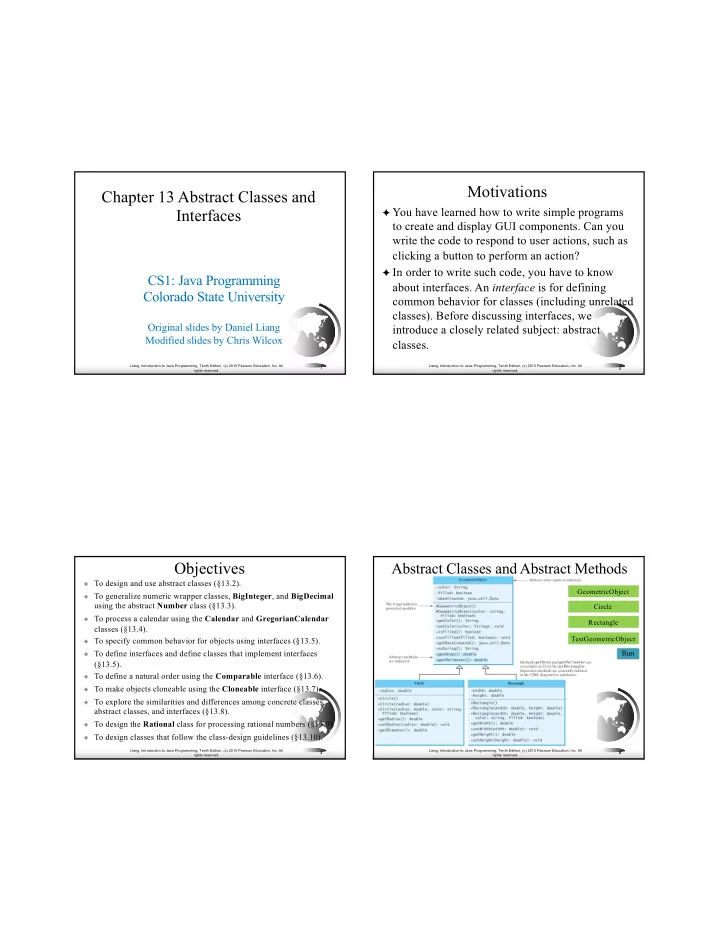
Abstract Classes and Abstract Methods
Run GeometricObject Circle Rectangle TestGeometricObject