Motivation Distributed computing, WWW, ubiquity Need - - PDF document

motivation
SMART_READER_LITE
LIVE PREVIEW

Motivation Distributed computing, WWW, ubiquity Need - - PDF document

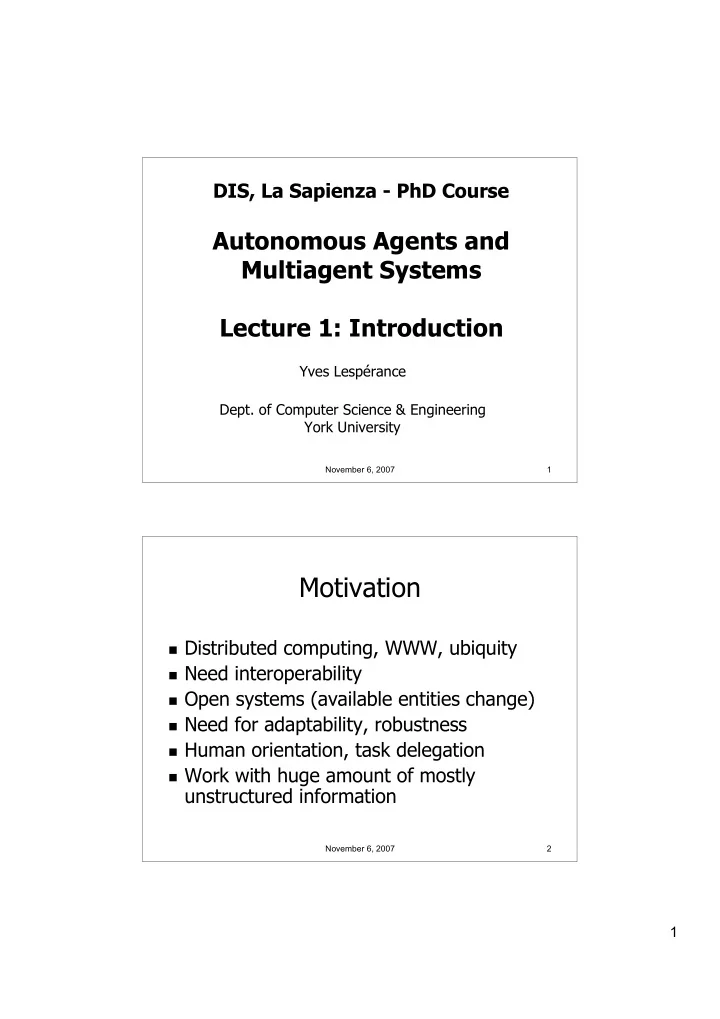
DIS, La Sapienza - PhD Course Autonomous Agents and Multiagent Systems Lecture 1: Introduction Yves Lesprance Dept. of Computer Science & Engineering York University November 6, 2007 1 Motivation Distributed computing, WWW,


slide-1
SLIDE 1

1

November 6, 2007 1

DIS, La Sapienza - PhD Course

Autonomous Agents and Multiagent Systems Lecture 1: Introduction

Yves Lespérance

  • Dept. of Computer Science & Engineering

York University

November 6, 2007 2

Motivation

 Distributed computing, WWW, ubiquity  Need interoperability  Open systems (available entities change)  Need for adaptability, robustness  Human orientation, task delegation  Work with huge amount of mostly

unstructured information

slide-2
SLIDE 2

2

November 6, 2007 3

Agent-Oriented Computing

 View a distributed computing system as a

society of agents

 Agents are autonomous, i.e. can make

their own decisions about how to act

November 6, 2007 4

Key Agent Technologies

 Yellow pages, matchmakers, brokers  Agent communication languages  Coordination/negotiation protocols  Ontologies, semantic markup languages  Communication infrastructure/middleware  Agent programming languages,

architectures, CASE tools

slide-3
SLIDE 3

3

November 6, 2007 5

What is an Agent?

 “An agent is a computer system that is

situated in some environment and is capable of autonomous action in this environment in order to meet its design

  • bjectives” [Wooldridge 02]

 Related to controllers, reactive systems  Many different notions of agents

November 6, 2007 6

Attributes of Intelligent Agents

 Autonomous, i.e. can make their own

decisions about how to act

 Reactive, i.e. perceive environment &

respond in timely way to changes

 Proactive, i.e. take the initiative & act to

achieve their goals

 Social abilities, i.e. can interract,

collaborate, negotiate with others

slide-4
SLIDE 4

4

November 6, 2007 7

What Could Agents Do?

 Personal digital assistant that can arrange

a trip for user by negotiating with service providers

 Air-traffic control system that can cope

with emergencies, e.g. craft failures, bad weather

 Autonomous control of a space probe or

planetary rover

November 6, 2007 8

Applications of Agents

 Industry: Air-traffic control, electricity distribution

management

 E-commerce: shopping agents, supply chain integration  Personal assistants: meeting scheduling, movie/book

selection

 Information management: mail/news filtering,

information retrieval

 Intelligent interfaces & groupware  Robotics: Deep Space I, museum guides, soccer  Believable agents for entertainment & games  See [Wooldridge 02, Chapter 11] for more info

slide-5
SLIDE 5

5

November 6, 2007 9

Agents as Intentional Systems

 Taking the intentional stance [Dennett 87] is

attributing beliefs, desires, & rationality to an entity to explain or predict its behavior

 Contrast to physical or design stance  Useful abstraction with complex systems  May take this further and assume agents are

designed to manipulate explicit representations

  • f their beliefs, desires, etc.

November 6, 2007 10

Types of Work on Individual Agents

 Agent theories: formal/logical specifications of

agents, their mental states, the relation between them and agent’s action

 Agent architectures: models for designing

systems that behave like agents, integrating planning, decision making, belief update, etc.

 Agent Programming Languages: languages for

programming agents

slide-6
SLIDE 6

6

November 6, 2007 11

Types of Work on Multiagent Systems

 Agent Communication Languages: speech acts

languages, content languages, ontologies

 Protocol Design & Negotiation: mechanisms for

reaching agreements between competitive agents, often through auctions; based on game and economic theory; analysis of protocol properties

November 6, 2007 12

Types of Work on Multiagent Systems

 Task Allocation & Coordination: mechanisms for

allocating tasks & sharing results, multiagent planning, ensuring that team members stay coordinated

 Multiagent Platforms/Infrastructures: languages

and tools for programming MAS, providing basic services such as networking, yellow pages, etc.; e.g. SRI's Open Agent Architecture (OAA), Telecom Italia's Java Agent Development Environment (JADE), which is FIPA compliant

slide-7
SLIDE 7

7

November 6, 2007 13

Agent Architecture: IRMA

  • IRMA [Bratman et al 88] architecture

for resource-bounded practical reasoning agents

  • Agent has beliefs, desires, &

intentions

  • Intentions are desires that agent is

committed to

  • Means/ends reasoner generates

possible intentions/plans/options

  • Deliberation process decides what
  • ptions to commit to
  • Current intentions act as a filter
  • ver new intentions, must be

compatible

  • Filter can be overridden when an
  • pportunity or problem is detected

November 6, 2007 14

Agent Theory/Logic: [Cohen & Levesque 90]

Start with a linear temporal/dynamic logic:

 (Happens α)  (Done α)  [] φ - Always φ  ◊ φ - Eventually φ  An action exp α can be simple, a test (φ?),

  • r a sequence (α1; α2)
slide-8
SLIDE 8

8

November 6, 2007 15

C&L Logic: Mental State Operators

 (Bel i φ) agent i believes φ (KD45 logic)  (Goal i φ) agent i has goal that φ (KD)  (P-Goal i φ) agent i has persistent goal

that φ

 (Int i α) agent i has intention to perform α

November 6, 2007 16

C&L Logic: Properties

 |= (Bel i φ) → (Goal i φ) - realism  Assumption: eventually, all goals get dropped

(no indefinite procrastination)

 Intention is dropped only if agent believes it has

been achieved or is unachievable

 Success theorem: if one intends α and one

never comes to believe that α is impossible, then eventually α happens

slide-9
SLIDE 9

9

November 6, 2007 17

Agent Programming Language: IndiGolog

  • High-level programming language for agents [De

Giacomo & Levesque 99, Lesperance & Ng 00]

  • Based on situation calculus, logic for reasoning

about dynamic worlds

  • Supports planning and plan execution in

dynamic and incompletely known environments

  • Supports complex behavior specifications
  • Supports ordinary, sensing, exogenous actions
  • Implemented on top of Prolog

November 6, 2007 18

IndiGolog Agent Structure (1)

 Declarative Part – Application domain

dynamics specification in situation calculus

 Includes axioms describing:

 Initial situation  Preconditions of primitive actions, i.e. when

they are possible

 How the world changes when a primitive

action is performed (including sensing)

 Etc.

slide-10
SLIDE 10

10

November 6, 2007 19

IndiGolog Agent Structure (2)

 Procedural Part – Rich set of constructs for

agent behaviour specification

 Recursive Procedures  If-then-else  While loops  Non-deterministic branch / choice of arguments /

iteration

 Concurrency with or without priorities  Interrupts  Search (planning) block

November 6, 2007 20

E.g. Multirobot Mail Delivery in IndiGolog + OAA [Lapouchnian & Lesperance 02]

 Varying number of robots  Dispatcher agent assigns incoming orders to

mail robots

 Dispatcher, robots implement a variation of

contract net protocol

 Robots – two agent architectures

 High-Level Control (HLC) in IndiGolog – bidding,

  • ptimal route planning

 Low-Level Control (LLC) – motion subsystem

 Also: GUI, PathPlanner, DB

slide-11
SLIDE 11

11

November 6, 2007 21

Interactions

November 6, 2007 22

HLC – Behaviour Specification

proc(control, [ prioritized_interrupts([ %high priority interrupt: handles bid requests interrupt([f,t,o], bid_requested(f,t,o)=true, pi([l,d], [?(l=next_location), ?(d=dist(l,f)), bid(o,d)])), %medium priority interrupt: handles newly assigned orders interrupt([f,t,o], and(canmove, delivery(f,t,o)=ordered), search(pconc(minimize_distance(0), envSimulator))), %low priority interrupt: when nothing to do, wait interrupt(true, no_op) ]) ]).

slide-12
SLIDE 12

12

November 6, 2007 23

E.g. Lights and Camera Project [Borzenko et al 06]

 Intelligent control of image acquisition, lights and

camera settings

 Applications in space, mining, surgery

November 6, 2007 24

Lights and Camera Architecture

Intelligent Controller

evaluation metrics, e.g. model matching error next light settings, vision parameters

Image DB

Image Server

Simulation

corresponding image lights and camera parameters parameters images

Acquisition

Vision Server

Pose Estimation Edge Detection Edge Linking

parameters images