Motivation We are given a data set, and are told that it was - - PDF document

motivation
SMART_READER_LITE
LIVE PREVIEW

Motivation We are given a data set, and are told that it was - - PDF document

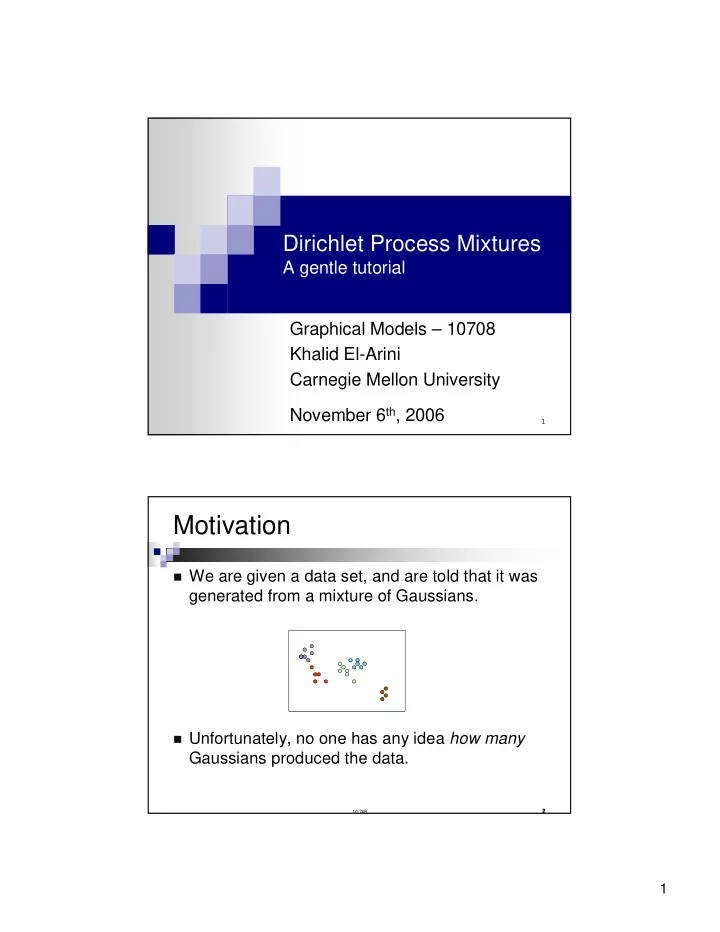
Dirichlet Process Mixtures A gentle tutorial Graphical Models 10708 Khalid El-Arini Carnegie Mellon University November 6 th , 2006 1 Motivation We are given a data set, and are told that it was generated from a mixture of Gaussians.


slide-1
SLIDE 1

1

1

Dirichlet Process Mixtures

A gentle tutorial Graphical Models – 10708 Khalid El-Arini Carnegie Mellon University November 6th, 2006

10-708 2

We are given a data set, and are told that it was

generated from a mixture of Gaussians.

Unfortunately, no one has any idea how many

Gaussians produced the data.

Motivation

slide-2
SLIDE 2

2

10-708 3

We are given a data set, and are told that it was

generated from a mixture of Gaussians.

Unfortunately, no one has any idea how many

Gaussians produced the data.

Motivation

10-708 4

What to do?

We can guess the number of clusters, do EM for

Gaussian Mixture Models, look at the results, and then try again…

We can do hierarchical agglomerative clustering,

and cut the tree at a visually appealing level…

We want to cluster the data in a statistically

principled manner, without resorting to hacks.

slide-3
SLIDE 3

3

10-708 5

Review: Dirichlet Distribution

Let We write: Distribution over possible parameter vectors for a

multinomial distribution, and is in fact the conjugate prior for the multinomial.

Beta distribution is the special case of a Dirichlet for 2

dimensions.

Samples from the distribution lie in the m-1 dimensional

simplex

Thus, it is in fact a “distribution over distributions.”

10-708 6

Dirichlet Process

A Dirichlet Process is also a distribution over

distributions.

We write:

G ~ DP(α, G0)

G0 is a base distribution α is a positive scaling parameter

G has the same support as G0

slide-4
SLIDE 4

4

10-708 7

Dirichlet Process

Consider Gaussian G0 G ~ DP(α, G0)

10-708 8

Dirichlet Process

G ~ DP(α, G0)

G0 is continuous, so the probability that any two samples

are equal is precisely zero.

However, G is a discrete distribution, made up of a

countably infinite number of point masses [Blackwell]

Therefore, there is always a non-zero probability of two samples

colliding

slide-5
SLIDE 5

5

10-708 9

Dirichlet Process

G ~ DP(α1, G0) G ~ DP(α2, G0)

α values determine how close G is to G0

10-708 10

Sampling from a DP

G ~ DP(α, G0) Xn | G ~ G for n = {1, …, N} (iid)

Marginalizing out G introduces dependencies between the Xn variables

G Xn N

slide-6
SLIDE 6

6

10-708 11

Sampling from a DP

Assume we view these variables in a specific order, and are interested in the behavior of Xn given the previous n - 1 observations. Let there be K unique values for the variables:

10-708 12

Sampling from a DP

Notice that the above formulation of the joint does not depend on the order we consider the variables. We can arrive at a mixture model by assuming exchangeability and applying DeFinetti’s Theorem (1935).

Chain rule P(partition) P(draws)

slide-7
SLIDE 7

7

10-708 13

Chinese Restaurant Process

Can rewrite as: Let there be K unique values for the variables:

10-708 14

Chinese Restaurant Process

Consider a restaurant with infinitely many tables, where the Xn’s represent the patrons of the restaurant. From the above conditional probability distribution, we can see that a customer is more likely to sit at a table if there are already many people sitting there. However, with probability proportional to α, the customer will sit at a new table. Also known as the “clustering effect,” and can be seen in the setting of social clubs. [Aldous]

slide-8
SLIDE 8

8

10-708 15

Dirichlet Process Mixture

G ηn N yn G0 α countably infinite number

  • f point masses

draw N times from G to get parameters for different mixture components If ηn were drawn from e.g. a Gaussian, no two values would be the same, but since they are drawn from a distribution drawn from a Dirichlet Process, we expect a clustering of the ηn # unique values for ηn = # mixture components

10-708 16

CRP Mixture

slide-9
SLIDE 9

9

10-708 17

Stick Breaking

So far, we’ve just mentioned properties of a

distribution G drawn from a Dirichlet Process

In 1994, Sethuraman developed a constructive

way of forming G, known as “stick breaking”

10-708 18

Stick Breaking

  • 1. Draw η1* from G0
  • 2. Draw v1 from Beta(1, α)
  • 4. Draw η2* from G0
  • 3. π1 = v1

  • 5. Draw v2 from Beta(1, α)
  • 6. π2 = v2(1 – v1)
slide-10
SLIDE 10

10

10-708 19

Formal Definition

Let α be a positive, real-valued scalar Let G0 be a non-atomic probability distribution

  • ver support set A

We say G ~ DP(α, G0), if for all natural numbers

k and k-partitions {A1, …, Ak},

10-708 20

Inference in a DPM

EM is generally used for

inference in a mixture model, but G is nonparametric, making EM difficult

Markov Chain Monte Carlo

techniques [Neal 2000]

Variational Inference [Blei

and Jordan 2006]

G ηn N yn G0 α

slide-11
SLIDE 11

11

10-708 21

Gibbs Sampling [Neal 2000]

Algorithm 1:

Define Hi to be the single

  • bservation posterior

We marginalize out G from

  • ur model, and sample each

ηn given everything else

G ηn N yn G0 α SLOW TO CONVERGE!

10-708 22

Gibbs Sampling [Neal 2000]

Algorithm 2:

G ηn N yn G0 α cn N yn G0 α ηc

[Grenager 2005]

slide-12
SLIDE 12

12

10-708 23

Gibbs Sampling [Neal 2000]

  • Algorithm 2 (cont.):

We sample from the distribution over an individual

cluster assignment cn given yn, and all the other cluster assignments

1.

Initialize cluster assignments c1, …, cN

2.

For i=1,…,N, draw ci from:

3.

For all c, draw ηc | yi (for all i such that ci = c)

if c = cj for some j ≠ i

  • therwise

10-708 24

We now have a statistically principled

mechanism for solving our original problem.

This was intended as a general and fairly

shallow overview of Dirichlet Processes.

Conclusion

slide-13
SLIDE 13

13

10-708 25

Acknowledgments

Much thanks goes to David Blei. Some material for this presentation was inspired

by slides from Teg Grenager and Zoubin Ghahramani.

10-708 26

References

Blei, David M. and Michael I. Jordan. “Variational inference for Dirichlet process mixtures.” Bayesian Analysis 1(1), 2006. R.M. Neal. Markov chain sampling methods for Dirichlet process mixture models. Journal of Computational and Graphical

Statistics, 9:249-265, 2000.

Ghahramani, Zoubin. “Non-parametric Bayesian Methods.” UAI Tutorial July 2005. Grenager, Teg. “Chinese Restaurants and Stick Breaking: An Introduction to the Dirichlet Process” Blackwell, David and James B. MacQueen. “Ferguson Distributions via Polya Urn Schemes.” The Annals of Statistics 1(2), 1973, 353-355. Ferguson, Thomas S. “A Bayesian Analysis of Some Nonparametric Problems” The Annals of Statistics 1(2), 1973, 209-230.