Motivation Garbage-in, garbage-out Cannot get good mining results - - PDF document

motivation
SMART_READER_LITE
LIVE PREVIEW

Motivation Garbage-in, garbage-out Cannot get good mining results - - PDF document

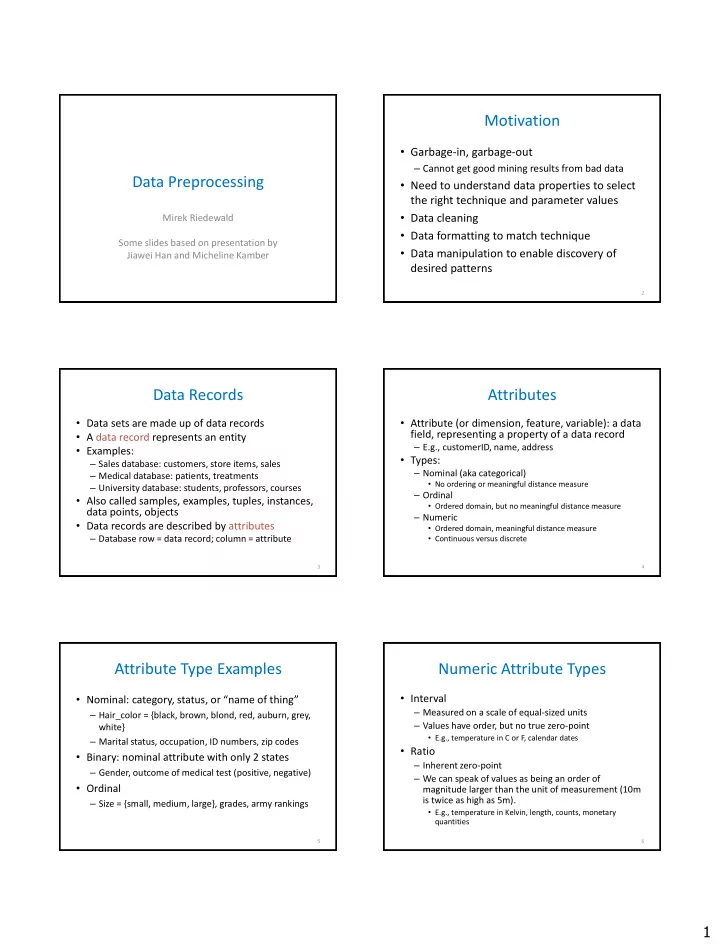
Motivation Garbage-in, garbage-out Cannot get good mining results from bad data Data Preprocessing Need to understand data properties to select the right technique and parameter values Data cleaning Mirek Riedewald Data


slide-1
SLIDE 1

1

Data Preprocessing

Mirek Riedewald Some slides based on presentation by Jiawei Han and Micheline Kamber

Motivation

  • Garbage-in, garbage-out

– Cannot get good mining results from bad data

  • Need to understand data properties to select

the right technique and parameter values

  • Data cleaning
  • Data formatting to match technique
  • Data manipulation to enable discovery of

desired patterns

2

Data Records

  • Data sets are made up of data records
  • A data record represents an entity
  • Examples:

– Sales database: customers, store items, sales – Medical database: patients, treatments – University database: students, professors, courses

  • Also called samples, examples, tuples, instances,

data points, objects

  • Data records are described by attributes

– Database row = data record; column = attribute

3

Attributes

  • Attribute (or dimension, feature, variable): a data

field, representing a property of a data record

– E.g., customerID, name, address

  • Types:

– Nominal (aka categorical)

  • No ordering or meaningful distance measure

– Ordinal

  • Ordered domain, but no meaningful distance measure

– Numeric

  • Ordered domain, meaningful distance measure
  • Continuous versus discrete

4

Attribute Type Examples

  • Nominal: category, status, or “name of thing”

– Hair_color = {black, brown, blond, red, auburn, grey, white} – Marital status, occupation, ID numbers, zip codes

  • Binary: nominal attribute with only 2 states

– Gender, outcome of medical test (positive, negative)

  • Ordinal

– Size = {small, medium, large}, grades, army rankings

5

Numeric Attribute Types

  • Interval

– Measured on a scale of equal-sized units – Values have order, but no true zero-point

  • E.g., temperature in C or F, calendar dates
  • Ratio

– Inherent zero-point – We can speak of values as being an order of magnitude larger than the unit of measurement (10m is twice as high as 5m).

  • E.g., temperature in Kelvin, length, counts, monetary

quantities

6

slide-2
SLIDE 2

2

Discrete vs. Continuous Attributes

  • Discrete Attribute

– Has only a finite or countably infinite set of values – Nominal, binary, ordinal attributes are usually discrete – Integer numeric attributes

  • Continuous Attribute

– Has real numbers as attribute values

  • E.g., temperature, height, or weight

– Practically, real values can only be measured and represented using a finite number of digits – Typically represented as floating-point variables

7

Data Preprocessing Overview

  • Descriptive data summarization
  • Data cleaning
  • Correlations
  • Data transformation
  • Summary

8

Measuring the Central Tendency

  • Sample mean:
  • Weighted arithmetic mean:

– Trimmed mean: set weights of extreme values to zero

  • Median

– Middle value if odd number of values; average of the middle two values otherwise

  • Mode

– Value that occurs most frequently in the data – E.g., unimodal or bimodal distribution

9

n i i

x n x

1

1

 

 

n i i n i i i

w x w x

1 1

Measuring Data Dispersion: Boxplot

  • Quartiles: Q1 (25th percentile), Q3 (75th percentile)

– Inter-quartile range: IQR = Q3 – Q1 – For N records, the p-th percentile is the record at position (p/100)N+0.5 in increasing order

  • If not integer, round to nearest integer or compute weighted average
  • E.g., for N=32, p=25: 25/100*32+0.5 = 8.5, i.e., Q1 is average of 8-th and 9-th

largest values

  • Boxplot: ends of the box are the quartiles, median is marked,

whiskers extend to min/max

– Often plots outliers individually: usually a value higher (or lower) than 1.5IQR from Q3 (or Q1)

10

Measuring Data Dispersion: Variance

  • Sample variance (aka second central

moment):

  • Standard deviation = square root of variance
  • Estimator of true population variance from a

sample:

11

 

 

   

n i i n i i n

x x n x x n s

1 2 2 1 2 2

1 ) ( 1

 

  

n i i n

x x n s

1 2 2 1

) ( 1 1

Histogram

  • Display of

tabulated frequencies

  • Shows proportion
  • f cases in each

category

  • Area (not height!)
  • f the bar denotes

the value

– Crucial distinction when the categories are not

  • f uniform width!

12

slide-3
SLIDE 3

3

Scatter plot

  • Visualizes relationship between two attributes, even a third (if categorical)

– For each data record, plot selected attribute pair in the plane

13

Correlated Data

14

Not Correlated Data

15

Data Preprocessing Overview

  • Descriptive data summarization
  • Data cleaning
  • Correlations
  • Data transformation
  • Summary

16

Why Data Cleaning?

  • Data in the real world is dirty

– Incomplete: lacking attribute values, lacking certain attributes of interest, or containing only aggregate data

  • E.g., occupation=“ ”

– Noisy: containing errors or outliers

  • E.g., Salary=“-10”

– Inconsistent: containing discrepancies in codes or names

  • E.g., Age=“42” and Birthday=“03/07/1967”
  • E.g., was rating “1, 2, 3”, now rating “A, B, C”

17

Example: Bird Observation Data

  • Change of range boundaries over time, e.g., for temperature
  • Different units, e.g., meters versus feet for elevation
  • Addition or removal of attributes over the years
  • Missing entries, especially for habitat and weather
  • GIS data based on 30m cells or 1km cells
  • Location accuracy

– ZIP code versus GPS coordinates – Walk along transect but report only single location

  • Inconsistent encoding of missing entries

– 0, -9999, -3.4E+38—need context to decide

  • Varying observer experience and capabilities

– Confusion of species, missed present species

  • Confusion about reporting protocol

– Report max versus sum seen – Report only interesting species, not all

18

Hairy vs. Downy Woodpecker

slide-4
SLIDE 4

4

How to Handle Missing Data?

  • Ignore the record

– Usually done when class label is missing (for classification tasks)

  • Fill in manually

– Tedious and often not clear what value to fill in

  • Fill in automatically with one of the following:

– Global constant, e.g., “unknown”

  • “Unknown” could be mistaken as new concept by data mining

algorithm

– Attribute mean or mean for all records belonging to the same class – Most probable value: inference-based such as Bayesian formula

  • r decision tree
  • Some methods, e.g., trees, can do this implicitly

19

How to Handle Noisy Data?

  • Noise = random error or variance in a measured

variable

  • Typical approach: smoothing
  • Adjust values of a record by taking values of other

“nearby” records into account

  • Many approaches
  • Recommendation: don’t do it unless you

understand the nature of the noise

  • A good data mining technique should be able to deal

with noise in the data

20

Data Preprocessing Overview

  • Descriptive data summarization
  • Data cleaning
  • Correlations
  • Data transformation
  • Summary

21

Covariance (Numerical Data)

  • Covariance computed for data samples (A1, B1), (A2, B2),…, (An, Bn):
  • If A and B are independent, then Cov(A, B) = 0, but the converse is

not true

– Two random variables may have covariance of 0, but are not independent

  • If Cov(A, B) > 0, then A and B tend to rise and fall together

– The greater, the more so

  • If covariance is negative, then A tends to rise as B falls and vice

versa

22

 

 

     

n i i i n i i i

B A B A n B B A A n B A

1 1

1 ) )( ( 1 ) , Cov(

Covariance Example

  • Suppose two stocks A and B have the

following values in one week:

– A: (2, 3, 5, 4, 6) – B: (5, 8, 10, 11, 14) – AVG(A) = (2 + 3 + 5 + 4 + 6)/ 5 = 20/5 = 4 – AVG(B) = (5 + 8 + 10 + 11 + 14) /5 = 48/5 = 9.6 – Cov(A,B) = (25+38+510+411+614)/5 − 49.6 = 4

  • Cov(A,B) > 0, therefore A and B tend to rise

and fall together

23

Correlation Analysis (Numerical Data)

  • Pearson’s product-moment correlation coefficient of random

variables A and B:

  • Computed for two attributes A and B from data samples (A1, B1),

(A2, B2),…, (An, Bn):

Where and are the sample means, and sA and sB are the sample standard deviations of A and B (using the variance formula for sn).

  • Note: -1 ≤ rA,B ≤ 1
  • rA,B > 0: A and B positively correlated (the higher, the stronger the

correlation)

  • rA,B < 0: negatively correlated

24

            

n i B i A i B A

s B B s A A n r

1 ,

1 1

A B

B A B A

B A Cov    ) , (

, 

slide-5
SLIDE 5

5 Correlation Analysis (Categorical Data)

  • 2 (chi-square) test
  • The larger the 2 value, the more likely the variables are

related

  • The cells that contribute the most to the 2 value are those

whose actual count is very different from the expected count

  • Correlation does not imply causality

– # of hospitals and # of car-thefts in a city are correlated – Both are causally linked to the third variable: population

25

  Expected ) Expected Observed (

2 2

Chi-Square Example

  • Numbers in parenthesis are expected counts calculated

based on the data distribution in the two categories

  • It shows that like_science_fiction and play_chess are

correlated in the group

26

Play chess Not play chess Sum (row) Like science fiction 250 (90) 200 (360) 450 Not like science fiction 50 (210) 1000 (840) 1050 Sum(col.) 300 1200 1500

93 . 507 840 ) 840 1000 ( 360 ) 360 200 ( 210 ) 210 50 ( 90 ) 90 250 (

2 2 2 2 2

         

Data Preprocessing Overview

  • Descriptive data summarization
  • Data cleaning
  • Correlations
  • Data transformation
  • Summary

27

Why Data Transformation?

  • Make data more “mineable”

– E.g., some patterns visible when using single time attribute (entire date-time combination), others only when making hour, day, month, year separate attributes – Some patterns only visible at right granularity of representation

  • Some methods require normalized data

– E.g., all attributes in range [0.0, 1.0]

  • Reduce data size, both #attributes and #records

28

Normalization

  • Min-max normalization to [new_minA, new_maxA]:

– E.g., normalize income range [$12,000, $98,000] to [0.0, 1.0]. Then $73,600 is mapped to

  • Z-score normalization (μ: mean, σ: standard deviation):

– E.g., for μ = 54,000 and σ = 16,000, $73,600 is mapped to

  • Normalization by decimal scaling:

where j is the smallest integer such that Max(|ν’|) < 1

29 A A A A A A

new_min ) new_min new_max ( min max min '      v v

716 . ) . 1 ( 000 , 12 000 , 98 000 , 12 600 , 73     

A A

v v     '

225 . 1 000 , 16 000 , 54 600 , 73  

j

v v 10 '

Data Reduction

  • Why data reduction?

– Mining cost often increases rapidly with data size and number of attributes

  • Goal: reduce data size, but produce (almost) the

same results

  • Data reduction strategies

– Dimensionality reduction – Data Compression – Numerosity reduction – Discretization

30

slide-6
SLIDE 6

6 Dimensionality Reduction: Attribute Subset Selection

  • Feature selection (i.e., attribute subset selection):

– Select a minimum set of attributes such that the mining result is still as good as (or even better than) when using all attributes

  • Heuristic methods (due to exponential number of

choices):

– Select independently based on some test – Step-wise forward selection – Step-wise backward elimination – Combining forward selection and backward elimination – Eliminate attributes that some trusted method did not use, e.g., a decision tree

31

Principal Component Analysis

  • Find projection that captures largest amount of

variation in the data

– Space defined by eigenvectors of the covariance matrix

  • Compression: use only first k eigenvectors

36

x2 x1 e1 e2

Data Reduction Method: Sampling

  • Select a small subset of a given data set
  • Reduces mining cost

– Mining cost usually is super-linear in data size – Often makes difference between in-memory processing and need for expensive I/O

  • Choose a representative subset of the data

– Simple random sampling may have poor performance in the presence of skew – Stratified sampling

  • E.g., sample more from small classes to avoid missing them

in small uniform sample

38

Data Reduction: Discretization

  • Applied to continuous attributes
  • Reduces domain size
  • Makes the attribute discrete and hence

enables use of techniques that only accept categorical attributes

  • Approach:

– Divide the range of the attribute into intervals – Interval labels replace the original data

39

Data Preprocessing Overview

  • Descriptive data summarization
  • Data cleaning
  • Correlations
  • Data transformation
  • Summary

40

Summary

  • Data preparation is a big issue for data mining
  • Descriptive data summarization is used to

understand data properties

  • Data preparation includes

– Data cleaning and integration – Data reduction and feature selection – Discretization

  • Many techniques and commercial tools, but

still major challenge and active research area

41