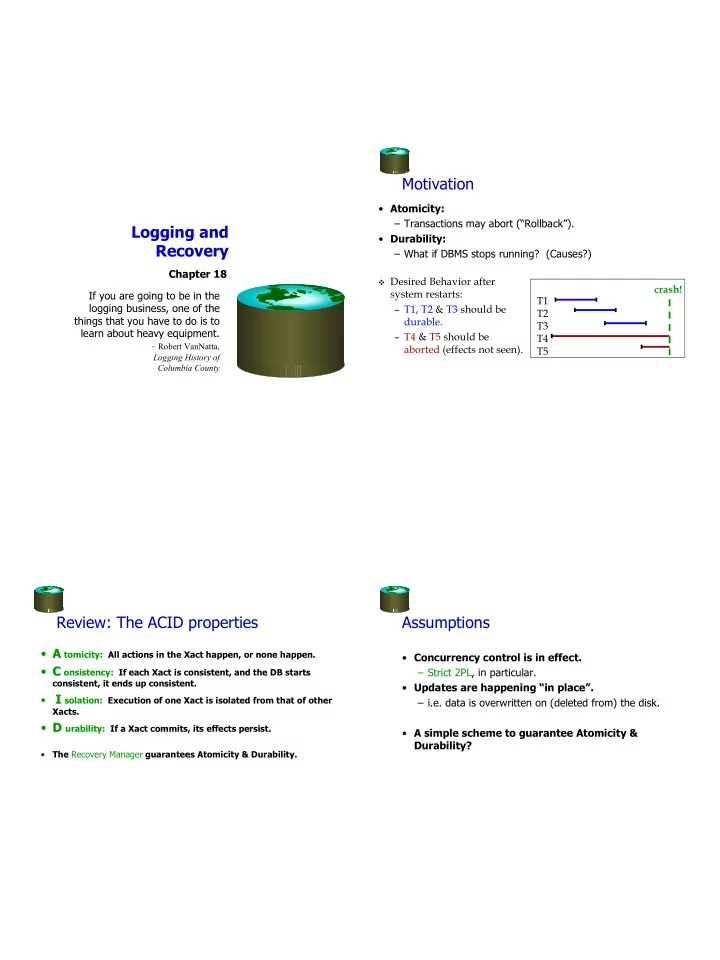
Motivation Atomicity: Transactions may abort (Rollback). Logging - - PDF document

motivation
SMART_READER_LITE
LIVE PREVIEW

Motivation Atomicity: Transactions may abort (Rollback). Logging - - PDF document

Motivation Atomicity: Transactions may abort (Rollback). Logging and Durability: Recovery What if DBMS stops running? (Causes?) Chapter 18 Desired Behavior after crash! system restarts: If you are going to be in


slide-1
SLIDE 1

Logging and Recovery

Chapter 18 If you are going to be in the logging business, one of the things that you have to do is to learn about heavy equipment.

  • Robert VanNatta,

Logging History of Columbia County

Review: The ACID properties

  • A

A tomicity: All actions in the Xact happen, or none happen.

  • C

C onsistency: If each Xact is consistent, and the DB starts

consistent, it ends up consistent.

  • I

I solation: Execution of one Xact is isolated from that of other

Xacts.

  • D

D urability: If a Xact commits, its effects persist.

  • The Recovery Manager guarantees Atomicity & Durability.

Motivation

  • Atomicity:

– Transactions may abort (“Rollback”).

  • Durability:

– What if DBMS stops running? (Causes?) crash!

Desired Behavior after

system restarts: – T1, T2 & T3 should be durable. – T4 & T5 should be aborted (effects not seen). T1 T2 T3 T4 T5

Assumptions

  • Concurrency control is in effect.

– Strict 2PL, in particular.

  • Updates are happening “in place”.

– i.e. data is overwritten on (deleted from) the disk.

  • A simple scheme to guarantee Atomicity &

Durability?

slide-2
SLIDE 2

Handling the Buffer Pool

  • Force write to disk at

commit? – Poor response time. – But provides durability.

  • Steal buffer-pool frames

from uncommited Xacts? – If not, poor throughput. – If so, how can we ensure atomicity?

Force No Force No Steal Steal

Trivial Desired

More on Steal and Force

  • STEAL (why enforcing Atomicity is hard)

– To steal frame F: Current page in F (say P) is written to disk; some Xact holds lock on P.

  • What if the Xact with the lock on P aborts?
  • Must remember the old value of P at steal time (to

support UNDOing the write to page P).

  • NO FORCE (why enforcing Durability is hard)

– What if system crashes before a modified page is written to disk? – Write as little as possible, in a convenient place, at commit time,to support REDOing modifications.

Basic Idea: Logging

  • Record REDO and UNDO information, for every

update, in a log. – Sequential writes to log (put it on a separate disk). – Minimal info (diff) written to log, so multiple updates fit in a single log page.

  • Log: An ordered list of REDO/UNDO actions

– Log record contains: <XID, pageID, offset, length, old data, new data> – and additional control info (which we’ll see soon).

Write-Ahead Logging (WAL)

  • The Write-Ahead Logging Protocol:

Must force the log record for an update before the corresponding data page gets to disk. Must write all log records for a Xact before commit.

  • #1 guarantees Atomicity.
  • #2 guarantees Durability.
  • Exactly how is logging (and recovery!) done?

– We’ll study the ARIES algorithms.

slide-3
SLIDE 3

WAL & the Log

  • Each log record has a unique Log Sequence

Number (LSN). – LSNs always increasing.

  • Each data page contains a pageLSN.

– The LSN of the most recent log record for an update to that page.

  • System keeps track of flushedLSN.

– The max LSN flushed so far.

  • WAL: Before a page is written,

– pageLSN ≤ flushedLSN

LSNs pageLSNs RAM flushedLSN

pageLSN

Log records flushed to disk “Log tail” in RAM DB

Log Records

Possible log record types:

  • Update
  • Commit
  • Abort
  • End (signifies end of commit
  • r abort)
  • Compensation Log Records

(CLRs) – for UNDO actions – (and some other tricks!) prevLSN XID type length pageID

  • ffset

before-image after-image

LogRecord fields:

update records

  • nly

Other Log-Related State

  • Transaction Table:

– One entry per active Xact. – Contains XID, status (running/commited/aborted), and lastLSN.

  • Dirty Page Table:

– One entry per dirty page in buffer pool. – Contains recLSN -- the LSN of the log record which first caused the page to be dirty.

Normal Execution of an Xact

  • Series of reads & writes, followed by commit or

abort. – We will assume that page write is atomic on disk.

  • In practice, additional details to deal with non-atomic writes.
  • Strict 2PL.
  • STEAL, NO-FORCE buffer management, with Write-

Ahead Logging.

slide-4
SLIDE 4

Checkpointing

  • Periodically, the DBMS creates a checkpoint, in order to

minimize the time taken to recover in the event of a system

  • crash. Write to log:

– begin_checkpoint record: Indicates when chkpt began. – end_checkpoint record: Contains current Xact table and dirty page

  • table. This is a `fuzzy checkpoint’:
  • Other Xacts continue to run; so these tables only known to reflect

some mix of state after the time of the begin_checkpoint record.

  • No attempt to force dirty pages to disk; effectiveness of checkpoint

limited by oldest unwritten change to a dirty page. (So it’s a good idea to periodically flush dirty pages to disk!)

– Store LSN of chkpt record in a safe place (master record).

The Big Picture: What’s Stored Where

DB Data pages

each with a pageLSN

Xact Table

lastLSN status

Dirty Page Table

recLSN

flushedLSN RAM

prevLSN XID type length pageID

  • ffset

before-image after-image

LogRecords LOG master record

Simple Transaction Abort

  • For now, consider an explicit abort of a Xact.

– No crash involved.

  • We want to “play back” the log in reverse
  • rder, UNDOing updates.

– Get lastLSN of Xact from Xact table. – Can follow chain of log records backward via the prevLSN field. – Note: before starting UNDO, could write an Abort log record.

  • Why bother?

Abort, cont.

  • To perform UNDO, must have a lock on data!

– No problem!

  • Before restoring old value of a page, write a CLR:

– You continue logging while you UNDO!! – CLR has one extra field: undonextLSN

  • Points to the next LSN to undo (i.e. the prevLSN of the record we’re

currently undoing).

– CLR contains REDO info – CLRs never Undone

  • Undo needn’t be idempotent (>1 UNDO won’t happen)
  • But they might be Redone when repeating history (=1 UNDO

guaranteed)

  • At end of all UNDOs, write an “end” log record.
slide-5
SLIDE 5

Transaction Commit

  • Write commit record to log.
  • All log records up to Xact’s lastLSN are flushed.

– Guarantees that flushedLSN ≥ lastLSN. – Note that log flushes are sequential, synchronous writes to disk. – Many log records per log page.

  • Make transaction visible

– Commit() returns, locks dropped, etc.

  • Write end record to log.

Crash Recovery: Big Picture

Start from a checkpoint (found

via master record).

Three phases. Need to:

– Figure out which Xacts committed since checkpoint, which failed (Analysis). – REDO all actions.

(repeat history)

– UNDO effects of failed Xacts.

Oldest log

  • rec. of Xact

active at crash Smallest recLSN in dirty page table after Analysis Last chkpt CRASH

A R U

Recovery: The Analysis Phase

  • Reconstruct state at checkpoint.

– via end_checkpoint record.

  • Scan log forward from begin_checkpoint.

– End record: Remove Xact from Xact table. – Other records: Add Xact to Xact table, set lastLSN=LSN, change Xact status on commit. – Update record: If P not in Dirty Page Table,

  • Add P to D.P.T., set its recLSN=LSN.

Recovery: The REDO Phase

  • We repeat History to reconstruct state at crash:

– Reapply all updates (even of aborted Xacts!), redo CLRs.

  • Scan forward from log rec containing smallest

recLSN in D.P.T. For each CLR or update log rec LSN,

REDO the action unless:

– Affected page is not in the Dirty Page Table, or – Affected page is in D.P.T., but has recLSN > LSN, or – pageLSN (in DB) ≥ LSN.

  • To REDO an action:

– Reapply logged action. – Set pageLSN to LSN. No additional logging!

slide-6
SLIDE 6

Recovery: The UNDO Phase

ToUndo={ l | l a lastLSN of a “loser” Xact} Repeat: – Choose largest LSN among ToUndo. – If this LSN is a CLR and undonextLSN==NULL

  • Write an End record for this Xact.

– If this LSN is a CLR, and undonextLSN != NULL

  • Add undonextLSN to ToUndo
  • (Q: what happens to other CLRs?)

– Else this LSN is an update. Undo the update, write a CLR, add prevLSN to ToUndo. Until ToUndo is empty.

Example of Recovery

begin_checkpoint end_checkpoint update: T1 writes P5 update T2 writes P3 T1 abort CLR: Undo T1 LSN 10 T1 End update: T3 writes P1 update: T2 writes P5 CRASH, RESTART

LSN LOG

00 05 10 20 30 40 45 50 60 Xact Table lastLSN status Dirty Page Table recLSN flushedLSN

ToUndo

prevLSNs

RAM

Example: Crash During Restart!

begin_checkpoint, end_checkpoint update: T1 writes P5 update T2 writes P3 T1 abort CLR: Undo T1 LSN 10, T1 End update: T3 writes P1 update: T2 writes P5 CRASH, RESTART CLR: Undo T2 LSN 60 CLR: Undo T3 LSN 50, T3 end CRASH, RESTART CLR: Undo T2 LSN 20, T2 end

LSN LOG

00,05 10 20 30 40,45 50 60 70 80,85 90 Xact Table lastLSN status Dirty Page Table recLSN flushedLSN

ToUndo

undonextLSN

RAM

Additional Crash Issues

  • What happens if system crashes during

Analysis? During REDO?

  • How do you limit the amount of work in REDO?

– Flush asynchronously in the background. – Watch “hot spots”!

  • How do you limit the amount of work in UNDO?

– Avoid long-running Xacts.

slide-7
SLIDE 7

Logical vs. Physical Logging

  • Roughly, ARIES does:

– Physical REDO – Logical UNDO

  • Why?

Logical vs. Physical Logging, Cont.

  • Page-oriented REDO logging

– Independence of REDO (e.g. indexes & tables) – Not quite physical, but close

  • Can have logical operations like increment/decrement

(“escrow transactions”)

  • Logical UNDO

– To allow for simple management of physical structures that are invisible to users – To allow for logical operations

  • Handles escrow transactions

Nested Top Actions

  • Trick to support physical operations you do not

want to ever be undone – Example?

  • Basic idea

– At end of the nested actions, write a dummy CLR

  • Nothing to REDO in this CLR

– Its UndoNextLSN points to the step before the nested action.

Summary of Logging/Recovery

  • Recovery Manager guarantees Atomicity &

Durability.

  • Use WAL to allow STEAL/NO-FORCE w/o

sacrificing correctness.

  • LSNs identify log records; linked into

backwards chains per transaction (via prevLSN).

  • pageLSN allows comparison of data page and

log records.

slide-8
SLIDE 8

Summary, Cont.

  • Checkpointing: A quick way to limit the

amount of log to scan on recovery.

  • Recovery works in 3 phases:

– Analysis: Forward from checkpoint. – Redo: Forward from oldest recLSN. – Undo: Backward from end to first LSN of oldest Xact alive at crash.

  • Upon Undo, write CLRs.
  • Redo “repeats history”: Simplifies the logic!