Motivation Future Internet: Let 1000 Networks Bloom (4WARD) - - PDF document

motivation
SMART_READER_LITE
LIVE PREVIEW

Motivation Future Internet: Let 1000 Networks Bloom (4WARD) - - PDF document

Providing End-to-End Connectivity Across Heterogeneous Networks Sebastian Mies, Hans Wippel Institute of Telematics, University of Karlsruhe (TH) 8th Wrzburg Workshop on IP: Joint EuroNF, ITC, and ITG Workshop on Visions of Future


slide-1
SLIDE 1

Providing End-to-End Connectivity Across Heterogeneous Networks

Sebastian Mies, Hans Wippel Institute of Telematics, University of Karlsruhe (TH)

8th Würzburg Workshop on IP: Joint EuroNF, ITC, and ITG Workshop on “Visions of Future Generation Networks” (EuroView2008) July 21st - July 22nd 2008, Würzburg/Germany 2008/07/22 Providing End-to-End Connectivity EuroView 2008 2

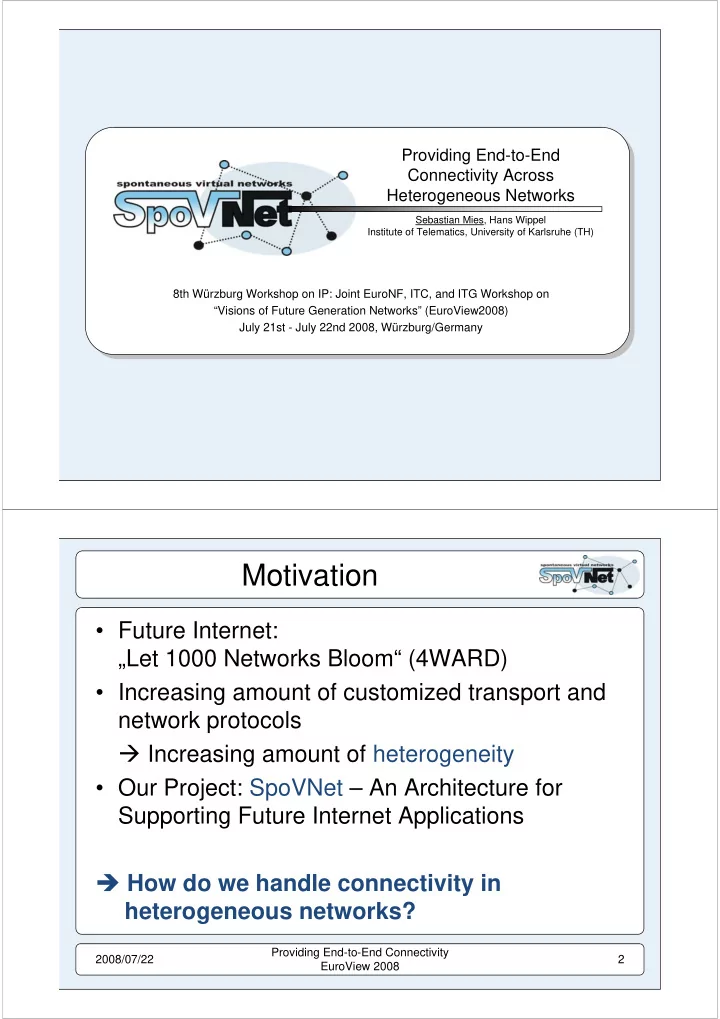
Motivation

  • Future Internet:

„Let 1000 Networks Bloom“ (4WARD)

  • Increasing amount of customized transport and

network protocols Increasing amount of heterogeneity

  • Our Project: SpoVNet – An Architecture for

Supporting Future Internet Applications How do we handle connectivity in heterogeneous networks?

slide-2
SLIDE 2

2008/07/22 Providing End-to-End Connectivity EuroView 2008 3

SpoVNet in a Nutshell

  • Extensible set of services implemented

by overlays

– Spontaneous and flexible per application – No infrastructure support required – Self-organizing, scalable and robust

  • Differences to other

Overlay-based approaches?

– Framework provides generic (transport-)mechanisms for convenient realization of overlay-based services and innovative applications – Optimization and adaptivity using cross-layer-Information

Fixed Cell

WLAN Hotspot

IPv6 IPv4 IPv4 IPv6 IPv4 IPv4 IPv4 Base Overlay Service Overlay 1 Service Overlay 2

2008/07/22 Providing End-to-End Connectivity EuroView 2008 4

SpoVNet Architecture

provides a framework that

1) allows comfortable creation of application supporting (overlay-)services in heterogeneous networks (e.g., multicast) 2) assures that these services can be incrementally replaced by evolving underlay services (e.g., IP multicast, QoS support)

Underlay Application Service abstraction Underlay abstraction SpoVNet base SpoVNet services

Facilitates comfortable creation of new services New Service Allows to replace SpoVNet services with underlay services

Service

slide-3
SLIDE 3

2008/07/22 Providing End-to-End Connectivity EuroView 2008 5

SpoVNet Underlay Abstraction

  • Provides generic transport mechanisms hiding

mobility, multi-homing and heterogeneity

SpoVNet Base Base Overlay Base Communication Link Layer IPv4 Services UDP TCP SCTP IPv6 Underlay abstraction

WLAN 802.3 UTRAN HSDPA

1x per Device 1x per Application

  • ID-based addressing
  • ID/Locator mapping
  • Robust connectivity
  • operates on locator sets
  • ID agnostic
  • provides/maintains

direct transport links between nodes 2008/07/22 Providing End-to-End Connectivity EuroView 2008 6

Connectivity

Fixed Cell

WLAN Hotspot

IPv4 – ISP A IPv6 – ISP B Sensor Network IPv4 – LAN Direct connectivity AD

Device C Device A Device D

Indirect connectivity AC Relay

Device B

Base Overlay

slide-4
SLIDE 4

2008/07/22 Providing End-to-End Connectivity EuroView 2008 7

Connectivity domain Z Connectivity domain Y Connectivity domain X

Connectivity Domains

Fixed Cell

WLAN Hotspot

IPv4 – ISP A IPv6 – ISP B Sensor Network IPv4 – LAN

Device C Device A Device D Device B

2008/07/22 Providing End-to-End Connectivity EuroView 2008 8

Connectivity Domains

  • Problem outline

– Detect connectivity domains and relays – Establish links across connectivity domains – Consider partitioning and merging

  • Our first solution

– Identification of connectivity domains with probabilistically unique identifiers – Detection of relays – Simple link state protocol finds relay paths

slide-5
SLIDE 5

2008/07/22 Providing End-to-End Connectivity EuroView 2008 9

Connectivity domain ID=0xa197a..

Detection Example

Fixed Cell

WLAN Hotspot

IPv4 – ISP A IPv6 – ISP B Sensor Network IPv4 – LAN

Device C Device A Device D Device B

Direct connection Choose ID 0xa197a…

2008/07/22 Providing End-to-End Connectivity EuroView 2008 10

Device E

Detection Example

Fixed Cell

WLAN Hotspot

IPv4 – ISP A IPv6 – ISP B Sensor Network IPv4 – LAN

Device C Device A Device D Device B

Connectivity domain ID=0xa197a.. Connectivity domain ID=0xf9812.. Connectivity domain ID=0x19752.. Relay: 0xa197a..  0xf9812.. Routes: 0x19752... E Relay: 0xf9812..  0x19752.. Routes: 0xa197a.. B Relay associations exchanged with gossiping

slide-6
SLIDE 6

2008/07/22 Providing End-to-End Connectivity EuroView 2008 11

Conclusion

  • First pragmatic approach allows

– Distributed detection of connectivity domains – Provides relay paths to each domain Provides end-to-end connectivity across heterogeneous networks!

  • Further work

– Algorithms to handle partitioning and merging – Optimization of relay paths with virtual coordinates

Thank you!

Questions?