Mosaicism Mosaicism Two different genotypes that developed from a - - PowerPoint PPT Presentation
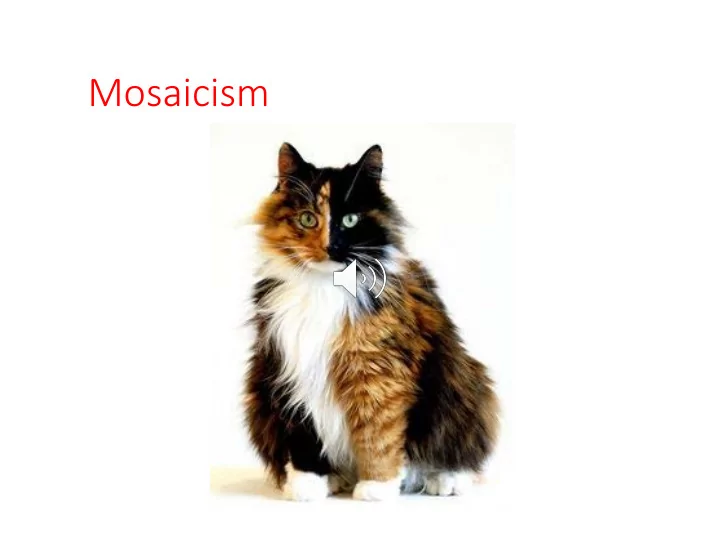
Mosaicism Mosaicism Two different genotypes that developed from a single fertilized egg Why? Event during cell division Chromosomal mutation during development Gene mutation during development (somatic) X-inactivation
Mosaicism
- Two different
genotypes that developed from a single fertilized egg
- Why?
- Event during cell
division
- Chromosomal mutation
during development
- Gene mutation during
development (somatic)
- X-inactivation (females)
Rudolf Happle, M.D.
- Well-renowned
pediatric dermatologist
- Professor in Marburg
and Freiburg
- Defined several
inherited dermatologic conditions
- Helped us understand
concepts in dermatology
The term mosaicism (somatic segregation)
- 1901 Rediscovery of Mendelian inheritance
- 1904 Valentin Häcker
- Mosaikbastarde: animals showing traits from both of
their parents in a mosaic pattern.
- 1913 Collins
- Variegated pattern in seeds of maize
Jumping Genes
- Investigated mosaic
patterns in maize
- Jumping genes
- Epigenetic mosaicism
Barbara McClintock
Happle R. Mosaicism in Human Skin
Incontinentia pigmenti
The pattern of lesions follows the lines of Blaschko. Also the areas of normal skin alternating with normal skin represent areas
- f random inactivation of x or X. Widukind Lenz described the
alternating lines as an example of X inactivation
Somatic mosaicism
- A postzygotic mutation CAN affect gonads,
therefore, an individual with type 1 segmental disease may have offsprings with non- segmental involvement!
Happle R. Mosaicism in Human Skin
Type 1 segmental involvement
- Tuberous sclerosis
Trauner MA. J Am Acad Dermatol 2003;49:S164-6
Type 2 segmental involvement
Pronounced manifestation in the background of milder diffuse manifestation
Ø Heterozygous embryo featuring loss of heterozygosity in the affected area
Examples include PTEN hamartoma syndrome
Genomic X-chromosome mosaicism in male patients Incontinentia pigmenti in males
- 46,XY males present with incontinentia
pigmenti (Bloch-Sulzberger syndrome) because
- f postzygotic X chromosome NEMO deletions
- The other explanation for males affected is
47,XXY karyotype
Patterns of skin involvement
- Lines of Blaschko
- Checkerboard pattern
- Phylloid pattern
- Patchy pattern without midline separation
- Lateralization pattern
- Sash-like pattern
Patterns of skin involvement
Happle R. Mosaicism in Human Ski
Epidermal nevus syndromes
Ep Epiderma rmal n nevu vus s s syndrome
- me
- Sporadic patients
- Cutaneous manifestations
- Skeletal manifestations
- Central nervous system manifestations
Ep Epiderma rmal n nevu vus s s syndrome
- me
- A syndrome that does not really exist!
- Schimmelpenning
- Sebaceous gland nevi, CNS anomalies, eye problems
- Νevus comedonicus
- Cataracts
- Pigmented and hairy nevus syndrome
- Becker nevus, chest hypoplasia, scoliosis
- Proteus syndrome
- Hamartomas
- CHILD syndrome
- Females, congenital hemidysplasia, ichthyosiform
erythroderma, limb defects