BIOE 301 Lecture 19 - - PDF document

bioe 301
SMART_READER_LITE
LIVE PREVIEW

BIOE 301 Lecture 19 - - PDF document

BIOE 301 Lecture 19 http://www.npr.org/templates/story/story.php?storyId= 1579643 Zantrex-3 One of the most popular weight loss supplements currently sold in the US One months supply: $50 http://www.intomyhealth.com/die Millions


slide-1
SLIDE 1

BIOE 301

Lecture 19

http://www.npr.org/templates/story/story.php?storyId= 1579643

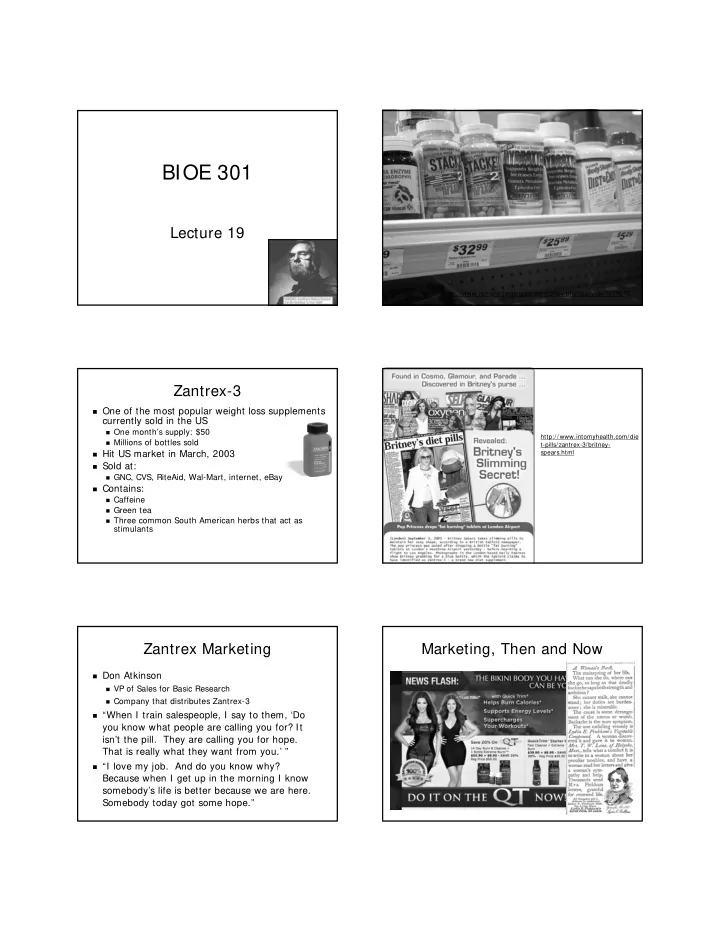
Zantrex-3

One of the most popular weight loss supplements

currently sold in the US

One month’s supply: $50 Millions of bottles sold

Hit US market in March, 2003 Sold at:

GNC, CVS, RiteAid, Wal-Mart, internet, eBay

Contains:

Caffeine Green tea Three common South American herbs that act as

stimulants

http://www.intomyhealth.com/die t-pills/zantrex-3/britney- spears.html

Zantrex Marketing

Don Atkinson

VP of Sales for Basic Research Company that distributes Zantrex-3

“When I train salespeople, I say to them, ‘Do

you know what people are calling you for? It isn’t the pill. They are calling you for hope. That is really what they want from you.’ ”

“I love my job. And do you know why?

Because when I get up in the morning I know somebody’s life is better because we are here. Somebody today got some hope.”

Marketing, Then and Now

slide-2
SLIDE 2

Benefits of Supplements

Vitamin C to prevent scurvy

Mid-18th century:

Scurvy killed more British sailors than war

Folic acid to prevent neural tube defects Calcium to prevent osteoporosis Vitamin B12 to prevent dementia Research in Alternative Medicine:

http://nccam.nih.gov/

History of Supplements

1793:

Patent legislation that permitted

manufacturers to protect their formulations

Did not require that they work

Early 1800s:

Number of newspapers in US published

increased dramatically

Early 1900s:

Patent-medicine business accounted for more

newspaper ads than any other kind of product

Lydia Pinkham’s Vegetable Compound

“A Positive Cure” for “all those Painful Complaints

and Weaknesses so common to our female population”

1914 AMA analyzed Pinkham’s compound

20% pure alcohol 80% pure vegetable extracts

Many supplements laced with:

Cocaine Caffeine Opium Morphine

http://www.lynximages.com/images3/lydia .jpg

History of Regulation

1906

First federal regulation of drugs Pure Food and Drug Act

1938

Food, Drug and Cosmetic Act

1962

Drug amendments to FD&C Act

1976

Medical Device Amendments to FD&C Act

1994:

Dietary Supplement Health & Education Act

History of Supplements

1906:

Pure Food and Drug Act Reaction to “The Jungle”

by Upton Sinclair

Permitted Bureau of

Chemistry to insure that labels contained no false

  • r misleading advertising

http://i.timeinc.net/time/magazine/arc hive/covers/1934/1101341022_400.jp g

1906

Pure Food and Drug Act

Label could not contain any statement

regarding therapeutic effect which is false and fraudulent

FDA could act only after drugs were

marketed

Was not enough to show that product did

not work

Had to show that seller knew the claims it

made were false

slide-3
SLIDE 3

History of Supplements

1937:

Sulfanilimide, antibiotic for streptococcal

infections, used safely as a pill for years

Most children can’t swallow pills One company in Tennessee found they could

dissolve drug in ethylene glycol (antifreeze)

Tested for flavor, appearance, fragrance, NOT

for toxicity

Shipped it all over the country Within weeks, scores of children were dead

Sulfanilimide

137 children died

Severe abdominal pain, nausea, vomiting,

convulsions

“Even the memory of her is mixed with

sorrow for we can see her little body tossing to and fro and hear that little voice screaming with pain and it seems as though it would drive me insane.”

Letter to FDR, from woman describing the

death of her child

History of Regulation

Food, Drug and Cosmetic Act - 1938

Gave FDA authority it needed to regulate such

products

New Drugs:

Could not be marketed without first notifying the

FDA and allowing agency time to assess safety

Beginning of era in which it is illegal to market a

new drug without FDA approval

Seller’s belief regarding product’s value was

no longer relevant

Issue – does the product really work?

History of Supplements

1940s-1960s:

Line between foods and drugs was fairly clear If manufacturers made a disease related claim

for a supplement, FDA would go after them

1970s:

Government started telling Americans to alter

diets if they wanted to have longer, healthier lives

Heart disease, diabetes, cancers eat less

salt, fat; add fiber, eat more fruits & vegetables

Kellogg’s All Bran

1984:

Launched campaign with NCI All-Bran cereal illustrated how low-fat, high-

fiber diet might reduce risk of certain cancers

http://www.kelloggs.com/brand/allbran/

1994: Dietary Supplement Health & Education Act

Congress deregulated supplement industry Companies are not required to prove products are effective

  • r even safe before marketing them

Companies CANNOT:

Blatantly lie Claim to have a cure for a specific disease (cancer, diabetes, AIDS)

Companies CAN say (without evidence):

Product is designed to support a healthy heart CardiAll Protect cells from damage Liverite Improve function of compromised immune system Resist

Almost no standards that regulate how pills are made Not tested once they are made
slide-4
SLIDE 4

Today

CANNOT mention disease CAN make claims that food can affect

structure or function of body

Examples:

CANNOT say that a product reduced

cholesterol but CAN say it maintains healthy cholesterol levels

CANNOT say echinacea cures disease, but

CAN say it has natural antibiotic activities and is considered an excellent herb for infections

  • f all kinds

Echinacea

One of the most commonly

used cold remedies in US

Clinical Trial:

400 children with common

colds over 4 months

Compared placebo to

echinacea

Placebo worked just as well Children taking echinacea

were more likely to develop a rash

http://www.kalyx.com/store/images/208 093.jpg

Ephedra

Was most popular supplement in US Brought in more than $1B/year 10% of supplement industry annual sales Risks of ephedra use (when used with caffeine):

Increased risk of heart attack, stroke, palpitations, anxiety,

psychosis, death

Steve Bechler

23 year old pitcher for Baltimore Orioles Died February, 2003 of heatstroke following taking an over-the-

counter product that contained ephedra http://www.npr.org/templates/story/story.php?s

toryId= 1576453

http://www.npr.org/templates/story/story.php?s

toryId= 11326842

Misfortune, disaster, & tragedy

Lead to reforms in drug and device regulation FDA

Regulates products whose annual sales account

for ¼ of consumer spending in US

Responsible for ensuring SAFETY and EFFICACY

  • f CHEMICAL, BIOLOGICAL agents and

sophisticated medical DEVICES

Safe:

Probable benefits to health for intended use outweigh

any probable risk of harm

Effective:

Device does what it is supposed to do in a reliable

fashion

1962

Drug Amendments to FD&C Act:

FDA must review evidence of drug safety and

effectiveness

Converted pre-market notification system into

pre-market approval system

Evidence of safety and efficacy must come

from well-controlled investigations by qualified experts

FDA has the authority to prevent harm

before it occurs

slide-5
SLIDE 5

Drug Approval Process

Pre-clinical testing (cell, animal) occurs first

Assess toxicity

Investigational New Drug (IND) Human clinical trials allowed with IND

Phase 1, 2, 3 clinical trials

Manufacturer files NDA (New Drug

Application) for permission to market new drug

Phases of Clinical Trials

Phase 1:

Goal: safety of compound Low doses administered to small group of

healthy volunteers

20-100 volunteers

Phase 2:

Goal: effectiveness of compound 100-300 patients who suffer from condition

Phase 3:

Final step before seeking FDA approval Randomized clinical trial

Post-Market Surveillance

Phase 4:

Study longer term effects of drug exposure Report adverse effects to FDA

Not Many Drugs Make It

For every 5,000-10,000 drugs that enter

pre-clinical testing

ONE makes it to market Average 15 years to develop one drug Cost of developing one new drug:

$360 million-$800 million

Oral Rehydration Therapy

Diarrhea – 2nd leading cause of death

under 5

1.5 million children per year Cause of death – dehydration Doesn’t treat diarrhea

slide-6
SLIDE 6

Story of ORT

Previously treated with IV fluid

Expensive, ineffective, dangerous

1950’s – anecdotal evidence by Dr.

Hemendra Chatterjee in India

Given no credibility, lack of controlled study or

mechanism for efficacy

Early 1960s’ – sodium-glucose cotransport

discovery

Sodium-glucose cotransport

Not affected by cholera or other diarrhea

causing diseases

Works DOWN the concentration gradient

Bangladesh Liberation War

Proved ORT was effective 3.6% death rate compared to 30% death

rate with IV fluid

LifeStraw

Vestegard Frandson Personal, portable, electricity free water

filter

100 micrometer mesh, 15 micrometer mesh,

iodine, activated carbon

Powered by suction Filters up to 700L water, about 1 year

supply

$2 Drawback – doesn’t kill giardia

PUR Purifier of Water

Procter and Gamble, brain child of Greg

Allgood

$0.10 per packet to treat 10L Uses treatment similar to water treatment

facilities

Bonus: cleans and disinfects turbid water