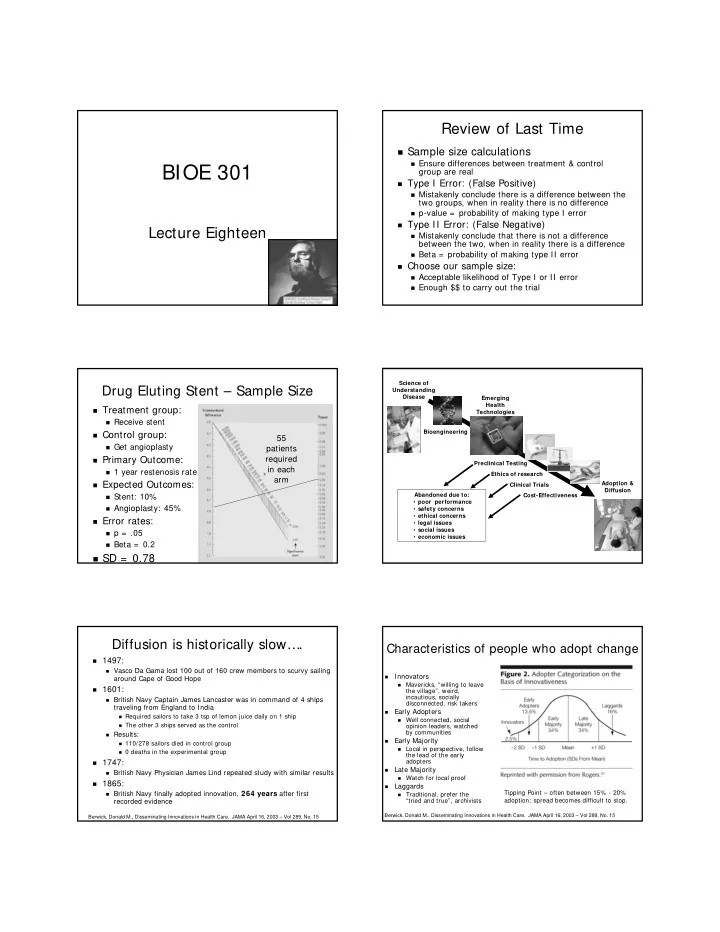

BIOE 301
Lecture Eighteen Review of Last Time
Sample size calculations
Ensure differences between treatment & control
group are real
Type I Error: (False Positive)
Mistakenly conclude there is a difference between the
two groups, when in reality there is no difference
p-value = probability of making type I error
Type II Error: (False Negative)
Mistakenly conclude that there is not a difference
between the two, when in reality there is a difference
Beta = probability of making type II error
Choose our sample size:
Acceptable likelihood of Type I or II error Enough $$ to carry out the trial
Drug Eluting Stent – Sample Size
Treatment group:
Receive stent
Control group:
Get angioplasty
Primary Outcome:
1 year restenosis rate
Expected Outcomes:
Stent: 10% Angioplasty: 45%
Error rates:
p = .05 Beta = 0.2
SD = 0.78 55 patients required in each arm
Science of Understanding Disease Emerging Health Technologies Preclinical Testing Clinical Trials Adoption & Diffusion Abandoned due to:
- poor performance
- safety concerns
- ethical concerns
- legal issues
- social issues
- economic issues
Bioengineering Ethics of research Cost-Effectiveness
Diffusion is historically slow….
1497:
Vasco Da Gama lost 100 out of 160 crew members to scurvy sailing
around Cape of Good Hope
1601:
British Navy Captain James Lancaster was in command of 4 ships
traveling from England to India
Required sailors to take 3 tsp of lemon juice daily on 1 ship The other 3 ships served as the control Results: 110/278 sailors died in control group 0 deaths in the experimental group
1747:
British Navy Physician James Lind repeated study with similar results
1865:
British Navy finally adopted innovation, 264 years after first
recorded evidence
Berwick, Donald M., Disseminating Innovations in Health Care. JAMA April 16, 2003 – Vol 289, No. 15
Characteristics of people who adopt change
- Innovators
- Mavericks, “willing to leave
the village”, weird, incautious, socially disconnected, risk takers
- Early Adopters
- Well connected, social
- pinion leaders, watched
by communities
- Early Majority
- Local in perspective, follow
the lead of the early adopters
- Late Majority
- Watch for local proof
- Laggards
- Traditional, prefer the
“tried and true”, archivists
Berwick, Donald M., Disseminating Innovations in Health Care. JAMA April 16, 2003 – Vol 289, No. 15
Tipping Point – often between 15% - 20% adoption; spread becomes difficult to stop.