SLIDE 1
More if-statments
SLIDE 2
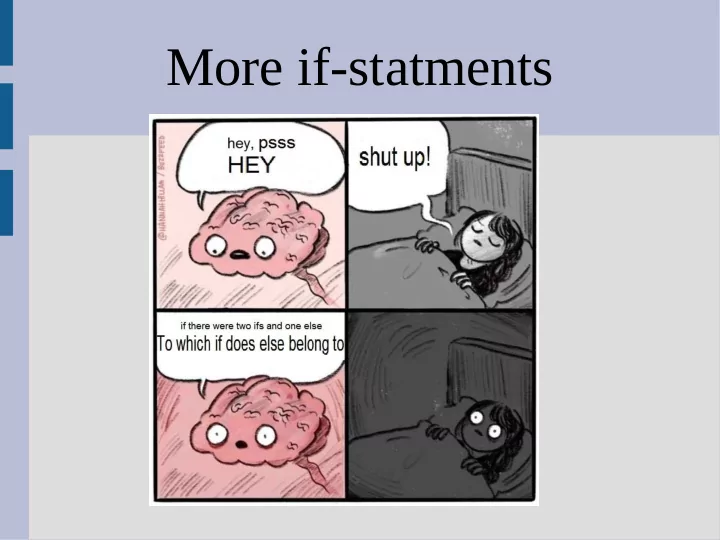
If... if... else!
(See: ifIfElse.cpp) When in doubt, use parenthesis and blocks! (Some people like to put the first brace after the if, others on a new line) What happens if you have an if if else?
SLIDE 3
Short-circuit evaluation
Short-circuit evaluation is when you have a complex bool expression (&& or ||) but you don't need to compute all parts. If this is false, then it will not check next (See: shortCircuit.cpp)
SLIDE 4
Short-circuit evaluation
Simple cases of short-circuit: When you have a bunch of ORs if( expression || exp || exp || exp ) Once it finds any true expression, if statement will be true When you have a bunch of ANDs if( expression && exp && exp && exp ) Once it finds any false expression, if statement will be false
SLIDE 5
Complex expressions
Be careful when negating, that you follow De Morgan's Law: bool a, b; !(a OR b) is equivalent to (!a) AND (!b) !(a AND b) is equivalent to (!a) OR (!b) “Neither rainy or sunny” means “Both not rain and not sunny”
SLIDE 6
Nested if statements
You can have as many if statements inside each other as you want.
SLIDE 7
Nested if statements
From a truth table perspective, nested loops are similar to AND The previous if code is equivalent to: However, sometimes you want to do other code between these evaluations
SLIDE 8
Nested if statements
(See: bridgeOfDeath.cpp)
SLIDE 9
Scope
Where a variable is visible is called its scope Typically variables only live inside the block (denoted with matching { and } ) A variable lives until the block is closed, so inner blocks can see everything from the block it was created inside
SLIDE 10
Scope
(See: scope.cpp)
SLIDE 11
Multiway if/else
This is a special format if you put an if statement after an else. (See: grades.cpp) This second “if statement” only is tested when the first “if statement” is not true
SLIDE 12
Switch
A switch statement checks to see if a variable has a specific value. Controlling Variable Case label Break statement
SLIDE 13
Switch
If the value of the controlling variable is found in a case label, all code until a break statement is ran (or the switch ends) Switch statements only test equality with case labels (not greater or less than) (See: switch.cpp)
SLIDE 14
Switch
Switch statements can be written as multiway if/else statements. (See: switchToIf.cpp) Could use just “if statements” but “else if” shows only one of these will run
SLIDE 15
Conditional operator
We will not use in this class, but if you use other people's code you will encounter Example: max = (x>y) ? x : y; (See: max.cpp) Shorthand for an if-else statement (boolean) ? [if true] : [if false]
SLIDE 16 if/else vs loops
if/else statements makes code inside
Loops make code inside run more than once Both use boolean expressions to determine if the code inside is run
SLIDE 17
while loop
A while loop tests a bool expression and will run until that expression is false (See: whileLoop.cpp) bool exp., no ;
SLIDE 18
while loop
The bool expression is tested when first entering the while loop And! When the end of the loop code is reached (the } to close the loop)
SLIDE 19
while loop
It can be helpful to manually work out what loops are doing and how variables change in each loop iteration This will build an insight into how loops work and will be beneficial when working with more complicated loops
SLIDE 20 while loop
3 parts to any (good) loop:
- Test variable initialized
- bool expression
- Test variable updated inside loop
SLIDE 21 for loop
A for loop is a compacted version of the while loop (the 3 important parts are together) for loops are used normally when iterating
- ver a sequence of numbers (i.e. 1, 2, 3, 4)
(See: forLoop.cpp) Initialization boolean expression Update
SLIDE 22
do-while loop
A do-while loop is similar to a normal while loop, except the bool expression is only tested at the end of the loop (not at the start) Note semicolon! (See: doWhile.cpp)
SLIDE 23
do-while loop
Q: Why would I ever want a do-while loop? A: When the first time the variable is set is inside the loop. You can initialize the variable correctly and use a normal while loop, but this makes the logic harder
SLIDE 24
Loops
99 bottles of beer on the wall, 99 bottles of beer! Take one down, pass it around, 98 bottles of beer on the wall! 98 bottles of beer on the wall, 98 bottles of beer! Take one down, pass it around, 97 bottles of beer on the wall! 97 bottles of beer on the wall, 97 bottles of beer! Take one down, pass it around, 96 bottles of beer on the wall! ... Write a program to output the above song (See 99beer.cpp)
SLIDE 25
continue
There are two commands that help control loops: continue tells the loop to start over again break stops the loop
SLIDE 26
continue
continue command can be issued to start at the next iteration of a loop doSkip true (See: continue.cpp)
SLIDE 27
SLIDE 28
break
break will exit the current loop (See: break.cpp)
doSkip true
SLIDE 29
Infinite loops
(See: countingSheep.cpp)
SLIDE 30
while loop
https://www.youtube.com/watch?v=7-Nl4JFDLOU
SLIDE 31
Loops to sum
Loops allow you to decide how many times a piece of code should run on the fly (i.e. at run time, not compile time) You can either directly prompt the user how many times or make a special value to “exit” on (See: sumLoop.cpp)
SLIDE 32 Debugging
When your program is not working, it is
- ften helpful to add cout commands
to find out what is going on Normally displaying the value of your variables will help you solve the issue Find up until the point where it works, then show all the values and see what is different than you expected