
Monitors Condition Variables
Otto J. Anshus University of {Tromsø, Oslo}
Monitor (Hoare 1974)
- Idea by Brinch-Hansen 1973 in the textbook “Operating
System Principles”
- Structure an OS into a set of modules each implementing a
resource scheduler
- Tony Hoare
– Combine together in each module
– Mutex – Shared data – Access methods to shared data – Condition synchronization – Local code and data
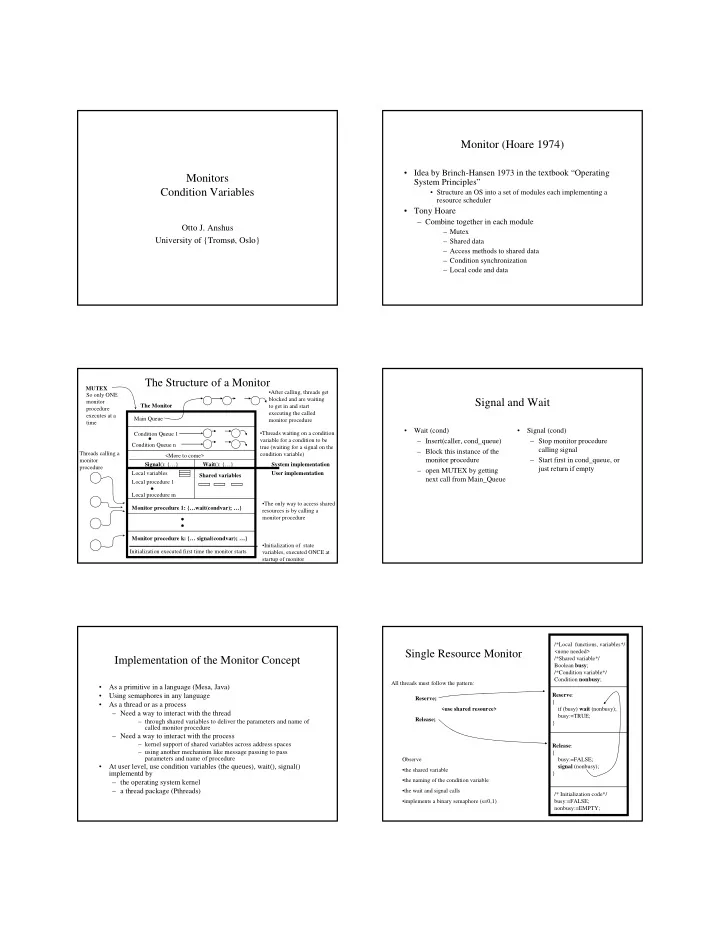
The Structure of a Monitor
- After calling, threads get
blocked and are waiting to get in and start executing the called monitor procedure Main Queue Condition Queue 1 Condition Queue n MUTEX
- Threads waiting on a condition
variable for a condition to be true (waiting for a signal on the condition variable) Local procedure 1 Local procedure m Local variables Shared variables Initialization executed first time the monitor starts
- Initialization of state
variables, executed ONCE at startup of monitor Monitor procedure k: {… signal(condvar); …} Monitor procedure 1: {…wait(condvar); …} Threads calling a monitor procedure <More to come>
- The only way to access shared
resources is by calling a monitor procedure So only ONE monitor procedure executes at a time The Monitor Signal(): {…} Wait(): {…} System implementation User implementation
Signal and Wait
- Wait (cond)
– Insert(caller, cond_queue) – Block this instance of the monitor procedure – open MUTEX by getting next call from Main_Queue
- Signal (cond)
– Stop monitor procedure calling signal – Start first in cond_queue, or just return if empty
Implementation of the Monitor Concept
- As a primitive in a language (Mesa, Java)
- Using semaphores in any language
- As a thread or as a process
– Need a way to interact with the thread
– through shared variables to deliver the parameters and name of called monitor procedure
– Need a way to interact with the process
– kernel support of shared variables across address spaces – using another mechanism like message passing to pass parameters and name of procedure
- At user level, use condition variables (the queues), wait(), signal()
implementd by – the operating system kernel – a thread package (Pthreads)
Single Resource Monitor
Reserve; <use shared resource> Release; Reserve: { if (busy) wait (nonbusy); busy:=TRUE; } /*Local functions, variables*/ <none needed> /*Shared variable*/ Boolean busy; /*Condition variable*/ Condition nonbusy; Release: { busy:=FALSE; signal (nonbusy); } /* Initialization code*/ busy:=FALSE; nonbusy:=EMPTY; All threads must follow the pattern: Observe
- the shared variable
- the naming of the condition variable
- the wait and signal calls
- implements a binary semaphore (s=0,1)