SLIDE 1 Moment and couple
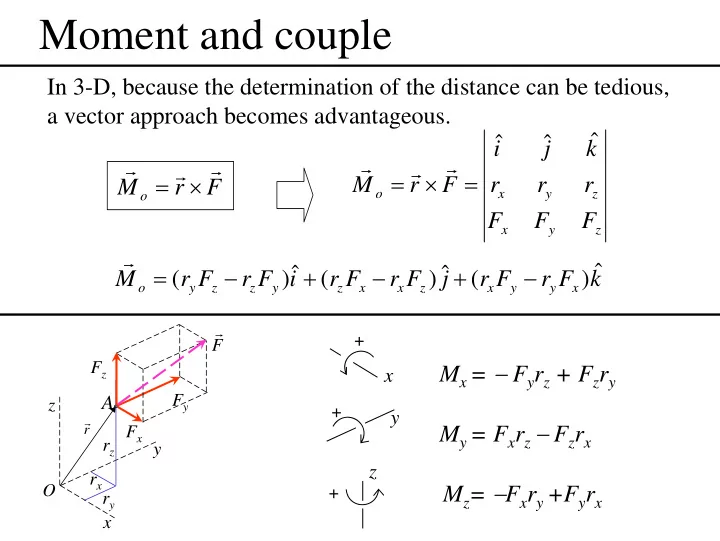
In 3-D, because the determination of the distance can be tedious, a vector approach becomes advantageous.
z y x z y x
F F r r r k j i F r M ˆ ˆ ˆ = × = r r r k F r F r j F r F r i F r F r M
x y y x z x x z y z z y
) ( ˆ ) ( ˆ ) ( − + − + − = r F r M o r r r × = Mx = − Fyrz + Fzry
+
x y
+
z
+
My = Fxrz − Fzrx Mz= −Fxry +Fyrx
x y z
r r
O
A
F r rz Fx Fy rxry Fz
SLIDE 2 Moment about an arbitrary axis
O
O
M r
r r F r
n ˆ
λ
λ
M r
F r M o Find moment about λ axis r r r × =
- 2. Calculate projection of
moment on λ axis n n F r n n M M
O
ˆ ) ˆ ( ˆ ) ˆ ( ⋅ × = ⋅ = r r r r
λ
) ˆ ˆ ˆ .( ˆ ˆ ˆ ) ˆ ( k j i F F F r r r k j i n F r
z y x z y x
γ β α + + = ⋅ × r r γ β α γ β α
z y x z y x z y x z y x
F F F r r r F F F r r r = = k j i ˆ ˆ ˆ γ β α + +
SLIDE 3 Varignon’s Theorem
O
r
3
F r
A
1
F r
2
F r
...) ( ...
3 2 1 3 2 1
+ + + × = + × + × + × = F F F r F r F r F r M o r r r r r r r r r r r ) (∑ × = F r r r
- Sum of the moments of a system
- f concurrent forces about a given
point equals the moment of their sum about the same point
R r F r M o r r r r r × = × = ∑ ) (
SLIDE 4 Couples(1)
O
F r
F r −
A
r r
B
r r
r r
A B M r d
F r r F r F r M
B A B A
r r r r r r r r × − = − × + × = ) ( ) (
- Couple is a moment produced by
two force of equal magnitude but
F r M r r r × =
- = vector from any point on the line of action of to any
point on the line of action of
- Moment of a couple is the same about all point Couple may be
represented as a free vector.
- Direction: normal to the plane of the two forces (right hand rule)
- Recall: Moment of force about a point is a sliding vector.
F r F r − r r
SLIDE 5 1
F r
2
F r
2
F r −
1
F r −
2
M r
1
M r
1
M r
2
M r F r M r F r −
Couples(2)
[Couple from F1]+[Couple from F2] = [Couple from F1+F2] couples are free vector. the line of action
- r point of action are not needed!!!
SLIDE 6 Force – couple systems
No changes in the net external effects
A B
F r
A B
F r
A B
F r F r F r − r r F r M r r r × =
- = Moment of about point B
- is a vector start from point B to any point on the line of
action of F r M r r r × = F r r r F r Couple
SLIDE 7
Sample 1
A Tension T of magnitude 10 kN is applied to the cable attached to the top A of the rigid mast and secured to the ground at B. Determine the moment Mz of T about the z-axis passing through the base O.
SLIDE 8
Sample 2
Determine the magnitude and direction of the couple M which will replace the two given couples and still produce the same external effect on the block. Specify the two force F and –F, applied in the two faces of the block parallel to the y-z plane, which may replace the four given forces. The 30-N forces act parallel to the y-z plane.
SLIDE 9 Sample 3
A force of 400 N is applied at A to the handle of the control lever which is attached to the fixed shaft OB. In determining the effect
- f the force on the shaft at a cross section such as that at O, we
may replace the force by an equivalent force at O and a couple. Describe this couple as a vector M.
SLIDE 10
Sample 4
If the magnitude of the moment of F about line CD is 50 Nm, determine the magnitude of F.
SLIDE 11
Sample 5
Tension in cable AB is 143.4 N. Determine the moment about the x-axis of this tension force acting on point A . Compare your result to the moment of the weight W of the 15-kg uniform plate about the x-axis. What is the moment of the tension force acting at A about line OB
SLIDE 12 Summary (Force-Moment 3-D)
Force
- 1. Determine coordinate
- 2. Determine unit vector
- 3. Force can be calculate
Angle between force and x-,y-,z-axis
- 1. Force = Fxi + Fyj + Fzk
- 2. Determine amplitude of force F
- 3. cosθx = Fx/F, cosθy = Fy/F, cosθz = Fz/F
Angle between force and arbitrary axis
- 1. Determine unit vectors (nF, n)
- 2. cosθ = nF・ n
SLIDE 13 Summary (Force-Moment 3-D)
Vector method Moment about an arbitrary point O
- 1. Determine r and F
- 2. Cross vector
Moment about an arbitrary axis
- 1. Determine moment about any point on the axis MO
- 2. Determine unit vector of the axis n
- 3. Moment about the axis = MO・n
Angle between moment and axis Same as angle between force and axis Moment Consider to use vector method or scalar method
SLIDE 14 Resultants(1)
Select a point to find moment Replace forces with forces at point O + couples Add forces and couples vectorially to get the resultant force and moment Step1 Step2 Step3
∑
= + + + = F F F F R r r r r r ...
3 2 1
∑
× = + + + = ) ( ...
3 2 1
F r M M M M r r r r r r
SLIDE 15 Resultants(2)
2-D
A
F r
B A B
M=Fd
F r
F M v v ⊥ Force + couple can be replaced by a force F by changing the position of F. 3-D
R r
M r
O
1
M r
2
M r
R M v v ⊥
2
M2 and R can be replaced by one force R by changing the position of R. R M v v //
1
M1 can not be replaced
SLIDE 16
Wrench resultant(1)
M2=Rd
SLIDE 17
Wrench resultant(2)
2-D: All force systems can be represented with only one resultant force or couple 3-D: All force systems can be represented with a wrench resultant Wrench: resultant couple M parallel to the resultant force R
r r
SLIDE 18 Sample 6
Determine the resultant of the system of parallel forces which act
- n the plate. Solve with a vector approach.
SLIDE 19
Sample 7
Replace the two forces and the negative wrench by a single force R applied at A and the corresponding couple M.
SLIDE 20 Sample 8
Determine the wrench resultant of the three forces acting on the
- bracket. Calculate the coordinates of the point P in the x-y plane
through which the resultant force of the wrench acts. Also find the magnitude of the couple M of the wrench.
SLIDE 21 Sample 9
The resultant of the two forces and couple may be represented by a
- wrench. Determine the vector expression for the moment M of the
wrench and find the coordinates of the point P in the x-z plane through which the resultant force of the wrench passes