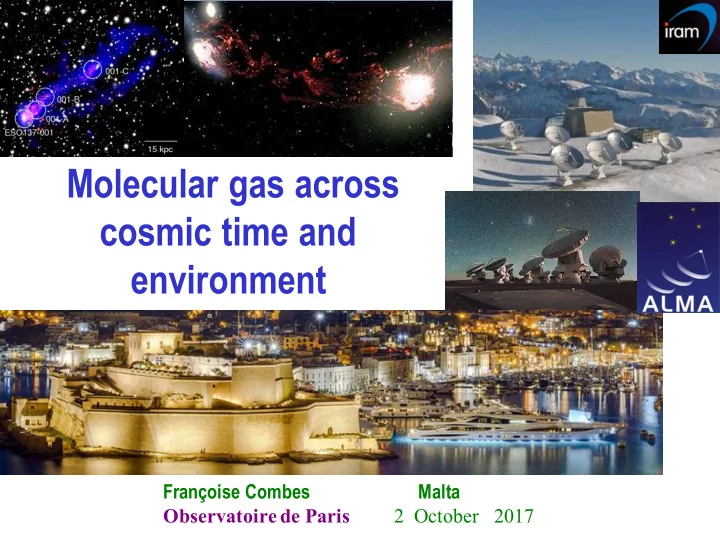
SLIDE 1 Françoise Combes Malta Observatoire de Paris 2 October 2017
Molecular gas across cosmic time and environment
SLIDE 2 Outline
1- Cosmic evolution of gas content 2- Evolution of Star Formation Efficiency 3- Physical processes of quenching 4- Environmental effects
(Mmol/M*)MS
SLIDE 3 Census of cold gas in galaxies
While 6% of baryons are in stars now (Fukugita et al 1998) Ω* ~ 3 10-3 the atomic gas HI in galaxies is ~10% (Zwaan et al 2005) ΩHI ~ 3.5 10-4 and the molecular gas, from CO (Sauty et al 2003, Keres et al 2003) ΩH2 ~ 1.2 10-4 The molecular fraction is expected to increase with z: Galaxy size ~ 1/(1+z), + Fgas higher: èDenser gas HI à H2 HIZELS, Thomson et al 2017 ΩH2 z
Popping
SLIDE 4
Cosmic evolution of H2
Walter et al, Decarli et al 2014: Deep PdBI obs of the HDF-N, 3mm Decarli et al 2016: ASPECS, ALMA of UDF in Bands 3 & 6 Evolution more contrasted then in models, factor 3-10 from M* function and fgas Maeda et al 2017
SLIDE 5 Madau & Dickinson 2014 Whitaker et al 2014
èGas fraction èStar formation efficiency Frequent mergers Shorter dynamical times Higher gas density èQuenching since z=1.7 Environment Morphology Mass
Why does SFR(z) increases?
M* SFR The main sequence
SLIDE 6 Large range of SF efficiency at high-z
In SMGs, starbursts tdep = 1/SFE ~10-100 Myr Massive BzK galaxies, CO sizes ~10kpc? L(FIR) ~1012 Lo « Normal » SFR, M(H2) ~ 2 1010 Mo tdep ~2 Gyr
Greve et al 2005, Daddi et al 2008
Low excitation, like MW è XCO 4.5 x that of ULIRGS SFE z
L(FIR)/L’CO T(depletion) Gyr
Starburst when gas concentrated in the center (nuclear SB) Caveat: XCO conversion ratio Requires high-J CO lines HCN, HCO+,, Dust emission, etc..
SLIDE 7
High SFE (starbursts) at z=1.4-3.2
Silverman et al 2015 CO det Herschel SFR(Mo/yr) M* (Mo) Herschel detected starbursts Galaxies from COSMOS, 300-800 Mo/yr, fgas 30-50% SFG, z=3.2 (COSMOS) Schinnerer et al 2017 Starburst SFR= 10x MS Tdep SFR z Tdep
SLIDE 8 PHIBSS-1 Project
Tacconi et al 2010, 2013 ~50 galaxies at z~2.3 and z~1.2 High detection rate >85%, in these « normal » massive Star Forming Galaxies (SFG) Gas content ~34% and 44% in average at z=1.2 and 2.3 resp. with L. Tacconi, R. Genzel,
- S. Garcia-Burillo, R. Neri, et al
SLIDE 9 Scaling relations, several samples
Tacconi et al 2017
Gas fraction increases regularly with z on the MS
(Mmol/M*)MS 2.8 slope
log(M*/Mo)=9.-11.8, δMS=SFR/SFR(MS) tdep ~ (1+z)-0.57 (δMS)-0.44 µ= Mmol/M* ~(1+z)2.8 (δMS)0.54 (M*)-0.34
SLIDE 10
Depletion time, CO or dust tracers
Genzel et al 2015 Tdep large variations quiescent-SB But slow variation on the MS
SLIDE 11 sSFR of disks?, slope ~0
Abramson et al 2014
DR4 different SFR estimation Overestimate in QG
SLIDE 12 More than B/T, the concentration (Sersic n)
The reason of sSFR/M* slope different from 0 èHigh-M galaxies have a much redder bulge Not for pseudo-bulges! Color(center) –Color(outer) low M* high M*
center
SLIDE 13
3- Quenching processes
Peng et al 2010 Mass Environment FAST (<~0.1 Gyr) èHeating the gas (transient) Turbulence by interactions, SF feedback Gas will dissipate, and SF come back èEjecting the gas present (transient) SN and AGN winds, radio jets SLOW (2-4 Gyr) èStabilising the gas: Morphological quenching, bulge formation èCutting the gas refueling: Gravity/halo quenching, Environment (harassment, strangulation, ram-pressure or tidal stripping..)
SLIDE 14
Galactic wind quenching
Sakamoto et al 2014 High-velocity wings in both nuclei! One nearly edge-on, the other face-on ALMA obs CO(3-2) Merger-induced Starburst: N3256 ULIRG z=0.01
SLIDE 15
Two bipolar flows, τ~ 1 Myr
Sakamoto et al 2014 Northern outflow: SF V > 750km/s, 60 Mo/yr Wide angle Southern outflow: AGN V ~2000km/s out to 300pc Ø50 Mo/yr ØHighly collimated Rate comparable to SFR èefficient quenching?
SLIDE 16 Molecular outflows
Mrk 231
AGN and also nuclear Starburst, 107-108Mo Outflow 700Mo/yr IRAM Ferruglio et al 2010 High density, HCN, HCO+, Aalto et al 2012 Blue wing Red wing On kpc scales, è affects the galaxy, quenches SF? dM/dt = 3v MOF/ROF ~1000 Mo/yr, (5xSFR) Kinetic power ~2 1044 erg/s è AGN
Cicone et al 2012
J1148 Z=6.4
Maiolino et al 2012
CO CII
SLIDE 17
AGN jet in the plane of N1068
Garcia-Burillo et al 2014 Black V=-50km/s White V=50km/s Outflow of 63Mo/yr About 10 times the SFR in this CMD region
SLIDE 18 Fueling BH and feedback in low-lum AGN
The smallest outflow detected AGN feedback V=100km/s, 7% of the mass MBH = 4 106Mo Flow momentum =10 LAGN/c
Combes et al 2013
Aalto et al 2015 N1377 precessing jet
SLIDE 19
Morphological Quenching (~5 Gyr)
Disks only are more unstable Bulges and central condensations stabilise disks Toomre parameter Q= σ/σcrit σcrit= 3.36 GΣ /κ Bulge increases κ, and Q If σ and Σ remains constant è Inside out quenching Martig et al 2009
SLIDE 20
Gravity quenching
Dekel & Birnboim 2005 Mh>1012Mo, shocks Mh<1012Mo Depends on halo mass (not galaxy) May stop the gas supply already in groups è red and dead R(kpc) T (Gyr)
SLIDE 21 4- Environmental effects
The reversal of the star formation-density relation? è Gas stripped in clusters at z=0 è A reversal is expected at z~1 Chung et al, VIVA with VLA Elbaz et al 2007
GOODS z=1
SFR Galaxies /Mpc2
SLIDE 22
Effects of mergers (major or minor)
Davies et al 2015 (GAMA) 300 000 galaxies, 20 000 pairs SF in general enhanced in major mergers However, suppressed in minor mergers, for the smallest companion èGas heating, stripping at the benefit of the primary Pair separation SFR All Major minor Low M High M secondary
SLIDE 23
Tides and ram-pressure
Both physical processes are acting, difficult to disentangle Vollmer et al 2005 Combes et al 1988 NGC 4438 & 4435 in Virgo First CO detections outside galaxy disks
SLIDE 24
CO detection in tidal dwarfs and tails
Braine et al 2000 A105 N2992 Aalto et al 2001 The Medusa Time-scales of the tail formation a few 100 Myr Time-scale of the bridge 50-100 Myr Time to form H2 clouds and new stars few 10Myr
SLIDE 25
Giant Hα tail in Virgo
Kenney+ 2008
SLIDE 26
Tail around M86 : H2 gas in hostile environment
Dasyra et al 2012 HI in grey Hα in blue 21 CO in red 107K ICM Survival during 100 Myr? MH2 =2 107Mo 10kpc South of M86 MH2 =7 106Mo 10kpc NE M86 In situ formation Or tail from N4438
SLIDE 27
Tidal tail N4388 – M86
Verdugo et al 2015 At 100kpc distance, 2 106Mo of H2 èFormation in situ of H2 Star formation enrich the ICM Low SFE, tdep ~500Gyr
SLIDE 28
Star formation efficiency
Verdugo et al 2015 Comparison with XUV disks Gas in tails, and far from disks have not enough pressure from stars And the gas surface density is not enough for fast HI to H2 transition ΣSFR Σgas
SLIDE 29
Importance of pressure
Blitz & Rosolowsky 2006 Shi, Helou et al 2011 The surface density of stars is very important for the SF efficiency The HI to H2 transituon is favored by external pressure Σgas Σstar ΣSFR/Σgas H2/HI
SLIDE 30
Ram-pressure in Norma cluster
Jachym et al 2014 Ram pressure in clusters: in general slow: In Virgo, HI deficient, but not H2 (Kenney & Young 1989) but can be fast in exceptional cases: ESO137-001
SLIDE 31 Ram-pressure quenching
Jachym et al 2014 Tail of 80kpc in X-ray gas, 40kpc in CO M(H2) in C =1.5 108Mo
molecular
A C B ΣSFR Σgas R(kpc)
SLIDE 32 Ram-pressure in Coma
Jachym et al 2016 D100 tail: thinner Last stage of stripping CO detected along, until 45kpc
MUSE Fumagalli et al 2014
R(kpc)
SLIDE 33
Centaurus A
SLIDE 34
Molecular gas in the shell
Red: CO, White: HI, FUV-Galex: black CO21, HI contours Hα map Salome et al 2016 H2 dominant at E, while HI at W
SLIDE 35
Star formation triggering
Salome et al 2016 The radio jet effectively triggers star formation in the shell along the jet è positive AGN feedback However, the SF efficiency is lower than in disks èNot enough pressure èTdep larger than a Hubble time
SLIDE 36 Role of mergers in starbursts
At low z, mergers trigger starbursts – The most energetic ULIRGs with highest SFE are all mergers (Sanders & Mirabel 1996) Mergers increase ~(1+z)4 (Lefevre et al, 2000, Lotz et al 2011) è How SFE varies with z? 60% gas 10% gas Due to high gas fraction, the number of clumps, violent instabilities, is already large in isolated galaxies at high z
Fensch et al 2017
SLIDE 37
Gas density PDF
Fgas = 10% Fgas = 60% No difference in the PDF for high gas fraction for isolated or interacting galaxies (Fensch et al 2017) Density threshold for star formation: 30 and 105 cm-3 to have SFR = 1Mo/yr and 60Mo/yr for isolated galaxies
SLIDE 38 Galaxy mergers with high gas content
Perret et al 2014
T=640 Myr Tperi No SFR difference with isolated case However: numerical effects? (temperature floor, depends on density)
SLIDE 39 Starbursts at high redshift z~ 2-3
z=3 z=2 Eddington limit tdep=20Myr MS, z=0 (tdep=2Gyr) Canameras et al 2016 Dust opacities κ=10, 30 cm2/g
Andrews & Thompson 2011
SLIDE 40
Conclusion
èGalaxies at high z have a larger gas fraction Whatever their position, on the MS or not èSFE vs z, small evolution on MS, larger for SB Depletion time 2 or 10 times smaller The starburst is triggered when the gas is concentrated (merger?) Diagnostics with CO excitation, Dense gas tracers (HCN, HCO+).. èSimulations show SF saturation at high z No influence of galaxy interactions, contrary to observations