Molar Solubility Le-Chatlier and Solubility Equilibrium Return to - - PDF document

molar solubility
SMART_READER_LITE
LIVE PREVIEW

Molar Solubility Le-Chatlier and Solubility Equilibrium Return to - - PDF document

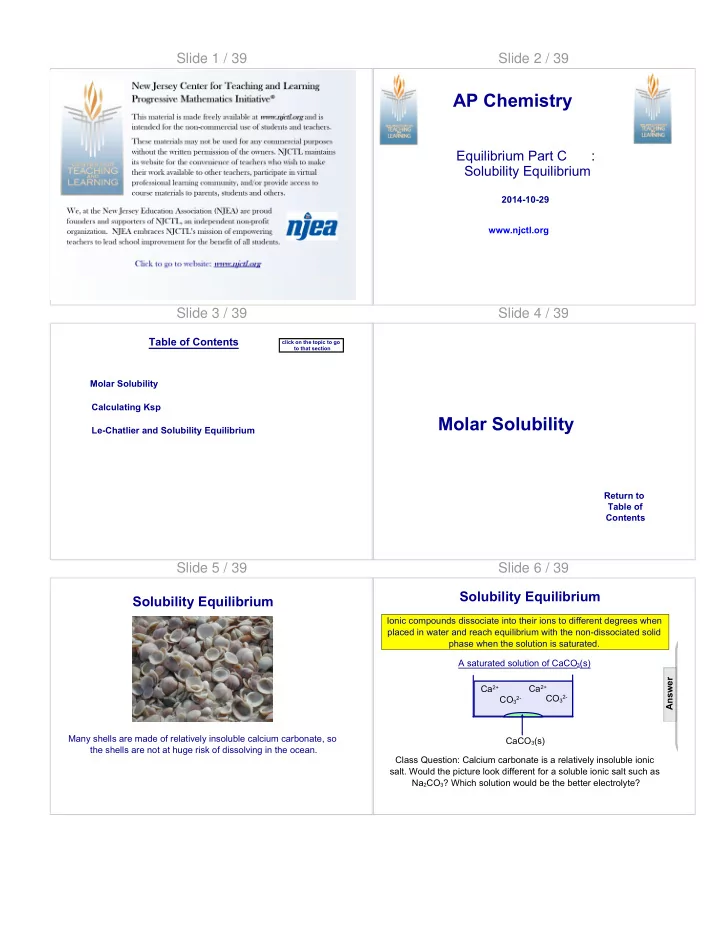
Slide 1 / 39 Slide 2 / 39 AP Chemistry Equilibrium Part C : Solubility Equilibrium 2014-10-29 www.njctl.org Slide 3 / 39 Slide 4 / 39 Table of Contents click on the topic to go to that section Molar Solubility Calculating Ksp Molar


slide-1
SLIDE 1

Slide 1 / 39 Slide 2 / 39

AP Chemistry

Equilibrium Part C : Solubility Equilibrium

www.njctl.org 2014-10-29

Slide 3 / 39

Table of Contents

click on the topic to go to that section

Molar Solubility Calculating Ksp Le-Chatlier and Solubility Equilibrium

Slide 4 / 39

Molar Solubility

Return to Table of Contents

Slide 5 / 39 Solubility Equilibrium

Many shells are made of relatively insoluble calcium carbonate, so the shells are not at huge risk of dissolving in the ocean.

Slide 6 / 39 Solubility Equilibrium

Ionic compounds dissociate into their ions to different degrees when placed in water and reach equilibrium with the non-dissociated solid phase when the solution is saturated. A saturated solution of CaCO3(s) CaCO3(s) Ca2+ Ca2+ CO32- CO32- Class Question: Calcium carbonate is a relatively insoluble ionic

  • salt. Would the picture look different for a soluble ionic salt such as

Na2CO3? Which solution would be the better electrolyte? Answer

slide-2
SLIDE 2

Slide 7 / 39

The degree to which an ionic compound dissociates in water can be determined by measuring it's "Ksp" or solubility product equilibrium constant.

Solubility Equilibrium

CaCO3(s) --> Ca2+(aq) + CO32-(aq) Ksp @ 25 C = 5.0 x 10⁻⁹ MgCO3(s) --> Mg2+(aq) + CO32-(aq) Ksp @ 25 C = 6.8 x 10⁻⁶ In both cases above, the equilibrium lies far to the left, meaning relatively few aqueous ions would be present in solution. Class Question: Which saturated solution above would have the higher conductivity and why? Answer

Slide 8 / 39 Molar Solubility

The molar solubility of an ionic salt is the molar equivalent (mol/L) of the solid that has dissociated into its ions. The molar solubility can be determined either by:

  • 1. Measuring the concentration of ions in solution directly
  • r by ...
  • 2. Using the equilibrium constant to first calculate the concentration
  • f ions and thereby use this to find the molar solubility.

Class Question: Using the Ksp values on the prior slide, which carbonate (MgCO3 or CaCO3) would have the higher molar solubility and why? Answer

Slide 9 / 39 Molar Solubility

Calculating the molar solubility from ion concentrations simply involves using stoichiometrical ratios. Example: What is the molar solubility of a saturated silver carbonate solution in which the [Ag+] = 2.4 x 10⁻⁸? Ag2CO3(s) --> 2Ag+(aq) + CO32-(aq) For every 2 silver ions in solution, 1 Ag2CO3 would have been required to dissociate. So... 2.4 x 10⁻⁸ M Ag+ x 1 M Ag2CO3 = 1.2 x 10⁻⁸ M 2 M Ag+ Class Question: What would one need to know to find the number of grams of silver carbonate that were dissolved? Then, explain how this would be calculated. Answer

Slide 10 / 39 Molar Solubility

Calculating the molar solubility from an equilibrium constant requires writing and using an equilibrium expression. Example: What is the molar solubility of a saturated aqueous solution of PbI2? (Ksp @25 C = 1.39 x 10⁻⁸) PbI2(s) --> Pb2+(aq) + 2I-(aq) Ksp = 1.39 x 10-8 = [Pb2+][I-]2 Since neither ion concentration is known, we will substitute "x" for the [Pb2+] and "2x" for the [I-]. 1.39 x 10-8 = (x)(2x)2 = 4x3 "x" = [Pb2+] = 1.51 x 10⁻³ M Since 1 Pb2+ required 1 PbI2, the molar solubility of the PbI2(s) = 1.51 x 10⁻³ M.

Slide 11 / 39

1 When 30 grams of NaCl are dissolved into 100 mL of distilled water, all of the solid NaCl has dissolved. The solution must be saturated and the Ksp for the NaCl must be very high. True False

Slide 11 (Answer) / 39

1 When 30 grams of NaCl are dissolved into 100 mL of distilled water, all of the solid NaCl has dissolved. The solution must be saturated and the Ksp for the NaCl must be very high. True False

[This object is a pull tab]

Answer B or D

slide-3
SLIDE 3

Slide 12 / 39

2 In two separate beakers with identical volumes of water, 10 grams of CuCO3 was added to beaker 1 and 10 grams

  • f PbCO3 was added to beaker 2. After stirring, the

contents of each beaker were poured through filter paper and dried. The mass of the the solid retained in the filter paper from beaker 1 was 9.995 grams while that from beaker 2 was 9.992 grams. It can be deduced that PbCO3 has the smaller Ksp. True False

Slide 12 (Answer) / 39

2 In two separate beakers with identical volumes of water, 10 grams of CuCO3 was added to beaker 1 and 10 grams

  • f PbCO3 was added to beaker 2. After stirring, the

contents of each beaker were poured through filter paper and dried. The mass of the the solid retained in the filter paper from beaker 1 was 9.995 grams while that from beaker 2 was 9.992 grams. It can be deduced that PbCO3 has the smaller Ksp. True False

[This object is a pull tab]

Answer False

Slide 13 / 39

3 Which of the following ionic salts would have the highest molar solubility? A NiCO3(s) Ksp = 6.61 x 10⁻⁹ B MnCO3(s) Ksp = 1.82 x 10⁻¹¹ C ZnCO3(s) Ksp = 1.45 x 10⁻¹¹ D Ag2CrO4(s) Ksp = 9.00 x 10⁻¹² E All have the same molar solubility

Slide 13 (Answer) / 39

3 Which of the following ionic salts would have the highest molar solubility? A NiCO3(s) Ksp = 6.61 x 10⁻⁹ B MnCO3(s) Ksp = 1.82 x 10⁻¹¹ C ZnCO3(s) Ksp = 1.45 x 10⁻¹¹ D Ag2CrO4(s) Ksp = 9.00 x 10⁻¹² E All have the same molar solubility

[This object is a pull tab]

Answer D

Slide 14 / 39

4 A student places 4.000 grams of PbI2(s) into distilled water to produce a 200.0 mL solution. After stirring, the student filters the solution and dries the solid. What would be expected mass of the solid PbI2 on the filter paper after drying?

Slide 14 (Answer) / 39

4 A student places 4.000 grams of PbI2(s) into distilled water to produce a 200.0 mL solution. After stirring, the student filters the solution and dries the solid. What would be expected mass of the solid PbI2 on the filter paper after drying?

[This object is a pull tab]

Answer 3.86 g

slide-4
SLIDE 4

Slide 15 / 39

5 The conductivity of a saturated solution of Ag2CO3 would be expected to be less than the conductivity of a saturated solution of CaCO3. True False

Slide 15 (Answer) / 39

5 The conductivity of a saturated solution of Ag2CO3 would be expected to be less than the conductivity of a saturated solution of CaCO3. True False

[This object is a pull tab]

Answer False

Slide 16 / 39

Calculating Ksp

Return to Table of Contents

Slide 17 / 39 Calculating Ksp

To find the Ksp, the concentrations of at least one of the ions must be known and an equilibrium expression must be used. Example: What is the Ksp of Fe(OH)3(s) if a saturated solution of it has a pH of 11.3? Fe(OH)3(s) --> Fe3+(aq) + 3OH-(aq) pH = 11.3 --> pOH = 2.7 --> [OH-] = 1.99 x 10⁻³ Ksp = [Fe3+][OH-]3 = (6.65 x 10⁻⁴)(1.99 x 10⁻³)3 = 5.24 x 10⁻¹² Note that the [Fe3+] is 1/3 that of the [OH-] Class Question: If an acid was added and reacted with some of the hydroxide ion, would the Ksp increase, decrease, or remain the same? Answer

Slide 18 / 39 Common Ion Effect

If one of the ions that is part of the solubility equilibria is either already present or added, the equilibria will shift accordingly thereby altering the equilibrium position. The pictures below represent MgCO3(s) being added to distilled water and to a solution that is 0.1 M Na2CO3. CO32- Na+ Na+ Distilled Water 0.1 M Na2CO3 MgCO3 MgCO3(s) --> Mg2+(aq) + CO32-(aq) MgCO3(s) --> Mg2+(aq) + CO32-(aq) The presence of the carbonate ion (common ion) in the 0.1 M Na2CO3 solution shifts the equilibria to the left, diminishing the solubility of the MgCO3.

Slide 19 / 39 Common Ion Effect

Finding the molar solubility when a common ion is present involves writing an equilibrium expression. Example: What is the molar solubility of AgI in a 0.041 M solution of MgI2? AgI(s) --> Ag+(aq) + I-(aq) Ksp (look-up) = 1.5 x 10-16 = [Ag+][I-] = [x][0.082 + x] Since the equilibria constant is so small, we will expect the change in the [I-] will be negligible compared to the amount already present. 1.5 x 10-16 = [x][0.082] x = [Ag+] = 1.83 x 10⁻¹⁵ M Since 1 AgI is needed to produce 1 Ag

+, the molar solubility of AgI

in this solution is 1.83 x 10⁻¹⁵ M.

slide-5
SLIDE 5

Slide 20 / 39 Common Ion Effect

Finding the molar solubility when a common ion is present involves writing an equilibrium expression. Class Question: If the solution were 0.041 M NaI as opposed to 0.041 M MgI2, how would the molar solubility be affected? Example: What is the molar solubility of AgI in a 0.041 M solution of MgI2? AgI(s) --> Ag+(aq) + I-(aq) Ksp (look-up) = 1.5 x 10-16 = [Ag+][I-] = [x][0.082 + x] Answer

Slide 21 / 39 Selective Precipitation

Ionic salts that share a common ion will require differing concentrations of that ion to form a precipitate. As a result, ions can be removed selectively from a solution. Consider a solution containing 0.3 M Ag+ and 0.3 M Pb2+. Both precipitate with chloride but require differing amounts of chloride as will be shown below. AgCl(s) --> Ag+(aq) + Cl-(aq) Ksp = 1.8 x 10⁻¹⁰ PbCl2(s) --> Pb2+(aq) + 2Cl-(aq) Ksp = 1.7 x 10⁻⁵

Slide 22 / 39 Selective Precipitation

Consider a solution containing 0.3 M Ag+ and 0.3 M Pb2+. Both precipitate with chloride but require differing amounts of chloride as will be shown below. AgCl(s) --> Ag+(aq) + Cl-(aq) Ksp = 1.8 x 10⁻¹⁰ PbCl2(s) --> Pb2+(aq) + 2Cl-(aq) Ksp = 1.7 x 10⁻⁵ Since AgCl is much less soluble, less Cl- will be needed to precipitate it. This can be calculated as shown below: [Cl-] needed to ppt. AgCl 1.8 x 10-10 = [0.3][Cl-] [Cl-] = 6.0 x 10⁻¹⁰ M [Cl-] needed to ppt. PbCl2 1.7 x 10-5 = [0.3][Cl-]2 [Cl-] = 7.5 x 10⁻³ M Since far less Cl- is needed to ppt. the AgCl, it can be precipitated and removed prior to precipitating PbCl2.

Slide 23 / 39

Selective Precipitation

Only salts with Ksp values differing by a few orders of magnitude can be selectively precipitated. The bigger the difference in Ksp's, the better. Example: A student has a solution that is 0.045 M Mg

2+(aq) and 0.045

M Ca2+(aq). They then attempt to selectively precipitate the ions by added sodium carbonate to the solution. What would be the concentration of Ca2+ when the Mg2+ begins to precipitate? MgCO3(s) --> Mg2+(aq) + CO32-(aq) Ksp = 6.0 x 10⁻⁶ 6.0 x 10-6 = [0.045][CO32-] [CO32-] = 1.33 x 10⁻⁴ M CaCO3(s) --> Ca2+(aq) + CO32-(aq) Ksp = 3.0 x 10⁻⁹ 3.0 x 10-9 = [Ca2+][1.33 x 10⁻⁴] [Ca2+] = 2.2 x 10⁻⁵ M

Note: The Ca2+ ion has been virtually entirely removed before the Mg2+ starts to precipitate, a good separation.

Slide 24 / 39

6 What is the Ksp of Ag2CrO4(s) if the chromate concentration in a saturated solution is 3.5 x 10⁻⁵ M?

Slide 24 (Answer) / 39

6 What is the Ksp of Ag2CrO4(s) if the chromate concentration in a saturated solution is 3.5 x 10⁻⁵ M?

[This object is a pull tab]

Answer 1.72 x 10⁻¹³
slide-6
SLIDE 6

Slide 25 / 39

7 A 1 L saturated solution of Cu(OH)

2 is filtered and the

filtrate is then reacted with 0.1 M HCl and it was found that 0.0042 L of the HCl was needed to reach the equivalence point. What is the Ksp of the Cu(OH)2?

Slide 25 (Answer) / 39

7 A 1 L saturated solution of Cu(OH)

2 is filtered and the

filtrate is then reacted with 0.1 M HCl and it was found that 0.0042 L of the HCl was needed to reach the equivalence point. What is the Ksp of the Cu(OH)2?

[This object is a pull tab]

Answer 3.7 x 10⁻¹¹

Slide 26 / 39

8 The molar solubility of BaSO4 would be higher when dissolved in a 0.3 M BaCl2 solution than in distilled water. True False

Slide 26 (Answer) / 39

8 The molar solubility of BaSO4 would be higher when dissolved in a 0.3 M BaCl2 solution than in distilled water. True False

[This object is a pull tab]

Answer False

Slide 27 / 39

9 The molar solubility of BaSO4 would be higher in a 0.3 M Na2SO4 than in a 0.3 M BaCl2 solution. True False

Slide 27 (Answer) / 39

9 The molar solubility of BaSO4 would be higher in a 0.3 M Na2SO4 than in a 0.3 M BaCl2 solution. True False

[This object is a pull tab]

Answer False

slide-7
SLIDE 7

Slide 28 / 39

10 Using a table of Ksp, predict which of the pairs of ions would be MOST difficult to separate by selective precipitation using hydroxide ions: A Cu2+ and Fe2+ B Fe2+ and Fe3+ C Fe3+ and Ag+ D Ag+ and Pb2+ E The Ksp values play no role in selective precipitation

Slide 28 (Answer) / 39

10 Using a table of Ksp, predict which of the pairs of ions would be MOST difficult to separate by selective precipitation using hydroxide ions: A Cu2+ and Fe2+ B Fe2+ and Fe3+ C Fe3+ and Ag+ D Ag+ and Pb2+ E The Ksp values play no role in selective precipitation

[This object is a pull tab]

Answer A

Slide 29 / 39

11 A student has a solution that is 0.087 M I- and 0.067 M Cl-. What concentration of Ag+ ions would be needed to first start to precipitate the I- AND the Cl-?

Slide 29 (Answer) / 39

11 A student has a solution that is 0.087 M I- and 0.067 M Cl-. What concentration of Ag+ ions would be needed to first start to precipitate the I- AND the Cl-?

[This object is a pull tab]

Answer I- = 9.77 x 10⁻¹⁶, Cl- = 2.53 x 10⁻⁹

Slide 30 / 39

12 Using the information from question 11, what would be the concentration of I- when the chloride ion starts to precipitate?

Slide 30 (Answer) / 39

12 Using the information from question 11, what would be the concentration of I- when the chloride ion starts to precipitate?

[This object is a pull tab]

Answer 3.35 x 10⁻⁸

slide-8
SLIDE 8

Slide 31 / 39

13 Salts with similar Ksp are easier to selectively precipitate than ones with significantly different Ksp values. True False

Slide 31 (Answer) / 39

13 Salts with similar Ksp are easier to selectively precipitate than ones with significantly different Ksp values. True False

[This object is a pull tab]

Answer False

Slide 32 / 39

Le-Chatlier and Solubility Equilibrium

Return to Table of Contents

Slide 33 / 39 Le-Chatelier and Solubility Equilibrium

As with any equilibria, changing the concentrations of reactants and products will shift the equilibrium but only changing the temperature will change the equilibrium constant. Common ways to shift solubility equilibria:

  • 1. Changing the temperature
  • 2. Removing an ion by precipitation
  • 3. Removing an ion by reacting it with an acid
  • 4. Increasing the concentration of an ion by adding it to

solution. Class Question: Why doesn't changing the concentration of an ion change the value of the Ksp? Answer

Slide 34 / 39 Le-Chatelier and Solubility Equilibrium

If two salts share a common ion, one salt can be made more soluble by having its common ion concentration diminished by the precipitation of the other salt Consider AgI(s) and AgBr(s) AgI(s) Ksp = 1.5 x 10⁻¹⁶ AgBr Ksp = 5.4 x 10⁻¹³ If one were to add NaI to a saturated solution of AgBr, the I- would preferentially precipitate with the Ag+, thereby dissolving the AgBr! Magic? No, just chemistry! AgBr(s) + I-(aq) --> AgI(s) + Br-(aq) Class Question: Could AgI be made more soluble be adding aqueous NaBr? Answer

Slide 35 / 39 Le-Chatelier and Solubility Equilibrium

Ionic salts with a weak base ion can be made more soluble in acidic solutions. CaCO3(s) + H+(aq) --> Ca2+(aq) + HCO3-(aq) In this case, the bicarbonate ion will react with a second proton and form carbonic acid which will decompose into CO2(g) and H2O(l). HCO3-(aq) + H+(aq) --> H2CO3(aq) --> CO2(g) + H2O(l) Being a gas, the carbon dioxide leaves and thus shifts the equilibrium farther to the right. This is the process that causes cave formation and the deterioration of limestone statues.

slide-9
SLIDE 9

Slide 36 / 39

14 When a saturated solution of Fe(OH)3 is prepared, the temperature of the solution increases. If the solution is cooled, the concentration of Fe3+ will increase and the Ksp will be unaffected. True False

Slide 36 (Answer) / 39

14 When a saturated solution of Fe(OH)3 is prepared, the temperature of the solution increases. If the solution is cooled, the concentration of Fe3+ will increase and the Ksp will be unaffected. True False

[This object is a pull tab]

Answer False

Slide 37 / 39

15 Which of the following would be TRUE if sodium carbonate were added to a saturated solution of MgCO3 (s): A The Ksp will decrease B The [Mg2+] will decrease C The conductivity of the solution will increase D Both A and B E None of these

Slide 37 (Answer) / 39

15 Which of the following would be TRUE if sodium carbonate were added to a saturated solution of MgCO3 (s): A The Ksp will decrease B The [Mg2+] will decrease C The conductivity of the solution will increase D Both A and B E None of these

[This object is a pull tab]

Answer B

Slide 38 / 39

16 Which of the following salts would be made appreciably more soluble if dissolved in acidic solution? A PbCl2 B CaSO4 C Cu(OH)2 D Hg2I2

Slide 38 (Answer) / 39

16 Which of the following salts would be made appreciably more soluble if dissolved in acidic solution? A PbCl2 B CaSO4 C Cu(OH)2 D Hg2I2

[This object is a pull tab]

Answer C

slide-10
SLIDE 10

Slide 39 / 39