Mol2Net-04 Structure-antimicrobial activity relationship of a series - - PDF document

mol2net 04
SMART_READER_LITE
LIVE PREVIEW

Mol2Net-04 Structure-antimicrobial activity relationship of a series - - PDF document

Mol2Net-04 , 2018 , BIOCHEMPHYS-01 (pages 1- x, type of paper, doi: xxx-xxxx http://sciforum.net/conference/mol2net-4 SciForum Mol2Net-04 Structure-antimicrobial activity relationship of a series of functionalized arylbenzothiazoles Fatma


slide-1
SLIDE 1

Mol2Net-04, 2018, BIOCHEMPHYS-01 (pages 1- x, type of paper, doi: xxx-xxxx http://sciforum.net/conference/mol2net-4

Mol2Net-04 Structure-antimicrobial activity relationship of a series of functionalized arylbenzothiazoles

Fatma Abdmouleh*1, 2, Mehdi El Arbi2, Maité Sylla-Iyarreta Veitía*1, Mamdouh Ben Ali2 and Clotilde Ferroud1

1 Equipe de Chimie Moléculaire, Laboratoire Génomique, bioinformatique et chimie moléculaire

GBCM, EA 7528, Conservatoire national des arts et métiers, 2 rue Conté, 75003, Paris France ; HESAM Université. maite.sylla@lecnam.net (M.S-IV), clotilde.ferroud@lecnam.net (C.F.)

2 Laboratoire de Biotechnologie Microbienne et d’Ingénierie des Enzymes (LBMIE). Centre de

Biotechnologie de Sfax, Université de Sfax. Route de Sidi Mansour Km 6, BP 1177, 3018 Sfax,

  • Tunisie. mehdi_arbi@yahoo.fr (M.E.); mamdouh.benali@cbs.rnrt.tn (M.B.)

* Author to whom correspondence should be addressed; E-Mail: maite.sylla@lecnam.net (M.S-IV), Tel.: +33-1-58 80 84 82, abdmouleh.fatma91@gmail.com (F.A) Received: / Accepted: / Published: Abstract: The antibacterial activity of a series of functionalized arylbenzothiazoles was investigated against Gram-positive pathogens including Staphylococcus aureus (ATCC 9144), Micrococcus luteus (LB14110), Salmonella enterica (NCTC 6017) and Gram-negative foodborne Pseudomonas aeruginosa (ATCC 9027), Escherichia coli (ATCC 8739). The antifungal activity was also evaluated against the

  • pportunistic pathogenic yeast Candida albicans (ATCC 2091). The results displayed that these

compounds exhibit a good antimicrobial activity compared with fusidic acid. The structure-antimicrobial activity relationships are also discussed. Keywords: arylbenzothiazoles, antibacterial activity, antifungal

  • 1. Introduction

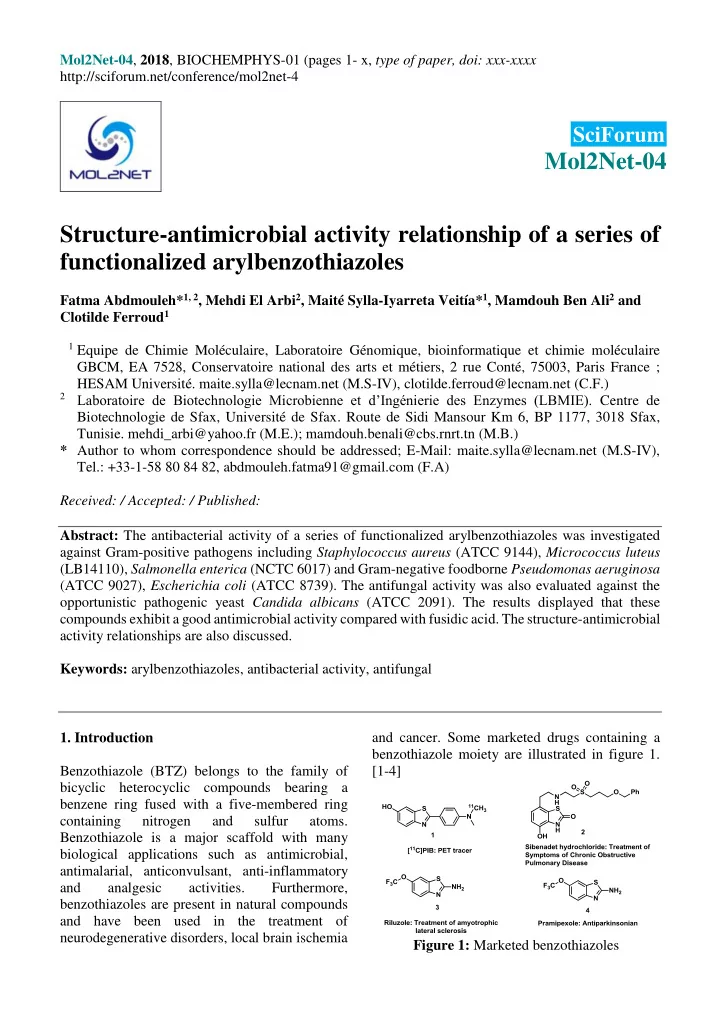
Benzothiazole (BTZ) belongs to the family of bicyclic heterocyclic compounds bearing a benzene ring fused with a five-membered ring containing nitrogen and sulfur atoms. Benzothiazole is a major scaffold with many biological applications such as antimicrobial, antimalarial, anticonvulsant, anti-inflammatory and analgesic activities. Furthermore, benzothiazoles are present in natural compounds and have been used in the treatment of neurodegenerative disorders, local brain ischemia and cancer. Some marketed drugs containing a benzothiazole moiety are illustrated in figure 1. [1-4] Figure 1: Marketed benzothiazoles

SciForum

slide-2
SLIDE 2

Mol2Net, 2018, 1(Section A, B, C, etc.), 1- x, type of paper, doi: xxx-xxxx 2 In 2013, encouraged by the high interest in [11C]PIB for research into the diagnosis of Alzheimer’s disease, we decided to develop a direct synthesis of the precursor 7 of [11C]PIB from commercially available reagents, by a Suzuki-Miyaura coupling reaction. We described a one-step cross-coupling reaction between unprotected 2-bromo-6-hydroxybenzothiazole 5 and 4-aminophenyl boronic acid pinacol ester 6 using Pd(dppf)Cl2.CH2Cl2 as catalyst leading to rapid and total conversion of the starting material without affecting the hydroxyl and amino groups (Scheme 1). [5] Scheme 1: Suzuki-Miyaura coupling reaction leading to the precursor 7 of the radiochemical tracer [11C]PIB 1. Inspired by the therapeutic potentialities of the benzothiazole scaffold, we are interested in studying the antibacterial and antifungal activity

  • f a series of arylbenzothiazoles previously

synthesized in our laboratory. We report herein the evaluation of the antibacterial activity of these arylbenzothiazoles using pathogens bacteria Gram positive and Gram negative. The antifungal activity against the opportunist yeast Candida Albicans is also described. The structure- antimicrobial activity relationships are also discussed.

  • 2. Results and Discussion

Biological studies Minimal Inhibitory Concentration (MIC) and Minimal Bactericidal Concentration (MBC) A series of functionalized arylbenzothiazoles was screened for antibacterial activity against Gram- positive and Gram-negative pathogens strains Micrococcus luteus, Staphylococcus aureus and Gram-negative strains Escherichia coli, Pseudomonas aeruginosa, and Salmonella enterica were used for inhibitory tests, using levofloxacin and fusidic acid, a broad-spectrum antibiotic, as a control. The minimal inhibitory concentration (MIC) and minimal bactericidal concentration (MBC) values are presented in Table 1. The MIC and MBC values for levofloxacin and fusidic acid were found to be < 1.52 µg/mL and ranging from 12.5 µg to 25 µg/mL. The functionalized aryl benzothiazoles showed a good antimicrobial activity. They seem to be more bacteriostatic than bactericidal, since the MBC/MIC ratio is greater than or equal to four (≥4). The obtained results are comparable with fusidic acid. Even if no significant difference in activity against Gram-positive or Gram-negative bacteria was observed, Gram-positive strains seem to be more sensitive than Gram-negative strains. Consequently, these results suggest a potential use against Gram-positive bacterial infections for these compounds particularly against Micrococcus luteus. As shown in Table 1 compound 7 displayed the best antimicrobial activity with MIC values between 6.25 to 12.5 µg/mL against Gram- positive pathogens Micrococcus luteus and Staphylococcus aureus. Gram-negative foodborne Pseudomonas aeruginosa, Escherichia coli, Salmonella enterica were also sensitive to compound 7 with MIC values between 12.25 and 25 μg/mL. In the evaluation of the antifungal activity against the opportunistic pathogenic yeast Candida albicans, compound 7 also showed the best activity with a MIC ranging between 12,5 to 25 µg/mL. These results suggest that combined functionalization of a hydroxyl group with an amino group has a positive influence on antibacterial and antifungal activity. When the hydroxy group of compound 7 is replaced by a methoxy group (compound 9) or a nitro group (compound 12), no difference in activity was observed against Micrococcus luteus (MIC values between 6.25-12.5). However, the antimicrobial activity decreases for most

  • pathogens. In addition, the introduction of amino

group (compound 14) doesn’t have a positive influence on the activity. These results could suggest that a hydroxy group may be required to

  • btain excellent antimicrobial activity.
slide-3
SLIDE 3

Mol2Net, 2018, 1(Section A, B, C, etc.), 1- x, type of paper, doi: xxx-xxxx 3 Table 1. Antimicrobial activities of a series of functionalized arylbenzothiazoles. Minimal inhibitory concentration (MIC) and minimal bactericidal concentration (MBC) in μg/mL.

  • 3. Materials and Methods

Experimental In vitro antibacterial activity Bacteria and growth conditions Microorganism growth inhibition assays were performed using LB (1% Bactotryptone, 0.5% Yeast extract, 0.5% NaCl) cultures of Gram- positive pathogens: Staphylococcus aureus (ATCC 9144), Micrococcus luteus (LB14110) and Gram-negative pathogens: Salmonella enterica (NCTC 6017), Pseudomonas aeruginosa (ATCC 9027), Escherichia coli (ATCC 8739). The antifungal activity was investigated against the opportunistic pathogenic yeast Candida albicans (ATCC 2091). Minimal Inhibitory Concentration (MIC) and Minimal Bactericidal Concentration (MBC) The synthesized compounds, dissolved in dimethylsulfoxide (DMSO), were tested in triplicate, using microplate dilution method. Minimal inhibitory concentrations (MICs) of compounds were determined according the National Committee for Clinical Laboratory

Cpd. Num R, Y Gram (+) Gram (-) Yeast

Micrococcus Staphylococcus

  • E. Coli

Pseudomonas Salmonella Candida

7 OH, NH2 MIC [6,25-12,5] [6,25-12,5] [12,5-25] [12,5-25] [12,5-25] [12,5-25] MBC 100 100 >100 >100 100 >100 8 OH, NO2 MIC [12,5-25] [12,5-25] [12,5-25] [25-50] [25-50] [25-50] MBC 100 >100 >100 >100 >100 >100 9 OMe, NH2 MIC [6,25-12,5] [25-50] [25-50] [25-50] [25-50] [25-50] MBC >100 >100 >100 >100 >100 >100 10 Me, NO2 MIC [6,25-12,5] [25-50] [12,5-25] [12,5-25] [25-50] [25-50] MBC >100 >100 >100 >100 >100 >100 11 OMe, NO2 MIC [6,25-12.5] [25-50] [12,5-25] [25-50] [50-100] [50-100] MBC >100 >100 100 >100 >100 >100 12 NO2, NH2 MIC [6.25-12.5] [12,5-25] [25-50] [12.5-25] [25-50] [25-50] MBC >100 >100 100 >100 50 100 13 NO2, NO2 MIC [6,25-12,5] [12,5-25] [25-50] [25-50] [25-50] [25-50] MBC >100 >100 >100 >100 >100 >100 14 NH2, NH2 MIC [12,5-25] [12,5-25] [12,5-25] [25-50] [25-50] [25-50] MBC 100 >100 >100 100 100 100

Levofloxacin

MIC <1,52 <1,52 <1,52 <1,52 <1,52 <1,52 MBC <1,52 <1,52 <1,52 <1,52 <1,52 <1,52

Fusidic acid

MIC [12.5-25] [12.5-25] [12.5-25] [12.5-25] [12.5-25] [12.5-25] MBC 100 100 >100 >100 >100 >100

slide-4
SLIDE 4

Mol2Net, 2015, 1(Section A, B, C, etc.), 1- x, type of paper, doi: xxx-xxxx 4 Standard (NCCLS, 2002). The test was performed in sterile 96-well microplates. Serial two fold dilutions of each sample to be evaluated were made to yield volumes of 100 μL per well with final concentrations ranging from 200 to 1,152 μg/mL. 100 μL of bacteria suspension with a concentration of 107 CFU/mL were added to each well. Negative control wells contained bacteria only in LB broth medium. After incubation at 37 °C for 20 h, the minimal inhibitory concentrations (MICs) were recorded as the lowest concentration of compound in the medium that showed no microbial growth. Then, 3-(4,5-dimethyl thiazol-2-yl)-2,5-diphenyl tetrazolium bromide (MTT) was added to the wells to facilitate reading of the plates. In case of microbial growth, MTT turns to blue, otherwise the medium remains yellow. Solvent medium and positive growth controls were also run

  • simultaneously. Then from each tube, one loopful

was cultured on plate count agar and incubated for 24 h at 30°C. The lowest concentration of the compound supporting no colony formation was defined as the MBC. Levofloxacin, a broad- spectrum antibiotic and fusidic acid, a narrow spectrum antibiotic were used as references. The inhibitory activity of the tested compounds was calculated according to the formula: IA (%) = 100−100 (OD 600 (x) / OD 600 (i)) where (x) is the microbial culture containing the inhibitor and (i) is the microbial culture without inhibitor.

  • 4. Conclusions

We discussed in this article the antibacterial and antifungal activity

  • f

a series

  • f
  • arylbenzothiazoles. The synthetized compounds

displayed a good antimicrobial activity and these results validate the potentialities

  • f

the benzothiazole scaffold in drug discovery process.

  • 5. Acknowledgments

We gratefully acknowledged Campus France (PHC UTIQUE 2017 37094WH) and the Tunisian Ministry of Higher Education and Scientific Research and Technology for financial support. Author Contributions All authors contributed to the drafting and revision of the article and approved the final version. Conflicts of Interest The authors declare no conflict of interest. References

  • 1. Gill, R. K., Rawal, R. K. et al. (2015). Recent

advances in the chemistry and biology of

  • benzothiazoles. Arch. Pharm. Chem. Life Sci. 348

: 155-178.

  • 2. Keri, R. S., Patil, M. R. et al. (2015). A

comprehensive review in current developments of benzothiazole-based molecules in medicinal

  • chemistry. Eur. J. Med. Chem. 89: 207-251.
  • 3. Pandey, D. D., Pal, D. (2013). Benzothiazole

– a potent pharmacophore in medicinal chemistry: a review. Int. J. Pham. Sci. Adv. 4: 84-93.

  • 3. Sharma, P. C., Sinhmar, A. (2013). Medicinal

significance of benzothiazole scaffold: an insight

  • view. J. Enzyme Inhib. Med. Chem. 28: 240-266.
  • 4. Bort G., Veitía, M. S.-I., et al. (2013).

Straightforward synthesis

  • f

PET tracer precursors used for the early diagnosis of Alzheimer’s disease through Suzuki–Miyaura cross-coupling reactions. Tetrahedron. 69: 7345- 7353.