Module 8: Evaluating Immune Correlates of Protection Instructors: - - PDF document

module 8
SMART_READER_LITE
LIVE PREVIEW

Module 8: Evaluating Immune Correlates of Protection Instructors: - - PDF document

6/30/2014 Module 8: Evaluating Immune Correlates of Protection Instructors: Ivan Chan, Peter Gilbert, Paul T. Edlefsen, Ying Huang Session 2: Introduction to Immune Correlates of Protection Summer Institute in Statistics and Modeling in


slide-1
SLIDE 1

6/30/2014 1

07/14-16/2014 • 1

Summer Institute in Statistics and Modeling in Infectious Diseases University of Washington, Department of Biostatistics

July 14-16, 2014

Module 8:

Evaluating Immune Correlates of Protection

Instructors: Ivan Chan, Peter Gilbert, Paul T. Edlefsen, Ying Huang

Session 2: Introduction to Immune Correlates of Protection

Course materials at: http://faculty.washington.edu/peterg/SISMID2014.html

07/14-16/2014 • 2

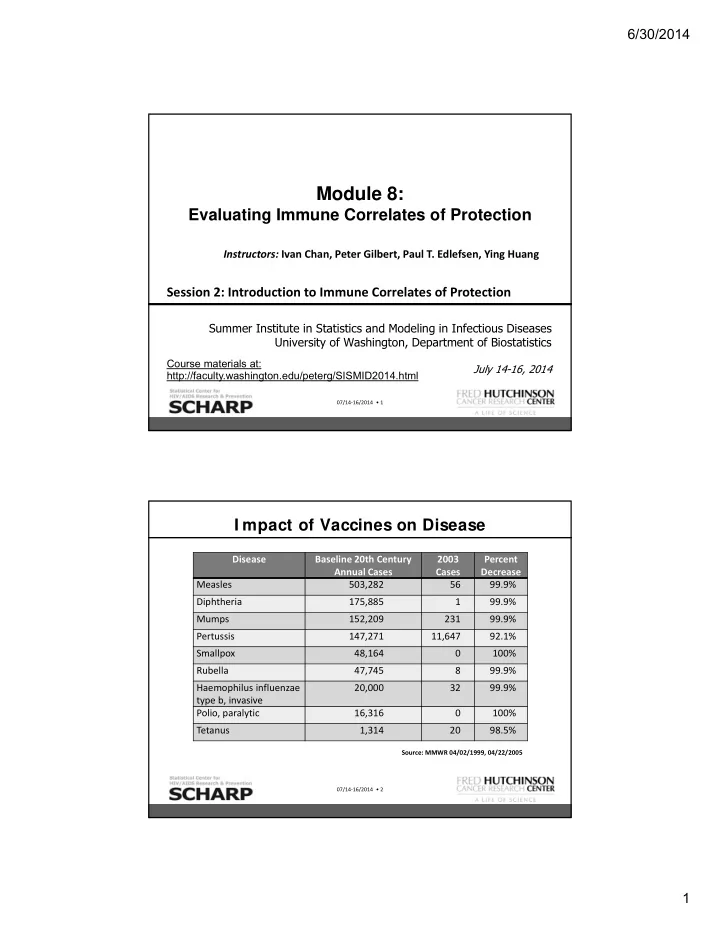
I mpact of Vaccines on Disease

Disease Baseline 20th Century Annual Cases 2003 Cases Percent Decrease Measles 503,282 56 99.9% Diphtheria 175,885 1 99.9% Mumps 152,209 231 99.9% Pertussis 147,271 11,647 92.1% Smallpox 48,164 100% Rubella 47,745 8 99.9% Haemophilus influenzae type b, invasive 20,000 32 99.9% Polio, paralytic 16,316 100% Tetanus 1,314 20 98.5%

Source: MMWR 04/02/1999, 04/22/2005

slide-2
SLIDE 2

6/30/2014 2

07/14-16/2014 • 3

I mpact of Vaccines on Disease

Disease Years to Develop Vaccine Typhoid 105 Haemophilus influenzae B 92 Pertussis 89 Measles 42 Polio 30 Hepatitis B 15 HIV 31 and counting

Source: Modified from H. Markel, NEJM, August 25, 2005

07/14-16/2014 • 4

Outline of Module 8

Session 1 (Chan) Introduction to Vaccines and Basic Concepts Session 2 (Gilbert) Introduction to Immune Correlates of Protection Session 3 (Chan) Evaluating Correlates of Protection using Individual, Population, and Titer-Specific Approaches Session 4 (Gilbert) Continuation of Session 2; plus Evaluating a Correlate of Risk (CoR) Session 5 (Chan) Use of Statistical Models in Assessing Correlates of Protection Session 6 (Edlefsen) Introduction to Sieve Analysis Session 7 (Gilbert) Thai Trial Case Study (Including Sieve Analysis) Session 8 (Chan) Validation using Prentice Criteria, Design Considerations Session 9 (Gilbert) Evaluating a Specific Correlate of Protection Part I (Gilbert and Hudgens, 2008) Session 10 (Huang) Evaluating a Specific Correlate of Protection Part II (Huang and Gilbert, 2011; Huang, Gilbert and Wolfson, 2013)

slide-3
SLIDE 3

6/30/2014 3

07/14-16/2014 • 5

Outline Session 2

  • 1. Introduction: Concepts and definitions of immune correlates
  • Two paradigms: Predictive correlates vs. mechanistic correlates
  • 2. Predictive correlates Tier 1: Correlate of Risk (CoR)
  • 3. Predictive correlates Tier 2: Specific Correlate of Protection (Specific CoP)
  • Statistical Surrogate (Prentice, 1989)
  • Principal Surrogate (Frangakis and Rubin, 2002)
  • 4. Predictive correlates Tier 3: General Correlate of Protection (Bridging CoP)
  • 5. Reconciling Immune Correlates Nomenclature
  • 6. Conclusions and Discussion

07/14-16/2014 • 6

Preventive Vaccine Efficacy Trial

  • Primary Objective

−Assess VE: Vaccine Efficacy to prevent infection or disease with a pathogen

  • Secondary Objective

−Assess vaccine-induced immune responses as “immune correlates of protection” against infection or disease Randomize Vaccine

Measure immune response

Follow for clinical endpoint (Infection or Disease)

Receive inoculations

Placebo

slide-4
SLIDE 4

6/30/2014 4

07/14-16/2014 • 7

I mportance of an I mmune Correlate

  • Finding an immune correlate is a central goal of vaccine research
  • One of the 14 ‘Grand Challenges of Global Health’ of the NIH & Gates

Foundation (for HIV, TB, Malaria)

  • Immune correlates useful for:
  • Shortening trials and reducing costs
  • Guiding iterative development of vaccines between basic and clinical

research

  • Guiding regulatory decisions
  • Guiding immunization policy
  • Bridging efficacy of a vaccine observed in a trial to a new setting

 Pearl (2011, International Journal of Biostatistics) suggests that bridging is the reason for a surrogate endpoint

Regulatory Agencies Typically set Thresholds of Protection for Guiding Vaccine Licensure (this slide from Former FDA CBER Director, Dr. Norman Baylor)

Vaccine Test Correlate of Protection Diphtheria Toxin Neutralization 0.01-0.1 IU/mL Hepatitis A ELISA 10 mIU/mL Hepatitis B ELISA 10 mIU/mL Hib Polysaccharides ELISA 1 mcg/mL Hib Conjugate ELISA 0.15 mcg/mL Influenza HAI 1/40 dilution Lyme ELISA 1100 EIA U/mL Measles Microneutralization 120 mIU/mL Pneumococcus ELISA (Opsonophagocytosis) 0.20-0.35 mcg/mL (for children); 1/8 dilution Polio Serum Neutralization 1/4 - 1/8 dilution Rabies Serum Neutralization 0.5 IU/mL Rubella Immunoprecipitation 10-15 mIU/mL Tetanus Toxin Neutralization 0.1 IU/mL Varicella Serum Neutralization; gb ELISA  1/64 dilution  5 IU/mL

Adapted from Plotkin S. Correlates of Vaccine Induced Immunity (Vaccines 2008:47)

slide-5
SLIDE 5

6/30/2014 5

07/14-16/2014 • 9

Hard to Rigorously I dentify I mmune Correlates: Knowledge Level about Correlates for Licensed Vaccines

Knowledge Level about Immunological Surrogate Endpoints for Licensed Vaccines None/Low Intermediate High

  • 1. Acellular Pertussis
  • 2. BCG Live
  • 3. Hepatitis A
  • 4. Japanese Encephalitis

Invactivated

  • 5. Poliovirus Inactivated
  • 6. Rotavirus
  • 7. Rubella Live
  • 8. Typhoid Live
  • 1. Anthrax
  • 2. Hepatitis B Recombinant
  • 3. Influenza Live
  • 4. Measles Live
  • 5. Mumps Live
  • 6. MMR
  • 7. Pneumococcal Polyvalent
  • 8. Smallpox
  • 1. Diphtheria & Tetanus Toxoids
  • 2. Haemophilus b Conjugate
  • 3. Meningococcal Polysaccharide

Diphtheria

  • 4. Rabies
  • 5. Tetanus & Diphtheria Toxoids
  • 6. Varicella Live
  • 7. Yellow Fever

07/14-16/2014 • 10

But What Exactly is an I mmune Correlate?

  • Confusion in the meaning of the terms: “Immune correlate,” “Correlate of

protection,” “Correlate of protective immunity”

  • Generally “immune correlate” is connected to the concept of a surrogate

endpoint, e.g. with definition: “A validated surrogate endpoint is an endpoint which allows prediction of a clinically important outcome.”

  • International Conference on Harmonization, document E8
  • What exactly does this mean?
  • Moreover, statistical methods for assessing the validity of surrogate

endpoints are surprisingly subtle and not widely understood

  • Many pitfalls for scientists to be misled about surrogate endpoints
slide-6
SLIDE 6

6/30/2014 6

07/14-16/2014 • 11

Outline of this Talk

  • This introductory talk will:
  • Clarify distinct concepts of “immune correlate”

 Two paradigms: Prediction vs. causal mechanism

  • Focus on the prediction paradigm:

 Define three types of immune correlates  For each type, summarize statistical frameworks for their assessment

  • Suggest how vaccine trials can be designed to improve the

evaluation and development of immune correlates

07/14-16/2014 • 12

Take Home Points

  • Important for the vaccine field to use a common nomenclature on

immune correlates

  • This talk will describe much of the existing nomenclature, and propose

a reconciliation

  • Participant characteristics that predict the immune responses of interest

are helpful for assessing immune correlates

  • Suggests expanding research to develop predictors of vaccine-

immunogenicity

  • Implications for study design (e.g., on sample collection and storage)

to ensure rigorous assessment of immune correlates

  • In efficacy trials, vaccinating placebo recipients at the end of follow-up

and measuring their immune responses can be helpful for assessing immune correlates

slide-7
SLIDE 7

6/30/2014 7

07/14-16/2014 • 13

Two Major Concepts/ Paradigms for Surrogacy

  • Causal agent paradigm (e.g., Plotkin, 2008, Clin Infect Dis)
  • Causal agent of protection = marker that mechanistically causes

vaccine efficacy against the clinical endpoint

  • Prediction paradigm (e.g., Qin et al., 2007, J Infect Dis)
  • Predictor of protection = marker that reliably predicts the level of

vaccine efficacy against the clinical endpoint

  • Both are extremely useful for vaccine development, but are assessed

using different approaches

  • For the goal of statistical assessment of surrogate endpoint validity in an

efficacy trial, the prediction paradigm is used

07/14-16/2014 • 14

A predictive correlate May or May Not be a Mechanism of Protection*

  • Informal Definition of a Surrogate: An endpoint that can be used to reliably

predict the vaccine effect on the clinical endpoint

  • Example: Meningococcal vaccine**
  • Mechanistic correlate: Bactericidal antibodies
  • Non-mechanistic correlate: Binding antibodies (ELISA)

Surrogate Endpoint (Predictor of Efficacy) Surrogate Endpoint (Predictor of Efficacy) Mechanistic correlate Mechanistic correlate Non-mechanistic correlate Non-mechanistic correlate

* Plotkin and Gilbert (2012 Clin Inf Dis) ** Borrow et al. (2005, Vaccine)

slide-8
SLIDE 8

6/30/2014 8

07/14-16/2014 • 15

Prediction Paradigm: Nested Hierarchy of I mmune Correlates Definitions (Qin et al., 2007, J I nfect Dis)

Definition Framework for Empiracal Assessment Correlate of Risk: Tier 1 The biomarker correlates with the clinical endpoint measuring vaccine efficacy Vaccine efficacy trials/ epidemiological studies Specific Surrogate

  • f Protection:

Tier 2 Vaccine effects on the biomarker predict vaccine efficacy, for the same setting as the efficacy trial Single large efficacy trial or multiple similar trials General Correlate

  • f Protection:

Tier 3 A specific CoP that reliably predicts vaccine efficacy in different settings (e.g., across vaccine lots, vaccine formulations, human populations, viral populations) Multiple diverse efficacy and/or post-licensure trials

  • Nomenclature:
  • Specific Surrogate = Specific CoP; General Surrogate = General CoP or Bridging CoP
  • Hierarchy in scientific importance and degree of data requirements for statistical

assessment

  • Bridging surrogates are for a particular new setting
  • E.g., new vaccine formulation, human population, viral population
  • Reliable prediction to one new setting may fail for a different new setting

07/14-16/2014 • 16

I mportance of Causal Agency for Credibility of Bridging Predictions of Vaccine Efficacy

  • A single efficacy trial can provide direct data for assessing CoRs and specific

surrogates, and perhaps supportive data for assessing causal agency, but typically provides few or no direct data for assessing bridging correlates

  • But, reliable bridging predictions is a central need for guiding research and

deployment

  • Knowledge of the causal mechanism(s) of protection is core for building the

rationale basis for bridging

Prediction Concepts Causal Agency Concepts Correlate of Risk (CoR) Specific CoP Specific Mechanistic CoP Bridging CoP Bridging Mechanistic CoP A single efficacy trial can provide empirical support The efficacy trial provides limited or no data
slide-9
SLIDE 9

6/30/2014 9

07/14-16/2014 • 17

Assessing a Mechanistic CoP

  • Many approaches outside of vaccine efficacy trials are

needed

  • Basic science
  • Understand specificity/functionality of biomarkers
  • Understand all the effects of vaccination (intended and unintended)
  • Understand the disease process
  • Laboratory validation studies
  • Understand measurement/variability characteristics of immune biomarkers
  • Causal manipulation studies in animal trials
  • Challenge efficacy trials comparing animals with and without induction of the

immune biomarker(s)

  • E.g., passive antibody transfer repeated low-dose challenge studies in

macaques

07/14-16/2014 • 18

Nesting of Correlate Definitions/ Concepts

Misleading for vaccine development: Does not predict clinical vaccine efficacy Useful for vaccine development: Predicts clinical vaccine efficacy CoR that is not a CoP CoP (Mechanistic) CoP (Non-mechanistic)

slide-10
SLIDE 10

6/30/2014 10

07/14-16/2014 • 19

Outline Session 2

  • 1. Introduction: Concepts and definitions of immune correlates/surrogate

endpoints

  • Two paradigms: predictive correlates vs. mechanistic correlates
  • 2. Predictive correlates Tier 1: Correlate of Risk (CoR)
  • 3. Predictive correlates Tier 2: Specific Correlate of Protection (Specific CoP)
  • Statistical Surrogate (Prentice, 1989)
  • Principal Surrogate (Frangakis and Rubin, 2002)
  • 4. Predictive correlates Tier 3: General Correlate of Protection (Bridging CoP)
  • 5. Reconciling Immune Correlates Nomenclature
  • 6. Conclusions and Discussion

07/14-16/2014 • 20

Tier 1: “Correlate of Risk” (CoR)

  • Definition: A correlate of risk (CoR) is an immunologic

measurement that predicts the rate of the clinical endpoint used to measure vaccine efficacy in some population

  • Example: Individuals with higher antibody titers have a lower

rate of pathogen-specific disease

  • In an observational study
  • In the vaccine group of a Phase III trial
  • In the placebo group of a Phase III trial
slide-11
SLIDE 11

6/30/2014 11

07/14-16/2014 • 21

In vaccine group assess several antibody response readouts including MN neutralization and MN/GNE8 CD4 blocking levels as predictors of HIV infection (Cox model) p = .026

Case-cohort design: Antibody data measured

  • n 239 infected/163

uninfected

*Gilbert et al., 2005,JID

Example 1. VaxGen 004 Phase I I I Trial: Assess Antibody Response Readouts as CoRs for HI V I nfection in the Vaccine Group*

07/14-16/2014 • 22

  • N = 1,776 men in an Army Service Unit at the University of Michigan
  • Evaluated a trivalent vaccine containing Weiss Strain A and PR8 Strain A
  • Men assigned vaccine or placebo based on alphabetical ordering of names

– Inoculations completed in 7 days

  • Strain-specific Ab titers to Weiss Strain A and to PR8 Strain A measured 2

weeks post-inoculation – Every 10th vaccinee and 5th placebo

  • Clinical endpoint = Hospitalization due to respiratory illness with a specific

influenza strain found in throat culture

  • Follow-up: Oct 25 1943 to Jan 1 1944

Example 2. 1943 I nfluenza Vaccine Field Trial (Salk, Menke, and Francis, 1945)

slide-12
SLIDE 12

6/30/2014 12

07/14-16/2014 • 23

Example 2. 1943 I nfluenza Vaccine Field Trial Distributions of Weiss Strain A Log Ab Titer

Placebo Group

Antibody Titer Percent

Vaccine Group

Antibody Titer Percent

07/14-16/2014 • 24

  • CoR Estimation
  • Estimate relationship between log Weiss strain A Ab titer and

clinical risk in the placebo group and in the vaccine group

Example 2. Ab Titer a CoR for Weiss Strain A- Specific Hospitalization

slide-13
SLIDE 13

6/30/2014 13

07/14-16/2014 • 25

“A Correlate Does not a Surrogate Make” Reasons Why CoRs Fail to be CoPs CoP = Valid or highly useful surrogate endpoint

− Tom Fleming

07/14-16/2014 • 26

A Perfect Surrogate is Mechanistic and Highly Predictive of the Vaccine Effect on the Clinical Endpoint

  • Assurance about surrogate validity requires a comprehensive

understanding of:

  • the biological processes leading to the clinical endpoint
  • the effects of vaccine on the surrogate and on the clinical endpoint
  • Understanding causal mechanism often leads to more predictive

correlates, but not necessarily

Vaccination Pathogen Exposure or Disease Surrogate Endpoint True Clinical Outcome

slide-14
SLIDE 14

6/30/2014 14

07/14-16/2014 • 27

Surrogate Failure Can Happen in Many Ways

  • 1. The biomarker is not in the pathway of the intervention's

effect, or is insensitive to its effect

  • 2. The biomarker is not in the causal pathway of the disease

process

  • 3. The intervention has mechanisms of action independent of

the disease process

07/14-16/2014 • 28

  • 1. The biomarker is not in the pathway of the intervention's

effect, or is insensitive to its effect

Reason for Surrogate Failure

Intervention Disease Biomarker Endpoint True Clinical Outcome

slide-15
SLIDE 15

6/30/2014 15

07/14-16/2014 • 29

  • If the tool for measuring the mechanism of protection has significant

measurement error, then the biomarker may fail to be a predictive correlate

  • A basic issue for developing surrogates is precision of estimation of the

biological function

  • Example 1: Seminal VL vs Plasma VL as surrogates for secondary

transmission

  • Seminal VL may be a mechanistic correlate
  • However, the seminal VL assay [qt-HIV assay (Gen-Probe)] has

greater intra-subject variability than the plasma VL assay

  • Plasma VL is a stronger predictor of transmission than seminal VL

(Butler, Little, et al., 2007, 2nd International Workshop on HIV Transmission)

Surrogate Failure Due to Measurement Error

07/14-16/2014 • 30

Surrogate Failure Due to Measurement Error

  • Example 2: iPrEX trial of oral PrEP (Grant et al., 2009, NEJM)
  • Trial showed that oral PrEP prevented HIV-1 infection (Estimated risk

reduction vs. placebo = 44%)

  • Secondary analysis supported that the protection was strongest in or

restricted to those adherent to oral PrEP

  • Self-reported adherence fails as a surrogate because of the high

degree of measurement error

  • Plasma drug levels may be a valid surrogate because they provide a

much more accurate indication of adherence

  • Defining marker variability (both biological and measurement error) is a

basic part of developing surrogates

slide-16
SLIDE 16

6/30/2014 16

07/14-16/2014 • 31

Reason for Surrogate Failure

  • 2. The biomarker is not in the causal pathway of the disease

process.

Disease Biomarker Endpoint True Clinical Outcome

07/14-16/2014 • 32

I llustration: VaxGen 004 Trial 1998-2003

Infection Biomarker Antibody Levels HIV Acquisition

The immune response is not in the causal pathway of HIV acquisition (antibodies only neutralize specific lab strains)

  • AIDSVAX:
  • Biomarkers: MN neutralization titers, CD4 blocking levels, binding

antibodies, ADCVI antibodies

VE 6% 95% CI (-24%, 17%)

slide-17
SLIDE 17

6/30/2014 17

07/14-16/2014 • 33

  • Antibody readouts are “mere markers” of infection risk- no

ability to predict VE

  • Vaccine recipients with lowest (highest) antibody titers had immune

systems less (more) able to naturally ward of infection

  • A third unmeasured factor (e.g., based on innate immunity/host

genetics) confounds the association between the potential surrogate and the clinical endpoint

  • Support for this explanation comes from a follow-up study of

the ability of vaccine recipient sera to neutralize 27 primary HIV-1 isolates sampled from VaxGen infected subjects

VaxGen 004 Trial: Antibody Readouts are I nverse CoRs But Do Not Predict VE

07/14-16/2014 • 34

HIV isolates from infected trial participants

VaxGen 004 Trial Example: Validation Study (Gilbert et al., 2010, JI D)

slide-18
SLIDE 18

6/30/2014 18

07/14-16/2014 • 35

HIV isolates from infected trial participants

VaxGen 004 Trial Example: Validation Study (Gilbert et al., 2010, JI D)

Conclusion: Absent or at best weak neutralization of circulating/exposing viruses supports that MN Neutralization is not a surrogate

07/14-16/2014 • 36

Reason for Surrogate Failure

  • 3. The intervention has mechanisms of action independent
  • f the disease process

Dotted lines = mechanisms of action that might exist Intervention Disease Biomarker Endpoint True Clinical Outcome

slide-19
SLIDE 19

6/30/2014 19

07/14-16/2014 • 37

Example 1: Acellular Pertussis Vaccines with Mechanisms

  • f Action I ndependent of the Disease Process*

(Sweden I Trial with DT control: 10,000 subjects)

  • Other relevant immune responses not captured by the assay (incomplete

measurement of Ab responses)

*Example from Tom Fleming

  • Biomarkers: Filamentous Haemagglutinin (FHA) and Pertussis Toxoid (PT)

antibody responses were superior with the SKB vaccine

Vaccine VE 95% SKB 58% (51%, 66%) Aventis Pasteur 85% (81%, 89%)

07/14-16/2014 • 38

Example 1: Acellular Pertussis Vaccines with Mechanisms

  • f Action I ndependent of the Disease Process

AP Vaccine Disease FHA & PT Antibodies Confirmed Pertussis

  • Other immune responses, including those resulting from additional

antigens in the vaccines:

  • Pertactin
  • Fimbriae (types 2 and 3)
slide-20
SLIDE 20

6/30/2014 20

07/14-16/2014 • 39

  • Encainide and flecainide in patients after a heart attack had a

promising effect on the putative surrogate Arrhythmia suppression

  • However, these drugs increased the rate of mortality

compared to placebo

  • Classic example of surrogate failure

Example 2: CAST Trial*

*Echt et al., 1991, New Engl J Med

07/14-16/2014 • 40

Example 3: AI DS Patients With MAI Bacteremia

Chaisson et al., 1994

Clarithromycin Dose (mg bid) 500 1000 2000 Bacterial Load 145 34 25

slide-21
SLIDE 21

6/30/2014 21

07/14-16/2014 • 41

Example 3: AI DS Patients With MAI Bacteremia

Clarithromycin Dose (mg bid) 500 1000 2000 Bacterial Load 145 34 25 12 week Mortality 5.7% 25.5% 28.0%

Chaisson et al., 1994

07/14-16/2014 • 42

CAST and MAI Bacteremia Studies I llustrate the ‘Surrogate Paradox’

  • Surrogate Paradox: Positive treatment effect on the surrogate, positive

association of the surrogate and clinical endpoints, but a negative overall clinical effect

  • For a vaccine trial, would mean that the vaccine induces an immune

response, vaccinees with higher responses have a lower infection rate (inverse CoR), but nonetheless VE < 0%

  • Causes of the Surrogate Paradox*
  • 1. [Confounding] Confounding of the association between the potential surrogate

and the clinical endpoint (failure reason 1)

  • 2. [Non-Transitivity] The vaccine positively affects both the surrogate and the

clinical endpoint, but for different sets of subjects (failure reason 2)

  • 3. [Off-Target Effects] The vaccine may have a negative clinical effect in ways not

involving the potential surrogate (failure reason 3)

*From Tyler Van der Weele

slide-22
SLIDE 22

6/30/2014 22

07/14-16/2014 • 43

“There is a plague on Man, the

  • pinion that he knows something.”

Michel de Montaigne (1580, Essays)

07/14-16/2014 • 44

“Medicine is something a doctor prescribes while waiting for nature to cure the disease.”

Voltaire (mid-18th Century)

slide-23
SLIDE 23

6/30/2014 23

07/14-16/2014 • 45

Outline Session 2

  • 1. Introduction: Concepts and definitions of immune correlates/surrogate

endpoints

  • Two paradigms: predictive correlates vs. mechanistic correlates
  • 2. Predictive correlates Tier 1: Correlate of Risk (CoR)
  • 3. Predictive correlates Tier 2: Specific Correlate of Protection (Specific CoP)
  • Statistical Surrogate (Prentice, 1989)
  • Principal Surrogate (Frangakis and Rubin, 2002)
  • 4. Predictive correlates Tier 3: General Correlate of Protection (Bridging CoP)
  • 5. Reconciling Immune Correlates Nomenclature
  • 6. Conclusions and Discussion

07/14-16/2014 • 46

Tier 2: Specific CoP

  • Consider evaluation of a candidate surrogate based on a single

efficacy trial

  • Definition: A specific surrogate of protection (specific CoP) is

an immunologic measurement such that vaccine effects on the marker reliably predict VE, for the same setting as the trial

  • E.g., subgroups with no vaccine-induced Ab response have no efficacy,

and subgroups with large vaccine-induced Ab response have large VE

  • 2 detailed definitions of a specific CoP- next slides
  • A specific CoP can reliably predict VE for identical or similar settings as

the vaccine trial

slide-24
SLIDE 24

6/30/2014 24

07/14-16/2014 • 47

Tier 2: Specific CoP

  • Connect the definition to the general definition of a valid

surrogate endpoint

  • International Conference on Harmonization's statement in

document E8: [More precisely, allows prediction of a treatment effect on a clinically important outcome/study endpoint]

“A validated surrogate endpoint is an endpoint which allows prediction of a clinically important outcome”

07/14-16/2014 • 48

Two Definitions of a Specific CoP

  • Statistical CoP [i.e., Statistical surrogate]
  • Prentice (1989, Stats Med) definition of a surrogate endpoint
  • Based on observed associations
  • 1. Principal CoP [i.e., Principal surrogate]
  • Builds on Frangakis and Rubin’s (2002) definition of a surrogate

endpoint

  • Based on potential outcomes framework for causal inference
slide-25
SLIDE 25

6/30/2014 25

07/14-16/2014 • 49

Prentice (1989, Statistics in Medicine) Criteria for a Statistical CoP

  • Definition: A statistical CoP is an immunologic measurement satisfying:

1. Vaccination impacts the immunological marker 2. The immunological marker is a CoR in each of the vaccine and placebo groups 3. The relationship between the immunological marker and the clinical endpoint rate is the same in the vaccine and placebo groups

  • I.e., after accounting for the marker, vaccine/placebo assignment

contains no information about clinical risk

  • Interpretation: All of the vaccine effect on the clinical endpoint is

mediated through the marker

07/14-16/2014 • 50

  • 98% retention of study participants
  • Incidence of Hospitalization with Weiss Strain A
  • Placebos:

75 of 888 (8.45%)

  • Vaccinees:

20 of 888 (2.25%)

Estimated VE = (1 – 2.25/8.45)×100% = 73%

  • Goal: Assess Weiss Strain A antibody titer as a statistical

CoP (check the 3 Prentice criteria)

Example 2. 1943 I nfluenza Vaccine Field Trial (Salk, Menke, and Francis, 1945)

slide-26
SLIDE 26

6/30/2014 26

07/14-16/2014 • 51

Criterion 1 Holds

  • Criterion 1: Weiss strain A

Ab titers are higher in the vaccine than placebo group

  • Criterion 1 holds 

Placebo Group Vaccine Group

Ab Titer Percent Percent

07/14-16/2014 • 52

Criterion 2 Holds*

  • Criterion 2: Weiss Strain A

Ab titers are inversely correlated with case rate in each study group

  • Criterion 2 holds 

*Based on logistic regression and on empirical fits

slide-27
SLIDE 27

6/30/2014 27

07/14-16/2014 • 53

Criterion 3 Holds*

*Based on logistic regression and on empirical fits

  • Criterion 3: Check for

consistency between CoR models in the vaccine and placebo groups

  • Same relationship of

antibody levels with the disease rate in the two groups

  • Criterion 3 holds 

07/14-16/2014 • 54

Criterion 3 Holds

Logistic Regression Models: Estimated Coefficients (SE)

  • As suggested by Model 3, vaccine assignment does not affect influenza

risk after controlling for log Ab titer

  • Criterion 3 holds

Control Group Only Control and Vaccine Groups Model 1 Model 2 Model 3 Model 4 Intercept 1.80 (0.54)

  • 2.38

(0.12) 1.62 (0.45) 1.80 (0.54) Log (Titer)

  • 1.30

(0.14)

  • 0.98

(0.12)

  • 1.03

(0.14) Trt

  • 1.39

(0.25) 0.33 (0.32)

  • 0.43

(1.28) Trt x log Titer

  • 0.16

(0.25)

Weiss Strain A

slide-28
SLIDE 28

6/30/2014 28

07/14-16/2014 • 55

Further Validation of a Statistical CoP: Estimated VE  Predicted VE

  • Direct estimate of VE (ignoring Ab

titer)

– Estimated VE = 73%

  • Predicted VE

– Based on the CoR model for the placebo group and the distribution of Ab titers in the vaccinated – Predicted VE = 82%

  • Conclusion: Log Weiss strain A

Ab titer satisfies the Prentice criteria for a statistical CoP

Placebo Group Vaccine Group

Ab Titer Percent Percent

07/14-16/2014 • 56

What about PR8 Strain A Ab titers?

Evaluate them as a CoR and a SoP for hospitalization with PR8 Strain A-specific influenza infection

slide-29
SLIDE 29

6/30/2014 29

07/14-16/2014 • 57

  • Incidence of Hospitalization with PR8 Strain A
  • Placebos:

73 of 888 (8.22%)

  • Vaccinees:

20 of 888 (2.25%) Estimated VE = (1 – 2.25/8.22)×100% = 73% (incidentally the same Estimated VE as for Weiss Strain A)

VE for PR8 Strain A

07/14-16/2014 • 58

Estimated Case Incidence as a Function of Log Ab Titer for Weiss and PR8 Strain A

slide-30
SLIDE 30

6/30/2014 30

07/14-16/2014 • 59

Logistic Regression Models: Estimated Coefficients (SE)

PR8 Strain A

Evidence that vaccination impacts PR8 Strain A hospitalization after accounting for Ab titer

Control Group Control and Vaccine Groups Model 1 Model 2 Model 3 Model 4 Intercept

  • 1.37

(0.59)

  • 2.41

(0.12) 1.27 (0.53)

  • 1.37

(0.59) Log (Titer)

  • 0.27

(0.15)

  • 0.29

(0.14)

  • 0.27

(0.15) Trt

  • 1.36

(0.26)

  • 0.89

(0.34)*

  • 0.22

(1.79) Trt*log Titer

  • 0.13

(0.34)

07/14-16/2014 • 60

Estimated and Predicted VE: PR8 Strain A

  • Direct estimate of VE (ignoring Ab titer)
  • Estimated VE = 73%
  • Predicted VE
  • Based on the CoR model for the placebo group and the distribution of

Ab titers in the vaccinated

  • Predicted VE = 33%
  • Full mediation condition for a statistical surrogate:
  • Log(Ab titer) does not satisfy criterion
  • Only ~½ of overall protective effect is predicted from effect on Ab

titer

slide-31
SLIDE 31

6/30/2014 31

07/14-16/2014 • 61

Weiss Strain A

Control Vaccine Risk Ab Titer

07/14-16/2014 • 62

Control Vaccine Risk Ab Titer Explained by CoR model Not explained by CoR model

PR8 Strain A

slide-32
SLIDE 32

6/30/2014 32

07/14-16/2014 • 63

Why Are PR8 Strain A Titers an I mperfect SoP?

  • Protection from PR8 Strain A only partly explained by PR8 Ab

titer

  • A possible explanation is that there are other protective immune

responses that were not measured

  • E.g., cell-mediated immune responses
  • Another is that PR8 Strain A has different protective determinants

than Weiss Strain A

  • Yet another is that PR8 Ab titer is a valid SoP, but there was residual

confounding in the regression assessment (more later)

07/14-16/2014 • 64

Challenges with the Statistical CoP Approach*

  • The immunologic measurement is a response to a pathogen-specific

protein or proteins

  • If trial participants have never been infected with the pathogen, the

immune response will be “non-response”/zero for (almost) all placebo recipients

  • No variation of the marker in the placebo arm implies:
  • CoR model in placebo group cannot be evaluated (Criterion 2)
  • Conceptually difficult to check Criterion 3 of “full mediation”

*This challenge discussed by Chan et al. (2002, Stats Med)

slide-33
SLIDE 33

6/30/2014 33

07/14-16/2014 • 65

Another Challenge with the Statistical CoP Approach

  • Checking “full mediation” entails checking, for each immune response

level s, equal clinical risk between the groups

  • {Vaccinees w/ marker level s} vs {Placebos w/ marker level s}
  • However, S is measured after randomization
  • Therefore this comparison may reflect selection bias, potentially

misleading about the markers’ value as a SoP

  • This limitation pointed out by Frangakis and Rubin (2002, Biometrics)

07/14-16/2014 • 66

I llustration of Post-randomization Selection Bias

  • Binary immunologic measurement (positive or negative)
  • Consider an unmeasured covariate reflecting strength of immune system

(strong or weak)

2000 Placebo N = 4000 2000 Vaccine 1000 Weak 10% w/ pos response 1000 Strong 90% w/ pos response 1000 Weak 0% w/ pos response 1000 Strong 0% w/ pos response

slide-34
SLIDE 34

6/30/2014 34

07/14-16/2014 • 67

Criterion for a Statistical CoP: Compares Apples and Oranges

{Vaccinees w/ neg response} vs {Placebos w/ neg response} compares clinical endpoint rates between the groups Placebo Negative Response

Weak Strong

Negative Response

Weak

Vaccine

Strong

Compares a group with 90% weak immune systems to one with 50% weak immune systems: Incomparable

07/14-16/2014 • 68

I mplicit Assumptions for the Validity

  • f the Statistical CoP Approach
  • Assumes that all common causes* of the biomarker and the clinical

endpoint are included in the regression model†

  • A strong unverifiable assumption
  • Need biological understanding to make the assumption plausible
  • Assumes that all common causes of the clinical endpoint prior to and

after the measurement of the biomarker are included in the regression model

  • I.e., need to adjust for all prognostic factors

*a common cause is a predictor of both endpoints † Discussed in Joffe and Greene (2009, Biometrics)

slide-35
SLIDE 35

6/30/2014 35

07/14-16/2014 • 69

Alternative Approach to Evaluating a Specific CoP

  • These limitations motivate research into an alternative

approach to surrogate endpoint evaluation

  • Principal surrogate framework that leverages augmented

data collection from vaccine efficacy trials

07/14-16/2014 • 70

Outline Session 2

  • 1. Introduction: Concepts and definitions of immune correlates/surrogate

endpoints

  • Two paradigms: predictive correlates vs. mechanistic correlates
  • 2. predictive correlates Tier 1: Correlate of Risk (CoR)
  • 3. predictive correlates Tier 2: Specific Correlate of Protection (Specific CoP)
  • Statistical Surrogate (Prentice, 1989)
  • Principal Surrogate (Frangakis and Rubin, 2002)
  • 4. predictive correlates Tier 3: General Correlate of Protection (Bridging CoP)
  • 5. Reconciling Immune Correlates Nomenclature
  • 6. Conclusions and Discussion
slide-36
SLIDE 36

6/30/2014 36

07/14-16/2014 • 71

Definition of a Principal surrogate (Heuristic- Precise Mathematics in Talk 2+ )

  • Consider the case where all placebo recipients have S = 0
  • Define
  • Interpretation: Percent reduction in clinical risk for groups of vaccinees

with Ab titer compared to if they had not been vaccinated

  • Definition: A Principal surrogate is an immunologic measurement

satisfying

  • 1. VE(negative response s = 0) = 0 [Average Causal Necessity]
  • 2. Large variability of VE(s) in s

[Strong Effect Modifier]

Risk of infection for Vaccinees with Ab titer s to Vaccine Risk of infection for Placebos with Ab titer s to Vaccine VE(s) = 1 –

07/14-16/2014 • 72

The Principal surrogate Framework Provides a Way to Compare the Ability of Different Markers to Predict VE

  • Black marker: Worthless as

surrogate

  • Green and blue markers satisfy

average causal necessity

  • Blue marker: Very good

surrogate

Immunological measurement s VE(s)

slide-37
SLIDE 37

6/30/2014 37

07/14-16/2014 • 73

Immunological measurement s

Excellent Surrogate: Sets the Target for I mproving the Vaccine

  • Black marker: worthless as

surrogate

  • Green and blue markers satisfy

average causal necessity

  • Blue marker: very good

surrogate

VE(s)

Target: Improve the vaccine regimen by increasing the percentage of vaccinees with high immune responses

07/14-16/2014 • 74

Simplest Way to Think About Principal Surrogacy

  • Conceptually it’s the same as evaluating vaccine efficacy in

subgroups

  • Evaluate if and how VE varies with ‘baseline’ subgroups defined by S
  • Principal stratification makes S equivalent to a baseline covariate
  • A good surrogate will have strong effect modification / VE(s) varies

greatly in s

  • It would be even more valuable to identify actual baseline covariates

that well-predict VE(s), but it’s often more likely that a response to vaccination well-predicts VE

slide-38
SLIDE 38

6/30/2014 38

07/14-16/2014 • 75

Knowledge of the Potential Surrogate May Guide Future Research to Develop I mproved Vaccines

  • Identification of a good surrogate/CoP in an efficacy trial is the

ideal primary endpoint in follow-up Phase I/II trials of refined vaccines

  • It also generates a bridging hypothesis: If a future vaccine is

identified that generates higher marker levels in more treated subjects, then it will have improved overall clinical efficacy

07/14-16/2014 • 76

Using the Surrogate/ CoP for I mproving the Vaccine Regimen

Original Vaccine New Vaccine 1 New Vaccine 2

Marker levels

slide-39
SLIDE 39

6/30/2014 39

07/14-16/2014 • 77

Using the Surrogate/CoP for Improving the Vaccine Regimen

  • Suppose each new vaccine is tested in an efficacy trial
  • Under the bridging hypothesis we expect the following efficacy results:
  • This is the idealized model for using a surrogate/CoP to iteratively

improve a vaccine regimen

Estimated VE Overall VE = 75% Overall VE = 50% Overall VE = 31%

Original Vaccine New Vaccine 1 New Vaccine 2

Marker Level Marker Level Marker Level

07/14-16/2014 • 78

Challenge to Evaluating a Principal surrogate: The I mmune Responses to Vaccine are Missing for Placebos

  • Accurately filling in the unknown immune responses is needed to precisely

evaluate a principal surrogate

  • Approaches to fill in the missing data:
  • At baseline, measure a predictor(s) of the immune response in both vaccinees and

placebos (Follmann, 2006, Biometrics)

  • Close-out placebo vaccination (Follmann, 2006, Biometrics)
  • Methods for evaluating a principal surrogate
  • Gilbert and Hudgens (2008, Biometrics)
  • Gilbert, Qin, Self (2009a, 2009b, Statistics in Medicine)
  • Joffe and Greene (2009, Biometrics)
  • Gallop, Small, Lin, Elliott, Joffe, Ten Have (2009, Statistics in Medicine)
  • Wolfson and Gilbert (2010, Biometrics)
  • Huang and Gilbert (2011, Biometrics)
  • Zigler and Belin (2012, Biometrics)
  • Miao, Li, Gilbert, Chan (2013, In: Risk Assessment and Evaluation of Predictions)
  • Huang, Gilbert, and Wolfson (2013, Biometrics)
  • Gabriel and Gilbert (2014, Biostatistics)
slide-40
SLIDE 40

6/30/2014 40

07/14-16/2014 • 79

Schematic of Baseline Predictor and Closeout Placebo Vaccination Trial Designs*

*Proposed by Follmann (2006, Biometrics)

07/14-16/2014 • 80

Baseline Predictor Trial Design

Placebo Group Vaccine Group

2 1 1 2 W 2 1 1 2 S 2 1 1 2 W 2 1 1 2 S

Evaluate correlation of W and S in vaccine group Predict S from vaccine group model and W in placebos

slide-41
SLIDE 41

6/30/2014 41

07/14-16/2014 • 81

Closeout Placebo Vaccination

  • At the end of the trial, inoculate a random sample of

uninfected placebo recipients with HIV vaccine

  • Measure the immune response on the same schedule as

it was measured for vaccine recipients

  • Assume the measurement is what we would have seen,

had we inoculated during the trial

07/14-16/2014 • 82

I llustration with 1943 I nfluenza Trial

  • S = log Ab titer to Weiss strain A if vaccinated
  • Inverse ranking approach to filling in S for placebos
  • Assume any two placebos with log Ab titers s1Plac < s2Plac have s1 > s2
  • This assumption allows construction of a complete dataset of S’s for all subjects

for whom the Ab titer was measured

Assume Inverse Ranking* *Supported by studies including Gorse et

  • al. (2004, JID)

Ab titer observed in placebos Imputed S (Ab titer to vaccine) 16 8192 32 4096 64 2048 128 1024 256 512 512 256 1024 32 or 128 (coin flip)

slide-42
SLIDE 42

6/30/2014 42

07/14-16/2014 • 83

Estimate of VE(s)

  • For each observed Ab level s = {32, 128, 256, 512, 1024, 2048, 4096, 8192}

estimate VE(s) by

  • Can also estimate the case rates by fitted values from regression models

Case rate for Vaccinees with Ab titer s Case Rate for Placebos with Imputed Ab titer s

  • Est. VE(s) = 1 –

07/14-16/2014 • 84

I nfluenza Trial: Estimated VE(s) Under I nverse Rank-Preserving Assumption

slide-43
SLIDE 43

6/30/2014 43

07/14-16/2014 • 85

Sensitivity Analysis: Estimated VE(s) Under Rank-Preservation

07/14-16/2014 • 86

Vaccine Development May Be I mproved by Prospective Research to Discover/ Measure Baseline Predictors

  • In efficacy trials where participants have prior exposure to the pathogen,

measure the potential surrogate at baseline and use it as the baseline predictor

  • Example: influenza vaccine trials
  • Investigate immune responses to licensed vaccines as baseline predictors
  • Example: In preparation for HIV vaccine efficacy trials in South Africa,

the HIV Vaccine Trials Network is assessing hepatitis B vaccination and tetanus vaccination in a preparatory Phase I HIV vaccine trial in South Africa

  • An objective of the Phase I trial is assessment of Hepatitis B surface

antigen antibody levels and tetanus toxoid antibody levels as predictors of a set of immune responses to the HIV vaccine

slide-44
SLIDE 44

6/30/2014 44

07/14-16/2014 • 87

Precedent for Antibody Levels to a Vaccine Predicting Response to Another Vaccine: Hepatitis A and B Vaccines*

*Czeschinski et al. (2000, Vaccine) 18:1074-1080

  • r = .85
  • No cross-reactivity

N=75 subjects

07/14-16/2014 • 88

Week 6 Titers

Fold Rise in Ab Titer Week 6 Titers Example: Varicella Zoster Vaccine [Gilbert, Gabriel, Chan et al., 2014, JID]

slide-45
SLIDE 45

6/30/2014 45

07/14-16/2014 • 89

Outline Session 2

  • 1. Introduction: Concepts and definitions of immune correlates/surrogate

endpoints

  • Two paradigms: predictive correlates vs. mechanistic correlates
  • 2. Predictive correlates Tier 1: Correlate of Risk (CoR)
  • 3. Predictive correlates Tier 2: Specific Correlate of Protection (Specific CoP)
  • Statistical Surrogate (Prentice, 1989)
  • Principal Surrogate (Frangakis and Rubin, 2002)
  • 4. Predictive correlates Tier 3: General Correlate of Protection (Bridging CoP)
  • 5. Reconciling Immune Correlates Nomenclature
  • 6. Conclusions and Discussion

07/14-16/2014 • 90

Challenge in Evaluating a Surrogate from a Single Trial

  • There is less precision for validating a surrogate than there

is for directly assessing the vaccine effect on the clinical endpoint!

  • Suggests the necessity of meta-analysis of multiple studies
slide-46
SLIDE 46

6/30/2014 46

07/14-16/2014 • 91

Tier 3: General SoP

  • Definition: An immunologic measurement that is a specific CoP in an

efficacy trial(s) and is predictive of VE in different settings (e.g., across vaccine lots, vaccine formulations, human populations, viral populations)

  • Approach to Evaluation: Meta-Analysis
  • N pairs of immunologic and clinical endpoint assessments among

vaccinees and placebos

  • Pairs chosen to reflect specific target of prediction
  • Example: Predict efficacy of new vaccine formulation: N vaccine

efficacy trials of comparable vaccines but with different formulations  Evaluation: Study the relationship between the estimated VE and the estimated vaccine effect on the immune response

07/14-16/2014 • 92

HI V-1 RNA and CD4 as CoRs for AI DS [HI V Surrogate Marker Collaboration Group, 2000, AI DS Res Hum Retroviruses]

slide-47
SLIDE 47

6/30/2014 47

07/14-16/2014 • 93

Surrogate Evaluation from Multiple Trials: Meta-Analysis (N = 25)*

Treatment Effect on AIDs vs Treatment Effect on VL *HIV Surrogate Marker Collaborative Group, 2000, AIDS Res Hum Retroviruses Treatment Effect on AIDs vs Treatment Effect on CD4

07/14-16/2014 • 94

Simulated Meta-Analysis Based on 29 I nfluenza Vaccine Trials (Villari et al., 2004, Vaccine)

Selected all placebo-controlled influenza vaccine trials of PIV vaccines with ≥ 5 placebo cases The N = 29 studies span different flu seasons over 30-40 years Objective: Predict VE for next year’s flu season Clinical endpoint = clinically Confirmed influenza infection Marker endpoint = log Ab titer to the dominant strain circulating in the trial region

  • Est. VE
  • Est. VE

in trial

Estimated VE vs Average difference in log Ab titer (Vaccine - Placebo)

slide-48
SLIDE 48

6/30/2014 48

07/14-16/2014 • 95

Simulated Meta-Analysis Based on 29 I nfluenza Vaccine Trials (Villari et al., 2004, Vaccine)

  • 07/14-16/2014 • 96

Predicting VE in a New Trial

  • Building on Daniels and Hughes (1997, Stats Med), Gail et
  • al. (2000, Biostatistics) developed methods for predicting

VE with a bootstrap confidence interval in a new trial from

  • A series of N trials with estimated vaccine effects on the biomarker and on

the clinical endpoint

  • A new trial with data on the biomarker only
  • Summary of Gail et al. conclusions:
  • The strength of correlation of vaccine effects has a large effect on the

precision for predicting VE

  • Need at least N=10 studies that have reasonably precise estimates of VE
  • Even with this, prediction of VE is quite imprecise
  • Fundamental Challenge: Do the N studies constitute an appropriate basis

for extrapolating results to the setting of the new trial?

slide-49
SLIDE 49

6/30/2014 49

07/14-16/2014 • 97

Example of Bridging Surrogate Failure: HSV-2 Vaccine (From Tom Fleming)

  • 2 Trial Meta-Analysis of HSV-1 Negative Subjects
  • VE vs. HSV-2 Infection: Females: 52% (25, 69); Males: -14% (-85,

29)

  • VE vs. Disease: Females: 75% (51, 87); Males: 9% (-76, 53)
  • Putative surrogates: No difference by gender in:
  • Glycoprotein-D-Alum-MPL vaccine elicited binding and neutralizing

antibodies vs. HSV-2

  • Glycoprotein-D-specific responses in the form of lymphoproliferation

and interferon-γ secretion

07/14-16/2014 • 98

Because the Bridging Hypothesis Cannot be Tested Directly Until the Future Efficacy Trial, Thought Exercises and Additional Analyses are Needed to Evaluate Bridging Credibility

  • Example: The RV144 Thai trial generated the hypothesis that

V1V2 antibody responses are a specific CoP for protection against HIV infection, and follow-up trials are planned of modified prime- boost vaccine regimens in South Africa

  • Differences of new setting compared to RV144:
  • Ethnic population/host genetics
  • Frequency and pattern of HIV exposure
  • Distribution of characteristics of HIV exposure (route, HIV genotype, HIV viral

load)

  • Vaccine regimen (new vectors, new protein boosts)
  • New vaccination schedule (add an extra boost)
slide-50
SLIDE 50

6/30/2014 50

07/14-16/2014 • 99

Summary on Tier 3 Evaluation

  • Meta-analysis is part of the statistical validation of SoPs
  • Directly assesses how well vaccine effects on the surrogate predict

vaccine effects on the clinical endpoint

  • The specific principal surrogate framework is similar conceptually to

meta-analysis (more in sequel talks)

  • Of course, large resource challenges to conducting several

diverse efficacy trials

  • Recent work is of interest: Pearl and Bareinboim (2011)

developed a causal diagram-based approach to evaluating a general surrogate: “transport formulas”

07/14-16/2014 • 100

Outline Session 2

  • 1. Introduction: Concepts and definitions of immune correlates/surrogate

endpoints

  • Two paradigms: predictive correlates vs. mechanistic correlates
  • 2. Predictive correlates Tier 1: Correlate of Risk (CoR)
  • 3. Predictive correlates Tier 2: Specific Correlate of Protection (Specific CoP)
  • Statistical Surrogate (Prentice, 1989)
  • Principal Surrogate (Frangakis and Rubin, 2002)
  • 4. Predictive correlates Tier 3: General Correlate of Protection (Bridging CoP)
  • 5. Reconciling Immune Correlates Nomenclature
  • 6. Conclusions and Discussion
slide-51
SLIDE 51

6/30/2014 51

07/14-16/2014 • 101

Nomenclature Re-Visited

Qin et al. (2007)

  • Correlate (of risk) = measured

immune response that predicts infection in the vaccine group

  • Surrogate = measured immune

response that can be used to reliably predict VE (may or may not be a mechanism of protection)

Plotkin (2008)

  • Correlate (of protection) = measured

immune response that actually causes protection (mechanism of protection)

  • Surrogate = measured immune

response that can be used to reliably predict VE (is definitely not a mechanism of protection) Qin et al. correlate  Plotkin correlate [very different] Qin et al. surrogate  Plotkin surrogate

07/14-16/2014 • 102

Reconciliation: Plotkin and Gilbert (2012, Clin I nf Dis)

Term Synonyms Definition CoP Correlate of Protection Predictor of Protection An immune marker statistically correlated with vaccine efficacy (equivalently predictive of vaccine efficacy)* that may or may not be a mechanistic causal agent of protection mCoP Mechanistic Correlate of Protection Causal Agent of Protection; Protective Immune Function A CoP that is mechanistically causally responsible for protection nCoP Non-Mechanistic Correlate of Protection Correlate of Protection Not Causal; Predictor

  • f Protection Not

Causal A CoP that is not a mechanistic causal agent

  • f protection

*A CoP can be used to accurately predict the level of vaccine efficacy conferred to vaccine recipients (individuals or subgroups defined by the immune marker level). Assessment may be based on the Prentice

  • r principal surrogate approaches, or by mediation/natural direct effect approaches
slide-52
SLIDE 52

6/30/2014 52

07/14-16/2014 • 103

Nested Nomenclature [Figure 1 from Plotkin and Gilbert (2012)]

Figure 1. A correlate of protection (CoP) may either be a mechanism of protection, termed mCoP, or a non-mechanism of protection, termed nCoP, which predicts vaccine efficacy through its (partial) correlation with another immune response(s) that mechanistically protects Correlate of Protection (CoP)

Non-mechanistic Correlate of Protection (nCoP) Mechanistic Correlate Mechanistic Correlate

  • f Protection

(mCoP)

07/14-16/2014 • 104

Mapping of New Nomenclature to Past Nomenclature

  • CoP = SoP of Qin et al. (2007)
  • Thus ‘correlate of protection’ and ‘surrogate of protection’ mean the

same thing, and are about statistical prediction of vaccine efficacy

  • Equalizing these terms may prevent confusion
  • mCoP = CoP of Plotkin (2008)
  • Now the modifier ‘mechanistic’ is needed to denote that a predictive

correlate is also a mechanism of protection

  • nCoP = surrogate of Plotkin (2008)
  • Now the modifier ‘non-mechanistic’ is needed to denote that a predictive

correlate is not a mechanism of protection

  • mCoP and nCoP supplant Plotkin’s (2008) CoP and surrogate
slide-53
SLIDE 53

6/30/2014 53

07/14-16/2014 • 105

Remaining Nomenclature From Qin et al. (2007), Plotkin (2008), Plotkin and Gilbert (2012)

  • Correlate of Risk (CoR)
  • Its assessment precedes assessment of a predictive correlate
  • Correlate of Protection (CoP) = Surrogate of Protection (SoP)
  • Specific CoP = Specific CoP
  • General CoP = General SoP
  • Mechanistic Correlate of Protection (mCoP)
  • Specific mCoP
  • General mCoP
  • Non-mechanistic Correlate of Protection (nCoP)
  • Specific nCoP
  • General nCoP

07/14-16/2014 • 106

Examples of Mechanistic and Non- Mechanistic CoPs

  • Meningococcal vaccine (Borrow et al., 2005, Vaccine)
  • mCoP = bactericidal antibodies
  • nCoP = binding antibodies (ELISA)
  • Zoster vaccine (Weinberg et al., 2009, J Infec Dis)
  • mCoP = cellular response (IFN- ELISpot)
  • nCoP = binding antibodies to varicella-zoster virus (gpELISA)
  • Rotavirus vaccines (Franco et al., 2006, Vaccine)
  • mCoP = none known
  • nCoP = total serum IgA antibody titers
slide-54
SLIDE 54

6/30/2014 54

07/14-16/2014 • 107

Outline Session 2

  • 1. Introduction: Concepts and definitions of immune correlates/surrogate

endpoints

  • Two paradigms: predictive correlates vs. mechanistic correlates
  • 2. Predictive correlates Tier 1: Correlate of Risk (CoR)
  • 3. Predictive correlates Tier 2: Specific Correlate of Protection (Specific CoP)
  • Statistical Surrogate (Prentice, 1989)
  • Principal Surrogate (Frangakis and Rubin, 2002)
  • 4. Predictive correlates Tier 3: General Correlate of Protection (Bridging CoP)
  • 5. Reconciling Immune Correlates Nomenclature
  • 6. Conclusions and Discussion

07/14-16/2014 • 108

Conclusions and Discussion (1)

  • What about ‘modern data?’

1. Microarrays, proteomics, microbiomics, etc.

  • Many of the concepts and principles are the same

2. Promise of modern data:

  • May yield more comprehensive understanding of vaccine effects

and of the infection and disease process, yielding mechanistic correlates that could not be uncovered with lower-dimensional techniques

  • May yield earlier predictive correlates (closer to randomization),

greatly aiding surrogate assessment methods and improving their practical utility

  • E.g., 2-4 subgroups may be defined based on high-dimensional

expression array profiles, and the categorical subgroup variable may be assessed as a CoP

slide-55
SLIDE 55

6/30/2014 55

07/14-16/2014 • 109

Conclusions and Discussion (2)

  • Some approaches to improving surrogate endpoint assessment

1. A basic issue is evaluation and optimization of biomarkers

  • Develop biomarkers that are biologically/functionally relevant and that have

favorable variability characteristics, and consider pilot studies to down-select biomarkers to potentially assess as surrogates (e.g., RV144 HIV vaccine trial) 2. Increase standardized and publicly available data-bases on efficacy trials and in some cases on post-licensure studies

  • Critical for meta-analysis

3. Increase research into subject characteristics predictive of the potential surrogates

  • Critically important for principal surrogate assessment
  • If good baseline predictors available, important to store baseline samples from

all subjects 4. Vaccinating placebo recipients at the end of follow-up and measuring their immune responses aides the principal surrogate approach

07/14-16/2014 • 110

Conclusions and Discussion (3)

  • Understanding surrogate validity is highly inter-disciplinary

and requires synthesis of many experimental and data sources

  • Basic science, pre-clinical research, clinical research work iteratively

and in parallel to generate and test hypotheses

  • Knowledge of mechanism is particularly important for building

credibility of surrogacy, especially for bridging efficacy to new settings

slide-56
SLIDE 56

6/30/2014 56

07/14-16/2014 • 111

Conclusions and Discussion (4)

predictive correlates Tier 1: Correlate of Risk (CoR)

  • 1. Where immune correlates are of interest, efficacy trials should be

powered to detect CoRs, taking into account factors such as error in the immunologic measurement that can attenuate power

  • 2. A CoR may not be a CoP [“a correlate does not a surrogate make” (Tom

Fleming)]

  • 3. Identifying a CoR generates the hypothesis that it is also a specific CoP,

and possibly also a general/bridging CoP for certain kinds of predictive bridges

– Need more research into formal “transport formulas” with clearly stated assumptions that license the transport

07/14-16/2014 • 112

Conclusions and Discussion (5)

Predictive correlates Tier 2: Specific Correlate of Protection

  • 1. The statistical CoP approach has 2 challenges:
  • Difficult to handle immunological measurements with no responses in placebos
  • For validity assumes no unmeasured common causes of the immune response

and clinical risk, and no unmeasured common causes of early clinical risk and clinical risk

  • 2. The principal surrogate approach may be more promising when can find a

reasonable way to fill in placebos’ immune responses to vaccine. Therefore evaluating a principal surrogate presents an opportunity for innovative trial design and data collection.

  • 3. A specific CoP can be used for predicting VE for the same or similar setting as

the efficacy trial. It may mislead for predicting VE in a new setting.

slide-57
SLIDE 57

6/30/2014 57

07/14-16/2014 • 113

Conclusions and Discussion (6)

Predictive correlate Tier 3: General Correlate of Protection

  • 1. Predictions based on a general CoP apply to a particular type of

predictive bridge

  • 2. Meta-analysis can be used to empirically evaluate whether a specific

CoP is a general SoP

  • 3. Predicting VE for a new setting based on meta-analysis usually can
  • nly be done with low precision, and it may be difficult to know that

the N selected trials form a reliable basis for prediction (Gail et al., 2000, Biostatistics)

  • 4. Mechanistic/biological knowledge can form the basis for making the

leap from a specific CoP to a general CoP (and more research on transport formulas is needed)

07/14-16/2014 • 114

Conclusions and Discussion (7)

  • Important for the vaccine field to use a common

nomenclature on immune correlates of protection

slide-58
SLIDE 58

6/30/2014 58

07/14-16/2014 • 115

Conclusions and Discussion (8)

  • Under all approaches surrogate endpoint assessment is hard*
  • Many ways for a promising correlate to turn out to mislead about

predicting clinical vaccine efficacy

  • Surrogate assessment methods need assumptions whose

validity may be difficult to verify

  • High data requirements for precise surrogate endpoint

assessment

*“Surrogate endpoint assessment is one of the most important problems and one of the most difficult.” − Tom Fleming

07/14-16/2014 • 116

Descartes vs. Pascal: Complexity of the Surrogate Endpoint Problem

  • Cartesian scientific method for discovering

scientific truth:

  • Accepting as "truth" only clear, distinct

ideas that could not be doubted

  • Breaking a problem down into parts
  • Deducing one conclusion from another
  • Conducting a systematic synthesis of all

things

  • Limited success, turned out to be overly-
  • ptimistic about what ‘reductionist science’

could deduce

  • Pascal was skeptical about what Descartes’

method could deliver: “But the parts of the world are all so related and linked together that I think it is impossible to know one without the other and without the whole”

Blaise Pascal (1670, The Pensees, Lafuma Edition, No. 199)

  • Correctly anticipated that complexity is too

great to understand via reductionist methods