Module 8: Memory Management Background Logical versus Physical - - PowerPoint PPT Presentation

module 8 memory management
SMART_READER_LITE
LIVE PREVIEW

Module 8: Memory Management Background Logical versus Physical - - PowerPoint PPT Presentation

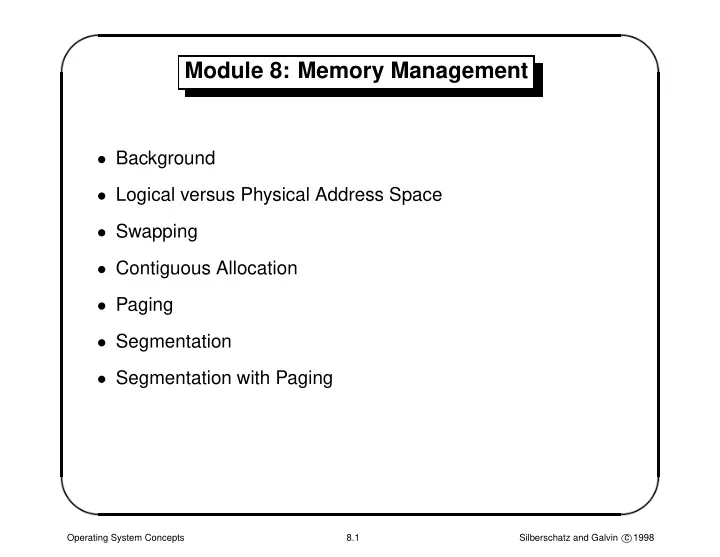
' $ Module 8: Memory Management Background Logical versus Physical Address Space Swapping Contiguous Allocation Paging Segmentation Segmentation with Paging & % Silberschatz and Galvin c Operating System


slide-1
SLIDE 1 ' & $ %

Module 8: Memory Management

  • Background
  • Logical versus Physical Address Space
  • Swapping
  • Contiguous Allocation
  • Paging
  • Segmentation
  • Segmentation with Paging

Operating System Concepts 8.1 Silberschatz and Galvin c 1998

slide-2
SLIDE 2 ' & $ %

Background

  • Program must be brought into memory and placed within a

process for it to be executed.

  • Input queue – collection of processes on the disk that are

waiting to be brought into memory for execution.

  • User programs go through several steps before being

executed.

Operating System Concepts 8.2 Silberschatz and Galvin c 1998

slide-3
SLIDE 3 ' & $ %

Binding of Instructions and Data to Memory

Address binding of instructions and data to memory addresses can happen at three different stages.

  • Compile time: If memory location known a priori, absolute

code can be generated; must recompile code if starting location changes.

  • Load time: Must generate relocatable code if memory location

is not known at compile time.

  • Execution time: Binding delayed until run time if the process

can be moved during its execution from one memory segment to another. Need hardware support for address maps (e.g., base and limit registers).

Operating System Concepts 8.3 Silberschatz and Galvin c 1998

slide-4
SLIDE 4 ' & $ %

Dynamic Loading

  • Routine is not loaded until it is called.
  • Better memory-space utilization; unused routine is never

loaded.

  • Useful when large amounts of code are needed to handle

infrequently occurring cases.

  • No special support from the operating system is required;

implemented through program design.

Operating System Concepts 8.4 Silberschatz and Galvin c 1998

slide-5
SLIDE 5 ' & $ %

Dynamic Linking

  • Linking postponed until execution time.
  • Small piece of code, stub, used to locate the appropriate

memory-resident library routine.

  • Stub replaces itself with the address of the routine, and

executes the routine.

  • Operating system needed to check if routine is in processes’

memory address.

Operating System Concepts 8.5 Silberschatz and Galvin c 1998

slide-6
SLIDE 6 ' & $ %

Overlays

  • Keep in memory only those instructions and data that are

needed at any given time.

  • Needed when process is larger than amount of memory

allocated to it.

  • Implemented by user, no special support needed from
  • perating system; programming design of overlay structure is

complex.

Operating System Concepts 8.6 Silberschatz and Galvin c 1998

slide-7
SLIDE 7 ' & $ %

Logical vs. Physical Address Space

  • The concept of a logical address space that is bound to a

separate physical address space is central to proper memory management. – Logical address – generated by the CPU; also referred to as virtual address. – Physical address – address seen by the memory unit.

  • Logical and physical addresses are the same in compile-time

and load-time address-binding schemes; logical (virtual) and physical addresses differ in execution-time address-binding scheme.

Operating System Concepts 8.7 Silberschatz and Galvin c 1998

slide-8
SLIDE 8 ' & $ %

Memory-Management Unit (MMU)

  • Hardware device that maps virtual to physical address.
  • In MMU scheme, the value in the relocation register is added to

every address generated by a user process at the time it is sent to memory.

  • The user program deals with logical addresses; it never sees

the real physical addresses.

Operating System Concepts 8.8 Silberschatz and Galvin c 1998

slide-9
SLIDE 9 ' & $ %

Swapping

  • A process can be swapped temporarily out of memory to a

backing store, and then brought back into memory for continued execution.

  • Backing store – fast disk large enough to accommodate copies
  • f all memory images for all users; must provide direct access

to these memory images.

  • Roll out, roll in – swapping variant used for priority-based

scheduling algorithms; lower-priority process is swapped out so higher-priority process can be loaded and executed.

  • Major part of swap time is transfer time; total transfer time is

directly proportional to the amount of memory swapped.

  • Modified versions of swapping are found on many systems,

i.e., UNIX and Microsoft Windows.

Operating System Concepts 8.9 Silberschatz and Galvin c 1998

slide-10
SLIDE 10 ' & $ %

Schematic View of Swapping

main memory backing store process P1 process P2 user space

  • perating

system swap out 1 swap in 2

Operating System Concepts 8.10 Silberschatz and Galvin c 1998

slide-11
SLIDE 11 ' & $ %

Contiguous Allocation

  • Main memory usually into two partitions:

– Resident operating system, usually held in low memory with interrupt vector. – User processes then held in high memory.

  • Single-partition allocation

– Relocation-register scheme used to protect user processes from each other, and from changing operating-system code and data. – Relocation register contains value of smallest physical address; limit register contains range of logical addresses – each logical address must be less than the limit register.

Operating System Concepts 8.11 Silberschatz and Galvin c 1998

slide-12
SLIDE 12 ' & $ %

Contiguous Allocation (Cont.)

  • Multiple-partition allocation

– Hole – block of available memory; holes of various size are scattered throughout memory. – When a process arrives, it is allocated memory from a hole large enough to accommodate it. – Operating system maintains information about: a) allocated partitions b) free partitions (hole)

OS OS OS OS process 8 process 10 process 9 process 5 process 5 process 5 process 5 process 9 process 2 process 2 process 2 process 2

Operating System Concepts 8.12 Silberschatz and Galvin c 1998

slide-13
SLIDE 13 ' & $ %

Dynamic Storage-Allocation Problem

How to satisfy a request of size n from a list of free holes.

  • First-fit: Allocate the first hole that is big enough.
  • Best-fit: Allocate the smallest hole that is big enough; must

search entire list, unless ordered by size. Produces the smallest leftover hole.

  • Worst-fit: Allocate the largest hole; must also search entire
  • list. Produces the largest leftover hole.

First-fit and best-fit better than worst-fit in terms of speed and storage utilization.

Operating System Concepts 8.13 Silberschatz and Galvin c 1998

slide-14
SLIDE 14 ' & $ %

Fragmentation

  • External fragmentation – total memory space exists to satisfy a

request, but it is not contiguous.

  • Internal fragmentation – allocated memory may be slightly

larger than requested memory; this size difference is memory internal to a partition, but not being used.

  • Reduce external fragmentation by compaction.

– Shuffle memory contents to place all free memory together in one large block. – Compaction is possible only if relocation is dynamic, and is done at execution time. – I/O problem ∗ Latch job in memory while it is involved in I/O. ∗ Do I/O only into OS buffers.

Operating System Concepts 8.14 Silberschatz and Galvin c 1998

slide-15
SLIDE 15 ' & $ %

Paging

  • Logical address space of a process can be noncontiguous;

process is allocated physical memory wherever the latter is available.

  • Divide physical memory into fixed-sized blocks called frames

(size is power of 2, between 512 bytes and 8192 bytes).

  • Divide logical memory into blocks of same size called pages.
  • Keep track of all free frames.
  • To run a program of size n pages, need to find n free frames

and load program.

  • Set up a page table to translate logical to physical addresses.
  • Internal fragmentation.

Operating System Concepts 8.15 Silberschatz and Galvin c 1998

slide-16
SLIDE 16 ' & $ %

Address Translation Scheme

  • Address generated by CPU is divided into:

– Page number (p) – used as an index into a page table which contains base address of each page in physical memory. – Page offset (d) – combined with base address to define the physical memory address that is sent to the memory unit.

Operating System Concepts 8.16 Silberschatz and Galvin c 1998

slide-17
SLIDE 17 ' & $ %

Address Translation Architecture

page table f CPU logical address physical address physical memory p d f d p

Operating System Concepts 8.17 Silberschatz and Galvin c 1998

slide-18
SLIDE 18 ' & $ %

Paging Example

physical memory page 3 7 6 5 page 1 4 page 2 3 2 page 0 1 frame number 1 1 4 2 3 3 7 page table logical memory page 3 page 1 page 2 page 0

Operating System Concepts 8.18 Silberschatz and Galvin c 1998

slide-19
SLIDE 19 ' & $ %

Implementation of Page Table

  • Page table is kept in main memory.
  • Page-table base register (PTBR) points to the page table.
  • Page-table length register (PTLR) indicates size of the page

table.

  • In this scheme every data/instruction access requires two

memory accesses. One for the page table and one for the data/instruction.

  • The two memory access problem can be solved by the use of

a special fast-lookup hardware cache called associative registers or translation look-aside buffers (TLBs).

Operating System Concepts 8.19 Silberschatz and Galvin c 1998

slide-20
SLIDE 20 ' & $ %

Associative Register

  • Associative registers – parallel search

Page # Frame #

Address translation (A′, A′′) – If A′ is in associative register, get frame # out. – Otherwise get frame # from page table in memory.

Operating System Concepts 8.20 Silberschatz and Galvin c 1998

slide-21
SLIDE 21 ' & $ %

Effective Access Time

  • Associative lookup = ǫ time unit
  • Assume memory cycle time is 1 microsecond
  • Hit ratio – percentage of times that a page number is found in

the associative registers; ratio related to number of associative registers.

  • Hit ratio = α
  • Effective Access Time (EAT)

EAT = (1 + ǫ)α + (2 + ǫ)(1 − α) = 2 + ǫ − α

Operating System Concepts 8.21 Silberschatz and Galvin c 1998

slide-22
SLIDE 22 ' & $ %

Memory Protection

  • Memory protection implemented by associating protection bits

with each frame.

  • Valid–invalid bit attached to each entry in the page table:

– “valid” indicates that the associated page is in the process’ logical address space, and is thus a legal page. – “invalid” indicates that the page is not in the process’ logical address space.

Operating System Concepts 8.22 Silberschatz and Galvin c 1998

slide-23
SLIDE 23 ' & $ %

Two-Level Page-Table Scheme

. . .

memory

. . . . . . . . . . . . . . .

page table 900 929

. . .

page of page table

. . .

708 100

. . . . . .

500 1

. . . . . .

  • uter-page

table 1 100 500 708 900 929

Operating System Concepts 8.23 Silberschatz and Galvin c 1998

slide-24
SLIDE 24 ' & $ %

Two-Level Paging Example

  • A logical address (on 32-bit machine with 4K page size) is

divided into: – a page number consisting of 20 bits. – a page offset consisting of 12 bits.

  • Since the page table is paged, the page number is further

divided into: – a 10-bit page number. – a 10-bit page offset.

  • Thus, a logical address is as follows:

page number page offset p1 p2 d 10 10 12 where p1 is an index into the outer page table, and p2 is the displacement within the page of the outer page table.

Operating System Concepts 8.24 Silberschatz and Galvin c 1998

slide-25
SLIDE 25 ' & $ %

Address-Translation Scheme

  • Address-translation scheme for a two-level 32-bit paging

architecture

  • uter-page

table logical address p1 d p2 p1 page of page table p2 d

Operating System Concepts 8.25 Silberschatz and Galvin c 1998

slide-26
SLIDE 26 ' & $ %

Multilevel Paging and Performance

  • Since each level is stored as a separate table in memory,

converting a logical address to a physical one may take four memory accesses.

  • Even though time needed for one memory access is

quintupled, caching permits performance to remain reasonable.

  • Cache hit rate of 98 percent yields:

effective access time = 0.98 × 120 + 0.02 × 520 = 128 nanoseconds. which is only a 28 percent slowdown in memory access time.

Operating System Concepts 8.26 Silberschatz and Galvin c 1998

slide-27
SLIDE 27 ' & $ %

Inverted Page Table

  • One entry for each real page of memory.
  • Entry consists of the virtual address of the page stored in that

real memory location, with information about the process that

  • wns that page.
  • Decreases memory needed to store each page table, but

increases time needed to search the table when a page reference occurs.

  • Use hash table to limit the search to one — or at most a few —

page-table entries.

Operating System Concepts 8.27 Silberschatz and Galvin c 1998

slide-28
SLIDE 28 ' & $ %

Inverted Page Table Architecture

page table pid CPU logical address physical memory i p search physical address i d pid p d

Operating System Concepts 8.28 Silberschatz and Galvin c 1998

slide-29
SLIDE 29 ' & $ %

Shared Pages

  • Shared code

– One copy of read-only (reentrant) code shared among processes (i.e., text editors, compilers, window systems). – Shared code must appear in same location in the logical address space of all processes.

  • Private code and data

– Each process keeps a separate copy of the code and data – the pages for the private code and data can appear anywhere in the logical address space

Operating System Concepts 8.29 Silberschatz and Galvin c 1998

slide-30
SLIDE 30 ' & $ %

Shared Pages Example

data 2 7 6 5 ed 2 4 ed 1 3 2 data 1 1 3 4 6 1 page table for P1 process P1 data 1 ed 2 ed 3 ed 1 3 4 6 2 page table for P3 process P3 data 3 ed 2 ed 3 ed 1 3 4 6 7 page table for P2 process P2 data 2 ed 2 ed 3 ed 1 8 9 10 data 3 ed 3

Operating System Concepts 8.30 Silberschatz and Galvin c 1998

slide-31
SLIDE 31 ' & $ %

Segmentation

  • Memory-management scheme that supports user view of

memory.

  • A program is a collection of segments. A segment is a logical

unit such as: main program, procedure, function, local variables, global variables, common block, stack, symbol table, arrays

Operating System Concepts 8.31 Silberschatz and Galvin c 1998

slide-32
SLIDE 32 ' & $ %

Logical View of Segmentation

1 4 3 1 4 3 2 2 physical memory user space

Operating System Concepts 8.32 Silberschatz and Galvin c 1998

slide-33
SLIDE 33 ' & $ %

Segmentation Architecture

  • Logical address consists of a two tuple:

<segment-number, offset>.

  • Segment table – maps two-dimensional user-defined

addresses into one-dimensional physical addresses; each table entry has: – base – contains the starting physical address where the segments reside in memory. – limit – specifies the length of the segment.

  • Segment-table base register (STBR) points to the segment

table’s location in memory.

  • Segment-table length register (STLR) indicates number of

segments used by a program; segment number s is legal if s < STLR.

Operating System Concepts 8.33 Silberschatz and Galvin c 1998

slide-34
SLIDE 34 ' & $ %

Segmentation Architecture (Cont.)

  • Relocation.

– dynamic – by segment table

  • Sharing.

– shared segments – same segment number

  • Allocation.

– first fit/best fit – external fragmentation

Operating System Concepts 8.34 Silberschatz and Galvin c 1998

slide-35
SLIDE 35 ' & $ %

Segmentation Architecture (Cont.)

  • Protection. With each entry in segment table associate:

– validation bit = 0 ⇒ illegal segment – read/write/execute privileges

  • Protection bits associated with segments; code sharing occurs

at segment level.

  • Since segments vary in length, memory allocation is a dynamic

storage-allocation problem.

  • A segmentation example is shown in the following diagram

Operating System Concepts 8.35 Silberschatz and Galvin c 1998

slide-36
SLIDE 36 ' & $ %

logical memory process P1 editor data 1 physical memory 98553 editor limit 1 25286 4425 base 43062 68348 segment 0 segment 1 editor data 2 segment 0 segment 1 segment table process P1 limit 1 25286 8850 base 43062 90003 segment table process P2 data 1 data 2 90003 72773 68348 43062 logical memory process P2 Operating System Concepts 8.36 Silberschatz and Galvin c 1998

slide-37
SLIDE 37 ' & $ %

Segmentation with Paging – MULTICS

  • The MULTICS system solved problems of external

fragmentation and lengthy search times by paging the segments.

  • Solution differs from pure segmentation in that the

segment-table entry contains not the base address of the segment, but rather the base address of a page table for this segment.

Operating System Concepts 8.37 Silberschatz and Galvin c 1998

slide-38
SLIDE 38 ' & $ %

MULTICS Address Translation Scheme

memory s d

+

segment table segment length page–table base logical address

trap no STBR p d' d

+

f d' f physical address page table for segment s yes Operating System Concepts 8.38 Silberschatz and Galvin c 1998

slide-39
SLIDE 39 ' & $ %

Segmentation with Paging – Intel 386

  • As shown in the following diagram, the Intel 386 uses

segmentation with paging for memory management, with a two-level paging scheme.

Operating System Concepts 8.39 Silberschatz and Galvin c 1998

slide-40
SLIDE 40 ' & $ %

physical address selector

  • ffset

+

page table entry logical address page frame page table directory entry page directory segment descriptor descriptor table directory linear address page

  • ffset

page directory base register Operating System Concepts 8.40 Silberschatz and Galvin c 1998

slide-41
SLIDE 41 ' & $ %

Comparing Memory-Management Strategies

  • Hardware support
  • Performance
  • Fragmentation
  • Relocation
  • Swapping
  • Sharing
  • Protection

Operating System Concepts 8.41 Silberschatz and Galvin c 1998